Hello dear ones,
I'm so happy to have you here with me tonight.
Wherever you're settling in,
Whether you've crawled under the covers,
Or you've already curled up with your eyes growing heavy,
Take a moment now to let today go.
Whatever needed doing has been done.
Or it can wait until morning.
Right now,
This time is yours.
Tonight's story is a quiet,
Gentle one.
And it comes from one of my very favorite authors,
Lucy Maud Montgomery.
The beloved voice behind Anne of Green Gables.
This piece is a little different from her novels.
It's a soft,
Wandering remembrance of a grandmother's garden,
Full of roses and old legends,
Birdsong and quiet summer evenings.
There's nothing to follow here.
No plot to hold on to.
Just beauty and memory and the kind of stillness that makes for the perfect bedtime listen.
So,
Let's take a few moments to settle in together before we begin.
Get as comfortable as you can.
Let your body sink into the mattress or the couch or wherever you happen to be right now.
Roll your shoulders back just slightly.
And then let them drop heavy and loose.
Take a slow breath in.
And let it go completely.
With every breath out.
Imagine yourself sinking a little deeper into softness,
Into quiet.
There's nothing to think through right now.
No plans to make.
No problems to solve.
Just this moment and the sound of my voice.
Feel your legs growing heavy.
Your arms heavy.
Your whole body settling.
Let your eyes rest closed if they haven't already.
And so,
My friend.
There's nothing left to do now but rest.
And listen.
And let your mind grow quiet.
And when you're ready.
Let's begin.
What wonder that the old wise story of Eden placed the beginning of life in a garden.
A garden fittingly belongs to the youth of the world,
And to the youth of us all,
For it never truly grows old.
The years,
Which steal so much from everything else,
Only add loveliness and sweetness to a garden.
Enriching it with memories,
Both beautiful and tender,
But never dimming its endless freshness.
It's really rather foolish to speak of old gardens at all.
Gardens are forever young.
The favorite haunt of flowers and children alike,
And Grandmother's garden was always full of both.
Some of her many grandchildren always came to the old homestead for their summer holidays.
One summer,
There were half a dozen of us staying there as guests and counting the ten more who lived nearby and spent nearly as much time at grandmother's as at their own homes.
We were the merriest little crew in the world.
The garden was our favorite haunt,
And we spent most of our waking hours there.
It was,
To us,
An enchanted place of pleasure.
And there is nothing in all my store of memories quite so sweet and spellbinding as my recollections of it.
Places I've visited in later years have grown dim and blurred with time.
But every nook and corner of my grandmother's garden is still as vivid in my memory as it was the day I last saw it.
That was many years ago now.
But even with my eyes closed,
I could walk straight to the flower bed beside the snowball tree where the first violets always grew.
The door of the big living room opened directly out into the garden.
He went down four wide,
Shallow steps made of natural slabs of red sandstone that Great Grandfather had carried out from the shore long ago.
The bottom step had sunk almost into the earth,
And mint grew thick around its edges.
Crushed so often under so many little feet,
The mint gave off its scent freely,
And that spicy smell always seemed to hang around the doorway like some invisible blessing.
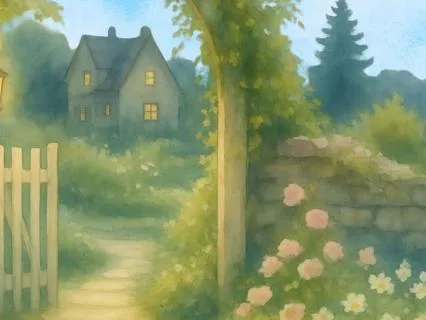
The garden itself was long and narrow,
Sloping gently toward the west.
Two sides were bordered by a high stone wall,
Or at least it seemed as high to us then.
I have a grown-up suspicion now that it might not seem quite so tall.
Things do have an odd habit of shrinking as we grow older.
But back then we could barely see over it standing on tiptoe,
And had to climb a little ladder fixed against the western end whenever we wanted a good view of the wide,
Sloping green fields beyond,
And the sea calling softly along its silvery glistening shore.
The third side of the garden was closed in by the house itself.
A long,
Quaint,
Whitewashed building draped generously in Virginia creeper and climbing roses.
Something about the five square windows on the second floor made the house look as though it were winking at us in a friendly sort of way through all that greenery.
At least,
That's what the story girl always said.
And once she pointed it out,
We could always see it too.
At one corner of the house,
A little gate opened into the kitchen garden where the vegetables grew.
But we never took much interest in that corner.
Partly,
I think,
Because Grandmother's old servant,
Jean,
Considered it her own special territory and had little patience for intruders.
Off you go to the flower garden.
That's the proper place for children,
" she would tell us,
With an unwavering sense of how things ought to be.
The fourth side of the garden was bordered by a grove of fir trees,
A cool,
Dim place where the wind loved to murmur and where a woodsy,
Resinous scent always lingered in the air.
Beyond the firs was a thick stand of slender silver birches and whispering poplars,
And just past that lay what we called the Wild Garden,
A sunny triangle of land bordered by the meadow fences and packed full of wildflowers.
Blue and white violets,
Dandelions,
Junebells,
Wild roses,
Daisies,
Buttercups,
Asters,
And goldenrod,
Each one generous in its own season.
The garden was crossed by straight paths,
Bordered with the big white clamshells so plentiful down by the bay,
And laid with gravel gathered from the shore.
A mix of colored pebbles and tiny white shells worked well into the soil.
In the beds between the paths,
And all along the wall,
Grew what seemed to us like every flower in the world.
Certain things were always found in exactly the same spot each year.
The clove pinks,
First planted in Grandmother's bridal days,
Always grew behind the big waxberry bush,
And the shadowed corner behind the sumacs was always sweet each spring with white narcissus.
There were roses everywhere,
Of course.
Roses that grew without the least bit of trouble and poured out a whole year's stored-up sweetness in one great burst of summer bloom.
No one there ever seemed to hear of mildew or slugs,
And nothing much ever was done for the rosebushes beyond the occasional bit of pruning.
A row of big double pink roses grew along one side of the front door,
And red and white ones filled the middle bed.
There was one yellow rose tree just to the left of the steps,
But the ones we loved best of all were the little Scotch Roses.
Oh,
How fragrant and dainty and thorny those small half-double blooms were,
With their pale waxen outer petals and the faintest blush of shell pink at their hearts.
Jean had carried the rosebush all the way from an old Scottish garden when she herself was just a young girl.
So in our eyes,
Those roses carried a touch of romance the others simply didn't have.
Grandmother's bed of lavender,
Caraway and sweet clover were especially dear to her heart.
The caraway and sweet clover had a habit of spreading wildly,
And it was one of our regular jobs to keep them properly contained,
Pulling up any stray bit that wandered from its given space.
We picked and dried the lavender for grandmother's linen closet.
And in return She made us the most delicious caraway cookies.
A kind I've never tasted anywhere since.
I'm afraid cookies like that simply aren't made anymore.
All the flower beds were edged with ribbon grass.
Big red peonies grew along the edge of the fir grove,
Glowing splendidly against its dark green backdrop,
And Hollyhock stood in stiff,
Proud roads by the kitchen garden gate.
The bed beside them was a beautiful sight when the yellow daffodils and tulips bloomed.
There was a cluster of tiger lilies in front of the door,
And a row of Madonna lilies further along.
One single pine tree grew in the garden,
And beneath it sat a stone bench made like the front steps from flat shore stones worn smooth by years of wind and waves.
Just behind that bench grew pale,
Sweet-smelling flowers that had no name any of us ever discovered.
No one seemed to know a thing about them.
They'd already been there,
When Grandfather's father first bought the place.
I have never seen their like anywhere else,
Nor found them described in any catalogs.
We called them the White Ladies,
A name the story girl gave them.
She said they look just like the souls of good women.
They were delicate and wonderfully dainty,
With a strange,
Haunting scent you could only catch from a little distance away.
It seemed to vanish entirely if you leaned in close.
They wilted the moment they were picked.
And though visitors often admired them and carried off roots or seeds,
Hoping to grow their own,
The flowers could never be coaxed to grow anywhere else.
There was one lovely old-fashioned bed full of bleeding hearts,
Sweet William,
Bride's bouquet,
Butter and eggs,
Adam and Eve,
Columbines,
Pink and white daisies,
And bouncing bets.
This was our favorite bed of all,
Because we were always allowed to pick from it freely,
Whenever we liked.
For the other beds,
We had to ask permission first,
Though it was rarely refused.
Poppies were the only flowers in the whole garden with free reign to wander wherever they pleased.
They sprang up everywhere,
Though their proper bed was in the northwest corner,
Where they shook out their fringed,
Silken skirts against a low thicket of young firs.
Asparagus,
Allowed a place because of the feathery grace of its later growth,
Grew behind the wellhouse,
Near the lilies of the valley.
The middle path was crossed at even intervals by three arches,
Each one draped in honeysuckle.
The well-house was a quaint,
Weathered little structure built over the well at the far end of the garden.
Four posts held up an odd peaked little roof.
Rather like something from a Chinese pagoda.
And the whole thing was hidden under vines that hung down from it in long swinging garlands almost to the ground.
The well itself was deep and dark,
And the water,
Drawn up by a windlass and chain in a mossy old bucket shaped like a tiny barrel and bound with icy hoops,
Was always startlingly cold.
As far down as we could see,
The walls of the well were covered in the most beautiful ferns.
The garden was full of birds,
And some of them we thought of as old friends,
Since they nested in the very same spots year after year,
And never seemed the least bit afraid of us.
A pair of bluebirds had taken a particular liking to a nook in the stonework of the well.
And two yellow hammers had claimed an old hollow poplar in the southwestern corner as their own.
Wild canaries kept house in the big lilac bush outside the parlor windows.
One especially memorable summer,
A pair of hummingbirds built their nest in the central honeysuckle arch,
Until a wild August storm tore it loose and dashed it to the ground where we found it the next morning.
We girls cried over it,
And then drew lots to see who would get to keep the tiny wonderful thing.
Woven of down and lichen and no bigger than a walnut.
Hummingbirds never returned,
Though we watched for them hopefully every summer after.
Robins,
On the other hand,
Were everywhere,
Especially in early spring.
Great,
Sleek,
Confident fellows strutting boldly along the paths.
On summer evenings,
Just after sunset,
They would sing among the firs,
Filling the air with sweet,
Faintly wistful music.
A garden with so many years behind it was bound to have a few legends of its own.
One of our favorites was the story of the poet who was kissed.
Long,
Long ago.
So long ago that Grandfather himself was still just a little boy.
A young man had come to visit this very garden.
A young man whose name had already begun to bloom with the fame that would later surround it.
He had come out to write a poem,
And had fallen asleep with his head resting on the old stone bench.
Into the garden then came Great-Aunt Alice,
Who wasn't anyone's aunt yet.
Just a laughing-eyed girl of 18,
Red-lipped and dark-haired,
Willful and sweet,
And just a little daring.
She had been away for some time.
And had only just come home.
So she knew nothing at all about her brother's famous ghast.
But there in the garden.
Fast asleep beneath the pine tree.
His curly head,
Resting on the hard stone bench,
And his half-finished poem lying beside him,
Was the handsomest young man she'd ever seen.
Mischievous Alice mistook him for a long-expected cousin visiting from Scotland,
And,
Leaning down until her dark curls brushed his shoulder,
She pressed a kiss onto his sunburned cheek,
Light and delicate as a falling rose petal.
He opened his big blue eyes and looked straight into her blushing face.
She blushed even harder then,
Realizing all at once that this could not possibly be her Scottish cousin.
She'd been told he had eyes as dark and soft as her own.
Alice sprang up and fled through the garden in a fluster of embarrassment,
A confusion that only deepened once she discovered exactly who the sleeping stranger really was.
But it all worked out happily in the end,
As these things tend to,
With wedding bells for Alice and her poet.
The story that fascinated us most of all,
Though,
Was the lost diamond.
Not long after grandfather and grandmother were married.
A fine,
Elegant lady had come to visit them.
A lady with a diamond ring sparkling on her pale,
Delicate hand.
She had gone out to walk in the garden,
And the diamond was still there in its setting when she stepped down the sandstone steps.
Grandmother remembered seeing it catch the light as the lady lifted the hem of her silk gown.
But when the lady came back inside,
The setting was empty,
And the diamond was gone.
It was never found again,
Then or ever after,
Though they searched and searched,
And nothing was ever searched for quite so thoroughly.
The story held an endless charm for us children.
We each secretly hoped we might be the one to find the missing stone,
And it made even the dullest chores feel light.
Nobody minded pulling weeds when every single pull carried the chance of turning up the glittering,
Long-lost gem.
And then,
Of course,
Our garden had its very own ghost.
We children weren't supposed to know anything about this.
Grandmother worried it might frighten us and had forbidden anyone from speaking of it in front of us.
Her efforts were wasted though.
For we already knew all about it.
The story girl had told us everything.
How she'd come to learn it,
I couldn't say.
But the legend never frightened us in the least.
If anything,
We found it deeply thrilling,
And rather a point of pride.
Not every garden could claim a ghost of its own after all.
And it seemed to lend ours a certain distinction.
We never once saw our ghost,
Though it certainly wasn't for lack of looking.
The legend,
As the story girl told it to us one misty evening,
In hushed whispers,
With little glances thrown back over her shoulder,
That made the whole thing feel wonderfully solemn.
Oh,
She really did know how to tell a story,
That girl.
Went something like this.
Long ago,
Even before Grandfather was born.
An orphaned cousin of his had come to live with his family.
Her name was Edith,
And she was small and sweet,
With wistful eyes,
Long smooth brown curls,
And a tiny birthmark shaped like a butterfly on one soft cheek.
She had a sweetheart.
The young son of a neighboring family.
And one day,
He told her shyly that he meant to come the very next morning to ask her a very important question.
And that he hoped to find her waiting in the garden.
Edith promised to meet him at the old stone bench,
And the next day she dressed carefully in pale blue muslin,
Smoothed her curls,
And sat waiting happily at their meeting place.
But instead of her sweetheart,
A careless young cousin came bursting in with the news that he had been killed that very morning in an accident.
Edith was never quite the same after that.
She found peace only in dressing in her blue gown and sitting on the old bench waiting,
Because,
She always said,
He was sure to come eventually.
She grew paler with each passing day,
While the little butterfly mark on her cheek seemed to grow redder and redder,
Like a small stain of blood against her pale skin.
When winter came,
She passed away.
But by the following summer.
Word began to spread that Edith could sometimes still be seen,
Sitting on that bench,
Waiting More than one person claimed to have seen her there.
Grandfather saw her once,
When he was just a little boy,
The story girl told us,
Nodding mysteriously.
And my mother saw her too,
Only once.
Did you ever see her?
One of the more doubtful boys wanted to know.
The story girl shook her head.
No,
But I will someday if I just keep believing,
She said quite confidently.
I wouldn't want to see her.
I'd be too afraid,
" said one of the more timid girls with a little shiver.
There's nothing to be afraid of,
" the story girl reassured her.
It's not as though she's a stranger's ghost.
She's our very own family ghost,
So of course she'd never hurt us.
We often acted out the story of Alice and her poet,
And we searched for the lost diamond in a hundred different ways and hiding places.
But we never once acted out Edith's story.
Ghosts,
It turns out,
Aren't the sort of thing you want to go stirring up carelessly,
Even when they happen to be your own family's ghost.
We had our own games and pastimes too,
Mostly ones we invented ourselves,
Since the story girl could dream up a new game more easily than most children can carry on a simple conversation.
Our playhouse was set up in the fir grove,
Complete with little shelves built into the trees and stocked with a dazzling collection of broken dishes and bits of colored glass.
We hollowed out little cupboards among the big tree roots and lined them with soft moss.
We wove crowns and wreaths of pink daisies,
And each girl took her turn being crowned queen for a day.
We had picnics and small festivals galore,
But when it came right down to it,
What we loved best of all was simply listening to the story girl tell her stories.
We would climb up to sit along the top of the western wall or settle onto the grass beneath the swaying fir branches and listen there for hours on end.
The story girl was an orphaned grandchild who had always lived with grandmother.
She was a slim,
Light-footed little thing with an oval sun-browned face and large,
Dreamy,
Dark blue eyes.
She had a remarkable memory,
And a real gift for painting pictures with her words.
Half of her story she made up entirely out of her own imagination.
And to us,
They seemed wonderful.
Even now looking back.
I still believe they truly were wonderful.
And I've often thought that.
Had she lived,
The wider world might have come to know her gift too.
She died while still quite young,
Far away in a foreign land,
Far from her beloved garden.
It was she who kept what we call the garden bug.
I found it tucked away in a box in the attic the last time I visited the old homestead,
And I brought it home with me.
So many of its little entries,
Bring the past rushing back as though it were happening all over again.
April 20th.
It is spring,
And I'm so glad.
The beauty of winter is that it makes you appreciate spring.
Little green things are poking up everywhere in the garden.
I always run out first thing every morning to see how much they've grown since yesterday.
I helped grandmother plant the sweet peas today.
And I planted a little bed of my own.
I'm not going to dig them up this year to see if they've sprouted.
It is bad for them.
I'm going to try to cultivate patience.
I read a new fairy book in the fir grove today.
A fir grove is exactly the right kind of place to read fairy stories.
Sally says it doesn't make any difference where you read them.
But oh,
It truly does.
May 10.
Warm with a south wind.
Grandmother and Jean finished planting the vegetable garden today.
I never much care for the vegetable garden,
Except when I'm hungry.
Then I do like to go and look at the neat little rows of onions and beets.
May 28.
I spent all day weeding.
Sally and Jack came over and helped.
I don't mind the weeding itself,
But I always feel a little sorry for the poor weeds.
It must be hard to be pulled up like that,
Though I suppose you shouldn't grow in the wrong place to begin with.
If weeds ever make it to heaven,
I imagine they must become flowers.
I do hope heaven is all flowers.
I think I could be good all the time if I lived in a garden forever.
Then again,
Adam and Eve lived in a garden too,
And they weren't always good at all.
June 8.
It rained this morning.
The garden always smells so sweet after rain.
Everything fresh and clean.
The scents lovelier than ever.
I wish you could see perfumes the way you can smell them.
I'm sure they would be beautiful.
Billy says it's just like a girl to wish for something so silly.
Billy is very practical.
He would never think to feel sorry for a weed.
Grandfather says he's very level-headed.
I suppose it's good to be level-headed.
But you do miss out on a lot of fun that way.
Our Canterbury bells are blooming.
I think Canterbury Bells is such a lovely name.
It makes you think of great cathedrals.
Sweet William seems like a rather dreadful name for a flower,
Honestly.
William is a man's name.
And men are never really sweet.
They can be admirable in plenty of ways.
But sweetness isn't really theirs to claim.
That's for women.
June 17.
The garden looks entirely different by moonlight.
Still beautiful,
But changed somehow.
When I was very small,
I used to believe fairies danced there under the moon.
I wish I could still believe it.
But it's so hard to believe in things you already know aren't true.
Uncle James told me there's no such thing as fairies.
He's a minister,
So of course he must be telling the truth.
It's his duty to,
And I don't blame him for it.
But I haven't felt quite the same about Uncle James ever since.
We acted out Alice and the Poet today.
I usually love it,
But not today.
Billy played the poet.
And he didn't look the least bit poetic with his round,
Freckled face.
I just wanted to laugh,
And it spoiled the whole thing for me.
I always like it better when Jack plays the poet.
He really licks the part.
And he doesn't squint his eyes shut nearly as tight as Billy does.
But it's hard to talk Jack into it,
While Billy is always so willing.
July 20th.
We all helped Grandmother make her rose jar today.
We picked quarts and quarts of rose petals.
The sweetest smelling ones always come from Grandmother's wedding bush.
When Grandmother was married,
She carried a bouquet of white roses,
And she planted one of the little green cuttings from it in the garden afterward,
Never really expecting it to grow.
But it did.
And now it's the biggest bush in the whole garden.
It seems so strange to think there was ever a time when grandfather and grandmother weren't married.
You'd think,
Looking at them,
That they'd always been together.
What a dreadful thing it would have been if they hadn't married each other after all.
I don't suppose any of us would even be here.
Or if we were,
We'd belong to someone else entirely,
Which seems almost as strange.
When I think how terrible it would be to have been born as someone else's child or not born at all.
I feel ever so grateful that Grandfather and Grandmother happened to choose each other out of everyone else in the world they might have married instead.
I'm trying hard to love the Xenias best,
Since no one else seems to care for them much,
And I'm sure that must hurt their feelings.
But deep down,
I know it's really the roses I love best.
You simply can't help loving the roses.
August 19th.
Grandmother let us have our tea out in the garden this afternoon,
And it was lovely.
We spread the tablecloth on the grass by the wellhouse,
And it felt just like a picnic.
Everything tasted twice as good out there,
And we didn't even mind the ants.
I've decided to start calling the southern wood Apple Ringy from now on.
Jean says that's what they call it in Scotland.
And I think it sounds so much more poetic than Southern would.
Jack insists the proper name is Boy's Love,
But I think that's silly.
September 5th.
Billy says a rich man in town has a floral clock in his garden.
Shaped just like a real clock face,
With flowers that open at different hours so you can always tell the time.
Billy wishes we had one here,
But I don't.
What good would it do?
Nobody ever wants to know the time when they're in a garden.
It was my turn to be queen today,
And I wore the daisy crown all day long.
I do like being Queen,
But honestly,
There's not quite as much fun in it as in just being an ordinary person.
Besides,
Everyone has to call you Your Majesty and curtsy whenever they come near you,
If they remember to that is,
And it does make you feel a little lonely after all.
September 27th.
Shadows are such pretty things,
And the garden is always full of them.
Sometimes they lie so still,
You'd think they were asleep.
Other times they seem to laugh and skip about.
Out past the garden,
Down in the shore fields,
They're always chasing one another.
Wild shadows,
Those.
The ones in the garden are tame by comparison.
October 20th.
Everything in the garden seems tired of growing now.
The pine,
The firs,
The chrysanthemums.
The sunlight has gone thick and golden and lazy,
And the crickets sing all day long.
Most of the birds have already gone.
The other day,
I thought I'd finally seen the ghost.
I was walking through the fir grove and spotted someone in blue sitting on the bench.
My heart nearly left out of my chest,
But it turned out only to be a visitor after all.
I'm honestly not sure whether I was relieved or disappointed.
I don't imagine it would be a very pleasant thing to actually see the ghost.
But just think what a heroine you'd be afterward.
November 10th.
A little snow fell last night,
Though it melted away as soon as the sun came out.
Everything in the garden has gone to sleep now,
And it feels lonely and a little sad out there.
I don't think I'll write in my garden book again until spring comes round.
Early mornings were an especially exquisite time in the garden.
Delicate dew glistened everywhere,
And the shadows lay long,
Black,
And sharply drawn Soft peach-tinted mist hung over the bay,
And little breezes crept across the fields,
Rustling through the poplar leaves in the wild corner.
But it was the evenings that were the loveliest of all,
When the sunset sky glowed with soft,
Shifting colors,
And a young moon hung low above the sea to the west.
Robins sang in the firs,
And now and then,
Drifting music from boats out on the bay carried faintly across the fields.
We would sit together on the old stone wall,
Watching the light fade slowly over the water and the stars begin to appear above the sea.
And at last,
Grandmother would come walking down the honeysuckle path to tell us it was time.
Time for birds and buds and little ones alike to be in bed.
Then we would troop off,
One by one,
To our own small beds in the house,
And the sweet,
Would settle gently over the garden of old delights.
Sweet dreams my friends.
Sleep well.
You you you you