Hi there,
I'm Michael Caine.
In today's video,
I'll be offering you a short but effective practice that I like to call landing.
This is a great practice for managing stress and overwhelm and depression throughout the day,
But also a really great and simple practice for just creating a more productive day,
More clarity,
And having more energy at the end of the day without feeling so overwhelmed and exhausted,
Kind of rebooting our nervous system,
Something that we can do in the moment when we're dealing with something difficult or just simply throughout the day to help us create more and more space to deal with the challenges at hand.
And it's almost like we're able to start over and begin again after this very short and simple practice.
Practice that I use every day here in my office in between seeing clients.
I like to kind of,
Like I said earlier,
I kind of like to reboot my system instead of just continually adding challenges and stress and experiences throughout the day.
It's a way of kind of rebooting and starting over,
A kind of beginner's mind again or beginning again.
And so,
Like I said,
It's really great for working with when you're feeling anxious or overwhelmed.
But also as just an everyday practice that can help you be more productive,
More efficient,
Create a lot more ease in the body,
More clarity,
And you'll find that if you do this practice,
You know,
Three maybe more times a day you'll find that at the end of the day you'll feel a lot less overwhelmed and tired and you'll feel a lot more kind of energy in your body so you can kind of keep going.
And not feel so exhausted.
So it's a great practice,
Very simple.
So it's something that you can do.
You know maybe it takes it takes certainly less than five minutes you can do it in about two to three minutes basically the whole practice.
So let's get started.
So the first thing that I do in this very simple practice is orienting.
So,
First of all,
I like to do this practice standing myself.
You can do it sitting or standing.
It's just,
For me,
It works better to stand,
But you can try it both ways.
For the video,
We're gonna do it sitting.
So the first thing that you want to do is you want to do some orienting.
And this really affects the nervous system directly,
Right,
The ventral vagal system.
And so first thing we want to do is just kind of let our eyes naturally move around the room or the environment that we're in,
Just noticing inside,
Outside,
Noticing things in the room that are pleasant to you,
Noticing colors and shapes.
Just letting the eyes kind of naturally move around the room.
And really coming into the present moment.
Into the environment.
Just really being here.
You want to do this for maybe.
.
.
30 seconds,
You can do it longer if you want,
Up to a minute.
You can see already just by orienting,
I just had a deeper breath that came in.
That's a good sign that The nervous system is settling a little bit.
So doing that,
Like I said,
For about 30 seconds to a minute.
And then the next thing you want to do is begin to notice your body and how it's being supported.
So.
If you're sitting,
You're going to notice your pelvis.
Sit bones.
Kind of feeling into that,
Noticing.
How you're being supported and connected,
The sensations that you feel of connection.
Like really landing here in the present moment in the spot that you are.
If you're leaning against something like a chair or the couch,
You can notice your back and your spine.
Notice the sensations of that support.
Just very simple here,
Outside of the body,
Right?
Just noticing those simple sensations of support.
And then you want to connect with your feet and your legs and notice your feet and your legs on the ground.
You want to definitely have your feet planted on the ground,
Whether you're standing or sitting.
And as you are noticing your legs and your feet connected to the ground,
You want to start to naturally just listen to sound.
Whatever sounds are are moving through your awareness.
Internal sounds,
External sounds,
Sounds that are far away.
Sounds that are close.
And again,
Taking.
.
.
30 seconds to a minute to do that.
Not needing to think about the sounds,
Just simply letting yourself notice the sounds.
Now at this point you should be feeling more settling or ease in the body and you want to start to notice in the body where you're feeling,
Or in your experience where you're feeling more settling,
More groundedness.
And just to track that a little bit,
Just kind of tracking,
Noticing.
Just tracking those places that feel more open and settled.
Now,
If this doesn't seem to be bringing you down and you need a bit more,
You can do what we call embodied movement.
And I'm not gonna go over that whole process.
I'm gonna do a separate video on embodied movement,
But I'll just give you a little bit right now.
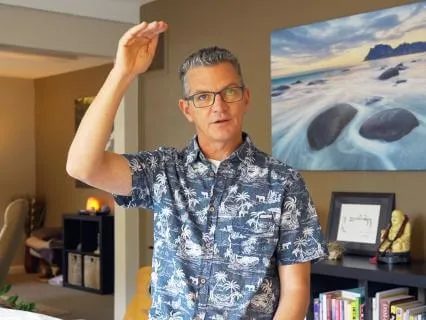
I would be moving the joints in my body.
When I open the joints in my body up and move them,
It helps energy to move.
It helps me to be more connected to my body.
Right?
So I'm slowly.
.
.
For instance,
For example,
Moving my fingers,
Right?
Moving my wrists.
Elbows.
I'm doing this a little faster than I usually would just to kind of give you an idea.
Moving my shoulders.
One direction,
Then the other direction,
And then moving my neck.
Back and forth.
And then my jaw,
Maybe two or three times,
I'm opening and closing the jaw.
Now again,
The movement,
You know,
You don't necessarily have to add that to this landing process,
But especially in those times when you're already feeling really anxious or overwhelmed.
It can be a good addition to the landing practice.
At this point,
I should be noticing that I have a deeper breath,
That I'm more settled.
And then what I want to do is kind of check into my body and I want to notice if there are any places still that have some resistance or tension or bracing in the body.
And again,
Not doing too much about that other than just to see if I can soften those places a little bit.
So I'm starting at the head,
Moving my way down.
Noticing if there's any places of tension or resistance.
I'm not trying to force anything to relax.
I'm allowing things to relax,
But I'm not forcing it.
If I notice any place like that,
I'm just softening,
Seeing if I can let go and soften those places of tension and resistance.
I'm just taking a little time to do that.
And then the final piece.
Here is once I feel like my system is more settled,
I want to again just come into my body and notice if there are any kinds of things left over from the last time I did this or from the day.
So I might notice some unprocessed emotions.
Again,
The tension,
If we notice any tension.
Anxiousness,
Anything like that,
Energy,
Sensations,
Unprocessed emotions,
Or something that I might be holding onto in my mind,
Some kind of worry.
And I want to see if I can just allow that to be,
If it's an emotion,
I'm just letting the emotion be experienced,
Accepted,
And letting it be heard in a way.
Again,
We're kind of rebooting here,
So anything that's left over.
.
.
From the day or just letting it kind of move through so that the system can kind of rebalance or reboot itself.
And you can take a minute or so to do that.
And then again,
If you notice a bit more settling,
You can kind of track the settling a little bit.
Just noticing any places of ease or openness.
And then at this point,
You can move on with your day.
So that's the practice.
Like I said,
It's quite simple.
Not always so easy,
But quite simple.
If you can kind of get into the habit of doing this,
You'll find that your days go better,
That you're more efficient,
You'll have less.
.
.
You know,
Tension and resistance and stress in your life.
And at the end of the day,
You'll feel like you're not so exhausted and overwhelmed.
So it's a really great practice to kind of get in the habit of doing.
It doesn't take much time,
Whether you're doing it as a kind of exercise throughout the day to create more,
You know,
Efficiency and balance and regulation,
Or you're doing it in an emergency when you're feeling anxious or overwhelmed.
It's a really simple and great practice to do.
So I hope that you will take this and try it out and see how it works for you.
And I hope this was helpful and I'll look forward to seeing you again next time.
Thanks.