Hello there,
It's Mandy here.
Welcome to the third in my series of walks and journeys,
Which I describe to you in some detail in the hope that they'll make you nod off comfortably to sleep.
These details are hopefully fairly interesting but not very interesting as we don't want anything that's likely to keep you awake.
Tonight I'm going to take you on a walk towards the sea and we'll take a gentle saunter down the pretty Victorian pier in a seaside town here in the UK.
I don't know if you came on walks number one and two but those both took place in Yorkshire.
This one is a little different as it takes place in North Norfolk which is in East Anglia,
That part of England about halfway down that juts out into the North Sea in a big round bulge.
The town itself,
Though charming in its way,
Has,
Like many of the seaside towns in the UK,
Seen better,
More prosperous days.
It's said in fact that in the early 19th century this particular town was visited by the future King Edward VII who played golf there.
Faded grandeur perhaps describes it the best.
Seaside towns here were the go-to destination for British holiday makers up until the 1970s when package holidays to the continent became available and the appeal of wall-to-wall sunshine for a fortnight,
Perhaps in Spain,
Began to make itself felt.
If you're at all familiar with the British weather this won't surprise you at all.
Indeed on our little walk now you will need either an umbrella or some reliable waterproofs with a hood and sturdy shoes.
Oh I forgot you're going to do this walk in your imagination.
Let me tell you that is a very sensible choice and I congratulate you for it.
It is raining today,
That fine misty rain mixed with sea fret that gets all over your face and seems much wetter than the ordinary inland sort of rain.
But you may still need to carry out some preparations like making sure you're really comfortable and settled either in your bed or in your chair.
Tune in to the temperature and the texture of your soft duvet or cool sheet or perhaps slightly rough blanket.
Whether you're in a bed or a chair let your arms relax,
Especially your shoulders and hands.
That's it.
Now if you're ready we'll begin.
Deciding to get away from it all for a weekend you have rented a tiny cottage a few minutes walk from the sea front.
The pictures on the website weren't the best but you took a chance and as you retrieve the key from the key safe and fit it into the front door lock you were glad that you did.
As the key turns with a slight click and you push the door open you recognise that the cottage is absolutely perfect for you.
You've already noticed how quiet the neighbourhood is and this tiny place has been made less tiny by the addition of an enclosed front porch.
A place where you immediately sling all your outdoor gear including a swimming wetsuit you've perhaps over optimistically brought with you.
Anticipating weather a trifle warmer you walk through a tiny kitchen and a small sitting room to a conservatory at the back which serves as a dining area and into which the daylight pours despite the grey weather outside.
The conservatory leads to a slice of outdoor space complete with a table and chair at which you immediately plan to drink your morning coffee tomorrow if it has stopped raining by then that is.
Despite the misty rain you feel you must look at the tiny garden.
A large blue umbrella thoughtfully placed by the back door whooshes as you put it up and you go out and walk slowly down the garden enjoying the sound of the crunch of wet gravel under your feet.
In the wooden planters that line either side of this mini garden you recognise foxgloves,
Carnations and everlasting sweet pea.
On the left a clematis with big eight-petalled pink and white blossoms climbs through an evergreen bush.
The bush has small cream florets exactly like miniature cauliflowers.
Everything is dripping wet and looks extra green.
The foxgloves look incredibly pink.
At the bottom of the garden a very tall hedge shoots up from a neighbour's place creating a high green screen.
You suspect Leylandii also known as Leyland Cypress.
A beautiful tree in its own right but a bit of a nightmare when it comes to hedging because it grows about two feet every year.
It's the subject of many long-running feuds and legal disputes between neighbours here in the UK.
But this is the beauty of a rented place.
How marvellous to think that you personally have no need to worry about this.
No need to contact the neighbour and think of a tactful way to ask them to trim the hedge before it totally blocks all the light from your garden.
You have no responsibilities here to fix this nor any of the other little issues you will no doubt notice over the weekend.
Well,
To be honest,
Little issues that you already have noticed.
For example,
The fact that there is virtually no worktop space in the kitchen and that one of the cupboard doors refuses to close.
But such is your delight in not having to get involved that you decide you won't even mention these small defects on the feedback form.
How wonderful.
You'd go so far as to say that as long as nothing major goes wrong you feel you can even welcome these defects because ignoring them makes you feel freer than you have felt for a long time.
But back to the rain.
It's starting again in earnest so you go back into the conservatory and stand listening to its steady patter on the reinforced plastic roof.
You close your eyes and hear it intensify slightly,
Then grow quieter,
Then get louder again.
It is such a comforting sound and even though you're standing up you begin to feel the tiniest bit drowsy.
The water sounds are so close,
Intimate even.
It's almost as if the water is coming in through the roof and dripping onto the floor tiles.
You open your eyes.
Oh dear,
It is.
Never mind.
You notice the bucket in the front porch with a picture of a crab on it and you fetch it now and place it carefully under the small leak.
The drips rise in pitch as they meet the plastic and sound louder.
But just think,
It isn't you who will have to phone a local roofer or handyman and stand feeling powerless while he tells you that although the leak looks small it is in fact coming from an irreparable crack in the plastic which means replacing the entire roof which is going to be expensive.
At the top of the exceptionally steep and narrow grey carpeted staircase which has grab rails in every possible place the bedroom is small but adequate and a tiny bathroom offers a shower,
A toilet and a wash hand basin on the side of which there is just enough room for a tube of toothpaste and a toothbrush.
The entire place reminds you of a boat.
Everything has its place and it will be important to keep it there.
But enough of indoors,
You will unpack later.
Now you are going to walk down to the sea,
Rain or no.
You don your waterproofs again,
Decide that it isn't raining that hard so your hood will do instead of an umbrella and you set off turning left out of the front door down the narrow lane you arrive by.
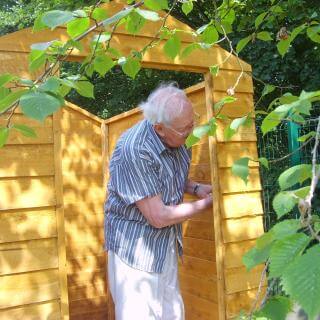
The first thing you see in one of the backyards on your right is a large wooden shed painted in cream and turquoise and festooned in bunting.
Each little triangular flag is made from colourful patterned material with pink being the overarching theme and at the point of each flag is a pom-pom.
If you had managed to arrive in this town somehow without knowing where you were this shed with its nod to the iconic British beach hut would tell you in no uncertain terms that you were at the seaside.
The shed is also adorned with large bees and ladybirds not to scale made out of painted metal.
They rattle slightly in the breeze.
Two shiny green metal geckos are frozen mid-run on the door.
An interesting combination of creatures you think,
Not to be found in the wild anywhere near each other,
Probably not even in the same country,
But they make happy enough shed fellows and lend the lane a festive feel.
You turn left onto the main road passing a low building calling itself the Church of God which is made of bright red new brick.
This was your landmark on the way here,
The place at which you turned right to find your cottage.
Feeling somewhat affectionate towards it because of this you linger briefly in front of it.
The red brick is wet to your touch.
You read the inscribed stone that says it was built as recently as the year 2000 but you don't linger.
Up ahead you can see a great blue-gray expanse,
A kind of emptiness that tells you that once you get to the end of the road ahead,
Lined with tall Victorian houses,
You will find the sea.
Your heart beats faster and you quicken your pace.
You have never lost that sense of childhood wonder at catching your first glimpse of the mystery that is the sea,
Stretching out flat as a sheet of metal into the beyond and then some.
In fact that's what flashes into your mind right now,
A memory of earlier days when you first saw the sea,
Or if not the sea,
A wide river or a lake.
Picturing yourself as you were then,
You remember approaching that large body of water,
Your day-to-day thoughts suddenly in the background as you felt the presence of something you hadn't seen before,
Something wondrous.
Perhaps you smelt salt water and felt a fine spray on your face,
Perhaps you sensed the deep stillness of the lake or loch,
Perhaps you heard the river rushing along.
You might have been a little scared or you might have wanted to run straight into the still or rushing water or the foamy waves.
Perhaps someone held you back or perhaps they laughed and let you plunge in.
Now as you walk towards that bluish space under huge piles of grey and white clouds,
You wonder for a moment if you're looking not at the sky above the sea but at the sea itself.
Isn't it strange how hard it sometimes is to tell them apart?
But then you think as lessons you learned in your school days,
No,
It isn't strange.
The sea always reflects the colour of the sky,
So it's no surprise that they look similar.
You wonder whether all the people who live in seaside towns still get excited at their first glimpse of the sea every morning.
You decide they probably don't,
In fact they no doubt stopped thinking about it ages ago and probably don't even notice it these days.
They've got kids to get out of bed and feed and then they've got to go to work or something like that and they,
Unlike you,
Aren't on holiday.
But quite apart from being on holiday,
Aren't we all just the same,
Quick to take for granted the things that other people will travel for hours to see?
You have to admit that it's really hard to keep our appreciation of things alive.
This is the value,
You think,
Of gratitude lists and also of going on ever so slow walks,
Not just in new places but around your own neighbourhood.
Slow walks might let you re-experience all the delights you have come to overlook.
But on your way to the under-appreciated sea,
You pass some interesting shops.
The plate glass window of Mighty Music,
Guitars,
Amps and more shows a row of instruments and a display of vintage badges.
Bowie,
Nirvana,
Iron Maiden.
T-shirts hang on either side.
One is from Queen's 1982 American tour and the other sports stylized black and white line drawings of the Beatles taken from their Revolver album cover.
You can hear the sound inside the shop of someone tuning up a guitar and you quicken your pace in case a bad rendition of Led Zeppelin's Stairway to Heaven is about to start.
Further on,
On Prince of Wales Terrace,
Is Brisbane Antiques with its peeling sky blue paintwork and gold-painted invitation.
Coins,
Medals and antiques sought,
Good prices paid.
Why this tiny shop is named after a big city on the other side of the world,
You can't imagine.
Brisbane is by the sea but that's the only similarity you can think of.
The origin of the name is lost in time perhaps or perhaps not and you're tempted to enter the shop to inquire but you resist.
The sea is drawing you to her and your feet take you past the shop.
The houses and lines of parked cars channel you onwards.
The rain is easing off now but still your face is wet.
Above seagulls wheel and dive,
Their cries loud and mechanical sounding,
Like machinery that needs oiling.
The sea isn't far away now.
Standing on the windowsill of a house you pass on the left,
With a fine net curtain as their backdrop,
Stand six carved and painted wooden figures.
They are all nautical and include a captain in a smart navy greatcoat,
A sailor in yellow oil skins and a deckhand carrying a broom.
All six of them sport beards,
Brown,
White,
Blue,
Black and their maker has made their faces stern and craggy,
A reflection of the tough life of the seagoing folk of this town perhaps.
They stand and stare at you as you pass,
Ridiculous to let carved wooden figures intimidate you but you're suddenly glad you're not eating an enormous ice cream or a waffle piled high with squirty cream.
You take a few more steps and then suddenly you're in no doubt.
There is the sea,
A silvery infinity beyond a line of parked cars and some railings.
You let out a sigh and cross the road going past the surprising number of families all bent over in the drizzle trying to get holes in one on the crazy golf course.
You feast your eyes on the gunmetal waters.
Now you are near,
Albeit still quite high above the sea and you can see the slight swell and heave of the water.
It isn't still at all but a living moving being.
Its waves sigh as they land then breathe in again huskily,
Gathering the beach's stones back into the sea.
Once many years ago you were walking past a building site when a lorry had its tailgate opened.
You stood and watched as the lorry bed tipped up and shed an enormous load of gravel onto the ground.
The sound you heard then was exactly the sound that waves make and you realised at that moment that the sound is created by the movement of hundreds and thousands of pebbles against each other,
Not by the sea itself.
A flight of steep concrete steps leads down to a promenade and you take them,
Looking down on a mini funfair as you go.
The rides are child-sized,
Revolving teacups on the roundabout,
Bumper cars,
A small helter-skelter,
All painted in bright colours,
Pinks,
Reds,
Blues,
Greens,
Yellows.
A few adults stand here and there but the funfair is deserted otherwise.
Perhaps the weather is just that bit too wet.
You reach the bottom of the steps to the relief of your knees and come level with the funfair.
You turn right and smell the scent of frying.
You notice a fish and chip store and a coffee and doughnut hut,
Both open for business but completely customer free.
You glance back up to the road and the big fish and chip shop that stands opposite the crazy golf course.
It was set up by a celebrity chef or so you've heard and is therefore besieged by holiday makers day and night,
Though many of the locals prefer a different and less famous shop in the next street.
But outside the well-known one,
Even now in the rain,
A long and heavily umbrellaed queue stands waiting to be served.
Only a flight of concrete steps or a slip road below on the promenade at the deserted fish and chip stall no one is buying.
Well,
There's really no one there to buy.
The only passing trade in weather like today's seems to be dog walkers.
You feel sorry for the two glum looking lads serving behind the hatch.
You feel sure,
With absolutely no evidence,
But when did that ever stop you from having an opinion that the actual fish and chips they serve are as good as anyone's?
You don't,
However,
Fancy eating a portion of fish and chips at three o'clock in the afternoon,
So despite your fellow feeling,
There's nothing concrete you can do to help.
You move ruthlessly on in the direction of the pier.
This pier,
You've read,
Was built in 1901 at a cost of £17,
000.
It is 151 metres long,
And to your mind looks unusually wide for a pier.
About two-thirds of the way down,
It houses the town's theatre,
The Pavilion.
It is one of only five piers in the UK to host a theatre.
Approaching it from the side,
You can see the lifeboat station beyond the theatre and the long ramp up and down which lifeboats access the sea.
It's easy enough to see how the boats might get down the ramp,
But less easy to see how they get up.
You imagine winching is involved.
You gaze out to sea,
But there is little activity at the moment.
The waters are brownish-grey,
With occasional frills of white,
And on the horizon you see the distant dark shape of what looks like a stationary tanker.
As you draw near the pier,
You notice large video screens at the entrance advertising the theatre's forthcoming shows,
Though no sound is coming from them.
You glance over,
Your interest mildly kindled.
If it rains all weekend,
You wouldn't mind an indoor activity,
But you see immediately that the season doesn't start until after you've left.
Instead of feeling disappointed,
You feel relieved.
That is one less decision to make,
And perhaps you have a longing,
A secret up until just now,
Even from yourself,
For a couple of peaceful evenings in,
Reading your book on the sofa and sipping hot cups of tea.
You walk across the decorative paving in front of the pier,
And pass between the two glazed rotundas that flank the entrance.
These must have been something to see in Victorian times.
Well,
They are still something to see now.
They lend the pier an air of grandeur,
As do the columns of white pillars that now guide you onto the long wooden boards of the pier itself.
Pleasure piers,
As they were initially called,
While at first the preserve of the Victorian middle classes,
Soon welcomed blue-collar workers too,
And by 1914,
A hundred piers bristled up and down the British coastline.
They provided an affordable fun day out for all the family,
With carousels to ride,
Punch and Judy shows to watch,
And a chance to eat food with your fingers straight out of the paper wrapper.
Which,
As we all know,
Is one of the great pleasures of life,
And must have seemed especially so to Victorian children,
Who were expected to be quiet,
Well-behaved,
And mannerly at all times.
Seen and not heard was the mantra.
Great fun then to be allowed to shriek with laughter at Punch's antics,
And eat chips with no cutlery in sight.
The pier today is sparsely populated.
Its long wooden boards that run vertically down its length glisten with the rain,
And everybody is wearing waterproofs.
Original cast-iron benches with ornate street lamps stand in a row down the middle of the pier,
But they're too wet for anyone to sit on.
Most of the people who are on the pier are fishing for crabs,
Casting orange lines over the side of the white railings into the murky waters beneath.
It's something of a sport here in Norfolk,
And the world's championships are held in this very town every August.
Instructions on how to catch these beautiful beings that live in the estuarial and creek waters here are displayed on friendly-looking blue notice boards along the railings.
Each is called the crustacean station.
You stop to read.
The lines are to be baited with morsels of bacon,
It says.
People are advised to bring their crab up in a net and place it in their bucket.
Don't lift them too quickly out of the sea,
Says the board,
And don't drop them back afterwards.
Take them down to the beach and release them gently back into the waters.
You are very relieved to read all this,
To know that the crabs are supposed to be returned to the sea after being fished out of it,
And also to know that it's recommended to do so in a gentle way.
Ever since you found out about the crabbing here,
You've been worrying about organized cruelty to crabs.
You feel this even though you grabbed a crab sandwich to eat earlier.
Or maybe that wasn't you,
Just someone who looked like you.
But following instructions,
The people crabbing at the railings,
All families,
Are setting a good example to their children,
Showing them how to be humane to other living creatures.
They have all filled their buckets with seawater down on the beach and have brought them up onto the pier.
Next to these buckets,
Their children stand,
Absorbed in the process,
Leaning slightly over railings,
Holding the orange strings.
You decide to walk the length of the pier,
Your feet sounding gently on the wet boards,
And with each little group that you pass,
You peer with interest into their buckets to see if there are any crabs in there.
But the buckets look empty of everything except murky water.
Some of the crabbers are eating ice creams,
The drizzles speckling the creamy surface.
You have got to hand it to the British.
Once they're on holiday at the seaside,
They are determined to enjoy themselves,
Whatever the weather.
As you move down the pier,
Enjoying the sense of walking deeper out to sea in a safe and comparatively dry way,
You look up and notice how the shining grey-brown boards of the pier,
The sky and the sea,
Are all roughly the same colour.
The sea and also the wet pier must both be reflecting the sky.
You walk over to the railings that line the sides of the pier and you place both hands on a top one.
How cold the cast iron is to the touch,
Even though technically this is summertime.
After a few moments of gazing over the grey waters at the distant and even paler grey horizon,
You wonder if pale grey is the archetypal colour of the non-event.
You start walking again,
Peering into more buckets.
You notice a dark layer at the bottom of some of them.
Could that be a crab or even several crabs,
You wonder,
But you don't like to go blatantly up and peer into someone's bucket.
Then you spot a bucket standing unattended with the accompanying line wrapped around a handy railing and you feel able then to go up close and inspect.
There is really rather a big crab settled at the bottom of the bucket.
The oval plate of its shell is a lovely terracotta colour and its claws are jointed,
Well-developed,
Glossy black at the pincer end.
It is a beauty.
You are quite surprised,
Having imagined that any crabs caught would be small and unimpressive,
But this is a prized specimen,
Temporarily detained in what must seem like a small cell.
Don't worry,
You whisper to it,
You'll soon be free and back in the sea again.
You move on towards and past the theatre at the end of the pier,
Its big doors closed at the moment and down one of its sides you walk towards the lifeboat station at the pier's very end.
Lifeboats have been launched from this station since 1858 you've been told,
With countless lives saved at sea and 56 medals for gallantry awarded to its crews over the years.
You stand for a moment,
Just trying to imagine the bravery involved in taking to sea in bad weather,
Following a distress call with little idea of what you and your team might find.
Of all people on the earth,
It is perhaps the rescue services that you admire the most,
People like paramedics,
Firemen and women and lifeboat crews,
Unsung heroes confronting daily the fragility of human existence here on this beautiful yet often dangerous planet.
The rain is beginning to come down in earnest again now.
You put your hood up again rather late as your hair has already turned to dripping rat's tails,
Or perhaps if you don't have hair,
The rain is running directly into your eyes.
Either way,
It's now suddenly heavy enough for you to remember that your waterproof jacket has a bad habit of funnelling rainwater down onto the front of your trousers just above the knees and you feel them beginning to go from damp and tolerable,
The right side of wet,
To the wrong side,
I.
E.
Cold and sodden.
You wish you'd remember to pack your waterproof trousers and wonder if it's worth buying some more just for the weekend.
You toss the idea back and forth a few times while you walk and decide not.
The irony of tussling with yourself about this minor matter in the face of the heroism at sea that you've just been thinking about is not lost on you,
But nevertheless it's all part of the sometimes sublime,
Sometimes petty and at all times contradictory jumble of thoughts,
Happenings and emotions that seem to make up daily life.
You turn and walk back the way you came with the rain at your back,
Battering the hood of your jacket.
You reflect on how it is more difficult to see when it's raining and you have your hood up.
Even so,
You catch a pretty view of the town at the top of the steep incline that leads up from the beach.
Pastel blues and pinks and creams,
The enormous red brick Victorian hotel on the seafront and behind all those the square tower of the old church of Saint Peter and Saint Paul,
Which can be seen from almost everywhere in the town.
You pass through the white pillars of the pier and back onto dry land,
Although it isn't very dry at all,
And you realise that your plan to go for a wander through the town and find a cappuccino will have to wait.
You are simply too wet now.
You don't want to drip all over someone's freshly mopped floor and anyway you're beginning to feel really cold.
Leaving the apron of the pier,
You walk over some beautiful stone flags decorated with strips of navy blue tiling commemorating the prowess of the lifeboat cruise over the years.
Lifeboat H F Bailey,
You read,
English trader of London,
26th of October 1941,
44 lives saved.
The same lifeboat had already saved 96 lives two months before,
You read,
On the 6th of August.
You are humbled by this all over again.
You press on,
Getting a face full of rain that gives you a tiny inkling of the sheer exposure,
The way the great flat reaches allow the weather to whip itself up into a frenzy with nothing to stand in its way.
Now you are passing the pillared portico of the gigantic red brick hotel.
This is the Hotel de Paris,
A name spelt out in huge gold painted cast iron letters attached across the breadth of the first floor balconies nearest to the entrance,
Or rather partially spelt out as the word hotel seems to have dropped off and then been completely removed.
Something about this sad state of disrepair says it all,
Not just about the Hotel de Paris,
Nor just about this particular seaside town,
But about nearly all the seaside towns up and down the British coastline,
Especially the ones in the north.
You think of the Grand Hotel in Scarborough,
A place you've visited many times over the years,
And an establishment even more ginormous than this one,
That these days no one can afford to refurbish properly or run to a decent standard.
But you didn't intend this walk to be a meditation on the decline of the British seaside resort,
So you walk past the hotel and cross the road to the mini golf course,
Which is shut now in the face of a prolonged downpour,
Although the queue for fish and chips has got even longer since you passed it earlier.
You are delighted to spot the name of the road that leads to the road that leads to your little cottage,
And you look forward to wrapping yourself in one of the huge grey fluffy towels that your landlady has provided for you,
And to putting on the cattle for a warming cup of tea,
So you put your head down and you hurry towards it.