Part of the challenge.
So I'd like to begin with a poem.
By Mary Oliver called The Song of Autumn.
And as I read it,
I invite you.
To listen,
Not just for the words.
But the way that she sees the world.
In this poem.
Notice what she imagines is happening.
Inside the leaves.
The trees.
Even the firewood.
See if you can.
Listen for the way that she sees the world.
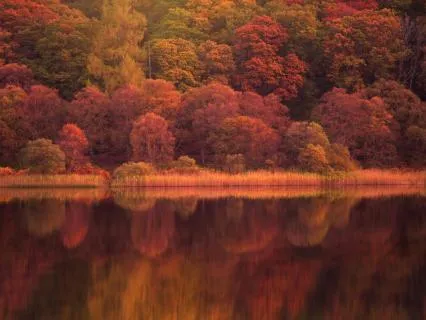
In the deep fall.
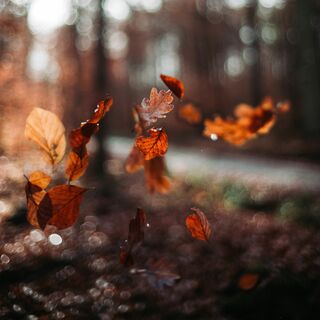
Don't you imagine the leaves think how comfortable it will be to touch the earth.
Instead of the nothingness of air.
And the endless freshness of wind.
And don't you think the trees themselves.
Especially those with mossy warm caves,
Begin to think of the birds that will come.
Six,
A dozen,
To sleep inside their bodies.
And don't you hear the goldenrod whispering goodbye?
The everlasting being crowned with the first tufts of snow.
The pond vanishes.
And the white field over.
Which the fox runs so quickly.
Brings out its blue shadows.
And the wind pumps its bellows.
And that evening especially.
The piled firewood shifts a little.
Longing.
To be on its way.
What I love about this poem what I love about fall.
Is that Mary Oliver invites us to imagine the world not as a collection of losing things?
Not a collection of losses.
But a world.
Turning towards what comes next.
Like the leaves dream of touching the earth.
The trees are preparing to shelter the birds.
And even the firewood.
Longing to be on its way.
You can almost picture the way that the golden firewood crumples up and rests at the base of the The ice would be in the fireplace.
So I love the way she turns our usual understanding of fall upside down.
I love the fall,
Like this rain that we have right now.
We tend to think of autumn.
As a season of loss?
To some extent,
You know,
We're watching the trees go dormant and the leaves fall.
The flowers are fading in our gardens.
The days are getting shorter.
It's dark in the morning and dark in the evening quickly.
The warmth that we had this summer.
You know,
Is.
Spilling away.
And winter's coming.
And hopefully with it a lot of snow.
So we see what is disappearing.
But Mary Oliver invites us to imagine what is being welcomed.
The leaves aren't simply falling away from something,
They're dreaming of touching the earth.
You know,
The trees sheltering the birds in their little mossy cocoons.
And the firewood fulfilling its purpose to become ash.
And I think what this really illustrates in this time of year really illustrates for me is that everything is moving.
Moving towards change,
Whatever comes next.
And.
It's an important recognition.
That we too are part of the movement.
Were not separate from the movement.
Our lives are continually changing and opening and closing.
And beginning again.
And we can begin again at any moment.
All moments are an opportunity to begin again.
And I guess I love autumn so much because It's a good time to practice seeing change.
More clearly.
It's happening.
It seems like this time of year is really,
It's.
.
.
Just potent with change.
And we all know,
You know,
We know about change.
But knowing about change intellectually.
And learning how to live.
In the changing world are very two different,
They're two different things.
Be part of the change.
I think it's really important,
In my practice anyway,
To focus on endings.
Like I have trained the mind to some extent to be aware of when things end.
It's a really helpful practice.
Particularly for some of us here,
Certain seasons of our life,
They're changing.
Maybe you're no longer skiing,
Or maybe you are,
But not the same way you used to,
Right?
Some of our familiar habit patterns are sort of disappearing.
Some folks,
Like Lili,
Who's not here today,
But she moved out of a big house into a condominium.
So we're like,
Changing even our homes.
Some of us are leaving our jobs or putting down our vocations.
And then in some ways,
We're also preparing to leave our loved ones in a way.
So in that,
As we age,
We're aging together.
But we're.
Our journey of dying is.
Is individual.
It's not like we do a pack like Romeo and Juliet.
You know,
We go separately.
Some of the endings that we have in our life,
We choose.
We choose not to ski.
Temerity anymore.
Those bumps are big!
Um,
And other times it's chosen for us.
Without our permission.
You know,
We can't,
We physically cannot do what we used to do.
I didn't really like run.
I still try to run.
I love running.
But my body does not like running.
It doesn't like it anymore.
I keep on wanting to choose it,
But every time I choose it,
It hurts.
And so that's going away.
And,
You know,
It's so,
And that kind of points to that even when we know that change is inevitable,
Like,
Okay,
That makes sense.
Like it makes sense that that's happening.
The joints are no longer what they were 20 years ago.
Something in us resists the change.
You know,
Don't we all have that?
I know it's not just me resisting change.
We want to hold on to these things that we love.
We want the good times to keep being good times.
That's what we kind of organize our life around,
Having good times.
Especially if you're retired,
It's all about like,
Let's travel and have a good time.
And there's nothing wrong with that.
But it's just.
.
.
It's not recognizing that time that we create.
Will have its duca right in the middle of it.
There'll be some sort of hiccup.
Like,
The plane will be late,
Or you'll miss a flight,
Or you'll get food poisoning at this exotic location that you go to.
Like,
It's not just going to be,
You know,
Flowers and chocolate the whole time.
On your great plan.
And there's this resistance we have to,
We want to create.
Our world where it's all good all the time.
And in fact,
We use that term quite a bit.
How's it going?
It's all good.
Yeah,
OK,
Good for you.
And then there's how we,
You know,
Resisting change is.
Is trying to control aspects of our lives.
I know that all of us have our ways of controlling certain aspects of our lives.
And the most common way that we go through control.
Or work with control.
Is we're so damn busy.
We're just so busy.
We all live in the same valley.
And to get together,
It's like two weeks out.
There was a time,
And I'm sure all of you here remember this,
When you could just pop over to somebody's house.
You didn't have to schedule.
Like two weeks out to like have dinner.
But now it's like everything is really deeply scheduled because we're so busy.
And that's a form of control.
And in some ways,
Like when we sit down and we do this practice.
At first,
We're planning out the whole next busy period.
But then eventually the body just wants to rest.
And then when the body stop,
Like when we stop the.
.
.
Attending to the mind that's creating all the plans and the memories and the making things happen.
Right below the surface.
I don't know if this is your experience,
But in this body's experience,
There's a grief.
There's a reckoning.
There's all this feeling that's been unattended to.
There's a longing.
I can feel the longing to move.
At the speed of nature.
Like there's a longing for that.
I think in some ways that's the.
.
.
The love of nature comes from that longing to move at its pace.
So I think this is what makes mindfulness practice so valuable.
When we sit down to meditate,
We start to see all the parts that we've healed.
Hurried past.
And we also get to notice.
How quickly things are changing in our own bodies and minds.
You know,
We sit down.
And.
We intend to focus on this inhale,
Exhale,
This in,
This out,
This rising,
This falling.
But then what happens is we travel off.
And then we come back and we travel off and we come back.
And we can start to see that we spend a whole lot of our life.
Living in our ideas,
In our plans,
In our projects.
And then as we come back and we settle and we start to feel that like there's that taste of settling that we have,
Maybe you experienced it just now in our meditation.
It's like,
Ah,
It's like a deep,
Deep rest.
Where we can live our life just right here,
Right now,
With the rain coming down,
In this room in the church,
With cookies and light and friends.
And it's like nothing is needed.
Everything we need is here.
It's not out there to get.
And yet we have to be reminded of that.
I mean,
Some of you come weekly,
And I'm really grateful for that.
But we have to remind ourselves of this almost daily,
Because what will happen is we will leave here,
Maybe the rain will stop,
Maybe not,
But we have plans.
Right?
We have things that we're going to do after this.
And I think that this practice is an invitation to The reminder is that we don't have to wait until the conditions of our life are less busy.
To slow down.
To move at the pace of nature.
To be like the fall.
You know,
Just to even notice,
Just to start noticing.
Whatever's happening in our life.
There's no urgency.
We create,
And again,
I'm speaking mainly for myself,
But I'm assuming because we're all human beings that we're all kind of doing this in one frame or another.
But we create a sense of urgency,
Like things need to happen like now.
I mean,
I do this all the time.
It's great.
I see myself do it.
And then I have to sort of like,
Lean back.
Lean back,
Physically lean back,
Like flop down on the couch.
And just stare off into space for a few minutes so that I don't get propelled by this.
This momentum of urgency to get it all done.
And that's where the practice is really beautiful because it allows us.
To see.
To rest,
To see what we're doing,
And to pause instead of.
Get,
Get going.
There's a really strong tendency to get going all the time,
Right?
So that falling back into the couch moment that I have.
Probably once a week.
Or it's like,
Wait a minute,
I have to force myself to stop.
So that I don't get carried away by this crazy momentum and speed that is our culture.
It's liberating when I can force myself to just fall.
Like the leaf.
That can't wait to touch the earth.
It's the same fog.
It's just in human form.
And I feel like us getting together regularly.
Is just this mindfulness bell.
You know,
Okay.
Pay attention!
Remember.
Pay attention.
Notice the life that we're actually living.
And not making it like wrong or bad or when we do get on our little speed train and we're just going at like a thousand miles a minute,
Getting it all done.
Not like it's bad or wrong we don't have to put the let's let's not overlay judgment on our behavior i think that that's the other thing that we do i should people should themselves even practitioners in this group who have been practicing for a long time they give themselves a whole ration of shooting it's like you can drop that just drop that It's not necessary.
And just turn to like,
Okay,
Let me,
Can I be like the leaf?
I just fall.
Towards the earth.
And that might be just sitting back in your chair.
And not getting all of the things done on the list.
I love that image of the leaf falling to touch the earth.
And the trees preparing to shelter the birds.
The flowers that die back saying goodbye to this season.
There's such a tenderness.
In seeing this way.
This poetic way.
I think that that's another,
Like,
I love poetry because it helps us see it slightly differently.
Everything.
Is participating in the movement of life.
And we are too,
But wouldn't it be?
Interesting to attempt to move at the speed of nature.
Instead of at the speed.
A culture of avoidance.
Which is the culture that I think we sort of live in.
I think what Mary Oliver is pointing to,
And what this teaching,
The Buddhist teaching is pointing to,
Is that we can love.
Without holding on.
Where we don't have to become indifferent to the world and the way that the world is moving.
And judge it as wrong and bad.
That we can actually attune,
And I think usefully attune,
To the speed of mindfulness,
The speed of nature.
The speed of attention.
We don't need to make all of our precious moments the moments that we've planned and curated.
Have,
You know,
Are journeying towards.
We don't have to make those moments last.
We can curate and do all the things to make these wonderful plans and future trips happen.
And also know that they're not going to last.
Focus that,
Oh yeah,
This,
Look at this thing that we created and look at it end.
It arises and it passes,
Just like me,
Just like the seasons.
Just like the rain.
I think.
I guess the offering today is that.
We don't have to hold on.
She'll be okay.
We can learn to let go.
In the same way that the leaflets go.
We can participate in this life.
Without needing to control it.
Oh,
That's the.
.
.
That's my intention anyway.
So I'm going to read it one more time,
And then I'm going to open it up for discussion.
Song for Autumn In the deep fall.
Don't you imagine the leaves,
Think how comfortable it will be to touch the earth.
Instead of the nothingness of air.
And the endless freshness of wind.
And don't you think the trees themselves,
Especially those with mossy warm caves,
Begin to think of the birds that will come,
Six,
A dozen.
To sleep inside their bodies.
And don't you hear the goldenrod whispering goodbye?
And the everlasting being crowded with the fist of tufts of snow.
The pawn vanishes.
And the white field over which the foxes run so quickly brings out its blue shadows.
And the wind pumps its bellows.
And at evening especially.
The piled firewood shifts a little.
Longing to be on its way.
So thank you.
Thank you for listening.
I hope this was of benefit.
Thank you,
Amy,
For being here.