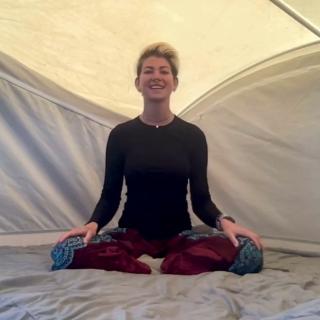
Hello and welcome to this meditation prep class.
This is called Finding Your Seat.
And if you're just getting started with meditation,
You can use this every time before you practice until you get a feel for it,
Or if you've been meditating for a while and you just need to check in with your seat,
You can use it as needed.
Let's get started.
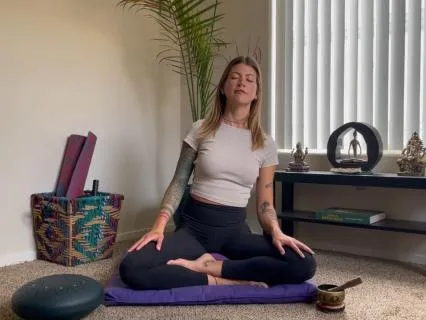
Go ahead and find the seat that you practice your meditation in.
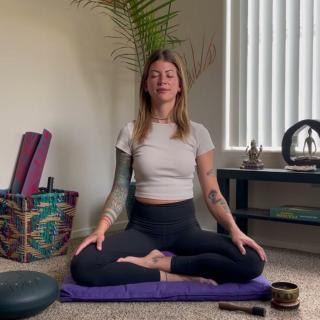
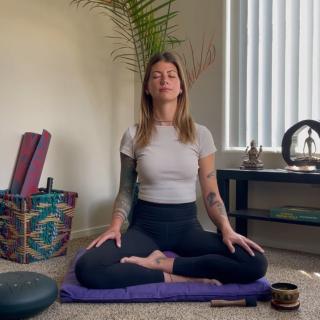
And I'll be sitting in a cushion for this class today,
But I'll give cues for if you're in a chair or a different type of seat as well.
So go ahead and close your eyes.
And just bring your awareness down to the sitting bones.
So just notice even weight between the left.
And the right sitting bone.
Now start to bring your awareness up to your shoulders.
And then roll your shoulders all the way up to your ears as high as they can go.
And then roll them open and down your back.
We'll do that again.
You can also inhale to bring your shoulders up nice and high.
And then exhale down the spine.
We're looking to open the chest here.
And now bring your awareness to your neck,
Your head,
And your chin.
And I want you to pull your chin back in space.
So that your ears are aligned over your shoulders.
Which should be more or less aligned over your hips.
The back of your neck is nice and long.
The sides of your neck are nice and long.
And then take a slight tuck of the chin.
Now,
I want you to imagine that there is a string.
That starts up at the crown of your head.
And then goes all the way down your spine.
Out the tailbone and into the earth.
And now I want you to imagine that there is someone pulling that string from above and below,
Lengthening your spine each time you breathe.
It's important in meditation that we have a nice long spine so that we have space in the front body for the breath to flow completely and naturally and easily.
This is called prana or life force.
So your ears are stacked over your shoulders,
They're stacked over your hips,
And the spine is nice and long.
And now bring your awareness back to the sitting bones.
And I want you to start rocking your weight from left to right.
So shifting all the way over to the left sitting bone and then all the way over to the right sitting bone.
These movements can be.
Fairly exaggerated as much as feels comfortable.
And if you're sitting in a chair,
It will be useful to go ahead and come forward a couple inches away from the back of your chair at this point.
You'll be able to go back to it,
But just while we find our seat for the next minute or two here.
Make some space between yourself and the back of the chair.
So from left to right,
Start turning this into circles.
So when you go left.
Come forward to make your way to the right.
To come backward to make your way back to the left.
So we're making some nice big circles with the upper body.
And then noticing how your weight now is shifting.
All around each sitting bone.
And imagine the body like a pendulum.
So these are nice.
Big circles.
And then allow your pendulum to start to make smaller circles.
And even smaller circles,
Maybe even slowing down.
Your movement.
And then see if you can allow.
Your body to make those circles as small as possible as you naturally find that point of equilibrium.
Your center of balance.
Feels right.
Your body.
And once you arrive there.
Come back to stillness.
And then check in.
Ears should still be more or less aligned over the shoulders.
Shoulders are down,
Away from the ears.
Your spine is nice and long.
Shoulders are stacked over the hips.
There's no tension in the hip flexors.
And no tension in the lower back.
Your legs can be completely relaxed.
If you're in a chair,
Your feet should be planted firmly on the ground.
And if you're on a cushion,
You can have legs crossed.
Or legs out in front of you,
Whatever's most comfortable,
But the legs should be relaxed.
Now bring your awareness.
To the upper body once again.
And Your palms should be nice and relaxed.
Your arms should be nice and relaxed.
Your hands can be resting on your knees or your thighs,
And your palms can be facing up or down.
That's totally a personal preference.
If you need help deciding,
Grounding will be palms facing down if you need some settling energy.
And if you'd like to be more open to receiving energy,
Your palms can face up.
Again,
Whatever feels most comfortable for you each time you meditate is totally fine.
And then relax your jaw and part your teeth slightly.
Let your tongue fall away from the roof of your mouth.
Relax the muscles in your cheeks.
And relax the muscles in your forehead.
If you're sitting in a chair,
You can maintain this posture while you slide back to rest your back up against the back of your chair again.
And then bring your awareness to your breath.