Welcome.
To get started for this practice,
We'll need to be ready to be in three positions.
The first one will be with legs up the wall.
The second one will be a seated position.
And third will be lying down.
If your current space for practice doesn't allow all of these,
You can do this practice in two of the three poses,
Or even do the whole thing seated or lying flat.
So I'll give the suggestion for the movement from one asana to the other through the practice,
But make it what you need it to be based on how your body is feeling and the space at your disposal.
We're going to start with legs up the wall.
As you arrive into the pose,
Ensure that you feel like your entire body,
From hips to heels of your feet,
Is supported.
The spine should feel easy,
Relaxed.
Start with the arms out wide to the sides.
Take a soft breath in through the nose.
Soft breath out through the nose.
And then deepen the inhale through the nose a little bit longer.
Once you finish the inhale,
Take a second inhale.
Exhale through the lips.
And then again,
Inhale through the nose.
Sip in a little bit more.
Second inhale.
Exhale through the mouth.
Clear it out.
And then one more like that.
Make the inhale even slower through the nose.
Take your second inhale.
Feel the breath unfold.
Exhale through the mouth.
Feel the breath on empty.
And then seal the lips.
Breath goes back in and out of the nose,
No longer pacing it.
Place both of your hands on your low belly,
Below the belly button.
Take your inhale through the nose.
Feel both hands lift up.
Hold the breath.
Exhale softly through the nose.
Inhale again.
Hands puff up.
Hold the breath.
Soft exhale.
Hands float down.
Pause.
And then continue at your own pace.
Not necessarily forcing the breath to be longer or shorter,
But link your observation of the breath to the gentle oscillation of the hands that occurs naturally with the breath cycle.
As you inhale,
The hands move up.
As you exhale,
The hands move back down.
Any time that it feels like the mind is wandering,
Which is totally normal,
Whenever that happens,
See if you can interrupt by doing a complete exhale and then start over.
Inhale.
You notice that the belly button lifts up.
Hands lift up.
Exhale.
Everything floats back down.
Inhale up.
Exhale down.
From here,
Start to bring your awareness to the base of the spine,
Right where your legs start.
Imagine a golden cube at the base of the spine,
Right where your legs first connect to the wall.
Take your inhale from the base of the spine all the way up to the crown of the head.
Exhale,
Top of the head,
Back down to the golden cube.
Inhale,
Golden cube,
Up to the crown of the head.
Leisurely exhale,
Back down to the golden cube.
Again,
Inhale,
Base of the spine,
To the crown of the head.
Exhale,
Top of the head,
Down to the golden cube.
Continue at your own pace for another six breath cycles.
Slowly let that breath visualization release and let your inhales and exhales return to normal.
See if you might lighten your toes,
Lighten your fingertips.
Maybe wiggle your jaw side to side.
Soften the forehead.
Maintaining legs up the wall,
Viparita karani,
Start to bend your left knee and then cross your left ankle over the right thigh.
The left knee will likely come away from the wall.
You might also put more of a bend in the right knee to accommodate this change in posture.
The legs are still supported by the wall and arms are wherever it feels comfortable for you.
Notice if there's any change in your breath quality or depth or pace.
Remove the left ankle,
Cross,
Come back to both legs up and then transition to the right side.
Bend your right knee.
Cross the right ankle towards your left thigh,
Like making a figure-four pose on the wall.
And again,
Allow the right knee to move away from the wall as it may need to.
Allow as much of a bend as needed in the left knee as well.
It is often the case that the pose can feel very different on the two sides of the body.
It may look different,
It may not,
But it can certainly feel different regardless.
Whatever the experience is,
Try to stay in the mode of observation,
Noticing it,
Being an eyewitness to what the experience is.
And then uncross the legs,
Come back to both feet up symmetrically.
Start to take your feet wider apart,
Like a straddle position with the legs.
Go gently at first.
Keep both knees very soft.
And let your breath guide you to the degree to which you open the legs.
If this feels more intense,
You could place your hands on your body,
On the abdomen.
For self-soothing.
Over the next two to three breaths,
Bend the knees so the legs can come back up straight again.
And then once you're back in the starting pose,
Bend both knees,
Place the feet on the wall,
And then roll over to the right side.
Pause there,
Resting.
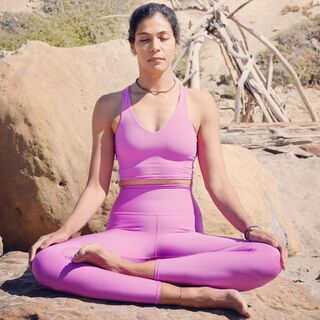
Please make your way to a comfortable seated position.
You might sit on a yoga mat with the ankles crossed,
Sukhasana.
You could sit in Virasana with your hips moving back towards your heels,
Knees coming forward.
You might sit up on a chair.
Pick something that allows your spine to be tall,
With no strain,
Minimal effort.
Once you arrive,
Place your hands on your knees.
Have the palms face up to start.
Close the eyes.
Release the tongue to the bottom of the mouth.
Take a big breath in through the nose.
Slow exhale through the nose.
Again,
Inhale.
Exhale.
Inhale.
Moving into Samabhruti.
Same length inhale,
Same length exhale.
I'll count for you.
Inhale for one,
Two,
Three,
Four.
Exhale,
One,
Two,
Three,
Four.
Inhale,
One,
Two,
Three,
Four.
Exhale,
One,
Two,
Three,
Four.
Inhale,
One,
Two,
Three,
Four.
Exhale,
One,
Two,
Three,
Four.
Adding on.
Inhale,
One,
Two,
Three,
Four.
Hold,
One,
Two,
Three,
Four.
Exhale,
One,
Two,
Three,
Four.
Inhale,
One,
Two,
Three,
Four.
Hold the breath,
Two,
Three,
Four.
Exhale,
One,
Two,
Three,
Four.
Inhale,
One,
Two,
Three,
Four.
Hold,
One,
Two,
Three,
Four.
Exhale,
One,
Two,
Three,
Four.
Adding on.
Inhale for one,
Two,
Three,
Four.
Hold,
One,
Two,
Three,
Four.
Exhale,
One,
Two,
Three,
Four.
Hold the breath out,
Two,
Three,
Four.
Inhale,
One,
Two,
Three,
Four.
Hold,
One,
Two,
Three,
Four.
Exhale,
One,
Two,
Three,
Four.
Hold the breath out,
Two,
Three,
Four.
Inhale,
One,
Two,
Three,
Four.
Hold,
One,
Two,
Three,
Four.
Exhale,
One,
Two,
Three,
Four.
Hold,
One,
Two,
Three,
Four.
Inhale,
One,
Two,
Three,
Four.
Hold,
One,
Two,
Three,
Four.
Exhale,
One,
Two,
Three,
Four.
Hold the breath out,
Two,
Three,
Four.
Let the breath return to normal,
Floating in and out of the nostrils.
Take both of your hands,
Stack your palms in front of your heart and center the chest.
Feel your heartbeat.
Notice your heartbeat.
Release your hands from the center of the chest.
Bring your palms back down towards your knees.
This time,
Arrange your hands so the palms are down.
Moving into a gratitude practice,
We're going to link gratitude to our breath.
To start with an example,
On the inhale,
You think,
I am grateful for.
On the exhale,
We'll name something.
It will come organically from your heart space,
Something that you are thankful for.
So for example,
Inhale,
I am grateful for.
Exhale,
My grandma.
Inhale,
I am grateful for.
Exhale,
My eyesight.
Whatever it is,
Items,
People,
Qualities,
Will come up organically and you will name them to yourself at the pace of your breath.
So the breath is unstrange,
Easy,
In and out of the nostrils.
Let's take a clearing breath to set and begin.
Slow inhale through the nose.
Sip in a little bit more at the top.
Exhale softly,
Completely.
And then begin.
Inhale,
I am grateful for.
Continue at your own pace for the next two,
Two and a half minutes.
Over the next two to three cycles of reciting your gratitude,
Start to wind the practice down and return to your regular breath.
As you're ready,
Take a slow inhale through the nose.
As you exhale,
Bring your hands to heart center,
Palms pressing into each other.
Blink your eyes open if they were closed.
And then make your way to lie on your back.
You might have your legs out straight,
Like Shavasana,
Or to give the spine a little bit more ease,
Bend your knees,
Put the feet flat,
And then take your feet wider than hip-width distance so that your knees could rest towards each other,
Kind of like making a triangle with your knees at the top,
Feet at the bases.
However the legs are,
Bring your arms down by the sides of the body.
Have the palms face up to the sky.
Bring your awareness to the points of contact between your body and the ground.
The point at the back of your head,
Your left shoulder,
Right shoulder,
Left elbow,
Right elbow,
Back of the left hand,
Back of the right hand,
The middle of the spine,
The lower back,
The hips.
Feel how the earth is completely holding you,
Supporting you when you lay down.
Grateful for that support.
It's always there.
You don't have to question it.
Bring your awareness back to the base of the spine,
To the golden cube.
Slow inhale from the golden cube up to the crown of the head.
At the crown of the head,
Imagine a brilliant red lotus flower with innumerable thousands of petals.
If you started to count the petals,
You wouldn't be able to finish counting them.
Doing a breathing loop,
Inhale from the golden cube,
Base of the spine,
Up to the crown of the head,
Red lotus.
Exhale from the lotus,
Back down to the golden cube.
Inhale up to the lotus.
Exhale down to the golden cube.
Continue at your own pace until the visualization falls away,
And then you're in Shavasana.