Okay,
So we're gonna be looking at the Stoic Theory of Emotions.
Epictetus says in the Enchiridion,
Men are disturbed not by things,
But by their judgments about things.
And everything that we're going to be looking at unpacks that because when we first look at this,
We can go on.
Surely that can't be true.
There are just some things that are intrinsically bad and that make us feel a certain way.
And that's just how it is.
And the Stoics broke things down and they just had a different theory.
The example here,
Right?
Someone you love walks in.
Glances at the room and sighs.
Before you've decided anything consciously,
You know internally what that meant.
It's like a felt knowing,
You could say.
The sigh was real,
But everything after that was actually you.
Okay,
So you get this a lot with body language,
You know,
If someone crosses their arms or looks a certain way,
We really feel the sense of certainty.
It's a bit like AI large language models,
One of the things they're criticized about is their overconfidence about everything.
Um,
And it can be very convincing,
You know,
Just having a chat bot confidently talk to you,
Like as if they know everything.
It's hard not to kind of believe it.
Right.
Because it's just feels plausible.
Our own mind is doing something similar.
It's confidently assuming that it knows what things mean.
And that gap between what actually happened and what you made it mean.
That is what the Stoics paid a lot of attention to.
So there are four main steps.
Okay.
So we have the impression,
Which is fantasia.
Uh,
We have sunkateftisis,
Which is ascent.
We have home,
Impulse,
And we have pathos,
Which is passion.
These are the four steps.
For fantasy,
Something arrives,
A site,
A word,
A memory.
And the thing that most people don't get about this is that it,
It sneaks in a claim about reality.
So it's subtly saying,
This thing is true.
This is how the world is.
This is what is happening here.
And we often just believe it.
We don't question it because it kind of sneaks in through the back door and it seems so confident that we just go,
Oh,
Okay.
That must be the way things are.
Our mind came up with it.
It must be true.
Sukhatathisis,
Ascent,
This is the only step in the entire process that is truly yours.
Epictetus had this concept called proharesis,
Which is like the faculty of choice,
And he believed that this is the self.
This is the only thing that is ours,
Ultimately,
If you break it down.
So we don't control the impression,
The fantasia.
We don't control pathos,
We don't control home,
But we do control the ascent.
We can test whether the claim that the impression brought to us is true.
And sort of meditate on that and remember that as you go through life.
If you really want to practice the dichotomy of control,
Ultimately,
What that really means is this,
You're practicing assent.
That is the one thing that is actually truly yours.
The next stage is homé,
And this is the,
So once you've assented,
Once you've agreed to the impression as being true,
There's a certain motion,
Internal motion,
The Slovak's thought,
That propels you to take action in some way.
It's sort of like the,
Like the stirring of like,
You know,
Someone triggers you and you have this like impulse,
This drive to retaliate,
To take revenge.
And then finally you have pathos.
When the impulse rests on a false judgment,
You get a destructive emotion.
So pathos,
Destructive emotion.
So when the Stoics say you can control your emotions,
It doesn't really mean you can control pathos.
It just means you can manage your impressions so that you can feel emotions more accurately.
And yeah,
As I said,
Freedom leads to step two.
And the purpose of meditation is not to try and suppress those thoughts,
But just to be mindful of them,
To notice them.
And over time,
You can just get better and better at being non-distracted.
You can't stop your body reacting and flinching.
You know,
If there's a loud noise,
You can't control it.
Between the impression and the belief,
There's a moment of ascent.
And that moment is ours,
But it takes training.
Okay,
So this is the first tool,
Which is the Dorman.
Epictetus says,
Don't let the force of the impression carry you away.
Just say to it,
Wait a moment.
Let me see what you are and what you represent.
Let me test you.
So the analogy that Epictetus had is that back in the day,
You would have a money changer.
And the money changer would test the coin by dropping it and listening to see if it rang.
It was a certain ring,
I suppose,
To certain metals.
And so he wouldn't just take a coin and look at it and maybe flick it.
He would drop it and listen to see if it rang true.
Using that analogy with our impressions.
So when an impression comes to us,
I actually do this as well.
I kind of take this metaphor and imagine that I'm dropping the impression to see if it rings true.
So someone disrespects you,
Just imagine dropping it.
Is that true?
Would I bet my money on that as being true and factual?
And if the answer is no,
Then more reason to withhold the scent.
These little nice visuals can help sometimes as well.
Would be the doorman.
You imagine like a nightclub doorman checking people's ID before they let them in.
You can do the same thing with impressions.
You can go,
Hang on a second.
Let me check you.
You're like,
Are you too drunk?
Are you the right age?
What's your date of birth before you let them come in?
And progress to the next step.
Second tool,
Fact versus story.
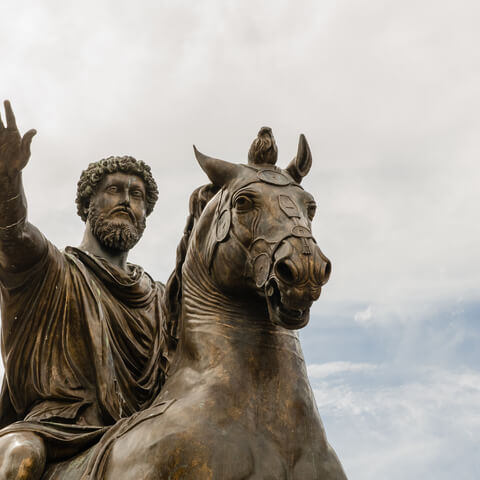
Marcus Aurelius says,
You've been told that someone has spoken ill of you.
That's what you've been told.
You have not been told that you've been harmed.
And often our mind will conjure up all of these stories.
So we need to get better as we go through life,
Separating the fact from the story.
This is another way to train impression and dissent.
So before your mind gets a vote.
You experience propathiae.
This is a pre-emotion or proto-passion.
A flush,
A flinch,
A drop in the stomach.
These proto-passions come before any judgment.
Seneca called them the first movements.
So three characteristics.
Involuntary,
You don't choose your pre-emotions.
If you're hungry and someone walks into the room with a delicious plate of food,
You don't choose whether you want that food.
It just comes upon you.
It's involuntary.
Blameless,
Even the wisest stoic sage has pre-emotions,
Propitheia.
And conditional,
The passion forms Only if your mind ascends to the story.
Okay.
So passion comes later on,
Way later.
So the flinch itself is not an issue.
Whether you believe the flinch or not,
That is where stoicism comes in.
Four categories of emotion.
I love this because it works perfectly as a two by two grid.
So the two by two grid is good and bad and present and future.
So this is how we look at the four different categories of passion or categories of negative,
Destructive emotion.
So the two present emotions is pleasure and distress.
Hedone and lupe.
Hedone is pleasure,
Lupe is distress.
Another way you could describe it is grief.
In the future,
You have craving and you have fear.
And so you have apparent good.
So I just love the way that this is mapped out.
Pleasure and craving kind of convinces you that it's good.
Apparent evil,
Distress and fear.
So whenever you're experiencing a negative emotion,
You can ask yourself,
Is this an apparent good or an apparent evil?
And is this about something occurring in the present or is this about something occurring in the future?
And you will find exactly what pathos or destructive emotion that you're dealing with.
If it's about something bad,
And it's something that's happening in the future,
You go fear.
If it's about something bad,
Then it's happening now,
It's distress.
If it's about something good and it's happening now,
It's pleasure,
And something good that's happening in the future,
Craving.
But anger,
According to the Stoics,
Is a form of craving.
Um,
Because if you think of anger,
What is anger?
It's about,
It's not,
It's about,
Uh,
It's about the future and it's something that is apparently.
Like good in a sense,
Like when you feel angry,
You want to correct an injustice.
Typically,
That's what Seneca believed that you feel like there's been some injustice and you want to take revenge on that and correct it.
So anger reaches forward into the future and it wants something.
Very rarely is anger just this like neutral emotion that just swirls with no impulse behind it.
You might want punishment.
You might want an apology.
You might want the past to be changed.
And the Stoics class that as a craving.
Key insight from the Stoics,
People get this wrong all the time.
The goal is not to stop feeling anything.
The goal is to feel accurately.
That's the idea.
So the sage still feels emotions,
But they don't suffer from false judgments.
So the aim as we go through the weeks and the months of practicing stoic philosophy and stoic practices is that we still have a very rich emotional life.
We still have lots of feelings,
But we stop assenting to false judgments.
And if we stop assenting to false judgments,
Then we don't get those destructive emotions.
So much that we experience here.
Distress,
Fear,
Craving,
And pleasure.
Now on the flip side of these four destructive emotions,
We have constructive emotions.
Upathai,
These are the good emotions.
Kara is joy,
And this is the opposite of pleasure.
So this is not the same as I got what I wanted.
But I am living well.
Rational wishing,
This is the counterpart to craving.
Wanting to pursue virtue,
Wanting to practice stoicism,
Wanting to examine your life,
That is a rational wishing.
And it's sort of like an aspiration or setting an intention that is wholesome.
I find that enjoyable.
You know when you read a good book or you're working on yourself or you're doing something good for other people?
There's a wishing there,
But it's not destructive.
It's not the same as craving.
Healthy caution is the counterpart to fear.
And,
You know,
It would be silly of the Stoics to say,
Never be cautious.
Like how can you exist in the world if you're not cautious?
You know,
It's wise to be cautious.
Otherwise we would just probably die quite young and we wouldn't really be able to better society.
There are risks that exist in the world and we should keep a lookout for them and be aware of them,
But we don't catastrophize.
So some level of attentiveness to your impressions is vital.
And the beautiful thing is you can do this just by making it an intention.
You know,
Just decide right now that for the rest of the day and the rest of the week,
You are just going to pay more attention to what arises in the mind.
Not in a judgmental way,
But just to be aware and vigilant and just go like,
Oh,
What does that impression say to me?
Am I accepting that impression?
You know,
Am I craving?
Am I not craving?
And this is the practice part.
So these are the three simple practices you can start doing.
So the first thing is the morning practice.
This premeditation of adversity.
What's likely to be difficult today?
How do I want to meet it?
You can do this just lying in bed if you want.
You can do it in a formal journal.
But this is something that is always good to do at the beginning of the day.
In the moment when an impression hits hard,
Say to it silently,
To the impression,
Not yourself.
Just like Empetita said,
You are an impression and not at all the thing you appear to represent.
And then I like to imagine dropping the impression and seeing if it rings true.
And in the evening,
What did I notice?
Where did I ascend to too quickly?
Where did I catch myself?
So I always try to include a little bit of a counter to Stoic practice because I don't want to come across like the Stoics had infinite knowledge about everything.
I like the idea of constantly updating stoicism,
But using it as the base.
So the model of emotions is really powerful,
But obviously it doesn't cover everything.
Some things need to have a conversation,
Not just an internal move.
Stoic practice can bring you to that conversation,
Regulated rather than reactive.
So yeah,
I always like to say that like sometimes in life you need specific skills and stoicism doesn't always provide those skills.
Like stoicism is not going to teach you how to fly a plane.
Sometimes you need to know how to fly a plane.
Sometimes you might have a situation in work and you need specific guidance for that.
And stoicism doesn't teach you,
But it can help you stay regulated so that you can go to the next level.
You don't react to the world,
You react to your impression of it.
Learn to hold the door.