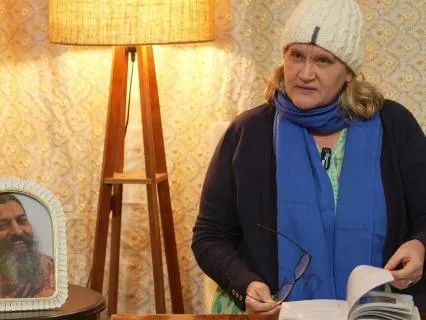
Welcome to.
.
.
Therapeutic psychology book club.
It's cold today here.
Everybody's bundled up.
Amen.
So before I keep reading,
Does anybody have anything,
Any insights you had over the week about what we were talking about last week?
It was kind of a heavy chapter,
Right,
Talking about my father dying.
Sometimes it can bring up your own memories of death and dying,
Losing people you love.
Does anybody have anything you want to share about that?
I was touched by the connection that somehow has been made by the emotional problem and the physical problem that your father suffered about this heart attack because he was emotionally very,
Let's say,
Under pressure or something.
Because normally.
.
.
I was never thinking that there is so much connection between mind and physical body.
So revealing a lot.
Up to that point,
Up to that extent.
Basically the pain can cause.
Yeah.
Break the heart.
So I was really touched.
Yeah.
It was shocking for me when I figured that out too.
I was like,
Oh my God.
Very shocking to hear.
Thank you.
Anything else?
Yeah,
What came to my mind is that we forget that there will be an end.
And that end can be any time,
For any reason or any cause.
My experience when I've lost someone,
A family member for instance,
Is that All of a sudden,
I realized I was thinking,
I should have done this.
Why did I behave like that?
Why I said this to this person?
It was so mean.
I had so much regrets.
And when it's over,
When the person is not there anymore,
Then we think,
I should have behaved like this,
I should have behaved like that,
I should have.
.
.
Don't.
I should have been more loving,
Basically.
But we forget about it.
So the story that you were sharing,
And after losing some family members,
But still I forget,
I try to remember that.
At any time.
It can end.
There's no time to waste to have loving relationship with the people who are important for me.
Or to work on the relationship I really want to have with someone.
Because we quarrel,
Because of ego,
Because of stupid things when we really think about it.
And we waste time and we cannot have it back.
Yeah.
So yeah,
That to lose someone for me,
It was really,
Wow.
Oh my God,
Then it's over.
It's over,
It's too late.
You can't rewind it back.
Yeah,
That's a very good insight.
It's hard to keep that present in your mind,
You know,
So when you hear a story and then you can.
.
.
Try to keep that close to your heart and act in that way,
It makes a big difference.
Because usually,
Like you said,
We're just caught up in our own story,
Our own ego,
Our own whatever else is going on for us that day or in that relationship that's petty.
Right?
And then you never actually got to say that I love you,
Or thank you,
Or you always were like,
We'll get to that point.
Once this person changes in this way,
And I'm happy with how they're behaving,
Then we can have a loving relation.
Exactly,
So I'm really grateful you know about the whole book and everything you share because Um.
.
.
To me,
It's a tool so that we become aware of all this and then we can really decide how to work on with the person to have loving relationship and how to make it work.
I find this so precious.
It's really kind of giving tools for us to say,
Okay,
What do I really want and why?
And how do I want to relate with this or this person?
Yeah.
Thank you.
And I think talking in a group is nice,
You know,
Instead of just reading it straight through to process,
To come back a week later to see what happened because everybody has such busy lives,
You know,
And sometimes you don't think about it.
But if you know,
Okay,
I'm coming back in another week,
We're going to still be on that same topic.
We can still talk about it and think about it and see how it affected us over the week.
Sometimes it affects you in subtle ways and sometimes it's very obvious ways.
Like,
Okay,
I need to work on this.
But sometimes you might just feel a little more sad or a little more reflective or contemplative or something might hit you in a different way,
More deeply,
You know?
Especially with this topic,
At this time of year,
Too,
Around the holidays,
You miss those people that you love,
That you never really,
You didn't end on a happy note.
Happy ending,
You know?
Like,
There are so many things that were unsaid.
There's so much unfinished business usually when somebody dies.
You know,
So this idea of you saying,
Like,
Why wait?
Just do it now.
Have a loving relationship now.
Let go of the petty stuff.
Yeah.
There's so many times when people hold on at the end of their lives.
To just hear that one person just say that one thing and then they'll let go,
You know?
Very often.
When somebody's dying,
They're not even,
You know.
Really,
And they're not able to even talk.
They look like they're already dead,
You know?
But then,
You know,
When you come and you ask the family members,
Is there any last person that hasn't said something to them that they haven't said goodbye to that they need to hear from?
And inevitably,
There is somebody.
And then you have that person come and say something in their ear and then very soon after that usually the person goes.
But why do we have to wait until that point?
It sounds like it's what you're saying,
Like,
Why not now?
That person can die at any time.
Why wait until they're at the very end,
To their last breath?
Why can't we have the happy relation now?
You know?
That's good,
Latalee.
Thank you.
Anything else?
I think someone has their hand on.
.
.
Then set Sorry,
I can't read very well.
Many thanks.
Hare Krishna.
I mean,
I didn't get a chance to ask this question.
I mean,
I shared mine about the last time,
But.
.
.
One,
I wanted to appreciate your courage in sharing such a such a traumatic moment in a sangha like this.
In fact,
Putting it down in the book,
I think it takes a lot of courage to share such moments.
People who you may not know.
So thank you for doing that.
Actually I connected more with how your father must have felt.
Because I fell in love.
He must have wanted to do the best for his family.
Circumstances,
Life,
You know,
Desires,
Vasanas,
They come in the way and some things are not met.
In the social structure,
And hence you search for things outside that social structure.
What he must have been going through when he saw the entire family together.
And how he must have felt that.
I am the cause of.
The destruction of this family.
This has been a very big fear personally for me,
That I might be the cause similarly for my family.
So when I heard that moment that he just collapsed,
And then when you shared later that there was that conversation between him and your mother,
I was like,
I just.
.
.
Sank and it was like so tight.
I felt my body go tight.
Amen.
Very good.
I felt his pain.
He does not he doesn't want to break this family.
He feels like he's the cause.
He's meant to be the protector of the family,
But he's failing everyone,
And he can no longer take it.
So I was just that was the emotion that hit me hardest.
And once again,
Thank you so much for sharing.
Yeah,
Thank you very much.
It's such a helpful insight that you shared,
You know,
From the man's point of view,
The husband and the father's point of view,
Right?
Because the story is more like from my point of view as the daughter and my mom and sisters,
What we went through.
But it's very helpful what you shared,
Because you're right.
You know,
I can see that you have a lot of empathy to be able to feel that for him what he must have been going through.
I mean,
That's why he died of a heart attack,
Because He couldn't take it,
You know,
He I mean obviously you don't just die of a heart attack from nothing His cholesterol was building up because of the decisions he was making leading up to that having an affair,
You know But the crescendo was when he saw the whole family together and thought oh Oh my god.
Like I'm not really going to be part of this family anymore,
You know,
We're at a family reunion,
He had already moved out,
They'd already decided to get divorced,
He was living in a hotel,
So everything was emotional,
But he hadn't told any of us yet,
And so to see everybody together like that,
You know,
I think he just couldn't take it,
And he was so proud of his family,
You know,
So that was his whole ahankara,
Was like his girls,
His four girls,
And his wife,
And he had invested so much of his time and energy and love in us,
And to think that he was going to break all of our hearts.
I think you're exactly right,
He couldn't take it.
But at the same time,
Another more subtle point that's coming out that actually came out between my mom and sisters and I,
Which helped us all grow,
Is about marriage.
Like,
Is it really realistic to think that you're going to marry one person and be with them for your whole life?
I mean,
My mom actually said,
You know what?
We kind of outgrew each other.
She was like,
You know,
I wish he didn't cheat on me.
I wish we could have like worked through it and just had an agreement and said,
You know,
We came together when we were really young and we were in love and we basically wanted a family And we had it.
You know,
But.
.
.
They didn't want to do the next step together.
My mom's like,
I actually.
.
.
Her partner she has now,
She's much happier with that type of person for this chapter of the life.
You know,
So I think that it could have been a more mature conversation even,
Potentially,
You know,
To just say,
Like,
Maybe it's not,
Maybe not for everybody you get married and you're together forever.
You know,
For my mom and dad,
What they had in common was wanting to have a family,
And they did it,
And we had a wonderful family.
But that chapter was kind of ending anyway.
Because we all were older.
I was 30 when he died.
You know,
My youngest sister was 20,
21.
So do you know what I mean?
Like my mom was,
My dad actually ended up with someone else and my mom did too.
So that also encouraged us to have a more open-minded thing about relationships in general.
So there's a lot,
I think,
To unpack there,
Not just death and dying,
But different people's perspectives,
Why they did what they did.
Because my dad was really torn,
I think.
He didn't want to break our family,
But he was also really not happy in the relationship with my mom for a long time.
They're compatible as mother and father more.
You know,
As young lovers,
And then as mother and father,
But not as like.
.
.
People.
They each did a good job in their role of mother and father,
But as two people,
I don't think they would have enjoyed life together.
My dad was very adventurous.
You know,
He was always traveling around the world and just doing things,
Hiking a mountain,
Canoeing and marathon running and very active type.
And my mom was not adventurous at all.
I mean,
She will never come visit me in India.
I've been here 10 years.
You know,
She doesn't even want to leave.
She doesn't even like to get in the car and go somewhere.
So their personalities just didn't really match.
And so there could have been some,
I think,
Good conversation between them to be like,
We love each other,
We're friends,
We raid this family together,
But maybe now we can still respect each other.
And I know some couples who've done that.
But I think he just couldn't.
He didn't have the skills,
Really.
But that's why,
You know,
I mean,
I just think that telling and talking about things can help.
If so,
If anybody else ever gets in that situation,
Maybe it doesn't have to be like that.
Maybe you could have that harder conversation from a loving place.
And it's not that he didn't love my mom,
It's just that they weren't compatible.
You know,
So.
There's a lot to that.
Thank you for bringing that point up.
Did you want to say anything else,
Vinita?
I was just.
.
.
Wondering,
I mean this is probably not part of this conversation,
But I was wondering how that these types of conversations might happen because when there's already a commitment and there's a family.
Involved,
Especially children are involved.
It seems like.
Children may not be able to take the vision.
But on the other hand we see that in the Vedic system there's a system that there's an ashram for monoprasthas where they you know make a voluntary decision to kind of separate of course,
Not just from the family,
But from material society.
So I feel like in today's a YouTube controlled world.
It's,
It's,
It's harder to make such conversations happen.
But this is a separate topic.
This is just something I was thinking about.
Yeah,
How do you make how do you make decisions?
When you have other people who depend on you,
Or at least the perception is,
My decision will might break everything.
I think it having conversations with equals is maybe easier,
But with those who you keep care for,
Juniors,
It can,
You know,
Bewilder them.
Yeah,
Definitely.
I would say just in general.
There's people who specialize in that type of therapy,
You know,
Like couples therapy or conversations,
Difficult conversations,
You know,
So you'd have the conversation with your partner first.
Also,
A guru is very important.
If you have a guru,
Talk to the guru first.
Then if you need to,
Have a couples therapist help you talk it out.
And then eventually,
Between what the guru is helping you with and then the therapist helping you with,
Then eventually you can decide,
Okay,
Now how do we tell this to the children,
You know?
But first,
The guru would be,
If you have a guru,
The guru is going to help you stay focused on what you're trying to do in this life,
You know?
And then if the guru says,
Yes,
It sounds like it's a good idea to get a divorce,
Then you would meet with a therapist who can help you have that difficult conversation in a loving way.
And then from there,
You would tell the kids,
Usually with the help of a therapist,
Because therapists who specialize with kids can do it in a way that kids can relate to.
Not get too much information,
You know.
Just enough so they can understand it,
But it can be very,
Very loving and very supportive.
But the kids,
I would say,
Would be the most important thing to be thinking of,
To not want to put those heavy sumscars on them.
But at the same time,
If you're completely suffering,
You know,
A lot of parents stay together and they're like,
No,
We committed,
But then they're like torturing their kids,
You know.
So that's why I would say it would be some conversations with the guru.
And with the therapist.
But it's possible.
Anything else?
Were you gonna say something,
Kamala?
I found out with her and what she was saying and then my question is how to deal with the regretful feelings because if we didn't have time to say or to do something and then the time is over and then we are left back with this type of regretting feelings.
So if there is a somehow a guidance step to step how to deal with that in a proper way without feeling frustrated and then divert the emotion in a wrong direction,
On the wrong person or something like that.
Which I was saying is usually when somebody dies,
Even if it's not suddenly,
Life is not so neat that everything's wrapped up wrap everything you ever want to tell that person you've checked off the box right and Everything's clear.
You understand me and I understand you I haven't seen a relationship like that yet,
Right?
So because of that there's always going to be some sort of unfinished business Regretful feelings or some other feeling that you needed to express.
So what you can do is you can write it write them a letter You know,
And usually there's like four categories that there's unfinished business in.
I love you,
You know,
Telling them what you love about them.
I'm sorry,
Please forgive me.
And the things that you want,
You know,
Please forgive me for this,
This and this,
You know,
And I forgive you for it.
This,
This,
And this,
And then the last one is goodbye.
Just actually saying goodbye,
You know,
And usually that would be like a thank you for.
So those are the common ones that you would want to cover in a goodbye letter,
You know?
To somebody.
And then you,
What I would suggest is write that,
And then make a date with them,
Even though they're not in their body anymore,
You know?
Have their picture,
Light a candle,
You know?
Make it very soothing,
Have a cup of tea,
And then you look at the picture and read the letter to them.
And then you can do some sort of ceremony where you put the letter in the ocean or tie it to a balloon and let it go.
Something where it's like,
You know,
Goodbye.
It's not really goodbye because you can still talk to them the next day too,
But to close out the stuff you never got to say in a way.
Yeah.
Anything else?
Malika?
So now,
We were speaking about when the person has already left,
But in my case,
For example,
My father is still there,
But I know,
I mean,
I'm aware that it doesn't,
I mean,
A moment will come.
So in order not to regret,
Would you then also recommend,
Let's say,
To solve these steps,
Or what is the recommendation for that?
I would say try to,
This idea that Latali was saying,
Try to just say what you want to say and do what you want to do now before he leaves,
It's easier,
But be careful because oftentimes there's an invisible string of what we're expecting back from them.
Like if you're like I love you and he's like How would you feel?
I don't want to make Jaya laugh.
But if you do that,
Right,
Oftentimes we expect some certain response.
That's why we want to have our business finished.
I want to tell you all the ways I appreciate you.
So you say all the ways,
And they're like,
Oh.
And what if they don't say any way they appreciate you back?
They're just like,
Oh,
Dinner's getting cold.
Come on.
And you're like,
Oh my God,
I just spilled out all my guts to you.
I told you everything.
So be more mindful of why you're doing it.
If you're doing it to clean the lane on your side because you just want to say all these things,
Great.
But if you're doing it because you're expecting them to also reciprocate,
That might make you feel more negative about the relationship.
So what I would say is write out those four areas.
Maybe read it to the picture first and see,
Even if he's alive,
Just see how it feels to even experience sharing with him.
Try to see what he might do.
Already what response you might get just feeling-wise.
And then decide what is actually.
Worth sharing that you're not going to feel hurt if he doesn't reciprocate back or he says something even negative back.
What do you think?
Yeah,
It makes sense what you say.
I mean,
I can imagine that it's important to keep certain,
I mean,
To set low down the expectation and,
I mean,
Set the boundary in the sense of stay with myself,
Right?
Not to set the expectation that he says it even though maybe my whole life he has never said it.
Exactly.
And then it will help you be more clear like once you've done the exercise yourself,
Then you can be like.
.
.
You know what,
No matter what he says,
I just want to tell him this.
He's my dad.
I just want to be like,
I love you and thank you for this.
Then you're more sure about what you're confident in saying,
Whether whatever he says back.
And then you can say,
You know what,
No matter what I said it,
At least I said it.
And however he responds,
You can still process that on your own.
But at least you did your side.
You didn't hold back.
That feels good to at least say I tried.
Good question.
Anything else?
Nothing.
All right,
Let's read a little.
So we ended off.
I think I ended on page 79,
Right?
Did I end off with the part in the gold letters?
The answer to my question would not bring my father back,
But at least I could understand the true cause of his death.
I think I ended there.
I think so.
I folded it there.
So I'll start there.
OK.
So it didn't make losing my father feel any easier,
But it did give me an insatiable desire to learn more about this beautiful ancient Indian science of life.
Ayurveda.
I made a vow to myself to study Ayurveda,
Reasoning that if I could help just one person to understand the connection between their emotions and their body.
Then maybe it could save their life and they wouldn't have to suffer a death like my father's.
So I dove headfirst into Ayurveda,
Pursuing an 18-month course at the Kripalu School of Ayurveda in Massachusetts.
The sudden tragic loss of my father is the most emotionally painful experience of my life.
I've ever gone through.
Yet it sent me on a quest for answers to important life questions that took me all the way to India.
To an Ayurvedic doctor and to a guru whose deep wisdom,
Kindness and compassion have been a healing tonic for my heart and mind.
I would never have guessed in a million years that my life would go this way.
But here I am.
I remember my father used to tell me to follow my heart.
And that sometimes you have to lose it all in order to win it all.
And I guess I did just that.
So my reflections are,
I wonder how my life would have gone if only I could have let go of the unhealthy relationship with my boyfriend when it first started feeling bad.
Instead of hanging on to something that was hurting me for so long.
Maybe I could have started my healing path sooner if I hadn't met you.
If I hadn't have forced myself to hold on to something that had already died long ago.
Have any of you guys experienced that?
I mean,
Maybe you don't realize it at the time,
But you're like holding on to something,
Hoping it's going to get better,
You know?
Or thinking,
Just if I only do these 10 more things or,
You know,
You're holding on to something that's really not good and it's not serving you,
But you don't want to give up.
You know,
So many times in my life I've done that and then after I'm like,
Why did I stay in that situation for so long,
You know?
Because it's like I couldn't see in the future something was going to be better.
So I thought what I had was like kind of good enough and I just had to work harder to make that relationship better.
But it was like my mom always used to say,
You stop trying to get water out of a rock.
That was my bad habit.
So thank you.
Okay,
So I said,
If I hadn't formed myself to hold on to something that had already died long ago,
If only I could have understood what the words of my father truly meant.
Lose it all to win it all.
Perhaps I could have accepted the loss of my boyfriend and father and tolerated the unpleasant emotions,
Knowing that my heart was getting cleared up for something higher.
This acceptance of loss and death perhaps would have prompted me to ask deeper questions.
Instead of asking,
How did my father die?
I could have asked,
Babaji,
Why do I get so upset when I lose something?
Or I could have asked,
Why are we here?
What is the purpose of relationships or even of my life?
If we are all going to die anyway someday.
What is the most appropriate use of human life?
So my lesson learned was to use each loss as an opportunity to let go and reflect upon the purpose of life,
And to take it as a reminder that everything is temporary.
So did anything come up for you guys there these last couple pages?
Thank you.
It's just,
When I read this loss,
Letting go something,
When I,
Like in 2010,
I was an active member of ISKCON,
I had my position and I was I was well established,
Let's say,
And then when I came here.
.
.
And had the first two conversations with Babaji,
It was so strong and I realized,
This man,
First of all,
I've never seen anybody who has this kind of realization,
Who knows Shastra so well,
And it was just a glimpse.
I felt I was in a room,
And suddenly a door opened to something completely,
Like a new space,
Which I had not experienced before.
And I thought,
I have to do that.
Which means like.
Whatever I have achieved in ISKCON,
Just cutting it.
Drop it.
Completely dropping it,
Being a.
.
.
Lose it all.
Rejected,
Dropped out,
You know,
Being called a parati and you know,
Whatever,
All that.
And I didn't know what the future would be here because there was nobody there.
Come along,
Jaya.
But I just felt,
Okay,
I have to do it.
And then I just let go.
I never regretted it.
That's a big move,
This idea of losing it all to win it all.
But to lose it all is,
Like,
You couldn't,
Like,
You're like,
Can I just,
There's no half-half,
Right?
And people told me,
I mean,
Several people told me,
You know,
You lose all your friends,
This,
This,
This,
Very graphically,
You know,
Several people,
Like,
You know,
Be clear what you're going to do.
Yeah.
So that was like a.
.
.
The dark night.
Yeah.
That's very powerful.
Yeah,
Thank you for sharing that.
It's very powerful when you're in a life choice like that and the path is like this.
It's not like this where you can do both,
You know?
You had to choose this or that.
And that was kind of like,
Okay,
You had two conversations.
It was really good,
But you were dropping so much,
You know?
To go in that direction.
It's very hard.
And then you look back and you can be like,
Oh,
Thank God I made that choice.
But at that time,
And then your friends or all your friends from there are going,
You're going to lose all these people,
You're going to lose all this,
You're going to lose,
Are you really,
You know,
You're crazy,
Right?
They probably made you doubt,
Try to doubt yourself a lot.
It's hard.
Anything else?
Okay.
Yeah,
I'm sweet.
I could relate to this point of yours when you were saying that if you could have let go that unhealthy relationship.
And instead of hoping that it's gonna get better and better I have also experienced this.
And If when I remember now.
I feel like why was I so much stupid?
And It was exactly like getting the water out of the rock.
And Did any water come?
No,
Not even one little drop?
And I was thinking that even we are like even we are so much hurt.
Still we are so much attached to it.
It's like we are loved.
We are in love with a snake who is biting at us every pinch.
And It really feels like a.
.
.
That we are stuck and emotionally also so much loss like you like it feels like nothing is going well and Like,
You're just completely,
I would say,
Devastated.
So like why we are so much attached to those?
I somehow with the help of Vedic psychology I see that because of the childhood traumas.
And the relationship we had.
Yeah,
So.
It is really very hurtful,
I would say that.
And it's also the,
You know,
It's.
.
.
It's just the nature of the human mind,
You know,
To attach.
Because it's your hankara,
Right?
So your identity,
If you're in love and you have this person who's making you feel beautiful and smart and important and not lonely and not rejected and not like a loser,
Then when that breaks,
If you let go of that.
Then who are you?
You don't have that next person lined up yet to make you feel like you're somebody,
Right?
So it's hard to let go of it if you don't already have some other next person.
But yeah,
I completely see that point.
But somehow we also see that.
In a relationship,
There is a one point where this person is not making us feel good.
But still we think that this loop will again come on.
For example,
Your boyfriend was not interested in you and you were trying so many efforts.
In that case,
Even if we are seeing that her ahankara is getting threshed like anything,
But still we are just piped to that and trying to.
.
.
Get something out of it.
Yeah,
Because number one is better than nothing.
And number two,
There's a sociological term,
I'll try to look it up for next time,
But there's a term related to this.
Where the people who are able to get you hooked the best are the ones who have bad behavior.
In other words,
They give you a few crumbles of love and you're like,
Oh my God,
This is love,
This is love.
And then they punch you like 10 times and you're like,
No,
But I'm going to get that love again.
It's coming.
I know it's coming.
So that's how it works with the mind,
You know,
It's a sociological phenomenon.
So that's why also we hang on to the ones,
Even if we don't have traumatic samskaras,
The ones who like,
You know,
They give us,
Like imagine they give you like a few chocolates.
Then the next day you're like,
Am I going to get chocolate?
But you get a punch or you get like a sour pickle.
But the next day,
You know,
You're going to get the chocolate because they already gave you chocolate before.
So you have it in your mind.
Those little basically love bombs at the beginning.
And you're holding out for those and you're always remembering.
What they did at the beginning.
And they do come again and they give it to you at some point.
When they can tell that you're finally gave up and you're walking away.
Then they'll give you another drop of that.
And you're like,
Oh,
See?
So there's a way that our mind is conditioned to get stuck into that pattern,
And there are certain people who know that.
And that's also a dynamic that happens while we get together.
They know how to do it.
But it's a good point.
And even this other point of losing somebody,
You know,
There's so much.
.
.
I think so much deep introspection about yourself,
About the meaning of life and death and so many other things can be uncovered if we're not just so much attached to that person.
And just grieving over that person and only thinking,
I miss that person,
But thinking bigger than that.
Some of those questions I wrote.
I was just like,
Why did my dad die?
You know,
How can I see him again?
When's he going to come back?
Instead of asking like deeper,
More meaningful questions about life.
Because it's not like he's the only person I'm going to lose.
And the questions I was asking was like only him.
You know,
So this idea of being so attached.
I think is.
.
.
It makes you have tunnel vision about things.
Just your need to feel better in that moment instead of bigger philosophical questions,
You know?
So then,
What did you learn then?
What is the meaning of relationships?
That's a big question.
I mean,
To me,
The meaning of this relationship or just in general relationship?
Meaning of this type of relationship with the father,
For example.
Yeah,
The father was a major person to give me my personality.
So he gave me my discipline,
My work ethic,
My sense of self.
My idea of what romantic love is.
All that comes from Father.
But the hard part is how to let him go in a way that's.
.
.
Smart,
You know,
How to.
.
.
You know,
Thank Him and then not be holding on and grasping.
Just being stuck.
There's a certain amount of time in my life that I needed that person,
My father,
To create my personality,
Basically,
And to be there for me,
Which is about the first 18 to 19 years.
And he was there,
Plus 10 more years after that.
But in my mind is this idea that he should never leave,
He should always be there for me,
He should always be supporting me instead of like being grateful like,
Wow,
I had a really good father for the most part.
And he gave me really good sunscars.
I feel fortunate that I had that.
But I couldn't really feel like that when I lost him.
I just felt devastated.
A question related to what Manjari was saying about staying in the attachment or even in the situation where the person is really thrashing us and making us suffering like consciously.
So then It could be,
It came in my mind like that,
Could be that.
.
.
Because you say better than nothing,
No?
And he's like,
Oh.
And then another thing could be also that.
.
.
Let's say I'm in this particular situation.
I cannot accept.
To be trashed or to be left alone or to be abandoned or to be whatever,
Having not the ability to accept.
The situation as it is,
Basically,
And trying to modify.
Either hoping.
.
.
Living in a different reality,
Basically.
Yeah,
Could be,
Could be that.
Yeah,
I think the.
.
.
It's very rare to see somebody who just accepts everything as it is,
Right?
To just say this is over or this isn't working and I'm going to move on and I stay grounded in myself.
Usually we're trying to get them to change or we're trying to.
.
.
Make something.
It's in a way forced,
To force something to happen that's not there.
And it's exhausting.
And then the ultimate is when the person dies,
And you're like,
This is the ultimate abandonment.
I've been trying so hard to make this thing work,
And now you're going to die on me?
Now what am I supposed to do?
Instead of just accepting.
That maybe in a way they'd already died on you,
Even though they're alive,
You know.
Like the relationship is not what you wanted it to be.
It's already kind of dead,
But then it means you have to be with yourself.
And you have to accept the fact they're not who you want them to be or how you want this thing to go.
And that's very hard to do.
And I got the double whammy of my boyfriend and my dad that same week.
Just said.
Then it means you have to be with yourself.
What does it mean to be with myself?
It means to know yourself.
To be comfortable with yourself,
To like yourself.
To take care of yourself,
To feel.
.
.
Calm and peaceful and happy.
As happy and calm and peaceful as you feel with whoever that it is that you love the most,
You should feel that with yourself first.
Then you don't need somebody else to make you feel that way.
I'm asking because I think that many reasons why I feel happy or good about myself is because of the way that others see me and the way I think I can whatever influence the lives of other people for example that I am valuable because I do this for you or do that for you So.
.
.
These kind of ideas are excluded in what you just said.
Yes,
Definitely.
That is codependent.
So in codependency,
My value,
How I feel about myself is based on what I do for you.
And if I am a good girl,
You know,
You like me,
I did a good job for you,
Then I feel good at the end of the day.
I made Nayan Sri happy because I did X,
Y,
Or Z.
But how it looks visually,
If you could imagine,
Imagine there's like a big pot with like 20 holes in it.
And you're like,
Well,
And water spilling out.
You're like,
Oh,
Now I got to go plug that one in.
Oops,
I didn't get any sleep tonight,
But I'm going to plug that one in.
Let me try to get my toe in that one.
You're just always trying to plug the holes because It is exhausting to try to please others so you can feel good.
It's those analogies that I always use,
Like if I have to pee,
Am I going to be like,
Oh,
Can you pee for me?
And now I have to eat.
Can you eat for me?
It's like putting all of your power in other people.
But if you.
.
.
Do the opposite and you're like,
Okay,
What I need today is this to feel happy and healthy and peaceful and that means I'm probably going to disappoint like five people just on the first thing I need.
And then the second thing I need,
Probably I'm going to piss off 10 more people,
But I've got to do it,
Otherwise I'm not taking care of me.
And the third thing I need to do,
I'm going to make even more people upset with me.
Oh well.
It's not purposely trying to hurt people,
But it's like,
Here's what I need to do for my mind to feel balanced,
My body to feel balanced.
This is what I need for me to feel healthy and happy.
Probably most days you're going to disappoint people.
It's called a boundary.
Not a negative boundary,
Not a hurtful boundary,
Because people misapply boundaries all the time.
But boundary means I'm taking care of me first,
Not in a selfish way,
But in a way that I'm not expecting you to make me feel better.
Then when you enter the world and you're happy and healthy and peaceful,
You don't need that.
You're only just engaging with people.
You know,
Just in a happy way,
And maybe if there's someone you can help them,
You can help,
But if not,
That's okay.
It's a very different way to operate.
You know,
But that's what I mean is that,
Like for me,
I was completely wired into that boyfriend making me feel happy and my father.
Those were like my two main people in my life.
Within a day.
I lost them both.
Those are my two supplies.
Like,
Imagine I'm like a,
I don't know,
Like a paper,
Like I just had these two sticks that were holding me up were those two men.
They're the two strongest forces of my life,
And just like that,
Gone.
So I had to learn this lesson very deeply in a very hard way,
And I definitely didn't learn it then.
I had to learn over many years.
Who am I without these two men holding me up and without me always trying to please them?
You know,
It's a hard,
Hard lesson.
It's a good question,
You know,
How do you be happy on your own?
Without feeling selfish,
And without being selfish.
Selfish is a negative word,
You know?
It's more about self-care.
And learning what that even looks like,
How to do it as a whole.
Art and science,
I guess you could say.
And it feels so hard at the beginning when you do it.
You just feel like such a selfish jerk,
You know?
Like being like,
No,
Actually I can't come,
Or no,
Actually I don't want to do that,
Or no,
You know,
You have to learn kind of nice ways to say it.
But at the end of the day,
Then when you show up in situations,
You're a lot happier person because you're not looking for any validation from someone else.
You don't need that anymore.
And then you don't do things that hurt you,
That you're so drained and you still agree to do something.
Just so that person will like you,
You know?
Because the worst is when it turns out they don't like you anyway.
Like you completely overextend yourself and then they're like criticizing you and you're like,
What?
I just.
.
.
Canceled all this other stuff just for you,
You know,
Or I just whatever in.
.
.
So our equation that if I do X,
Y,
And Z,
Then you're going to like me,
That comes from a very young,
Maybe three,
Four-year-old.
Mentality.
It's a very young thing we learned in childhood when we couldn't get mom and dad's love in a straight way.
In a clean,
Clear,
Easy way,
Then we start doing these calculations.
I don't know,
Mop the floor for mom,
Then she'll love me.
And then she's like,
Yeah,
You're such a good little boy.
You mop the floor.
So you're like,
Oh,
That's what I should do.
Okay,
Cool.
So then the next day you do the bigger thing.
Mom,
I vacuumed your room.
That's the next.
You know how to use a vacuum when you're only three?
Wow.
Check.
Okay,
So mop the floor,
Vacuum the room.
Okay,
Maybe I could try the dishes the next day.
Within a week,
You're like,
I made the dinner for the whole family.
She's like,
Wow,
You're such a good little boy,
You know?
Check,
Check,
Check.
Okay.
I know how to get love now.
And that's what I'm saying.
And so this equation was written at a very young age,
If you've got that type of equation.
We all have a different equation of what our way is to get love.
That's what our personalities formed on.
That's what I'm saying.
And then when you undo it,
It's like,
Wait a minute,
I'm not,
I don't think I'm going to ever get love again.
People are going to hate me.
And they're actually probably going to ignore me,
Too.
They're going to ignore me.
They're going to think I'm a jerk.
You know,
Because the way we learned,
We've been doing it for decades.
So to undo it feels like really almost like you have to lose it all again.
You have to drop that personality to show up in a different way.
And it's scary.
You can relate in your industry.
You can relate.
I can't tell if you're laughing or crying.
I'm like,
Is she laughing or crying?
I think somebody had their hand up over there.
Online.
Or maybe they took it down.
Does somebody online want to say something?
I just saw a tiny little hand,
But I couldn't tell.
Is that Vineet?
Vineet,
Did you want to share something?
I just had this question.
In a relationship,
How do you open all the doors?
Martin Luther King,
You know,
Versus.
.
.
This other person is not fully embedded in the relationship.
Because you spoke about people who.
.
.
The most charismatic people,
But the ones who we have the most chemistry with are those who know how to evolve our innocence by our good will and kindness.
Drop these small lump balls,
That's it.
But how do I know that I have not done enough for them?
How do I know that this relationship is actually taking place,
Which helps me understand who I am?
And not that.
Or the hardware that I use.
Our civic relations.
It was breaking up a little bit.
Your question is,
How do you know if,
Did you say you're in a parasitic relationship?
I couldn't tell the story.
How do I know whether I'm the parasite in the relationship or if the other person is?
Things I've said.
There's a lot of nuances to relationships,
So I would say just be a little bit careful of misapplying it,
You know?
But the general question of saying,
Like,
Oh,
How do I know if I'm the taker or the giver,
If I'm giving too much or not enough or all that?
You have to be good with yourself first,
Right?
Which means you may need a lot more than you realize.
And so I wouldn't be worrying about if I'm giving enough to the other person right now.
First you have to figure out what do you need and are you giving yourself that first.
Then whatever's left over,
The other person,
Maybe you're going to give some to them,
But usually we do it the other way around.
Because I want to have somebody in my life,
So I have to give,
Give,
Give.
And then I'm in short supply for myself.
But actually,
The healthy way to do it is,
What do I need for me?
To be healthy and happy.
And then you have to do those things.
And then you have to say,
Now I have this left over.
And that's what I have to decide who I want to give that to.
And if I'm in a relationship,
I have to figure out with my partner,
Okay,
It could even be a conversation.
You don't have to do it in the dark.
But the first thing is you,
And most often if you're asking these kind of questions,
It means you're not giving yourself enough.
Because we have a lot of guilt.
A lot of people have guilt that we take too much.
That we need to give more,
That I'm being greedy,
I'm being selfish,
I'm taking too much,
I just need to give more.
Oftentimes from a parent who needed us in a way that was unhealthy.
Needed us to show up as a kid in a way for them that was unhealthy.
Because we shouldn't feel that we're dead.
Taking too much if we need things for our health,
For our physical or mental health.
But then it's like,
Well,
What should I do now?
I'm already in a relationship,
Maybe even a long-term one.
Maybe I'm in a marriage,
You know?
It doesn't mean you have to end the marriage or anything,
But it means you have to have some quiet time and figure out,
What do I actually really need?
Unapologetically,
What do I need?
Then you don't have to go tell the person.
Just think.
Here's what I need and now what would I have to do to get it?
Things were going to have to change,
You know?
But we usually have a lot of guilt around honoring actually what we really need.
We have this idea of sacrificing,
But in a way that's hurtful.
Of not even getting our basic needs met.
So I'd worry about you first,
Not if you're the parasite or if he or she's the parasite,
But just what is it that you need.
That you would need to feel happy mentally,
Physically,
Spiritually?
What are those needs?
Financially.
There's many different areas,
Right,
In life.
And the more you can fulfill yourself that way,
Then the less you need from other people.
Because you're already taking care of it,
You know.
Then that's really the only point that you can truly give to someone else.
What if the needs sound very superficial?
What if I've written down something and I see that,
Hey,
My need is.
.
.
Some sort of house.
So it feels very amazing.
Disappointing to someone who has spent some time reading Shastra then you feel like I'm so low like all I need is that I'm only interested in money and a house but Shastra saying you should not be interested in those things you should be interested in your sadhana,
Your japa,
Anything else.
So that feels so,
It drives so much guilt in the heart that when I write down my needs,
I'm seeing money and other superficial things.
To Shastras,
These are all superficial,
You should do them.
You should do deeper things,
I don't know.
Yeah,
But you also need money to live,
You need a house to be stable in.
How are you going to study Shastra if you're out on the street?
I mean you have to have your basics.
Covered.
So that's why I was saying earlier,
It's good to have a guru and run these things by him,
If you're not sure about your priorities.
Because I can't answer each person,
Their case by case,
You know,
But the Guru can.
Because if we just take Shastra ourselves and say Shastra says this,
That's not how the Guru would see it.
Because then he can always say,
Well,
Shastra says this or this or this.
So it's good to say,
OK,
Here's my situation.
Here's what I think my needs are.
And then ask the guru.
Okay,
How should I see it for me,
For my case,
For your case,
You know?
Because otherwise then it's just our own ahamkara saying.
You can always find something in Shastra to quote your way,
Either to criticize your own self or to boost yourself up or to rationalize what you're doing,
But the guru can see beyond all that and he can give the best answer.
It's hard to decide on your own those types of things,
I think,
Especially big decisions around how to spend your time,
Resources,
Priorities,
You know.
Be blessed.
You mentioned one of the roles of the father is to teach about romantic love.
So did you say because you are a girl and then,
You know,
Naturally.
He would attach to males and therefore the father teaches what is romantic love or is it in general for all sexes?
No,
Your first love is your opposite sex parent.
So my first love was my father.
You know,
And then if I had like a brother,
His first love would be my mother.
And he's not like,
Honey,
Let me teach you about romantic love.
Let's meet tonight and check,
Check.
You know,
It's not like that.
It's just through the relation I'm learning.
Oh,
OK.
Love means blah,
Blah,
Blah,
Blah,
Blah.
You know,
By how he's treating me.
And then that's the blueprint that gets made in me.
And that's how I go after the partner.
That's who I decide.
Oh,
Oh,
I love that guy because it feels just like how dad treated me.
You know,
So it's,
Yeah,
That's how it is.
Anything else?
Anyone else online?
So next week we're going to start with Chapter 5.
And this one is called,
Babaji,
Please advise what happens when a person dies.
So we're going to hear what Babaji has to say about that.
And um.
.
.
In that chapter.
Looks like we have,
So next week is.
25th.
It's actually Christmas Day in the US.
So I'm going to read next week.
For those who are listening online,
If you're going to be around,
It'll be your Christmas morning.
And then we're going to have two weeks off on the book club.
So we'll see how far we get with this chapter,
But then because there's a break with Babaji's teaching schedule at the Bhakti Ratna,
So we'll have Bhakti Tirtha,
We'll have.
.
.
The first two weeks of January off,
Right?
The first two Wednesdays of January off.
So our last book club meeting will be.
.
.
Next Wednesday,
Then two weeks off,
And then we'll start again in mid-January.
So thank you guys,
Have a good.
Rest of your week.
Haribol!