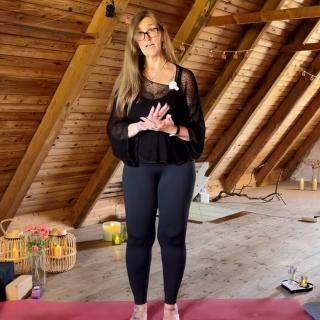
Hi and welcome to this how-to video.
This video series isn't about.
.
.
Making the perfect.
Position.
It's about learning the intention.
Of the pose and then trying to adapt that pose to your body and how your body functions.
And today we're going to look into shavasana.
Shava means corpse and asana,
Pose.
So corpse pose.
And although the name may sound unusual,
The intention isn't about death.
It's about complete rest.
Stillness and letting go of unnecessary effort.
And in today's society,
Many people.
.
.
Rush.
Never let themselves rest.
And I know lots of people that think shavasana isn't important and they skip that.
But shavasana is one of the most important poses in yoga.
We really need that post,
So please don't skip it.
Give it at least five minutes in each practice,
Perhaps even longer if possible.
Because it's in Shavasana the body integrates.
All that it has done and felt during the practice.
So let's see how it goes.
Supposed to be looking and then how we can adapt it to our own bodies depending on our needs.
So first of all,
Of course,
We're going to be on our backs,
Feet in each corner.
So one foot in the right and one in the left.
And then just come back to lie on your back.
Tuck your shoulder blades a bit under you and the chin a little bit towards your chest so that you stretch the skin in your neck you don't want to put your chin up towards the sky and wrinkle the skin in the neck but you don't want to do it too much because we don't want to block.
The airways,
We don't want to stop the free flow of breath.
So shoulder blades a bit under us,
Arms at our sides,
Palms facing upwards.
And if it's comfortable,
Close the eyes.
And if you do have an eye pillow,
Or perhaps a shawl,
You can use that and put it over your eyes to help the nervous system relax.
Most people think that feels really,
Really nice.
You can also take a blanket or something heavy and place over your pelvis area,
Lower belly and pelvis,
Hips,
Because that's also a thing that helps the nervous system to relax.
And then of course there's people,
Me included,
That have problems with their back and can't be on the backs for longer periods of time.
Some people can't for just a short period even.
And then there's options depending on what you have with you and what you can use if you don't have anything you can place your feet more than hip widths apart so either long side of the mat if you have yoga mat and then let the knees meet in the middle then they will support each other and you get release in your lower back.
So this is one option.
If you have a big enough pillow or a bolster You can.
Use that and place it under your knees and that way you ease up the tension in your spine.
Good options,
All of them,
And you find what works for you.
So explore that and see what works for you.
And when we leave shavasana many people just forcefully sit up and that's fine but I prefer to use a kind of softer way to come back up to a seated position and that is to roll over to one side preferably the right side because we have the heart a little bit to the left and if we we roll over to the left we press our hearts together but maybe left isn't an option for you because of what your how your body is feeling then take a Sorry,
The right might not be an option for you.
Then take the left.
So whichever way that works for you.
And then Take a few moments,
Breathe for a while in a fetus-like position.
It's a very kind,
Gentle way to do it.
Softly.
Wake your body after a longer time on your back in rest.
And for some people,
This is a nice symbolic.
Kind of rebirth after corpse pose,
After being or in a very restful state.
So this can be a very soft,
Gentle,
And nice symbolic,
If you like,
To come back up.
To land in before you come back up to your seated position.
And Then you go on with the rest.
So this isn't about.
Finding.
Perfect form.
It's about finding the version of Shavasana that works for you.