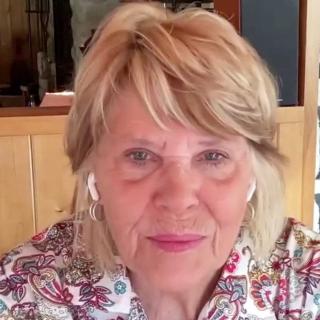
I'm really excited about today with Sally.
But let's start with just slowing things down a little bit.
And coming into the body if that feels safe for you in our gathering.
Just check and see.
It feels okay to slow things down and just notice what's in the room around you.
And then you might want to just soften your gaze.
And slowly bring your attention somewhere down into the center of your body.
Today we're going to explore with Sally Maslensky,
The.
Broad and deep ways that our consciousness protects us.
When really scary things are happening.
So I like to call it dissociative identity adaptation.
And there's lots of different.
Thoughts and ideas about this.
But what I really welcome us to do right now is to just take a moment to Take everything you know and think about multiple personality or dissociative identity.
And all the other ways that we think about.
Mental health.
And just for now put them to the side.
So that we can be in this conversation together.
With what Eugene Jenlin called fresh listening.
Listening freshly.
Being present with another person without all these ideas and concepts and disorders and Just putting them to the side for now so we can be really here.
And really curious.
About the amazing ways that bodies have of keeping us alive.
And you might want to also just take a moment to clear space from whatever else is happening for you that might get in the way of being present here.
With yourself and with all of us together.
Just feeling down into your feet.
Feeling the ground beneath us.
Feeling down into Mother Earth.
And feeling how the earth supports us and holds us up.
And then when you're ready,
You can slowly and gently.
Open your eyes.
Now back to our room.
Yeah so sally so wonderful to to get a chance to really be with you i'm so you now after all of those years of healing with uh dan siegel and his beautiful model of interpersonal neurobiology.
So you then trained?
And now you're a therapist yourself.
I'm a therapist.
I've been a therapist for about 20 years now.
Yeah.
Yeah.
Yeah.
LMFT.
And I live and work in Chapel Hill,
North.
OK,
What do you think of identity disorder used to be called multiple personality disorder?
Yes.
And the name change.
Tell us.
Tell us.
Just give us a little sense of what is that?
What are we talking about?
Right.
So when Dan first diagnosed me very quickly and it was in the first few months of our work together,
He diagnosed me in nineteen when it was still known as multiple personality disorder.
And the only thing I knew about that disorder,
I wasn't a therapist at the time,
Was from the movie Sybil.
And that really didn't resonate with me much.
To me,
That just meant crazy.
And that's the first thing Dan said to me.
He said,
Well,
You're not crazy.
It's not crazy.
It's actually a brilliant adaptation to what you experienced as a child.
So the way I experienced DID,
It was changed in 1994,
I think.
And the way Dan worked with me was that I had many,
Many.
Different states of mind.
And the states of mind aren't,
What he talks about,
Is they're not fixed identities,
They're not nouns,
They're verbs.
Oh,
I like that.
So every state of mind had a purpose,
It was there for a reason,
And it really did protect me in a very specific way.
And all of those states of mind had protective memory barriers,
So they were very isolated from the whole.
There was no whole,
There was just fragments.
And that happened because I had developed very early on in my childhood a disorganized attachment.
And what disorganized attachment is.
.
.
At its core is fear without solution,
A biological paradox.
So when you're a young child,
And I think to get disorganized attachment,
It has to happen within the first seven years of life.
It's because the people that you depend on and your attachment circuitry is telling you to go towards for care and safety and being soothed are also the people that are hurting you and your brainstem is telling you to get away from.
So a child's mind cannot process,
Go towards,
And get away from the same person.
So it fragments and it can lead to dissociative identity disorder.
So I don't,
My experience of DID was never that I had many different fixed identities,
Different personalities that were fully fledged people.
Mine was that all states had a very specific job to do.
And once I was able to become more and more aware of what the jobs were,
And all the other different jobs started to,
The protective memory barrier started to dissolve.
Integration started to unfold in a very natural way so that today I am Sally Mislansky,
I don't dissociate.
I have lots of wisdom from all the things that happened to me and how I was able to protect myself,
But I no longer need separate parts to do anything specific for me.
I'm just one whole integrated human being.
Does that make sense?
Yes,
Yes,
Yes.
And I really like,
We were sharing before we started that I started doing this work actually right when I graduated 45 years ago because I ended up running a group for young women who were incest survivors.
Like yourself.
And so,
Of course,
In a group like that,
You're going to meet people that have dissociated big time,
Right?
Yes.
Yeah.
Yeah.
Thankfully.
Thankfully.
I always say I was really lucky that I dissociated.
I know people that had similar histories of mine that didn't dissociate.
And it's just a really difficult situation.
Yeah.
It's such a gift when there is no safety.
And this is where it really really brings in also very much polyvagal theory and working with the nervous system,
Right?
Yes.
You know,
The way in which these,
All of these things are adaptations.
And when we see it like that,
Yeah,
And we really understand the wisdom of the body.
That's right.
And,
And,
And understand that it's something to be honored and embrace,
Not something to to deny or like we had talked earlier,
I'm hearing people with DID telling me they have therapists that say they can't work with them if they're going to dissociate in session.
It is that the dissociation is.
.
.
Is bad or broken.
Dissociation is the whole point.
That's the way to healing is to embrace it.
Yeah.
Yeah.
Well,
I think it speaks to the paradigm shift,
Right?
I mean,
I really working towards and I like this about Siegel's model,
Too,
That it's very much about depathologizing.
Yes.
Yeah.
And that I think we have to move away from the language of disorder,
Too,
And use the language of adaptation.
All of these things are adaptations.
And there's a bit of a movement within in the DID world to call it dissociative identity response instead of disorder.
So it's similar to adaptation.
Yeah,
I like adaptation better.
I like the way that Dan gave you that in the beginning.
Sadly,
It's a brilliant adaptation.
Yes,
And because of the way he treated me,
Worked with me,
Especially in 1991 when the False Memory Society or Foundation,
Whatever it was called,
Was forming and there was a lot of controversy about memory.
I mean,
I knew about all that,
But the way Dan treated me was just complete and total acceptance,
Embracing.
We're going to do this together.
There's nothing wrong with you.
You're not crazy.
This is I mean,
It was just so for such a difficult period of my life.
It was also one of the most positive things I've ever done in my life.
The work I did with him,
It was it was painful,
Certainly.
But I always knew because he held this sense that We're gonna get through this and you're gonna heal.
Yeah,
He was an incredible father figure,
That reparenting process and really,
Really depathologizing.
Yes.
And that's what I learned back,
You know,
45 years ago from the feminist community.
So it was people like Chris Courtois and Judith Herman and Ellen Bass and Laura Davis that wrote The Courage to Heal,
A brilliant book.
Yes.
Bible for a long time because there weren't that many books back then.
No.
Yeah.
Sandra Butler wrote the first book,
The Conspiracy of Silence.
Yes.
I saw all these all these women came to Toronto.
Wow.
Well,
Yeah,
We had these conferences called No More Secrets.
No More Secrets.
That's isn't that I mean,
I used to say many times I use it in the book.
The truth is your friend and it will set you free.
And it really has and always.
It's really true.
It's so true.
Let's figure out what and because and it was so important and as Dan said it says all the time when we talk Because someone comes in as I did with him not remembering my childhood Doesn't mean something bad happened to you in your childhood.
You know,
There's a big percentage of people that don't remember their childhood.
Yeah but that it's certainly just something to be open to,
And let's see where this is going to take us.
Yeah.
Yeah,
Yeah,
Always.
Excuse me.
Yeah.
And so often,
You know,
We can see the symptoms that come.
And then,
You know,
We start to work with what's under those,
Right?
Yeah.
And I really,
I've been excited by,
You know,
This great thing about in the trauma world is like,
It just keeps evolving.
Yes.
And so it's,
I mean,
I don't work with people that have DID.
When I first became a therapist in my 50s,
I didn't think it was within my scope of practice,
And I was a newbie,
And I just didn't feel like,
And there was still so much stigma around it,
It felt.
.
.
Not right for me,
And it especially felt not right for me to not be able to self-disclose that I had it.
Yeah.
But I've ended up,
I work with quite a few families of people with a family member with it.
I just lost my train of thought.
Oh,
That happens.
Yes.
But I'm also a little foggy from this thing I've been fighting.
But the trauma is everywhere,
You know,
And it's and one of the things I And I don't mean to mean that it's possible,
100 percent possible.
I know not everybody does,
But it is possible to recover.
And I that's all I ever knew from the way Dan Siegel treated me.
Yes.
It never occurred to me that I wasn't going to get better,
Even though sometimes I didn't.
I was afraid I wouldn't.
I was afraid I wouldn't be able to get there because I was so terrified.
But the knowing the nervous system and the and polyvagal and all these things,
It's 100 percent neuroplasticity makes it possible.
Yeah,
And it's such an important message.
And I think it's what's opening up trauma,
Right?
That we it's not a it's not a death sentence.
It's not a you don't have to you don't have to be a prisoner of your past forever.
Yeah.
Yeah.
But it also requires that the people helping are people that are really informed,
And have been on their own somatic journey of healing.
And we can't do this unless we've been there.
We really can't.
At least,
We don't,
Doesn't have to be exactly the same experience,
Right?
But we have to know.
You know,
It's,
You know,
One of the first things Dan told me in our first week or two of therapy,
When we were trying to gather information about my childhood,
And the thing that it sent me to Dan,
Was I was afraid there was something going on with my son.
Who I'd adopted from Romania.
Yeah.
And Dan knew Sam and knew that there was nothing wrong.
I knew Sam was doing very well.
So one of the things he told me early on was from attachment research that the most robust predictor of how a child's going to do in life and how a child's going to grow up to thrive,
Not just survive,
Is the degree to which that child's caregivers have made sense of their own life story.
And at first,
That really panicked me because I thought,
Oh,
My God,
I don't know anything about my story.
I can't remember anything.
What does that mean?
And Dan was like,
Well,
That's kind of the point.
We're going to start to make sense of your story.
And then you're going to be able to help Sam make sense of his,
Because part of my fear was that I wasn't going to be able to help him understand.
Know,
His early beginnings.
He was 18 months old and we brought him home from a Romanian orphanage.
And so I think the same with therapy,
Right?
As a therapist,
If I haven't made sense of my story,
And it's a lifelong process,
You're constantly making sense,
That's going to get in the way of me Helping other people so I have to have a real awareness of this and how it works and do my own work Constantly a hundred percent.
Yeah.
Yeah,
We all do.
Yes.
Well,
Not everybody.
That's like Does but we yeah,
We need to we need to it needs to be part of the training.
Yeah,
Absolutely Yeah,
Absolutely.
It is part of my that's how I teach it So yeah,
We'll go on their own journey and learn the concepts through their own experiencing first.
That's right Yeah,
Beautiful.
But you know,
It's interesting too though,
Sally,
Because then we,
You know,
Part of what we were saying before we started too is that When you.
When you have the experience or you witness the experience of people being behaving in such horrific ways It's just the word evil comes to mind.
And knowing then that that is the range of human experience.
And,
You know,
We're seeing a lot of this in the world today.
Yeah.
And that it's not,
It's not rare.
It's not rare.
No.
Cause we used to way back,
We would talk about traumas if it was one huge experience that was outside of the realm of normal functioning.
And here,
You know,
I'm like working with these groups of women that are being raped by their fathers.
And I'm thinking,
This is not outside the realm of You know,
I just want to mention that Bessel van der Kolk's foreword to Steve Porges' Pauly Vagel thing,
It's one of the greatest things that describes that shift.
And it's just,
I read it to clients all the time because it is about,
It's not just one little thing,
Right?
It's repeated things that we used to just think,
Yeah,
It was like a an earthquake or,
You know,
Some massive assault or something.
Or a war.
Exactly.
Because when you go to war,
Yes,
It's traumatizing,
But you know you're going to a war.
That's right.
That's right.
You didn't know you were living in a war.
And you're an adult.
And you're an adult.
Yeah.
So it's interesting because,
I mean,
These ideas They're not new either.
No.
But we can't seem to kind of forget them and then they resurface again this thing about complex trauma it's like yeah but we were talking about that in the 90s yeah yeah but it's hard for people to take in so you know something you know when i when um my husband when i was married And I was in the thick of all this.
And when I was,
You know,
Beginning to talk about it a little bit more,
Feeling a little bit more comfortable.
My husband Paul would say,
You know,
Sally,
Nothing clears.
And he said in a very loving and he was a very funny man way.
He said,
Nothing clears a room faster than when you start talking about your childhood sexual abuse.
Right.
And he's so true.
But what I when I think about it,
You know,
When I say to people,
Even people I know well,
That I was sexually abused by both my parents,
My mother and my father.
You almost always see someone start to dissociate a little in the group,
Right?
And it's because it's almost impossible to take in.
It's too much.
It's too much,
But it shouldn't be because look how prevalent it is and how long it's been prevalent.
That's one of the things I'm hoping to change too,
That this happened to me,
My family wasn't.
My family was prominent,
You know,
I mean,
It just.
It they didn't look weird they didn't look weird they know they were they were big part of the community and yeah they didn't have horns no one would have ever guessed yeah and and no one until i started having the symptoms that i had after we adopted our son none of my friends my husband i didn't know that i just knew i i knew i had I knew I was confused a lot.
I knew there was something about myself I didn't understand.
There were struggles I had like that,
But I had no idea that I had this thing called multiple personality disorder,
Because the only thing I knew about it was Sybil,
And that wasn't what my experience was.
Yeah,
Yeah,
Yeah.
Yeah,
It sounds like your experience,
It didn't look dramatic on the outside.
No,
It was inside,
Deeply internal.
Yeah,
Although it can,
I certainly worked with people where I never knew what part was showing up.
Well,
And once I got into therapy,
I mean,
When Dan talks about his experience with me,
It's very different because it was very external for him.
But,
You know,
I once I got safe in his office and could I mean,
And I realized that the different states really got me to him.
And,
You know,
Then I could just all let loose and come free and and and and and start to come together.
Really,
I he I used to always be afraid I was having a nervous breakdown.
And he would always say,
Oh,
No,
I think it's actually a nervous breakthrough.
Yes.
Yeah.
And it was constantly that positive reframe.
Yeah,
Exactly.
And when you understand how.
The body works.
That's not an effort.
It's like,
Yes,
This is how it is.
Our culture has done an enormous disservice.
I mean,
It's just horrible,
This top-down,
Always,
Always just top-down.
I mean,
Top-down's great,
But not without bottom-up.
And also not believing clients,
You know,
And just because the client says,
I might have been abused,
It might not be accurate,
But that's really not the point of therapy.
It's not,
It's not a courtroom.
It's really,
Let's explore what's going on here.
Yeah,
The implicit world.
Yes,
Yeah.
Yeah,
What makes you say that?
What's going on for you?
And then going with that rather than getting stuck in,
Are you,
Aren't you?
Because often we don't even know,
Really.
Explaining,
I think it was in one of the first or second or third sessions,
Because I presented,
I came to Dan because I was having intense feeling of terror.
And it made no sense in my life.
There was nothing terrorizing in my life.
And when he explained to me about implicit memory,
And this is why psychoeducation is so important,
And I teach this to almost every client pretty quickly,
Because it applies in so many ways,
Not just traumatic ways,
When he explained that probably what I was experiencing sounded like an implicit memory,
And an implicit memory,
I think of it as memories of feelings,
Are feelings,
Sensations,
Feelings,
Mental models,
Priming,
That are 100% in conscious awareness,
But that they're from your past are not in conscious awareness.
I mean,
It's definitely the building block of a flashback.
And once I started to realize,
Oh,
This feeling of terror and some of the physical sensations I had of sexually being attacked.
Which made me think I was crazy.
These are I don't remember my childhood.
This is the memory of my childhood.
We're truly.
Yeah.
Yeah.
Yeah.
And it made it was such a huge early turning point before I even know what I had.
Yeah.
Yeah.
We call those body memories.
Yes.
Yeah.
Yeah.
Yeah.
Yeah.
And,
You know,
We had these beautiful language that that the feminist therapist community created.
So what we call flashbacks are these kind of body memories was that they were fresh frozen.
Right.
Yes.
Such focusing.
It's such felt sense language,
Right?
It's what comes right from the body,
From the right atmosphere.
So they're fresh like it's happening right now.
Yeah.
They're frozen.
And then boom.
Yes.
Yeah.
These neural networks.
And it's so important for a therapist to be to embrace them,
You know,
And bring them into the world.
Yeah.
Not be afraid of them.
Yeah.
Yeah.
Because there's a lot.
That can be really scary when you're working with DID,
Right?
Yes.
Yes.
Well,
It was something I realized,
Too,
Was I don't think there was a state of mind once I became aware of them,
That I fought them coming forward.
I didn't want any state of mind because I was terrified for many different reasons for all of them.
And Dan was incredibly patient and supportive and finally one would show up.
And what I realized pretty quickly as the person having it,
Was that they were children.
So they were really angry children.
But they weren't evil adults.
And it was a really important distinction.
So I stopped being so much afraid.
I was still tentative,
But I knew I wasn't in danger.
I knew it might be scary,
But not dangerous.
And it was a really important,
Again,
Turning point in my work.
Yeah,
Yeah,
Very important to not be afraid of parts of you.
Yeah,
That we're children,
That we're born as children.
Yeah,
Yeah.
And one of the things that Dan did that was so helpful and I use a lot was when I'd be really terrified and something would come up.
And he would say,
You know,
I want you to go home tonight and look at Sam,
My son,
Who was like little.
And you know,
Just look at him because that's how little you were when this was happening to you.
You weren't grown up Sally,
Tall,
Big as you are now.
You were little,
Little,
Little.
And it really forget that you know you forget that you were a little teeny kid yeah yeah yeah helpless yeah and so often you know the way that the memory surfaced for you it happens where you know it's the child when we have a child yes yes that's what brought it all very often yeah and then for you that you had you had actively chosen a child that had been abandoned yeah and rescued you know i mean we flew to romania i mean talk about like I had quite a fantasy life as a kid of wanting to be rescued in a different way than I rescued Sam.
But,
You know,
Of course,
I didn't know that until I got into therapy and it all unfolded.
And again,
I think it's really important to share.
It was an unfolding and again,
Terrifying,
Extremely difficult.
There was nothing about it that was easy.
But when I look back on that process now,
It's one of the things that most value in my life.
Because to actually learn from the inside out how it all worked was an incredible gift.
Yeah,
And when you in so many ways,
Right?
Yes.
So then you took that.
And as often,
You know,
We do,
You took that experience.
And now you're able to help other people with gas.
And that's,
I think,
You know,
Huge meaning making,
Right?
Because it shatters that sense of meaning making.
Yes,
This happens.
It's like,
How?
Yeah.
So there's so many things I want to say.
But the one,
Before we go to our audience,
I want to also really highlight something we touched on before we were on air too,
That the way that Dan was with you.
In terms of the boundaries that he created to hold you.
Is the way that we worked as feminist therapists.
It's the way I've always worked.
It's the way that I was treated by four different therapists who really helped me.
And those boundaries are different and sometimes even violate our colleges.
Yeah.
Boundaries around touch.
Boundaries around contact.
So one of the things you talked about in the book was how he said,
You know,
You can call me anytime.
I mean,
We're not supposed to say that.
And yet these kinds of boundaries are,
They're not,
They're absolutely essential with certain clients in certain situations.
And,
You know,
Marsha Linehan saw that,
Right?
In DBT,
She said,
You can't be treating somebody once a week.
Are you kidding?
And,
You know,
And so so imagine me so up for 10 years,
I'm working from like about the age of 37 to 47.
I'm working with Dan Siegel.
And then I go to school.
And I loved my master's program.
But I didn't learn one thing about the brain or the mind.
I mean,
It was there's so much that was just archaic about the way they taught.
And then when I got into my training,
Of course,
The first thing is blank face.
You can't,
You know,
No outside contact.
And it was just completely against what I knew had worked for me.
And I'm so glad I had it with Dan.
Yeah.
And so what he would do with me is I would be so I could call him anytime.
And if I needed him to call me back.
Back then is when we had,
Um,
You know,
Uh,
Voice machines,
I would ask,
I would either say,
I need you to call me back.
And he would call me back when he could,
If it was urgent,
He would call me back very quickly.
But I would usually say,
It's not necessary to call me right back.
Just when you have a minute,
Or I would sometimes just call and let him know what was going on.
You don't need to call me back.
And sometimes I wouldn't even leave a message.
I just needed to hear his voice.
Yeah.
That's what we did.
Yeah.
And none of it was weird or,
Or,
Or irritating.
Yeah.
It was incredible.
And it was a huge part of my recovery.
Yeah.
We bodies need that.
We need that to know that person is there and there and that they're a real person.
Yes.
You know that you could see that how you were impacted.
That's right.
Yes,
That we are real to them.
Dan always says that I changed him as much as he changed me.
Yeah.
Well,
The whole psychiatric training and he writes about that so beautifully how it just takes it out of you.
Of you and I know my husband is trained as a psychiatrist too and would say the same thing.
It's like you're supposed to just hold that all back and yet that is the food.
And that no one talks about,
I mean,
Dan used to talk about in big conferences,
How many people in the audience have had a formal training in their formal training as therapists on the mind.
No one.
And his wife,
Who's an attorney,
Which he said would say to him,
That's sort of like me saying I went to law school and never had a course in the law.
Yeah.
Yeah.
Well,
There's lots of work to do.
Lots of work to do.
Yes,
And I'm so glad we're doing it.
Yes,
It's good.
I'm glad we're doing it too.