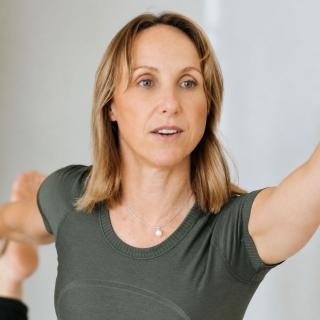
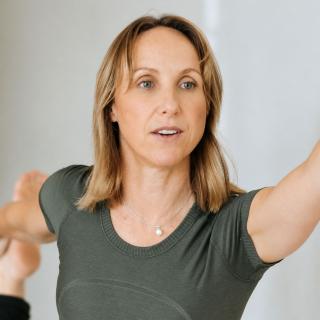
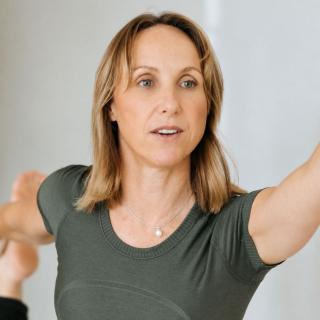
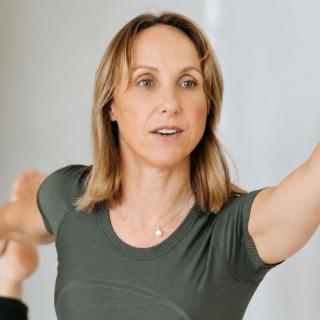
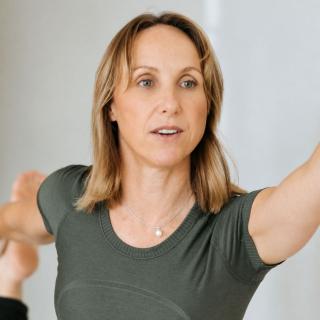
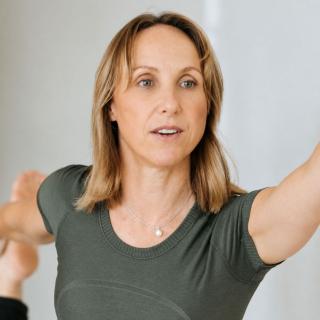
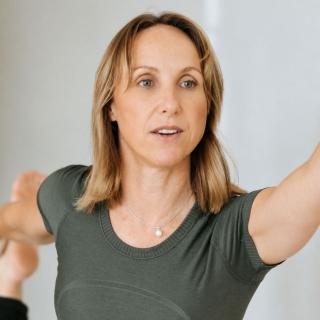
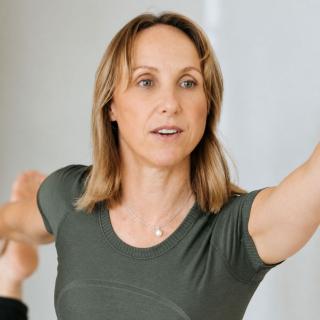
This first one's for a little bit of all over strength.
In your shoulders,
Chest,
Your abs.
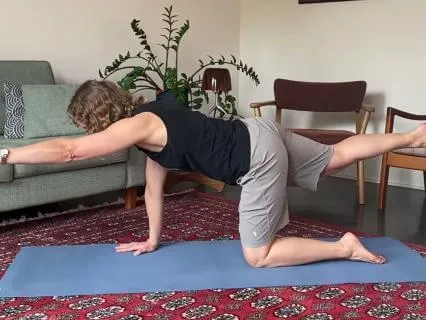
And your lower back and the glutes so it's a bit of all over so first thing brace through your core like somebody's about to punch you in your belly so the muscles when you cough those muscles when you brace when you make that sound Those muscles,
That's all connected.
Also lift through your pelvic floor.
Everything stable,
Try not to move your head or your torso,
Just your opposite arm to leg,
Reach.
And then back to all fours.
The lowering down,
So it's the lifting up.
And the lowering down is also core.
So this is a gold core all over exercise.
That will particularly help.
Your lower back,
But it's also a little bit of weight in your wrist.
Shoulder stability.
And a bit of glutes.
And to help your lower back,
Keep those muscles.
So squeezing in your belly button,
Squeezing in your lower front ribs.
Trying to hold your head quite neutral.
So I do see a lot of my students their heads here or the heads here.
If you want to make it safer.
And.
.
.
More stable,
Keep your head steady.
So if you move your head around.
It's okay and you get to extension,
It's not as safe.
The one I'm doing there,
See I'm extending my neck,
Extending my lumbar.
So that is not as safe,
It's okay for me.
But for a lot of people,
Keep it neutral,
Keep your spa neutral.
And if you find It's just too easy.
What you can do is you do a wide-legged plank,
Bring your hand in a little bit,
And you try.
That you do progress to that and it takes a while.
You've got to build up to that one and you start off with a split second and you build up to it.
A little bit longer.
Slow it down,
So that would be.
A little bit harder,
Wide-legged plank.
But start off this one,
Really.
This is just so good,
It's called Bird Dog.
Such a good one to do.
So the next one.
Which is a great everyday exercise,
Especially if you do get back pain.
Keeping everything stable is side plank.
So you build up to the full side plank that I'm doing here.
You start with the bent knees and then you build up to the top foot in front and then you build up to feet are stacked.
And in this one,
Make sure you're not like that.
So you're not jamming your neck.
So technique is important.
Shoulders down,
Hold the length through your neck.
So it's as much about core,
Your waist here,
Your adductors,
Your glutes here,
Your shoulder here,
But it's also actually the left side of the neck.
So having a strong neck is very important.
And most people in the older do not have such a strong anywhere,
Especially their neck.
So you hold 10,
20,
30 seconds,
And then you go to the other side.
So be careful in the transition.
If you're not used to it,
You might go more slowly than I did.
So it's your shoulders transitioning.
So you hold 10,
20,
30 seconds just to feel your muscles.
Feeling our deep muscles.
Holding,
Have someone check your alignment that you're not here and your top hip is not rolled back.
And I like to do.
A couple on each side.
We'll do three on each side.
I also like to add in some Sometimes I do some shoulder mobility,
Sometimes I just hold my hand on my hip.
You can also have that hand down.
Sometimes I like to do.
.
.
A bit of.
Blood flow simulation.
I'm working my hands at the same time.
A few little dips.
There's lots of options in the pose.
Lift the top leg.
There's lots of ways you can make it harder.
Two.
Sometimes if I just do one on each side I'll make it harder so I'll sort of do that.
But if I'm doing three on each side,
I might just make it a bit easier.
So sometimes you just want to get the job done quickly and just go straight to harder,
But you've got to build up to that because some of you are still here.
Make a start,
Your body adapts quickly.
Quite quickly your body will get stronger and what a great thing when you're older to get stronger,
You can get stronger at any age.
And strength is going to help you in your life.
Confidence.
Stability,
Blood flow,
Blood sugar regulation,
Circulation of the brain,
Bone density,
Looking better,
Looking younger,
Having good muscles.
Connected to health and longevity,
Health-gevity.
So that's the great one.
Okay,
And then we'll do this one.
You keep your hips level,
Squeeze your belly,
And see how I'm making a really small start,
And that is where you start.
You keep your pubic bone pushing down,
Your hip bones level,
So your posterior tilt your pelvis,
You keep the length through your lower back.
So you don't do that.
You do not do that.
It's not about lifting your leg up higher.
It's about feeling the muscles in the back of your body.
And when you get a bit stronger,
You can progress to elbows in back pockets,
So squeezing in shoulder blades.
And then when you get really strong you progress to reach,
Reach,
Pull.
Straight legs,
Bent legs.
And even harder is touch,
Reach.
Touch the calf,
Reach.
Touch the calf.
But that's not safe for your lower back unless you've done a lot of yoga and you're ready.
You're more flexible in the front of the body and you're stronger in the back of the body.
So you've got to build up to that.
Cool.
This is a great one that involves a bit of coordination.
So starting off like this,
I'm going to call that the center.
So look at the center.
And then look at me first.
I'm going to move opposite arm to foot.
Away.
Holding the other two steady in the centre,
Not moving the other two arm to foot.
Who's called Dead Bug in the fitness industry.
And so I find with my older students.
Even if they've got the good strength,
The good core,
It's the coordination of not moving.
The brain connection.
Not moving.
The.
.
.
Arm and leg that's totally in the center.
And so if you want to make it easier don't reach as far Because as your leg moves away from you,
It's harder.
Your core needs to work harder to stabilise eccentrically.
Don't let your back arch,
Keep the abs on to help the lower back here.
So that is a fantastic core strength exercise.
And then when you get really strong,
You can do It's not going to challenge your brain,
But both legs reaching away.
Some people say that's not safe for your lower back.
I say if you build up to it and you've got the strong muscles,
Perfectly safe.
But if you rush into it,
Especially long legs,
You could strain the ligaments in your lower back or even worse,
The discs.
So stick with this for as long as you like.
And when you feel,
Oh,
I'm going to try a harder one,
And then the harder.
If I was going to go straight to the hardest,
I'll just hold.
I'll just do this for 20 seconds.
It's very strong.
The eccentric contraction.
Your muscles work harder when they're lengthened.
And what's missing from a lot of core strength exercise videos and classes,
Pilates,
Yoga,
Any classes,
Is just pelvic floors on their own.
So you start off,
We'll quickly go through that,
Progressive pelvic floors.
Or should I make a separate video?
No,
I'll do a quick bit on the core because the pelvic floor are connected to the core.
They're the foundation of the core.
So just squeeze up your pelvic floors,
Let go.
So squeeze up there,
Trying to stop urination.
Lift all those muscles side to side,
Front to back.
Let go.
And then your progress too.
That's the easiest one,
Really.
Then you progress too.
See if you can sit and squeeze up here eight floors and let go.
Okay,
Have you got the awareness that you can lift or contract and let go?
Lift through your pelvic floor,
Let go through your pelvic floor,
Your muscles in your pelvic floor.
And then can you do it standing with your legs out wide?
Can you do it with your legs bent and out wide?
And can you do it?
This is the ultimate test of pelvic floor strength.
Big glass of water,
Wait a few minutes,
Jump out,
Legs out wide,
Cough.
And your pelvic floor can handle that.
Then you know they're pretty good.
So just awareness there and try to exercise those muscles regularly,
Like any muscles.
They're important.
They're very important.
You don't want to be weighing your pants or even worse,
When you're older.
It's very common.
People don't talk about it.