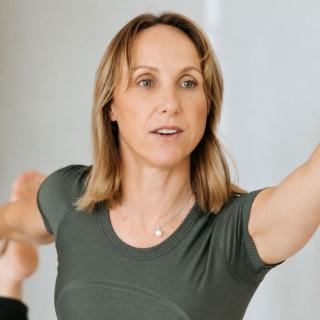
Starting off,
Turning your feet.
Knees and thigh bones externally.
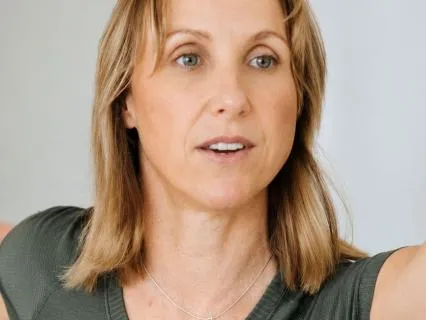
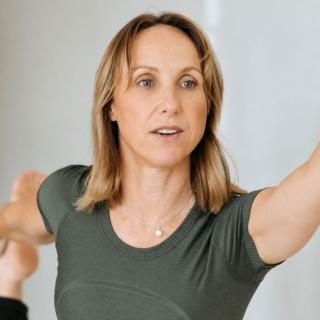
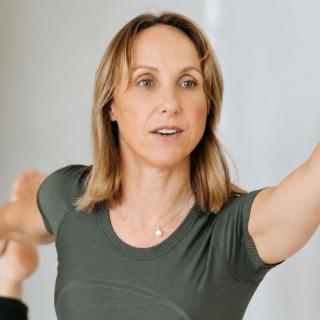
So turn your feet out like a ballerina and then bring your arms into external rotation.
So try to turn your upper arm bones externally in the shoulder socket.
Squeeze your knees and elbows straight.
Lift your chest.
Put a little muscle into it,
So grip into your thighs,
Your glutes.
And really try to use your biceps and your triceps actually as well to externally rotate.
And then go into internal rotation in your shoulders.
And then go into pigeon toes,
So internally rotate.
Your thigh bones,
Try to squeeze.
Muscles in your thighs and turn your,
As though you're trying to make your thigh bones turn inwards in the hip socket.
And I'm gonna keep the thighs turning in.
And then turn your shoulders out.
And then we'll do opposite.
So a bit of coordination,
Inhale.
Exhale.
Feet turning out,
Shoulders turning in.
Have a quick look at your feet.
Inhale,
Hold.
Excess swap opposites.
Thighs turning in,
Shoulders turning out.
Inhale,
Hold.
Excess swap.
So if you're new to this it's quite hard to coordinate.
That good try hard things.
Focused mind.
Swapping.
So what we're doing is we're lubricating into the hips and shoulder sockets and working on strength and mobility as well for internal and external rotation.
Last one,
Shoulders turning in.
Thighs turning out.
And then thighs turning in,
Shoulders turning out.
You can really put some muscle into it.
And actually warm up.
Back to neutral.
Feet parallel,
Knees facing straight ahead.
Lift through your chest.
Don't be like this when you're older.
No,
That's speeding up aging.
We want to slow it down,
Slowing down degenerative changes in our spine.
Elbows in back pockets,
Squeeze in your shoulder blades,
And then heels up,
Strengthen your calf muscles.
And then bend your knees,
Push the palms of the hands together.
Keeping the lift through your chest.
So don't go into a rounded spine.
Adding on inhale,
Elbows and back pockets to heel raise.
Weight into the base of the big toes,
Don't let your ankles splay out.
Exhale,
Bench knees.
If your knees pull in,
Try to not let them do that too much.
If you feel pain.
Your knees don't bend your knees as much just do a little bend but maybe you can do a deeper bend just go to your own edge with everything And this is pumping blood and it's strengthening and lengthening your calves,
Your ankles.
Very important to work on both.
So if you get stiffer,
You're not going to be as mobile.
And if you get weaker,
You're not going to be as strong and mobile.
We want to have a strong free walk into old age.
So this is a particularly good one.
And keeping your calf muscles strong.
But also flexible.
Also working on postural muscles.
When we put our elbows in our back pockets,
We're really preventing routed,
Shorter posture.
Last one.
Working on spine and mobility,
Reach one arm up,
Reach the other arm up,
Pushing your hips off center.
And not letting those natural,
Sorry,
Not letting those lateral muscles.
Get tight because then your shoulders your side ribs,
Your breathing,
And your waist,
And your whole spine will get tighter if you get stiffer up your sides.
Don't get stiffer because then your breath gets stiffer.
And then your oxygenation to all your trillions of cells slows down and then aging starts.
Biological or cellular aging is speeding up.
And we want to slow it down,
So keep your spine free.
Spinal flexion and extension like a standing cat cow.
If you're a beginner.
Don't worry if you don't take in all the information.
Just move your body in a different way and you'll feel so good.
Don't worry if you're not doing it perfectly.
Moving in a different way is very good for you.
Just go slowly.
Maybe watch this.
And just do what you can.
But eventually you're going to take in all the information.
Especially if you're doing all my videos,
You'll be learning so much and you'll see the same moves happening all the time that you'll get to know it inside out.
Next one,
Spinal rotation with hip flexion.
So working on strength up the front of the hip,
So you can walk up steep hills when you're older,
And steep stairs,
Not losing those muscles.
Also working on loosening our spine,
Nice rotation through our spine,
Very,
Very important for moving freely,
Breathing freely.
Keeping the spine young,
Keeping the body younger,
Slowing down aging.
Can't stop it.
That we can slow it down.
And have a younger body.
Than the average person our age.
I'm going for 15 years younger,
That's quite ambitious.
If I get 10,
I'll be happy with that though.
If I'm 90 going on 80 one day,
I'll be quite happy with that.
Okay everybody.
We're going to do spinal rolls.
If you know Pilates,
You'll know these.
So if you don't know Pilates,
Have a quick look at what it looks like.
Voodoo Bray by Voodoo Bray.
Vertebrae by vertebrae.
So you're trying to go lift out of the lower spine and take your head forward and then try to feel your spine releasing.
Joint by joint and just just make it feel good.
Feel like you're releasing the muscles up the back of the spine.
Don't go onto your hamstrings,
Bend your knees a bit.
Just have your arms quite relaxed.
One more.
You can go off centre and you can target one side of the spine a bit more.
Keep your core gently on.
Really good.
We're going to work on lunges,
Which is really,
Really important to not let the hip flexors get tight.
So just go from behind.
Inhale.
Exhale,
Step your left leg back,
Left arm up.
Inhale.
Exhale,
Right leg back,
Right arm up.
Find your rhythm.
Keep looking straight ahead.
Horizontal gaze.
Try not to look at the floor.
And this is working on a little bit strength,
A little bit flexibility,
A little bit coordination.
And a little bit balance and also a little bit cardiovascular fitness.
That's a really good one.
Easier is just a little step back.
Don't go right down like I'm going now,
Lightly touching the knee to the floor.
That's a little bit harder.
We'll do one more each side.
Great work.
Find a wall or a window ledge or the kitchen bench put your hands like this lengthening out reaching the crown of the head and tailbone opposite directions.
A lot of you will know this one inside out because I do it all the time in a lot of my videos.
Spread your toes.
Try to breathe in and out through the nose as steadily as you can.
Make it feel really good.
Really good.
Okay,
We're going to work on very,
Very,
Very important muscles to keep strong.
Our abductors,
These muscles here,
The glutes,
Hip stability,
Balance,
Spine density.
In this area.
So important for.
.
.
Us older people to keep these muscles strong.
So find a spot on the wall and be about your right arm about a foot away from the wall.
You can go a bit closer is easier,
A bit further away is harder.
And then we're just going to bring our left leg up.
And just abduct.
Through that left leg.
So lift and lower.
Try to keep your spotty side on so you're not going like this and you're not going arching into it so it's just straight and you're trying to feel the outer hip muscles actually try to get the top hip forward So try not to let the top hip roll back and the foot turn out.
You're also weight bearing into the standing leg,
The right leg.
Abductors are working hard here too.
And then lift it and hold it and now open your wings and try to take the hand off the wall 10,
9,
8,
7,
6,
5,
4,
3,
2,
1 Hope you got a bit wobbly because that's your muscles working harder.
Turn your body around to face a different direction.
Don't be too close,
Don't make it too easy.
And then bring the right hand on the hip.
Straight to the side.
You can make it easier to go a bit closer.
You can make it easy on your standing leg if you go closer,
If it feels too strong.
Make sure your head's not forward.
Make sure your shoulders are down.
And make sure the top hip is forward,
So you're not letting the top hip roll back and the knee turn out.
Trying to really feel those outer hip muscles doing the right thing by your future body.
Your future hips.
Make it quite hard,
Feeling those muscles.
And then lift and hold and try to open your wings,
Take the hand off the wall and balance.
Take it to your edge,
Don't play it too safe.
Recover,
Stabilize.
Eight,
Seven,
Six,
Five,
Four,
Three,
Two,
One.
One,
Really good.
At the wall,
Go back to quickly look at me,
So like that,
Exhale,
And then like that,
Look up,
Turn,
Look,
So arching a spine,
Inhale,
Sort of like a cat up dog down dog.
With your hands on the wall.
So inhale,
Look up,
Feel the stretch through the front.
Exhale,
Lengthening your lower back.
Look at your feet.
Lengthening your belly.
Try and look at the ceiling behind your head.
A couple more,
Make it feel really good.
Not letting our spine get stiff.
Really getting blood flow to the brain as well,
Stimulating lymph,
Gut,
Blood flow,
Nothing getting stagnant,
Hydrating the discs.
One more balanced pose.
Stay near the wall if you need.
Reaching up,
Inhale.
Hugging in the left knee,
Exhale.
Rotate the ankle one way.
Rotate the ankle the other way.
Hug the knee in a bit closer.
And then fade down,
Reach up,
Inhale.
Exhaling,
Hugging your right knee in.
One hand on the wall is fine.
Put a hand behind your knee is fine.
Do what you can,
Rotate your ankle one way,
Rotate your ankle the other way.
If everything's hard,
Good.
Do challenging things.
Keep it up.
You get more benefit.
If you do hard things,
You push your body.
We're going to go down to the floor now and do a bit of work on core strength.
Using body weight,
Keeping everything strong and then a little stretch and relax at the end.
A bit of a reward after working quite hard.
Coming down to the floor,
Inhale reaching up.
Exhale,
Stretch forward.
Just take a few breaths.
Some of you might go,
That's perfect for your body.
Some people stretch a bit further forward.
Just to your own edge,
Not overstretching.
One more breath.
And stepping to your downward dog pose.
I need my yoga mat for that.
It's good to have a sticky yoga match.
Because then.
.
.
You get a good bit of grip.
Downward dog pose like this and with heel pumps.
Heels up,
Heels down,
Really pumping blood flow to the brain.
The brain needs so much of your blood oxygen level.
Your brain is 2% of your body weight,
But it needs 20% of your oxygen.
So especially as we get older,
Because the vertebral arteries,
The channels are narrowing.
And so we need to give.
I'll body all the hilt.
Our heart.
Our cardiovascular system,
Our brain.
Through movements,
Especially the calf muscles contracting and lengthening and we're upside down.
Good,
Into a bit of strength work.
Quickly look at what I'm doing here first.
Have a quick look.
See my right,
I'm on my left side and opening out the right Clam,
That's called clam.
And then internally rotate.
So work on hip mobility here,
External.
And internal.
A little bit of weight bearing on the left shoulder.
To make this one easier,
Lie down on your left side.
To make it harder.
Come up into your side plank.
So you're working left hip.
Strength,
Right hip strength and mobility.
Left shoulder strength,
Left waist strength.
And right side of the neck.
Make sure that top hip does not come back.
Keep the hips quite squared up to the front of you.
Try to keep your head held up,
So the length through your neck and the shoulders down.
If you feel like you've had enough,
Come back down,
Have a little rest.
Some of you can do a bit more.
And then those of you that are advanced.
Then finish on half.
Hold the side plank.
If you're having a rest,
Maybe try bent knee side plank,
Even for 10 seconds,
Make a small start.
But some of you are ready for the full.
And a really hard one here.
Is that one.
But most of my students Ah,
Doing the bent knee one actually.
10,
9,
8,
7,
6,
5,
4,
For keeping the lift too.
One,
Well done.
Be on your right elbow down.
And then don't let the left hip roll back.
Keep the left hip forward.
And we're trying to work on strength.
And mobility.
For internal and external rotation in the left hip.
So if you want,
You can lie down and that makes it a bit easier.
Maybe pull a pillow under your head if you need,
If your shoulder is a bit stiff.
Or you can lie on your arm if you're flexible.
Try to do as much as you can without aggravating or overstretching.
This is harder so you're Make sure you're keeping that lift,
Not like this.
Shoulders down.
Working on deep strength,
Deep mobility,
Core strength,
Hip strength,
Neck strength,
Shoulder stability.
So you might have a little rest.
And then try to just hold the bent knee side plank,
Even for just a 10 second start.
Or even five.
The hard one.
That's not for most people,
But some of you will be able to do that,
And the really hard one is that.
10 more counts.
Keeping everything lifted.
Deep strength,
Five.
For two one well done so if you don't work on strength you will lose strength as you get older and that means your your energy your resting metabolism,
Your general energy.
For life.
And also your resting metabolism,
Your ability to deal with blood sugars from the foods you eat,
You're just speeding up aging.
If you don't work on strength,
You will lose strength and then age will be accelerating.
So if we stay strong,
We're staying healthy,
Basically.
Easier is push-ups.
Little push-ups.
Some of you that's a good start.
For the rest for shoulders,
For chest muscles.
Some of you can do a bit more.
So the plank with a few push-ups.
Can you do a half?
What can you do?
Can you do one half push-up,
One full half push-up?
What can you do?
You reach a point where you reach your itch.
Just do what you can.
You showed us what.
.
.
Tell you when you've done enough.
Even just holding the plank.
Is a good start.
Make sure someone checks that you're not doing that and you're not doing that.
So you've got that straight line through your body.
Elbow planks great too,
Like this.
Really important.
I'm not going to the gym.
I've never been to the gym in my life.
So I'm using my.
.
.
Body weight which is you can make it really strong.
Your body can be a gym.
Nine,
Maybe a few more push-ups if you're still not fatiguing.
Eight.
Seven.
Five.
Give your shoulders a quick little stretch.
You just have to take it to your edge.
It doesn't need to be.
.
.
Anything as much as I'm doing.
Just a little bit of strength for our lower back here.
Inhale,
Exhale,
Lift one leg up.
Inhale,
Exhale,
Lift your other leg up.
Keep your hip bones level.
Squeeze your belly.
Push your pubic bone down.
To lengthen and strengthen your lower back.
Squeeze your glutes.
Feel a few little muscles in your lower back.
Keeping them strong,
Not getting rounded as well as we get older.
Now try a little bit to hold your elbows in your back pockets.
And then try reaching out forward.
Try to get your head lower and your arms higher.
That's much stronger.
When you feel like that's enough of your back,
Put your hands back down.
10,
Nein.
Eight,
Seven,
Six,
Now finish reaching your arms back,
Try and touch your little toes,
Five,
For One,
Well done.
Coming to kneeling.
And stretch forward giving your lower back a release If you can't kneel,
Just lie on your back,
Hug your knees in will be easier on your knees or your ankles.
Okay,
Lying on your back and a little bit of abdominal core and some hip mobility.
So quickly look at me because we're going to do shoulders and hips mobility.
Quickly look at me for the shoulders.
So we're going to be doing Shoulders turning out,
Shoulders turning in with the elbows bent and try to keep your elbows up high,
But we're doing that on the floor.
And then have a look first because most people don't.
Just do not do this very well.
I need to work on people in my yoga class.
So we're going to go.
Shoulders turning out,
Hips turning out.
So see how the soles of the feet together and then shoulders turning in,
Thighs turning in,
And then we're going to do opposites.
I'll just say.
There you go.
So first put your arms up and your shoulders turning out.
And then put your feet up and your thighs turning out,
So soles of the feet together.
Inhale.
Exhale,
Swap.
So same,
Same.
Thighs internally rotating,
Shoulders internally rotating.
Inhale.
Excess swap.
Turning out.
Inhale.
Exhale,
Swap,
Turning in.
Now keep the thighs turning in,
Turn the shoulders out.
Now we're going to make your head have to focus a bit more.
Inhale,
Exhale,
Swap.
So it's opposite.
Keep your feet up.
Inhale,
Exhale,
Keep your thighs vertical,
Your shins horizontal.
Inhale,
Try to keep the right angle,
Elbows up.
Keep the sharp right angle with the elbow joint.
If you're confused,
Don't worry.
Lots of people get confused with this,
But eventually they get it and it's so good for you.
Two more.
Strengthening and loosening and focusing our mind.
And then hug your knees in,
Relax.
So the next one easier looks like this.
Open,
Cross,
Open.
And harder is like this with your feet closer to the floor and you go legs a bit wider.
So feeling your abdominals,
Your thighs,
You're working on inner thigh strength and flexibility.
Squeeze your inner thighs,
Lengthen and strengthen.
Contract,
Lengthen and strengthen,
Eccentric,
Concentric,
Isometric.
And if your head's up,
It's a bit harder,
More upper abdominals.
And your lower abdominals as well.
Should be quite hard work this one.
Let's do 10 more counts.
So make it quite hard.
Feet a bit closer.
Don't hunch your head,
Elbows back.
5,
Four,
Three,
One,
Hold your legs out wide,
Five.
For One,
Hold your feet together,
Feet close to the floor.
Five.
Once.
You should have felt some deep muscles then if you took it to your edge.
Relaxing,
A few stretches and relax.
You have earned your little stretch and relax today.
Allow a good feeling,
Have your effort,
And you really can.
Relax deeply now and enjoy the stretch.
Hugging your knees in,
One then the other.
One more nice deep breath in,
Hugging your knees into your chest.
And then right abductor stretch.
Quick look if you don't know what I'm talking about.
Like that.
A little rock.
We've strengthened all the right areas today,
Calf muscles,
Back muscles,
Hip muscles,
And core muscles.
Final exhalation here,
A bit more stretch.
No force Straighten out,
Spread fingers and toes,
Squeeze up vigorously above your knees.
Stabilise and work on knee extension or straightening your knees.
Very,
Very important for walking freely.
And then left abductor stretch.
I like to rock a little bit for this.
Trying to stretch your outer hip,
Your abductors that we've worked on,
We strengthen into them.
One more deep breath.
Great work.
Straighten out,
Spread fingers and toes,
Squeeze your knees straight.
Grip tight.
And then curl your toes,
Make a fist.
Spread fingers and toes,
Stretch.
Contract.
Stretch.
Contract one more,
Really stimulating blood flow in a nice gentle way,
But also powerful way.
Okay,
We're going to roll onto our belly.
I'm just having my back to you.
You're going to have to look at this.
It's so good for your back.
Just the best physio release.
So just quickly look,
Come into Sphinx like that first.
Try to face towards the screen so you can.
See what's happening here.
It's a bit of coordination.
Some people find it quite harsh.
To do.
You know the stretch you're about to do,
But we're coming into it from a different way.
Usually we line up back.
Just have a quick look.
Push that.
Right arm under.
And then try to with the right hand grab the left knee Bring the left knee over to the right and then look and turn your body to the left.
So you're trying to get your left shoulder down and your left knee down and your left ear down at the same time.
Just do your best.
Final exhalation.
Roll back onto your belly into sphinx.
Take a breath here.
It's just the best exercise.
And I'm going to push the left hand under.
Turn onto your back and then try to,
With the left hand,
You need a bit of room around you,
Especially if you're long.
I'm just locked into the corner of my bedroom.
A little quiet space to record.
For the videos.
Although the kids have left home,
So it's not too noisy here anymore.
Try and get the right knee down.
Right shoulder down and right ear down,
No force.
Roll that onto your belly.
And you'll feel like you've gone further into your sphinx.
And if you feel like you need more,
You can go into your cobra.
Let's do it once more.
Push the right hand under.
Try and get the left shoulder down.
One more breath.
Onto your belly.
Push the left hand under.
Try to get the right shoulder down.
Final exhalation.
Back onto your bellies,
Sphinx or Cobra.
Sorry,
I have my front to you for that.
Okay,
Good.
Kneeling stretch forward or traditional child's pose with your arms beside you.
Like giving yourself a hug very calming effect.
One more breath.
And then grab a pillow or a block or a bolster.
And put your legs up the wall.
So most of you are familiar with this.
But if you're not,
Have a quick look.
I've got a couple of pillows here.
That's a memory foam pillow and a normal pillow.
Or if you've got a yoga bolster.
And it's really nice.
So prop your hips up a little bit.
What you need is a block.
That's very relaxing and really good for circulation,
Blood flow to the brain.
Venus,
Return.
So it can get a bit blocked in the valves of the veins.
Don't have muscular walls they're a passive system so it's nice to use these movements.
Walking is the king,
But moving more throughout your day is the key to stimulating blood flow.
Just using your muscles gently throughout the day.
The healthiest older people do just move more.
Sit less,
But a lot of us are at the computer,
We are just sitting a lot,
The modern world,
And so we can Just break up sitting,
Put your legs up,
Walk around the block,
Do a lunge,
Put your hands on your desk.
Any of these exercises.
Just break up sitting if you do sit a lot,
Just break it up maybe every 30 minutes or 45 minutes.
Close your eyes.
Steady your eyeballs behind your closed eyes.
Relax your jaw,
Tongue and throat a bit more.
Whole body,
Just letting go.
Just feel your diaphragm moving when you breathe in.
And out If you're feeling completely relaxed in your head,
Stay here for the last few minutes.
If you're feeling a bit too much pressure in your head,
Especially if you're over 65 and you're feeling like there's too much pressure behind your eyes,
Then that will be enough.
So either stay here if you're feeling totally comfortable.
But if you're feeling a bit of intraocular pressure.
Finish in shavasana that I'm doing here.
And you might even put the pliers under your nails or your bolster.
If your necks are arched,
Have something under your head.
See if your neck feels neutral.
And a final few minutes with the legs up or lying on your back.
This is very important.
It's self-care.
Taking responsibility for our health care.
And mental health and physical health.
Consciously scan through your body.
Feel like you're sinking down,
Relaxing down.
You can call it conscious relaxation.
Constructive rest.
You can call it practice for when you can't sleep.
Feel your body relaxing down,
Being still.
Heavy eyeballs.
Face,
Jaw,
Tongue,
Throat.
Feel your belly move when you breathe in.
And out.
Not a time for thinking.
There's a time and a place for thinking and planning and organizing and worrying.
Right now,
Focus on your body relaxing down at night,
In bed,
At the end of yoga,
Meditation.
Trying to practice holding our mind steady most of the time in our life.
Feel the body breathing in and out.
The body relaxing.
Enjoying every moment we're young and healthy.
And you're not going to be younger than you are now.
So you are young.
You might think you're old because you're 60.
Wait till you're 80.
If you think you're old and you're 80,
Wait till you're 90.