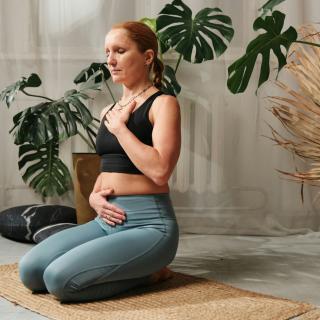
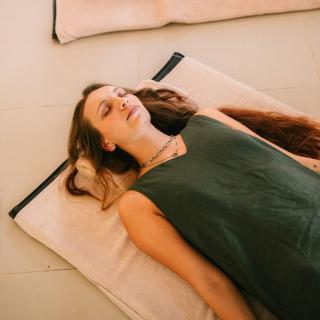
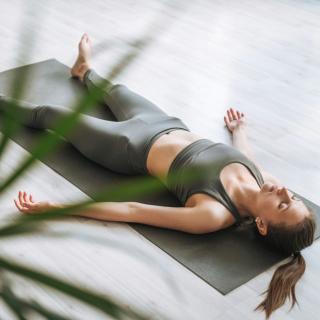
The body scan meditation.
We typically do body scan meditations while lying down,
But it's fine to be sitting or standing.
Choose whatever posture is most comfortable for you.
It's also fine to move during the practice and to change posture if you need to.
Take your time getting comfortable.
You might want a pillow or a blanket.
If you want to lie down on the floor,
Be careful about getting down to the floor and back up again.
Move slowly,
Using your arms for support so as not to injure your back.
If you're lying down,
Adjust your cushion to be the right height for your head.
You might want to support your lower back by having a cushion under your knees if lying down or behind your back if you're sitting on a chair.
So,
Taking a moment to get settled into whatever posture you've chosen,
Giving up the weight of your body to the surface beneath you,
Letting go and allowing gravity to hold your body.
Perhaps you're lying on a bed or sofa or maybe a mat on the floor.
Or you may be sitting on a chair.
I'll guide this meditation as if you're lying down.
So if you've chosen a different posture,
Simply adapt my guidance to suit the posture that you've chosen.
Just noticing the contact of your body with the surface beneath you,
The weight of your body sinking gently into this surface.
You could have your hands resting gently on your belly or by your sides.
If it feels comfortable,
You may like to close your eyes.
And I invite you to take your attention to your whole body.
Noticing any sensations.
Some areas may feel intense or numb.
That doesn't matter.
What matters is that you're aware of what's happening now.
Is there any tension,
Any clenching?
Perhaps you can allow this to gently release and soften as you allow your weight to sink into gravity.
And if you're experiencing pain or discomfort,
Allow it to be massaged by your breath,
Saturated with gentleness and kindliness,
Responding to your own pain as you would naturally respond to a loved one who was hurting.
And now I invite you to narrow your attention,
Bringing attention to the front of your torso,
To your stomach,
Your abdomen,
Your ribcage.
What do you feel here in this moment?
What sensations do you notice?
Perhaps you notice the subtle movement of your body with the breath.
Within our torso,
Our diaphragm sits below our lungs and our heart and is shaped like a dome.
As we breathe in,
The diaphragm contracts and flattens and the chest cavity enlarges.
This contraction creates a vacuum which pulls air into the lungs.
As you exhale,
The diaphragm relaxes and returns to its dome-like shape and air is forced out of the lungs.
The movement of the diaphragm causes our belly to swell on the in-breath on the out-breath.
We're simply noticing this movement of our natural breathing.
No need to change it.
Perhaps noticing the swelling and subsiding of your belly,
Or that your ribcage expands and contracts with each in-breath and out-breath.
Perhaps noticing the rise and fall of your chest.
Simply noticing what is here now.
And within your pelvis is the pelvic floor.
And the diamond-shaped muscle of the pelvic diaphragm.
Which experiences the echo of the breath like an ocean swell.
So simply noticing the movement of the breath in your body.
On the in-breath and the out-breath in this moment.
I'm now taking your attention to your buttocks.
Perhaps here you notice some clenching or some tension from sitting.
And maybe in noticing this you're able to gently release it and allow the buttocks to soften to relax into the surface beneath you.
And taking your attention to your groin,
Your hips and your pelvis.
What do you notice here?
What do you feel in these parts of your body?
If you don't notice anything,
That's also fine.
And if your mind starts to wander,
That's perfectly normal.
That's what minds are made for.
You can simply notice that your mind has wandered,
Acknowledge the thought,
And gently guide your attention back to the body,
Back to the sensations,
The physical experience,
And the part of the body that we're focusing on.
And remember that simply noticing that you've wandered off is a moment of awareness.
And that's the practice of mindfulness.
And now taking attention to your lower back,
Middle back.
Upper back and shoulders.
What do you notice here?
Noticing the movement of the breath.
In the whole back of your body.
Perhaps feeling the back press against the surface,
Beneath or behind you,
With each in-breath.
Perhaps noticing the rise and fall of your shoulders.
Is there any tension?
If there is,
Perhaps allowing your shoulders to drop a little.
And then taking your attention to your upper arms,
To your biceps and your triceps resting against your body or the surface beneath you.
What do you feel here?
And noticing your elbows,
The back of your elbows and the inside of your elbows before moving to your lower arms.
What do you notice here?
Directing your attention to your whole arms,
The upper arms and the lower arms gently resting.
Just noticing any sensations without judgment.
And if you don't feel anything,
That's also fine,
Simply noticing this.
If you feel any tension,
Perhaps directing a kindly breath towards the area of discomfort and allowing it to gently release.
And then moving your attention to your wrists and your hands,
To the back of your hands,
The palm of your hands,
Your thumbs and your fingers.
What do you feel here?
Is there any tingling?
Perhaps warmth or coolness?
Maybe you notice your fingers and thumbs pressing against each other.
Or perhaps you have your hands lying in your lap and you can notice the sensation of their weight.
Just taking a moment to focus your attention on your hands.
And then moving your attention back up.
From your hands to your lower arms and your upper arms and back up to your shoulders and your upper back.
What do you notice here?
And taking your attention to your neck.
Back,
Sides and front of your neck and your throat.
What do you notice here?
If there's any tension,
Perhaps gently relaxing and allowing the neck to soften.
And taking your attention to the back of the head.
Resting perhaps on a pillow beneath you.
And to the top of the head and the crown of the head.
Let the head be heavy.
What do you notice here?
What do you feel in this moment?
And moving to your forehead,
To your eyebrows and your eyelids and your eyes behind your eyelids.
What do you notice here?
If your mind wanders,
Just acknowledging the thought and gently bringing your attention back to the eyes and the eyelids and the eyebrows.
Just noticing any sensations here.
And taking your attention to the nose.
Perhaps you can notice the sensations of breathing here.
And to your cheeks,
What do you feel here?
And your ears.
What sensations do you notice in the ears?
Is there any tickling or tingling?
Perhaps you can feel the coolness or the warmth of the air against your ears.
And taking attention to your lips.
Are they open or closed?
Perhaps you can notice if they're dry.
What sensations do you feel here?
And noticing any sensations in your mouth.
Perhaps you notice your tongue is on the roof of your mouth and you can gently release it.
And taking attention to your jaw and the top of your throat.
Maybe you notice some tension here.
It's quite common to hold tension in our jaws.
If you do feel tension,
You might want to give your jaw a little wiggle from side to side to just gently release it.
Allow your jaw to hang loose and your vocal diaphragm to relax as you unclench your teeth.
So just noticing any sensations in your jaw and your chin.
And it's fine if you don't notice any.
And then broadening attention to the whole of your face and your head.
And your neck and your shoulders.
Just noticing any sensations here and letting any tension gently release.
And now I invite you to take your attention downwards.
To your hips and your legs.
Giving them up to gravity.
First taking attention to your thighs.
These large muscles in our body that carry so much of our weight.
What do you notice here?
If you're carrying any tension,
Can you allow it to simply soften?
And moving to your knees.
What do you notice here?
And moving to your lower legs.
Your shins at the front and your calves at the back.
Feeling the weight of your whole leg sinking into the surface beneath you.
What sensations do you notice here?
And now to your feet.
Noticing any sensations in your feet,
The heels,
The soles of the feet,
The tops of the feet and the toes.
What do you feel here?
Perhaps there's warmth or coolness,
Or you might notice some tingling,
Or the contact of the toes with each other.
And it's okay if you don't feel any sensations.
And now expanding your attention to the whole of your body.
Noticing the weight of your body and the contact between your body and the surface beneath you.
Noticing the breath flowing in your whole body.
Allowing your kindly breath to massage and soothe any areas of discomfort.
Our sensations are also continually changing,
Fluid like the breath.
Pain or discomfort.
Is not as solid as we might first think.
We only experience the flow of sensations one moment at a time.
So simply noticing any sensations in this moment.
And in this moment.
And as we begin to bring this practice to a close,
Perhaps noticing the contact of your skin with the fabric of the clothes that you're wearing or any blankets that you might have on top of you.
Noticing the temperature of the air around you.
And gently expanding your attention to the space around you.
Noticing any signs,
Any smells,
Perhaps the light on your eyelids if they're closed.
And when you feel ready.
You can gently blink your eyelids open and return to the space around you.
And if you've been lying down or seated,
You might like to give yourself a bit of a stretch,
Just gently,
Not stretching too hard.
Maybe a bit of a jiggle just to bring yourself back to the space around you and to the rest of your day.
Bringing an attitude of kindly gentle awareness as we bring this practice to a close.
Thank you for practicing today.