Hi,
Everyone.
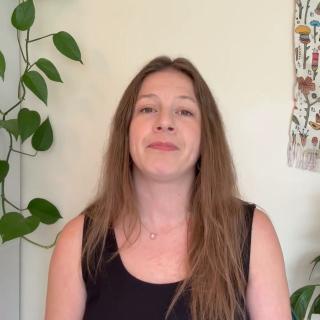
Emily here.
Today I'm going to share with you some somatic ways for becoming more present,
Just being right here,
Right now.
One way that really works quite well to become very present in the moment in your body is through a variety of ways to orient.
Now,
Orienting is a natural innate instinct that we all share.
Whenever we get into a new location,
It's instinctual for us to scan the environment,
Take things in,
Notice who's there,
What's around,
If it's safe or unsafe.
So orienting is really natural,
But often it's quite subconscious.
It's not always something that we bring our conscious awareness to.
And if we do bring our awareness to how we orient and what happens when we orient,
We might learn a little something about our nervous system and also find some ways to help calm and soothe our nervous system in the moment.
So today I'm going to share a few different ways that we orient.
And also what to do when you feel overwhelmed by being overstimulated by what you're orienting to.
So we're going to start with visual orienting using our eyes.
Visual orienting is something,
Again,
You do quite naturally all the time,
But this time we're going to really bring some curiosity to this practice.
So no matter where you are,
Even if you're in a room you've been in a million times before,
We're going to slowly start to look around the room or outside wherever you're at.
As if it's the very first time you're stepping foot into that place.
So we're bringing this sense of curiosity behind the eyes.
So when you're ready,
Just.
.
.
Start to casually gaze around.
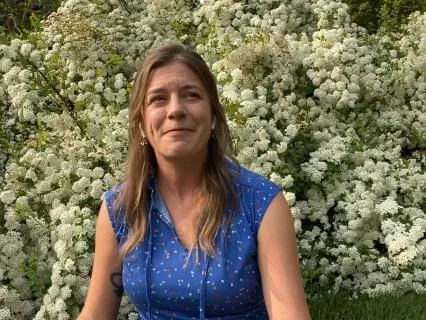
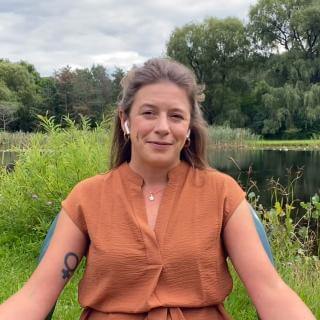
I'm squinting a little in this direction because the sun is shining.
It's springtime in central New York today.
The flowers are blooming as you can see.
So we're just starting to gaze around.
We're bringing that curiosity.
We're noticing.
What colors pop out and draw your eyes.
What textures are your eyes seeing?
Drawn toward.
Can you really take it all in,
Turning your head,
Using those muscles of your neck?
Even turning around and looking behind you.
And we're checking out the space for a few reasons here.
First,
This concept of defensive orienting,
Which we do when we're feeling unsure or a little threatened or like something might not be quite safe,
Is we're on guard.
We're taking it in.
We're a bit vigilant.
We're looking.
Is there anything dangerous here that I need to be ready to respond to?
So you might notice if you're doing defensive orienting in your body,
As you look around,
You might feel a little vigilant.
Perhaps some jumpiness or some tension in your nervous system.
This might be a sign that there is a little bit of that defensive orienting happening.
So your body is tuning in to where are the threats?
Are you ready to respond?
As you keep looking around,
I want to invite you to try to bring some curiosity into this practice,
To also look for things that tell you you are safe.
Or comfortable,
Or that things are familiar and okay where you are.
So as you look around,
What are the things your eyes are drawn to?
What's pleasant that you like to look at?
Notice what happens in your posture,
In your body,
As you start to look around and take in the space.
With this curiosity,
Because this is what we call exploratory orienting.
Like a brand new baby taking in the world.
Just everything looks so magical and sparkly and new,
And we're very curious about it.
So that's what we want to bring behind the eyes here.
Where do your eyes want to land?
What tells you you're safe,
You're good?
This practice also just opens our vision up to the periphery.
And when we open up to the peripheral vision,
It's a direct signal to our nervous system that We're safe.
We don't have to have tunnel vision here.
We can relax.
We can open up.
As my teacher,
Lael Keane,
Says,
Humans are meant for wide open spaces.
Our eyes want to have these vast spaces to take in.
And just notice what happens in your body.
As you open up to the periphery and really notice what's in the corners,
What's far away,
What's the furthest thing away that you can see in the distance.
For me,
Just doing this practice,
I'm orienting to some pine trees in my grandmother's yard where I am today.
These pine trees are huge.
They've been here since I was little,
And I feel a little more space.
In my chest.
When I see those pine trees,
I feel a little calm in my body because there's some happy memories there.
So just be curious what this is like for you.
And when you are done visually orienting,
Or if you're feeling like it's too much to take in all this stuff,
Let's give the eyes a chance to rest.
So again,
Sometimes less is more.
Sometimes we need to dim or dull some of our senses to bring us out of that hypervigilance.
So let's take the hands,
Create little cups with your hands,
And just gently bring them over your eyes.
You can cross those fingertips across your forehead,
Blocking out even more light if you'd like.
Closing the eyes if you wish.
But just gently cupping hands over the eyes and letting the eyes rest.
Into that darkness.
Can the muscles around your eyes soften?
I notice for myself,
I take a deep breath,
As I just did.
Become aware of that darkness and let my eyes soften.
So just notice what happens for you.
And hang out there as long as you'd like.
And before you release your hands down away from your eyes here,
You might actually bring a little space between your fingers.
So we're just letting a little bit of light in.
We're letting the eyes adjust ever so gently back to the light in the room.
And then gently releasing the hands.
Away from the eyes.
So that was our visual orienting practice.
And now we're going to move into auditory orienting.
So tuning in to the sounds.
Sometimes we can become stressed out internally if we're trying to focus on just one sound,
But there's a lot of other sounds happening.
So we're going to give our ears a break.
For a moment and just allow all the sounds in the environment to flow in unfiltered.
So just noticing what sounds are around you,
Tuning into your ears.
No need to label the sound.
Or simply allowing some unfiltered hearing to happen.
Do a little experiment with noticing what's the furthest away sound that you can possibly hear.
Again,
Opening up that sound to the periphery,
Our sense of hearing to the wide open spaces.
What else is out there.
What are these sounds that are coming in?
And let's start to notice the sounds closer towards your body,
Bringing it back in towards you.
Any sounds in the immediate vicinity of where you're sitting.
Perhaps.
Sound of your own breath or heart beating.
You may choose to have your eyes closed here as I do.
But of course,
It's optional.
If it's better for you to have your eyes open,
Gazing gently at something in your space.
That's a perfect choice.
Let's start to shift our awareness now moving out of that auditory.
Orienting and we're going to do a similar exercise to cupping the eyes where we cup the ears.
Again,
Sometimes we can get overstimulated and why not offer your nervous system something that can help soothe it.
So again,
Cupping your hands,
We're going to just gently bring the hands to rest over the ears.
I'm not sure how these hands over my ears will mess with my microphone,
So I'm going to release mine down,
But you can keep your hands there.
And again,
Just being curious and noticing what happens when we tune out sound a little bit,
When we dampen it or muffle it and give our ears a chance to rest.
What happens in your body,
What happens to your breathing.
And as you're ready,
Again,
Just letting those hands release down,
Relaxing them in your lap.
Closing eyes or softening your gaze.
Down towards your lap.
Now let's start to tune into another one of our senses.
We can also orient through smell.
Your olfactory senses.
So our olfactory senses are directly linked with our memory and can often bring up a lot of memories for better or for worse.
So if you have pleasant ambient smells around you,
Just stay where you are.
If you're not quite sure how it smells in your space,
Go ahead and grab some nice lotion or a candle or some essential oils or something that you like the smell of.
Even a cup of tea or an orange can work well for this.
And just have that available to use during this part of the exercise.
So again,
You might choose to close your eyes or not.
But take a moment to just bring attention to your olfactory senses,
Your nose.
Any smells or scents.
That you're experiencing either ambiently in the room.
Or perhaps you're holding something that smells delightful.
Right underneath your nostrils.
I'm smelling all these incredible flowers behind me.
So my experience is delightful today.
And just noticing what you're smelling.
Affects how you feel inside?
What is that internal landscape doing?
How is it changing as you take in this pleasant smell?
It's funny,
I smell the sweetness of flowers and the sensation in my body is amazing.
Kind of like a sweetness,
It's just this sweet.
Syrupy softness.
So I'm curious what you're smelling and what you feel in response.
And the final piece of orienting is we're going to let go of the olfactory senses for a moment.
And we are going to orient.
Using our tactile sensation.
So our sense of touch,
Of feeling,
Of texture.
So I invite you to even explore letting your hands just rest and first seeing if you can tune in just to the sensation on your skin.
Now,
Perhaps you're wearing long sleeves.
That's OK.
See if you might feel any sense of temperature on the skin of your arms.
Perhaps in your faith.
Noticing is there any movement in the air in your room that you can pick up on and just all those little nerves on the surface of your skin.
Lighting up and tuning in to what sensation is available just here in this space.
Another way to help you orient using texture is to.
.
.
Feel your pants that you're wearing.
You can rub your hands gently and slowly up and down your thighs and just feel for texture.
And temperature.
You could find a soft fuzzy blanket or a stuffed animal or one of your fuzzy pets and rub your hands up and down that and notice.
What happens in your body when you touch something soft?
We're smooth.
Or warm.
And again,
Just letting go of judgment and bringing that curiosity.
What is it like for you?
To bring that awareness into your hands.
I'm getting oriented to the textures.
In your immediate vicinity and how they make you feel.
So after a few moments of that,
You might just come back to a comfortable seat.
Letting go of the exercises,
Letting go of the skills for now.
And just bring some gentle curiosity inside,
Noticing.
How are you doing?
How are you feeling?
Are you perhaps a little more present right here,
Right now,
After orienting using all of your bodily senses?
Taking in the sights around you,
The sounds,
The smells,
Feeling the textures,
Using your body.
Little bug.
So just be curious.
And send yourself some gratitude for making the time to become a little more present today.
Thanks for joining in.