Hi,
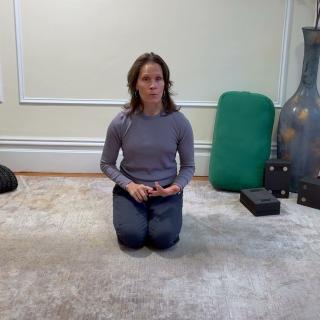
I'm Lisa,
And I'm so happy you're here for this short practice that I hope will give you some things you can do to help yourself if you are living with tinnitus.
Now,
This is not meant to replace any treatment you may currently be in,
And you can always check with your doctor about adding this to your program.
One of the best things that you can do overall for yourself is reduce your level of stress.
You can also help by releasing muscular tension in the area of your jaw,
Your neck,
And shoulders.
And sometimes increasing blood flow to your head and ears can be helpful.
And so we'll be looking at different ways that you can do all of those things.
Spinal alignment is also very beneficial.
So we'll look at ways that you can help regain,
If you've lost it,
Good spinal alignment.
Now,
As a general rule of practice in hana somatic education,
Hana somatic yoga,
You're tuned into what the movements,
The practices feel like within you.
And you want to do them in a way that is comfortable and easeful.
So we don't force.
And if today a comfortable movement means you just imagine it,
That's what you do.
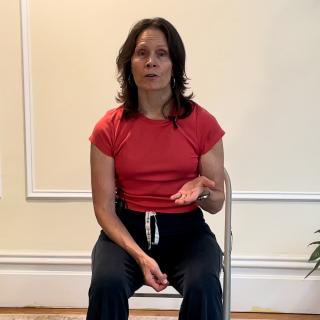
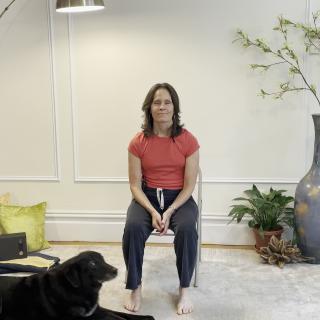
I'm going to do this practice today seated.
And maybe in the future,
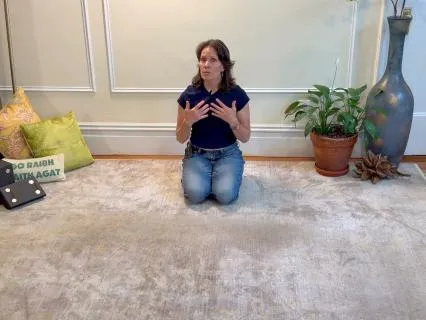
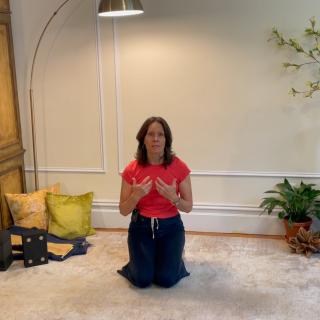
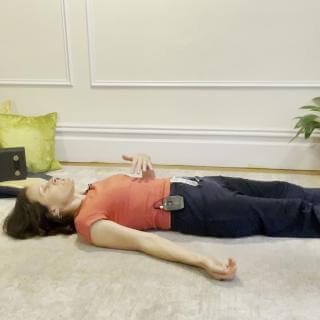
I'll put together a few things that you can do if you want to practice from the floor.
I like doing a seated practice because you can do it any time you're sitting and able to tune in.
So take a moment and make sure that you are comfortable as you're sitting,
Best if your chair doesn't have wheels,
Helpful if it doesn't have arms.
And let's start with heart-focused breathing.
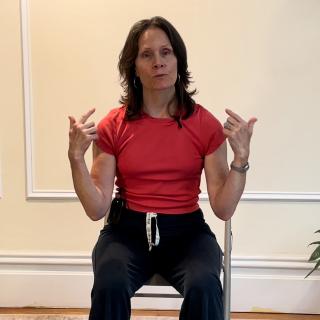
So you're going to put your attention in the area of your heart.
If it's helpful,
You can put your hands over your heart.
You'll begin to breathe a little bit slower and a little bit deeper than you were breathing a moment ago.
Find the rhythm that feels comfortable to you.
And now you can begin to imagine you are taking those slower,
Deeper breaths through the area around your heart.
Take a moment to tune in.
Do a scan of your body,
Use your mind,
And notice what internal bodily sensations are present.
If you brought your hands up,
You can let them come down.
And we're going to do a hanosomatic exercise to work with muscles in your neck and shoulder area,
The upper portion of your trapezius,
Which is an area a lot of us hold contraction.
Now,
These movements are voluntary pandiculations,
So you go slowly into it,
Slowly so that you know you're using your motor cortex,
And even more slowly as you release out of it.
It's in that release that your motor cortex is lowering the level of contraction in the muscle.
And so if that muscle is tight and impinging on nerves or restricting the flow of blood to your brain,
You may find it helpful in working with your tinnitus.
Slowly draw your two shoulders up,
Tilt your head back just a little.
That's the contraction.
Now even more slowly release,
Allow your shoulders to come down,
Allow your head to come out of that backward tilt.
You can breathe in as you draw your two shoulders up,
Tilt your head back.
Breathe out as you release.
Letting your shoulders come down,
Letting your head come forward to neutral.
Inhale as you lift your shoulders,
Tilting your head back a little bit.
Exhale as you release,
Returning to your new neutral,
And you can take a moment there and notice the effect.
Now to target the muscles of your trunk,
Muscles that attach to your spine,
And if they're chronically tight,
Maybe pulling you out of good spinal alignment,
We're going to do some movements of your pelvis and your head,
Which will move lumbar spine,
Thoracic spine,
And cervical spine.
And I'm just going to turn to the side.
So if there's confusion,
You can use me as a model,
But because I want you to have your experience as much as you can listen to the instructions and organize your movement without watching me.
Gently draw your belt line your belly forward.
You've rolled to the front of your sitting bones,
Your pelvis is in a forward tilt.
Bring your head a little forward,
Chin towards chest.
And then slowly release.
Now gently flatten your low back.
You're drawing your belly and beltline back.
Your pelvis is rocking backwards towards the back of your sitting bones.
And you're going to gently rock your head back.
And slowly release and return to neutral.
So you're moving your head and pelvis in the same direction.
As you arch your low back and tip your pelvis forward,
Just gently bring your chin towards your chest.
You may notice your chest is lifting.
Slowly release.
And now as you flatten your low back,
Tilting your pelvis back,
You can tilt your head back.
And you may notice your chest is depressing.
And slowly release.
And just one more time,
Gently tip head and pelvis forward.
Slowly,
As smoothly as you can,
Release,
Returning to your neutral.
And then flatten your low back,
Rolling your head backwards.
And slowly release,
Return to neutral.
Pause a moment to notice what new sensations you may have.
As you did that movement,
Your head and pelvis were moving in the same direction.
You may have noticed,
And you may not.
Your cervical spine,
Your neck,
And your lumbar spine,
Your low back,
Were actually doing different things.
When one was extending or arching,
The other was flattening or flexing.
So now we're going to move your head and pelvis in opposite directions.
And your spine will be doing the same thing,
Either full extension or flexion.
And we'll use this as an opportunity to work with some muscles of your shoulders and even some muscles of your lower leg.
Arch your back,
Bring your belt line,
Your chest forward.
You can move your shoulders and your head a little backward.
You've brought your tailbone and the back of your head a little closer together.
Slowly release,
Return to neutral.
Now to flex your spine,
Bring your belly back,
Your chest back.
You can draw your head and shoulders a little forward.
And you've brought your forehead and pubic bone a little closer.
And slowly release,
Return to neutral.
As you arch again,
Put your attention on your back.
Exhale as you release.
You get to feel those muscles in your back returning to length.
And on an exhale,
Curl forward and focus on what you're tightening in the front of your body.
As you inhale,
You release out of that curl,
And you get to feel abdominal muscles,
Chest muscles returning to length.
So now if you'd like,
Add in your feet.
The next time you inhale and arch,
You can lift your heels.
Exhale,
Returning to your neutral.
Exhale,
As you curl forward,
Flex your ankle.
Pick up the ball of each foot.
And slowly release.
Let's do one more cycle.
Inhale as you arch,
Lifting your heels,
Attention your back.
Over a slow exhale,
You release what you were contracting.
Find your neutral.
And then with an exhale,
Curl forward,
Lifting the ball of your foot.
Return to your neutral,
Take just a brief moment,
Tune in and feel the effects of what you were doing.
So let's look at patterns of bending sideways.
Some of us are in a little bit of a pattern pulled to one side.
We're going to use the crescent moon posture here.
And we're going to do two different versions of it.
So visualize yourself as you're sitting there with your feet grounded,
Arms at your side,
Gently bending to one side.
So you're taking on the shape of a crescent moon.
You're going to put your attention in the side you're bending towards.
Breathe regularly.
Go just as far as it's easy to go.
And after about 5 or 10 seconds,
Slowly release up and come to the other side.
Once you visualized it,
Go ahead and do what you visualized.
In this version,
You're depressing your scapula,
So you're working with the muscles that do that.
As you come up out of it slowly,
You are helping those muscles to release chronic contraction if they hold chronic contraction.
And you may find now it's easier to do the version of crescent moon with your arms above your head.
Join your hands above your head where it feels comfortable.
Bend a little to one side.
Focus on the side you've bent towards.
After about 5 or 10 seconds,
Come up.
And bend a little to the other side.
If you notice tension as you're doing the posture,
See what you can do to release the tension.
And when you've completed,
Just take a brief moment,
Invite your body to relax and feel the effect.
So let's work with.
The last range of motion available in your spine,
We've done flexion,
Extension,
Side flexion.
Let's do rotation.
You can start this movement with your eyes.
If you move your eyes and you start to feel any kind of pressure,
Then leave your eyes out of it.
Just let your eyes move with your head.
Decide which direction you're going to rotate towards first,
And just very gently move your eyes a little to that side.
Blink as you need,
Right?
Let your body be relaxed.
And then after a moment,
Now turn your head to the side you moved your eyes,
Just as far as is comfortable.
And after a moment,
You're now going to turn your shoulders,
Your upper ribs.
And you can keep turning through mid ribs and low ribs and low back.
Going around to where you feel comfortable.
Focusing on the muscles you're using to do this,
Oblique muscles in your abdomen.
And you'll slowly release.
And if it felt OK to differentiate your eyes,
Meaning move them without your head,
You can start your movement to the other side with your eyes.
And then your head comes along.
And then your shoulders,
Upper ribs,
Mid ribs,
Low ribs,
Low back.
And after about 10 or 15 seconds,
Return to your neutral.
And take a moment to tune in.
So please visualize now a forward fold,
Your legs straighter out in front of you.
You're focusing on abdominal muscles and pelvic muscles that your brain contracts to bring you forward.
And this is a nice way to increase blood flow to your head.
Once you visualized it,
Come into that forward fold.
Go slowly so that momentum doesn't take you too far Only go as far as it's easy to go so you don't want to pull on something that feels tight in the back of your body.
And you can always stay longer.
For the sake of this practice,
You'll find an inhale and come up.
Find a comfortable way of sitting and just take a moment to tune in and feel the effect.
So lastly,
Let's look at some movements you can do to work with the muscles of your jaw.
You're going to move your jaw a little bit to one side,
Slowly release,
And then move it to the other.
Stay within an easeful range.
The next time you're in the middle,
Pause.
And let's work with the muscles that lower your jaw so your mouth will be opening.
Slowly,
Gently lower your jaw.
And then even more slowly release what you contracted and let it come up.
Final movement if you notice and you it can sometimes be helpful to do this in front of a screen or a mirror If you felt when you moved your jaw to the side there was clearly a side of ease,
Or you noticed when you were lowering your jaw that it wanted to go to one side,
You can work with that pattern by combining them.
As you lower your jaw,
Gently take it to the side of ease.
And you may go to that side a couple of times and then change.
When you return to neutral the next time,
Let your jaw relax.
If you'd like,
Close your eyes.
Tune in,
Scan your body to notice what new sensations are present.
Place your attention on the internal sensation of breathing.
Bring your focus now to the ground.
If you want to stay longer in that breathing meditation,
Do.
Otherwise,
Bring your attention to the ground.
Slowly open your eyes if they close.
Take a moment to thank yourself for practicing.
And I thank you for joining me.
Have a wonderful day.