Welcome.
This practice is a form of mental rehearsal for the hand and arm.
It is designed to accompany rehabilitation and not replace it.
Settle into a safe position where your back is supported.
And your affected arm can rest comfortably on a pillow or armrest or table.
Let the fingers and hands rest in a position that's natural for you.
During this recording.
Most of the movement will happen in your imagination.
If your hand actually makes a small movement on its own,
This is natural.
Stop anytime if you feel pain,
Dizziness,
Unusual shortness of breath,
Or a sudden change in your symptoms.
Let's begin.
You may close your eyes.
Soften your gaze.
Or simply keep your eyes open.
You may notice an image,
A sensation,
Direction.
A rhythm,
Or simply the idea of movement.
Any one of these can be a useful way to practice.
There is no right and wrong.
Begin by noticing the support beneath you.
Feel the chair.
Bed or cushion carrying some of your weight.
Let your feet be supported if they can.
Notice how you can settle into the seat even more.
Relax your hips,
Knees,
And ankles.
Your body is supported.
You can surrender.
Take an easy breath in.
And let the breath leave without pushing.
Again,
Breathe at a comfortable size.
And breathe out at a comfortable pace.
Let each breath be quiet enough that your jaw can soften.
Relax the shoulders,
Elbows,
Wrists,
Hands,
And fingers.
Relax the eyes.
Relax the hairline.
The ears.
The forehead.
The back of the jaw and throat.
Allow the space around you.
And your eyes to soften.
Let your tongue rest.
Now bring attention to the supported affected arm.
Notice your arm.
The shoulder.
The elbow.
The forearm.
The wrist,
And the back of the hand.
Bring your awareness to your hands.
You can imagine a bright light starting to glow on top of the hand.
And watch in your mind.
You can feel on your skin.
This bright light gets warm Maybe the light travels from one hand to the other.
Or maybe it stays in one particular spot.
Let the light choose where to land.
Now focus your mental attention in your mind.
To your affected hand.
Imagine looking at it as you would see it naturally.
Notice the outline of the wrist.
Notice the back of the hand,
The blood vessels,
The curves of the knuckles.
To fingernail.
You can turn it over and see the poem.
The inside of the thumb.
And each finger.
The image may be clear or faint.
Keep focusing on your hand and your mind's eye.
Notice the details.
Now focus on the feeling of the hand.
You can feel the weight of the hand resting on your support.
You can feel the position of each finger.
Is it straight?
Is it curved?
You can imagine the quiet length of the fingers and thumbs.
Focus on the sensation.
And imagine your hand opening slowly.
Uncurling the fingers,
Stretching them out far and wide.
This is in your mind.
Pay attention to the thumb.
Can you feel the fingers widen and separate them as big as they can get?
Now imagine closing the hands.
Slowly.
Bringing the fingers together.
And curling them back into the palm.
Resting the thumb into the hand.
Imagine the hand is fully closed.
Picture the wrist.
Support it in study.
Into your mind,
Turn the hand over.
And under.
And over and under again,
From the palm to the back of the hand.
Now rest.
Let's practice this again in our mind.
Opening and closing of the hands.
You imagine the movement beginning before you can see it.
The back of the hand feels long.
The palm begins to open.
The thumb gently moves away from the palm.
One finger,
Then another.
Has room to lengthen.
The fingertips move out and lengthen.
The hand opens wide,
Separating.
See how far you can stretch the fingers.
And then relax.
In your mind,
Imagine the fingers returning into a soft curve.
A comfortable close.
With the thumb resting easily.
Can you imagine the hand opening again?
The palm widens.
The thumb moves.
The fingers stretch.
And return to a loose,
Resting shape.
We're going to expand on this idea.
Of mental imagery.
Open your hand again.
The palm wide.
The fingers moving out.
And lengthening.
Turn your hand so it rests on a surface.
Calm down.
Now imagine the fingers lightly tapping on a surface.
Any rhythm is fine,
Slow or fast.
In your mind.
Tap your index finger,
Your first finger,
On the surface.
Tap,
Tap,
Tap.
Now try the middle finger.
Tap,
Tap,
Tap.
Let's try all the fingers.
Tap,
Tap.
It's time to rest the hand.
In your mind,
Imagine the hand relaxing.
The back of the hand,
The fingers,
All rest in a natural position.
Next,
You find yourself sitting at a table.
One where you would normally eat a meal.
Feel your feet touching the ground.
The room is comfortable,
The exact right temperature for you.
The light in the room is the exact brightness for you.
You look down and see your hands resting on a tabletop in front of you.
In front of you is your usual drinking cup or mug.
In your mind.
Reach out with your hand.
And pull the cup closer.
So you can look inside.
You imagine looking inside.
It is empty.
It's easy to see.
Now notice the cup's shape.
Its color.
And the curve of the rim.
The surface beneath your fingertips.
In your mind,
You can feel how smooth the cup is.
Relax.
I will explain the sequence next and ask you to imagine it in your head and mind.
Then I will guide you to repeat the motion a few times in your own mind.
The arm reaches.
The hand opens before it arrives to grasp the cup.
The thumb and fingers gently touch the cup.
And you apply pressure through the hand to begin to lift the cup up slowly.
The cup lifts a short distance.
Now lower the cup gently to rest on the table.
The cup returns to the table.
The hand opens and releases.
Pulling up and back from the cup.
The arm and hand return to the natural resting position.
Now it's your turn to imagine the details.
In your imagination and mind,
Let's begin.
The arm reaches.
The hand opens before it arrives to grasp the cup.
As the hand approaches the cup,
The palm widens.
The thumb moves away from the fingers.
The fingers stretch open and fit around the cup.
All fingers gently touch the cup.
Continue gently breathing.
The pads of your fingers meet one side of the cup.
The thumb curls around the edge of the cup and touches the other side.
The grasp is secure,
But not tight.
Imagine the smooth surface against the skin.
Notice its weight,
Its density in your hand.
And now in your mind,
You apply pressure through the hand.
And begin to lift up the cup,
Slowly.
The cup lifts of short distance.
And now lower the cup gently to rest on the table.
The cup returns to the table.
Your gentle breathing continues.
You are free to open the hand and release.
So your hand releases from the cup.
The arm and hand.
Return to a natural resting position.
We're going to repeat the sequence again.
This time.
Try to use both hands.
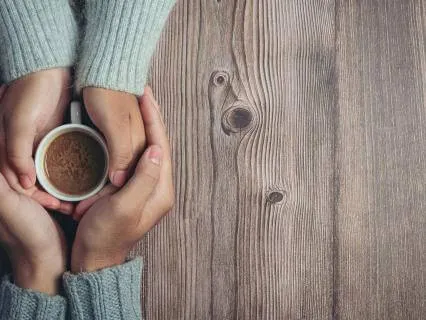
As if they're curling around a warm mug of tea.
And we will add more sensory detail.
You may need to move much slower in your imagination when using both hands.
Let's begin.
The arms and hands reach out together.
The hands open before they arrive to grasp the cup.
As the hands approach the cup.
The palms widen.
The thumbs move away from the fingers.
The fingers open and stretch enough to fit around the cup.
Your fingers gently touch the cup.
Feel how warm it is.
Continue gently breathing.
All of your finger pads are resting on the surface of the cup.
The thumbs curl around the edge of the cup.
The grasp.
Is secure but not tight.
The warmth travels up your hands into your wrists.
And the cup is smooth against your skin.
Gently rub your fingers up and down the smooth surface.
Did you feel any texture?
You can notice its weight,
Its density in your hand.
And now in your mind,
You apply pressure through the hands and fingertips.
Begin to lift the cup up,
Slowly.
You can still feel the smooth surface of the cup,
A slight pressure beneath the fingertips.
And focus on the moment that the weight shifted.
Into the hand.
Let's lower the cup back down to the table.
Your gentle breathing continues.
You might even hear the sound of the cup hitting the table.
Your hands open and release,
Pulling back from the cup.
And rest naturally.
Let's rest.
Let the imagined cup fade from view.
The mental imagery practice is complete.
For today.
You may return to the practice of the visual motor imagery at any time.
Bring your attention back to the natural breathing.
And feel the support beneath your body.
Begin to notice the room around you.
And listen for the nearest sound.
Feel your hands.
You can invite small.
Comfortable movement.
Anywhere in the body.
You can move your fingers or toes.
And then your wrists and ankles.
And gently turn the head.
Let it go.
Be proud.
You've done an amazing job.
When you're ready,
Let your eyes open.
And lift your gaze.