Hi there,
This is Stephen.
These days I like to tell my listeners that I'm a real human being.
Every single word you hear tonight.
Was spoken by me.
Sitting in my studio.
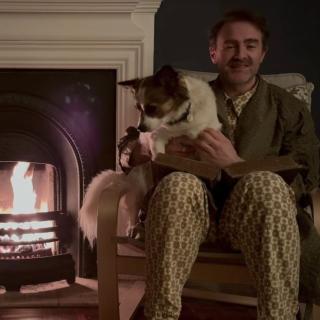
With my dogs asleep at my feet.
And with that.
Hello my friend,
Welcome to your sleep story.
My name is Stephen Dalton.
I'm an Irish storyteller,
And it's my great privilege to be the voice that you listen to.
As you go to sleep tonight.
I know how much you all love train stories.
And one that seems to really have resonated with you recently.
Is the stormy nice on a train?
And so I made another one.
Is a different feel.
It has the same sounds,
The train and the storm.
And on this particular train journey.
Not a lot is happening.
But everything is happening at the same time.
It's a cozy,
Quaint tale of a group of people on a very long train journey through the night.
And if you have ideas for future train stories,
Let me know in the comments.
Okay,
Let's do the relaxation session now,
Which will take a few minutes before tonight's sleep story.
I'm going to count down from 10 to 1,
And as I do,
Allow yourself to let go.
More and more.
Feel the support.
Of the bed beneath you.
Or the floor.
Or whatever you lie upon tonight.
Beneath all of that.
Feel the support.
Of the Earth.
Our home.
Constant support.
And as you become aware of that grounding.
Calming support.
See if you can.
Let go a little more now.
Just.
.
.
Ease into this moment.
A little more now.
Nein.
You.
Are safe.
Tonight.
Allow my voice.
To be a friend.
To be an anchor of safety.
Knows this.
My voice will never take you to anywhere unsafe.
It will only ever take you to safe.
Places.
Places of coziness and comfort.
Places where stories are told.
With a spirit of kindness.
And human understanding.
And allow that vacuum.
To enable you.
To adjust.
Be here.
And listen.
And move closer and closer to sleep.
Become aware of your body now.
Feel into your body.
Where are you holding tension?
Where do you perhaps feel pain?
Maybe it's in your feet.
Maybe in your lower legs your thighs,
Yips.
Belly.
Your chest.
You're back.
Maybe your neck.
Your shoulders.
Your arms.
Your hands.
Or maybe you're like me.
Do you hold tension in your face?
Or in the top of your head.
Wherever you're holding tension wherever you're feeling pain,
If you are.
See if becoming aware of it.
And help ease it a little.
Seven.
The day.
Is.
Whatever has been.
Has been.
Whatever will be.
Of being.
Whatever thoughts you might be having.
About the future or the past.
Know this.
Neither of those places exists.
That you have.
Is now.
Is this moment.
So choose to be kind to yourself in this moment.
And begin to let go.
If a sword arrives.
Don't fight it.
Welcome it.
It is a part of being human.
See it for what it is.
A thought.
Then don't follow it.
Let it flows away.
Like leaves floating away on a moonlit river.
Or a cloud.
Passing by.
Through a starlit sky.
6.
Peace.
Lives within you.
I promise you it does.
It is always there.
It is always just.
Waiting to be found.
Wishing.
To be felt.
To see if you can find that peace tonight.
Ask yourself.
Where does it live within me?
Sometimes I think I find it in my chest.
Sometimes in my head.
When you find it.
It can have an immediate effect on your whole body.
Sometimes it can be found.
Through a simple,
Deep breath.
Let's take one now together.
Breathe in through your nose.
And out through your mouth Maybe you've found your peace.
Or maybe you're on the way to.
Don't force it.
It will come.
If it hasn't already.
Size.
This is your moment.
This is your time.
Allow that fact.
To enable you.
To let go completely.
You have nowhere to be.
Nowhere to go.
Allow yourself to indulge in this moment.
Perhaps allow a little gratitude now.
Gratitude.
For the simple things.
Are the ones who love you.
And who you love.
For the roof over your head tonight.
With the breath in your body.
With the ability to lie here tonight.
And listen to a sleep story.
Begin to engage with your imagination now.
Begin to see a beautiful old train.
The colour of green moss,
And each carriage has its own little stove.
Yes,
This is the coziest train you will ever find.
And outside.
This storm.
And insight.
Is a place of joy and cosiness.
And kindness.
Two.
Checking in with your body once again.
More time now.
Your body has worked hard for you today.
It's time to give it rest.
What?
Completely letting go now.
As I tell you.
Tonight.
Sleep story.
There is a railway line.
In the west of the country.
Called the Emberline.
And it is never once.
Been in a hurry.
It runs for forty-one miles between Larkspur Holt and mistletoe.
And in all that distance.
It does not manage a single streak.
Mile.
It bends around Mr.
Hollow's orchard.
Because Mr.
Hollow's grandfather would not sell the corner of it.
And nobody has liked to ask again.
It goes the long way about Beaulieu.
Because the hill was there first.
And that uttery bottom.
It crosses a stream.
On a low stone bridge.
With a wobble in it.
Which is why every driver on the line slows to a walking pace there.
And lifts one hand off the regulator.
The way you might lift a hand to an old neighbour over a garden wall.
The last train of the night on the amber line.
Is the 1040.
It is not a grand train.
There is the engine.
Whose name is perseverance.
Painted a dark green.
That has gone the colour of moss.
Behind her.
There are four carriages.
Each one older than the last.
And at the very back.
There is a guards van.
With a small iron stove in it.
A shelf of paperwork.
Nobody has ever read twice.
And a wooden chair,
Worn into the exact shape of one particular man.
That man.
Is Mr.
Silas Trundle.
Mr.
Chundo had been the guard on the night train for thirty-one years.
He was a tall unhurried person.
With a moustache.
That had given up all ambition.
And he owned two things he considered important.
The first was a brass lamp that showed green,
Red,
Or a plain buttery white.
Depending on which way you turn to the colour.
The second was a cool scuttle.
It was an ordinary scuttle.
Dented on one side.
And Mr.
Trundle carried it up and down that train.
Every winter night of his life.
The way other men carry an umbrella.
On the night of this story.
The rain began at twenty past ten.
It did not begin gently.
It arrived all at once.
And all together.
The way a crowd comes out of a hall.
And within a minute.
Platform at Larkspur Hall.
Was hissing.
The gushers were going like taps.
And the four gas lamps along the fence.
That shrunk to four small trembling coins of light.
Thunder came in from somewhere behind Beaulieu Hill.
Took its time crossing the sky.
And settled over the valley.
To stay.
Inside the waiting room.
The fire was burning in the grate.
And eleven people were standing as close to it as politeness allowed.
Mr.
Trundle put his head round the door.
Cheese in a Z.
Take your time.
Nobody gets left.
That was the whole of his announcement.
Yet never.
In 31 years.
Said anything longer.
They came out.
One by one.
Under the dripping canopy.
A beekeeper with a hive.
A large man with a larger instrument case.
An old lady with a knitting bag the size of a sheep.
A small girl holding a biscuit tin with both arms.
And seven others.
Who will not be in this story.
Because they were asleep before the second page.
The engine breezed out.
The firebox door swung open for a moment as the fireman shoveled.
And a white orange light.
Came out across the wet platform.
And every raindrop in it.
Turned briefly.
Gold.
Then the door shut.
And the light went back in.
The whistle went once.
High and thin,
And immediately swallowed by the weather.
Couplings took up one after another,
All down the train.
A run of small iron knocks.
Going away into the dark.
And the ten-forty pulled out of Larkspur Hall.
Into the storm.
At the speed of a man walking home.
And it would not stop again until morning.
Here is a thing about the Amber Line that most railways have long since done away with.
Every carriage.
At its own stove.
They were small cast-iron ones.
No taller than a milk train.
Each with a little mica window in the door that glowed like an orange eye.
There was one at the end of every carriage.
And one in the refreshment car.
And one in the guard's van.
And one in the signal box at uttery bottom.
And one great roaring one in the belly of perseverance herself.
Mr.
Chundo had counted them so often.
That he thought of the whole train.
As a line of small fires.
Travelling through the dark.
With the rails underneath.
And the rain on top.
And forty-one miles of west country in between.
This job.
On a night like this.
Was to keep all nine of them alive.
He began his rounds.
He went up through the swaying corridor With the dented scuttle in one hand and the brass lump in the other.
There is a particular way of moving on a train.
And Mr.
Trundle had it perfectly.
A long slow roll.
From one foot to the other.
Never fighting this way.
Letting the courage take him where it was going anyway.
The corridor doors rumbled open.
And banged shut behind him.
Between the carriages,
The noise came up loud for a moment through the gangway.
Wheels and rain and wind all at once.
And then the door is shut.
And it went soft again.
At every stove he stops.
Opened the door with a gloss.
Look dead.
And made his judgment.
Some fires wanted feeding.
Some want it leaving entirely alone.
Mr.
Chundo had strong views on this.
And his strongest view.
Was that most fires in the world are ruined by people fussing at them.
You put on what it can eat,
He liked to say.
Not what you feel like giving it.
In the first carriage.
He added four small pieces and shut the door.
In the second.
He added nothing at all.
And stood a moment watching.
And then nodded to it.
As though they had reached an agreement.
In this earth.
The stove had got silky.
So he knelt down on one knee which took him a while and blue on it twice.
And it came up bright and pleased with itself.
And he told it.
That it had done that all on its own.
Outside.
And the rain went past the windows in long silver ropes.
Driven flat by the wind.
The carriage lamps rocked on their brackets.
And underneath everything.
Brand the sound that only an old train makes.
It is not a rattle and not a hum.
But something in between.
The long even piece of the wheels.
Binding the rail joints.
One.
And then another.
One.
And then another.
With the woodwork creaking gently in the gaps.
At the far end of the third carriage.
There was a small girl in a red coat.
Sitting up very straight,
With a biscuit tin held in both arms.
How are we going to be late?
" he asked.
Mr.
Chundo considered this seriously.
He never gave a child a quick answer if a slow one would do.
We are,
He said.
Oh.
Said the girl.
Is that alright?
The girl soars about it.
She looked at the black window and the silver ropes of rain and the orange eye of the stone.
It's a long empty corridor.
With its rocking lamps.
And something in her decided.
That it was,
In fact.
Entirely alright.
Yes.
Said Mr.
Trunder.
Then we're agreed.
And there's nothing more to be done about it.
And he went on up the train with his scuttle,
Opening doors.
Looking in.
And putting on exactly what each one could eat.
At three minutes past eleven.
The train came round to the curve.
S.
Uttery Bottom.
And slow.
And slowed further.
Until a person could have walked alongside it without shortening their stride.
This was on account.
Of the weather.
In a storm on the amber line.
There is what the rule book calls a slow order.
And what everybody actually calls the core.
And it means that from the first thunder until the last of it.
The train goes at the pace of somebody sinking.
Nothing is wrong.
Nothing is in danger.
It is simply that on a night of water and wind You go gently.
The way you would carry a full cup across a room The signal-man at uttery-bottom was Mr.
Crandall Sox.
A round and comfortable man.
Who had spent twenty years in a wooden box on stilts above a stream.
And who considered himself the luckiest person on the line.
His box had a stove.
A kettle that lived permanently on top of it.
A row of gleaming levers.
And a window on all four sides.
So that the weather could be watched from every angle.
Without any of it getting in.
He was out on his little balcony as they came by.
In the doorway.
With the whole warm orange inside of the box behind him.
And the rain coming off the roof.
In a sheet.
Past his shoulder.
He held out the token,
Which is a brass ring on a leather loop.
That gives a train permission to be where it is.
Mrs.
Bellows leaned out of the cab and took it neatly off his arms.
Without either of them stopping.
Which is a thing they had done four thousand times.
And were both still quietly proud of.
Filthy night.
Old Mr.
Sock.
Beautiful night.
Mrs.
Bellows.
That's what I said.
And the box went by.
And the light of it slid along the wet carriage windows.
One by one.
And was gone.
And the train cooled on.
Over the wobbly bridge.
With the stream roaring underneath.
Going at nothing at all.
At that speed.
41 miles.
Takes the whole night.
Now there are railways in the world.
Where this would have caused a great deal of shouting.
The amber line was not one of them.
Mr.
Chundo walked the length of his train.
And at the door of each carriage.
He stopped and said the same 24 words.
In the same unhurried voice.
So that everybody heard the identical thing.
We run the crawl till the storm's done.
We'll arrive at breakfast.
But near enough.
The stoves are lit.
So get cozy.
And enjoy.
Be walked back down again.
To see if anybody wanted anything.
And that is where the whole night ends.
Quietly turned around.
Because a long,
Slow journey,
You understand.
Is a strange sort of gift.
It arrives disguised as a nuisance.
It comes wrapped in a great deal of Sigh.
Looking at watches.
And underneath those eyes.
If you unwrap it properly.
Is an evening.
You were never expecting.
To be given.
There's nothing whatsoever in it.
That you are supposed to do.
Some people never manage to get the wrapping off.
The passengers on the 1040.
Got it off in about 15 minutes.
And it was the beekeeper who started it.
Her name was Miss Lavinia Combe.
And she was travelling with a hive.
It sat on the seat opposite her.
Strapped down with two leather belts,
A white wooden box with a mesh panel across the front and a folded blanket over the top.
She had been watching it for the last hour,
The way other people watch a sleeping baby.
Which is to say without appearing to watch it at all.
Mr.
Trundle put four pieces into the stove at the end of her carriage and looked at the box.
Are they warm enough?
Miss Cone was so pleased by the question.
That she nearly forgot to answer it.
Nobody had ever asked her that before.
People asked whether the bees might get out.
People asked whether she had been stung,
And how often,
And whether it hurt.
And would you mind explaining precisely how much?
Nobody had ever once asked whether they were warm.
They're perfect.
She said.
They make their own want,
You see.
In a cold night they gather into a ball in the middle of the corn.
All of them together.
And they shiver.
Shiver on purpose.
They shiver their wing muscles without moving their wings and that makes heat and the ball stays warm all the way through the winter.
The ones on the outside take a turn and then they swap in for the ones on the inside and round it goes Nobody stays cold for long.
And nobody stays warm for long.
It's the fairest arrangement I know of.
Mr Chundor stood holding his scuttle and thought about that for a while.
That's a good deal like a fire.
He said at last.
Except a fire only does it the once.
Miss Cone,
Love.
Which she also did not do often.
Thunder went round the valley.
A continuous,
Slow,
Heavy shifting behind the hills And Miss Comb leaned over.
And put her ear against the side of the white box.
And after a moment she beckoned and Mr.
Trundle bent down and did the same.
Inside there was a sound.
It was a very low and very even sound.
A soft,
Dry humming.
Thousands of small wings held perfectly still.
And thousands of small bodies.
Shivering in the dark.
All of them keeping one another warm.
In the middle of a rainstorm.
In a wooden box.
On a slow train.
In the west of the country.
They do that all night.
Whispered Miss Comb.
Every night.
Whether anyone listens or not.
The large man in the second carriage.
Was Mr.
Roland Puckett.
And the case beside him.
Was very nearly the size of a wardrobe.
Euphonium.
He said.
Before anybody had asked.
His name is Cornelius.
Mr.
Pocket played in a brass band.
In missile suite.
And had played in it for twenty-two years.
And was carrying Cornelius home from a repair shop,
Where a small dent had been coaxed out of him by a man with a wooden mallet.
And a great deal of patience.
Would he mind?
" said Mr.
Trundle.
Only we've got all night.
Mr.
Pocket looked genuinely startled.
In 22 years.
Nobody had ever asked him to play.
They had asked him to stop.
On three occasions.
And once they had asked him to move to a different room.
But they had never asked him to start.
He got the case open.
Cornelius came out into the lamp-light.
Enormous and gold.
And gleaming.
With a bell on him like the mouth of a whale.
And every polished curve of him.
Picked up the orange of the stove.
And passed it along to the next curve.
Nothing left.
Said Mr.
Puckett.
Not at this hour.
And he played.
Very softly indeed.
A slow,
Bold tune.
About going home.
A euphonium played quietly in a railway carriage at midnight.
Is one of the warmest sounds there is.
It is alone.
Round.
Round,
Gold sort of sound and it does not go into your ears.
So much as into your chest.
And it moves through a drain.
Like heat.
Moves through a house.
I went up the corridor.
And under the doors.
It went past the beekeeper.
Look close to your eyes.
It went along to the third carriage.
Were an old lady's knitting needles.
Slowed down.
And then stop to work together.
And because the wheels were going underneath it all the while.
One joint.
And then another.
One joint.
And then another.
The tune fell in with them.
Without Mr.
Pocket particularly meaning it to.
So that the train was keeping time and the euphonium was singing over the top.
And the rain was doing.
Whatever the rain like.
As usual.
When he came to the end.
And put the instrument across his knees.
The whole train seemed to be listening for a while afterwards.
In the way a room goes on holding a note.
For a moment after a bell.
Again,
Said a voice from the corridor.
There were five or six of them standing out there in the dark.
Holding the brass rail.
Having come along quietly from the other carriages.
Mr.
Pocket went red.
From his collar to his hairline.
Which is a considerable distance.
On a man of that construction.
And he lifted Cornelius.
And played it again.
The old lady in the third carriage.
Who is Mrs.
Maud Twill.
And she was knitting a scarf that had got completely out of hand.
It came out of the bag.
On the seat beside it.
Went across her lap.
Over the armrests.
Down onto the floor.
Along the aisle for some considerable distance.
And finish.
In a soft,
Grey heat.
Under the window.
Three rows down.
She had started it eleven years earlier.
She had never once decided to stop.
And it had never occurred to her to finish.
And serve.
The two of them.
Had simply gone on together.
It isn't for anyone,
" she said,
When Mr.
Trundle asked.
That's the whole trick of it.
The moment a thing is for somebody it has to be done by Tuesday.
The small girl in the red coat had come up the train by now,
Holding the seat-backs,
One at a time,
Against the swaying Her name was Poppy Ninnis.
Eh,
She was seven.
And she was going to her grandmother's for the summer.
And she still had not let go of her biscuit tin.
What's in the tin?
" said Mrs Twill.
Poppy looked at her for a long moment.
Weighing her up.
And then decided in her favor.
And got the lid off.
Buttons.
Hundreds of them.
Brass ones and wooden ones,
And ones made of green glass.
And one shaped like a strawberry,
And four small pearly ones from a christening gown,
And a big flat black one that had come off a coat belonging to somebody's uncle,
In a year nobody could now remember.
They were my mothers.
Said Poppy.
And her mothers.
Then you'd better spread them out.
Said Mrs.
Twill.
Because there is no sense at all in a button and a tin.
So.
They turned the seat table into a sorting yard.
This was more complicated than it sounds because the table was going gently up and down and side to side the whole time.
And buttons are natural travellers.
Every so often the courage leaned into a curve,
And the entire collection set off south together,
And had to be rounded up and brought home.
In the end.
Mrs.
Twill built them a wall out of the scarf laid along the edge of the table in a long grey coil.
And after that.
Nothing escapes.
They sorted them first by color.
Than by size.
Then by which ones would be friends?
This last method took the longest.
And was the most satisfactory.
The green glass one was put next to the strawberry.
Because they were obviously fond of each other.
The four pearly ones were kept together,
As they had always been.
The big flat black one was given the whole top corner to itself.
Because it was clearly somebody important.
In the first carriage.
There was.
Tree.
It stood on the seat in a terracotta pot,
The size of a washing basket.
Roped upright to the luggage rail,
With its head bent slightly sideways where the roof came down.
It was a lemon tree.
It had nine dark green leaves that had gone leathery with age.
One small hard green fruit.
That had not made up its mind about anything yet.
And a trunk with a twist in it,
Like a walking stick.
Sitting beside it,
With his hat on his knee.
Was Mr.
Osric Vett.
Mr.
Vetch was a nurseryman.
He had a glasshouse at Larkspur that his grandmother had built out of second-hand window frames and stubbornness.
And in the middle of it,
In the warm corner by the little iron stove,
This tree had stood for sixty-one years.
She's called Signora,
He said.
Not my doing.
My grandmother named her.
And by the time I was old enough to have opinions,
It was far too late.
And she's going to Missle's weight,
" Said Mr Trundle.
There's a new glass house going up there.
Proper one.
With heating pipes and a vent that opens itself when it gets to 70.
My grandmother would have thought that was showing off.
Mr Vetch looked at the tree with his head on one side.
She'll get the whole South Wall to herself.
61 years in a corner and now she gets a war.
Mr.
Trundle put three pieces into the stove at the end of the carriage.
And then,
After a moment's thought,
Moved the whole pot eight inches nearer to it.
How many lemons has she given you?
" he asked.
Mr.
Vetch had the number ready.
Two hundred and six,
" he said,
Not counting this year.
She does four or five a season now.
She used to do fifteen.
My grandmother put every one of them in a bowl on the kitchen windowsill,
And never used a single one until it went soft.
Because she said,
A lemon in a bowl is worth more than a lemon in a pudding.
That's a very fine bit of nonsense,
" said Mr Trundle.
It is,
Mr Vetch agreed.
I've kept it up for forty years.
Some way up the line a door was opened by somebody stepping into the gangway.
And the noise of the night came down the corridor all at once.
Wheels and wind and water.
And with it a cold,
Wet dress.
Mr.
Vetch was out of his seat before he had thought about it.
He took off his coat,
Which was a good tweed one,
And the only one he owned.
And he put it round the pot and tucked it in at the base.
And he stood there holding the collar shut around a tree until the door was closed again.
And the sound went soft.
Then he sat down in his shirt sleeves,
Considerably colder.
And looked perfectly satisfied.
He's never been out of that glass house,
He explained.
In the tone of a man who did not feel he needed to explain.
Not once in sixty-one years.
This is the whole of her travelling,
This one night.
And I'd rather she didn't remember it as a draft.
Little Poppy Ninnis,
Who had followed the buttons and the noise and the euphonium up and down the train all evening,
And had now arrived here,
Stood in the aisle and looked up at the lemon tree in its tweed coat.
Does it know?
She said.
Mr Vetch thought about that for a while.
Outside the rain went on and on against the glass and the small hard green fruit swung a quarter of an inch with the motion of the carriage.
Not quite ready to be anything.
Be said at last.
That I do.
And somebody ought to.
Up at the front of the train,
In the cab of perseverance.
There were two people and a very great deal of heat.
The driver was Mrs Pegg Bellows,
Who had driven on the Ember Line for nineteen years,
And had never once been late in a way that mattered.
The fireman was a boy of seventeen,
Named Jem Ashby,
Who had been on the footplate for eleven weeks,
And who was,
At this precise moment,
Doing the wrong thing with his shovel.
Said Mrs.
Bellows.
Gemstone.
What are you doing?
Building her up.
For a while from the cool till daylight.
There's no hill.
There's no hurry.
And there's nothing at the far end of that shovel but a great deal of wasted coal.
Mrs.
Bellows took it out of his hands.
Not unkindly.
Anybody can make a big fire,
Gem.
You threw it all on it once.
And stand back and there's your fire.
And it roars and in 20 minutes it's a heap of clinker and you're worse off than you started.
That's not a job.
What's the job then?
Little and often,
" said Mrs.
Bellows,
And she showed him.
Six shovelfuls,
No more,
Placed where they were wanted,
And nowhere else to go.
One at each back corner,
One under each door,
And two spread thin across the middle.
Then the door swung shut and the roar dropped away.
And the needle on the pressure gauge stayed exactly where it had been.
Not climbing.
Not falling.
Sitting there as steady as a held breath.
We do that again in 11 minutes.
She said.
And again,
11 minutes after that.
All night.
That's all of it.
That's all of it.
It never gets exciting.
That's the point of it.
She hung the shovel on its hook.
A fire you keep going for nine hours is a different animal from a fire you make for ten minutes.
And it wants the opposite treatment.
And every young fireman on earth has to learn that the hard way while somebody older stands behind him saying stop gem love.
The exhaust bet away slowly at the chimney above them.
Four soft blows to every turn of the wheels unhurried as a big animal breathing.
The injector hissed and went quiet.
Rain came slanting through the open sides of the cabin.
And hits the hot metal.
And vanished with a small tick.
Over and over.
And the firebox glowed white gold at their boots.
And out in front,
The lamp lit,
May be forty feet of wet rail.
Before the dark took the rest.
They went round the long bend at Beaulieu,
With the wheels singing on the curve.
And Mrs.
Bellows sat down on the wooden seat.
With her back against the warm boiler.
Which was the best place on the entire ember line,
And let the engine walk.
Sit down,
Gem,
" she said.
That's the other half of the job.
And it's the earth nobody teaches you.
By half past midnight.
The whole train had drifted.
One at a time.
And without anybody suggesting it.
Into the refreshment car.
This was the third carriage from the front,
And it was run by Mrs.
Hester Comfit.
A small brisk person who had a counter,
An urn,
A stove that she was completely proprietorial about,
And a tin of biscuits she had been saving for an occasion.
You had been saving us,
In fact.
For two and a half years.
There had never once been an occasion.
This is an occasion.
Said Mrs.
Comfit,
And got the tin down.
She made tea for 19 people.
She made it properly.
One part at a time.
And she would not be hurried.
And she filled every cup two-thirds full and no more.
Because she had spent thirty years pouring on a moving train.
And knew exactly what the last third gets up to.
By the time she had finished.
The windows had gone opaque with steam,
And the refreshment car had turned into the warmest place any of them had been all year.
They say.
Where they landed.
Miss Combe had her hive on the seat beside her,
With the blanket over it.
Mr.
Pocket,
At Cornelius,
Laid along two seats like a sleeping dog.
Mrs.
Twill knitted in the corner with a yard of grey scar trailing off under the counter.
Poppy Ninnis,
At her buttons spread out on a table,
Inside their wall of wool.
With three grown-ups helping and disagreeing about which ones were friends.
Mr.
Trundle stood by the door with his scuttle at his feet.
And the talk went the way that talk goes at that hour which is nowhere at all comfortably.
Somebody explained the correct way to eat a biscuit.
That has gone soft.
And was contradicted.
Somebody else knew a station in the north.
Where the stationmaster grew tomatoes on the down platform and gave them away in September.
Miss Combe told them about the bees shivering.
And everybody wanted to hear it against the box.
And everybody did.
One at a time.
Going quiet and bending down and coming back up with the same expression on their face.
Halfway through all this.
Poppy Ninnis got down off her seat.
Walk to the length of the swaying carriage.
With something held tight in her fist.
And put the green glass button down on the counter in front of Mrs.
Comfit without a word.
What's this for?
For the occasion.
Dead puppy.
Mrs.
Comfort,
Who had run that counter for thirty years,
And had been given a great many things across it,
Most of them cups,
Held the green glass button up to the lump and turned it round twice.
Then she put it in the empty biscuit tin and shut the lid.
And put the tin back up on its shaft.
Where it stayed for the rest of her career.
With one button in it.
Now that,
She said.
Is properly saved.
Mr Vetch came through at some point in his shirt sleeves.
And was asked four separate times whether he was cold.
And said no on all four occasions.
And was eventually made to sit next to the stove by general agreement.
Somebody asked what a lemon tree eats.
Somebody else.
Who had once been to Italy for eleven days.
Described a lemon the size of a fist.
And was not believed.
And produced no evidence whatsoever.
And enjoyed himself enormously.
The stove in the corner glow.
The urn ticked as it cooled.
The rain and the storm kept happening outside and gradually.
The conversation began to have gaps in it.
Nobody minded the gaps.
That is the true measure of a good hour with strangers.
The silence has arrived.
And nobody rushes to fill them.
And everybody just sits in the warmth with a cup going cold in their hands.
Listening to weather.
The storm did not go anywhere all night.
It had got into the valley between Bewley Hill and the Missal Ridge.
And a stone that gets in there tends to stay in there.
Going round and round the rim.
Like water swirling in a basin arriving from the west.
Going out to the East.
And zen.
An hour later.
Coming back again from the west with nothing learned.
You could follow the whole of it from a window if you were still awake.
And one or two of them were.
Thunder would build somewhere off behind the hill.
Than it would come near.
Then it would arrive properly overhead and roll right across the roof of the train and the whole valley would go pale blue for half a second every wet field and dripping hedge and flooded ditch.
Would be there in perfect detail.
And then it would all go black again.
And take a while to come back.
As shapes.
And nobody on board sat up and nobody counted the seconds.
And after the third or fourth time it stopped being an event at all and became simply what was happening The train cut came through at about this time.
Her name was Sleeper.
And she belonged to the ember line rather than to any person in it She had a white chest,
And a fine indignant face,
And a private timetable of her own,
That had nothing to do with the printed one.
She went the length of the refreshment car,
Inspecting laps.
And rejected all of them for reasons she did not disclose.
And finally settled on the folded blanket on top of the beehive which was the warmest thing in the carriage.
And was also humming very faintly.
She turned around three times.
And went to sleep at once.
Mr Trundle went out into the gangway between two carriages and stood for a while with the top of the door open a hand's width.
Letting the night come in past him.
Cold air.
Wet iron.
The roar of the wheels down there in the dark.
And rain.
Landing on his face.
The sideways way.
That rain has.
When you are moving through it.
Then you shut the door.
The world went quiet again.
And he walked back down to his van.
And put on four small pieces.
And sat in the chair that fit him.
There is a strait at Cullavardin.
About 90 miles out from Missile Suite.
And it is the only straight on the whole line.
And it is where every driver in the world is.
Would have opened her up.
Mrs.
Bellows came to it at four in the morning.
With the rain still going and the thunder still walking round the rim of the valley and she look does it.
And she left the regulator exactly where it was gem.
Who by now had fired the engine little and often for five hours straight.
And was learning things faster than he knew.
I did not ask why.
But she told him anyway.
Because it was four in the morning.
And that is the hour of words.
There's nobody meeting this train,
He said.
There's nobody waiting up there.
If I run her hard down that strait,
I'll get them to mistletoe at half-past five in the morning,
In the pitch dark and the rain.
And every one of them will sit on a cold platform for two hours wishing they were still where they were which is where,
Warm,
Said Mrs Bellows,
Asleep,
Going somewhere.
So.
.
.
They went down the Covered and Straight at ten miles an hour in a storm.
In the dark.
With nine small fires burning in a line behind them.
And here is the thing that the ember line has always known.
And that most of the world has not got round to yet.
Hurrying is only worth it.
If there is something better at the far end Very often there is not.
Very often.
The best part of the whole journey.
Is the middle of it.
The long,
Slow hours in the dark.
When the fire is lit.
And the rain is on the roof.
And there is nothing at all that you are supposed to be doing.
Going quietly along.
Getting there is the least of it.
Behind her.
One at a time.
In a warm carriage with the wheels going underneath.
The passengers of the 1040 had all fallen asleep.
Miss Comb was asleep upright.
With one hand resting on the white box.
Mr Puckett was asleep with his arm over Cornelius.
And his chin on his collar.
Mrs.
Twill was asleep.
With the needles still in her fingers.
And eleven new rows added to his scarf.
That would never be finished by anybody.
Mr.
Vetch was asleep,
Two carriages back.
With one hand on the rim of a terracotta pot.
And his coat still rounded.
Poppy Ninnis was asleep across two seats.
With a red coat over her.
And her buttons safe inside their grey wool.
Sleeper the cat was asleep on the hive.
And Mrs.
Comfit was asleep.
Behind her own counter.
With the empty biscuit tin above her on the shelf.
And one green glass button inside it.
The train is still moving.
It will be moving all the rest of the night.
At the speed of somebody's thinking through water and wind.
And the long,
Slow circling of the thunder round the hills.
The sky ahead is not light yet.
And will not be for hours.
The fields go by.
Wet and black.
And glint.
The rails run out in front.
Close up behind you.
And the wheels bind the joints.
At long even intervals.
And then another One.
And then another.
On.
And earn.
And earn.
The rain keeps on at the roof and the roof keeps on holding.
Somewhere in front.
The whistle sounds once for a crossing.
Far away and soft.
And then there is only the going inside.
Nothing has changed.
The rain is on the roof.
Everyone is one.
And everyone is cozy.
And everyone.
Is the sleep.