Welcome to Restful Journeys.
In this track,
I will continue reading The Leavenworth Case by Anna Catherine Greene.
Please find a comfortable place to sit or lie down and relax.
Take a few moments to clear your mind and allow yourself to listen to these words.
Let's continue with Chapter Two,
The Coroner's Inquest.
For a few minutes,
I sat dazed by the sudden flood of light greeting me from the many open windows.
Then,
As the strongly contrasting features of the scene before me began to impress themselves upon my consciousness,
I found myself experiencing something of the same sensation of double personality which years before had followed an enforced use of ether,
As at that time I appeared to be living two lives at once,
In two distinct places,
With two separate sets of incidents going on.
So now,
I seemed to be divided between two irreconcilable trains of thought.
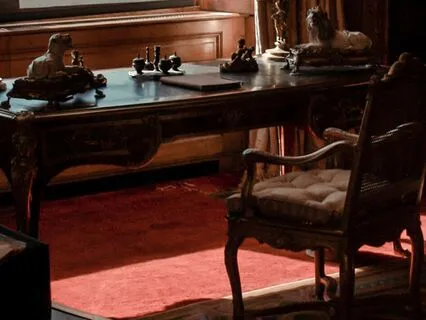
The gorgeous house,
Its elaborate furnishings,
The little glimpses of yesterday's life,
As seen in the open piano,
With its sheet music held in place by a lady's fan,
Occupying my attention fully as the aspect of the throng of incongruous and impatient people huddled about me.
Perhaps one reason of this lay in the extraordinary splendor of this room I was in,
The glow of satin,
Glitter of bronze,
And glimmer of marble meeting the eye at every turn.
But I am rather inclined to think it was mainly due to the force and eloquence of a certain picture which confronted me from the opposite wall.
A sweet picture,
Sweet enough and poetic enough to have been conceived by the most idealistic of artists,
Simple too.
The vision of a young flaxen-haired,
Blue-eyed coquette,
Dressed in the costume of the first empire,
Standing in a wood path,
Looking back over her shoulder at someone following,
Yet such a dash of something not altogether saint-like in the corners of her meek eyes and baby-like lips that it impressed me with the individuality of life.
Had it not been for the open dress,
With its waist almost beneath the armpits,
The hair cut short on the forehead,
And the perfection of the neck and shoulders,
I should have taken it for a literal portrait of one of the ladies of the house.
As it was,
I could not rid myself of the idea that one,
If not both,
Of Mr.
Leavenworth's nieces looked down upon me from the eyes of this entrancing blonde with the beckoning glance and forbidding hand.
So vividly did this fancy impress me that I half shuddered as I looked,
Wondering if this sweet creature did not know what had occurred in this house since the happy yesterday,
And if so,
How she could stand there smiling so invitingly,
When suddenly I became aware that I had been watching the little crowd of men about me with as complete an absorption as if nothing else in the room had attracted my attention that the face of the coroner,
Sternly intelligent and attentive,
Was as distinctly imprinted on my mind as that of this lovely picture,
Or the clearer cut or more noble features of the sculptured psyche,
Shining in mellow beauty from the crimson-hung window at his right.
Yes,
Even that the various countenances of the jurymen clustered before me,
Commonplace and insignificant as most of them were.
The trembling forms of the excited servants crowded into a far corner,
And the still more disagreeable aspect of the pale-faced seedy reporter seated at a small table and writing with a ghoul-like avidity that made my flesh creep,
Where each and all as fixed as an element in the remarkable scene before me,
As the splendor of the surroundings,
Which made their presence such a nightmare of discord and unreality.
I have spoken of the coroner.
As fortune would have it,
He was no stranger to me.
I had not only seen him before,
But had held frequent conversations with him,
In fact,
Knew him.
His name was Hammond,
And he was universally regarded as a man of more than ordinary acuteness,
Fully capable of conducting an important examination with the necessary skill and address.
Interested as I was,
Or rather was likely to be in this particular inquiry,
I could not but congratulate myself upon our good fortune in having so intelligent a coroner.
As for his jurymen,
They were,
As I have intimated,
Very much like all other bodies of a similar character,
Picked up at random from the streets,
But from such streets as the Fifth and Sixth Avenues.
They presented much the same appearance of average intelligence and refinement as might be seen in the chance occupants of one of our city's stages.
Indeed,
I marked but one amongst them,
All who seemed to take any interest in the inquiry as an inquiry,
All the rest appearing to be actuated in the fulfillment of the duty by the commoner instincts of pity and indignation.
Dr.
Maynard,
The well-known surgeon of 36th Street,
Was the first witness called.
His testimony concerned the nature of the wound found in the murdered man's head,
As some of the facts presented by him are likely to prove of importance to us in our narrative.
I will proceed to give a synopsis of what he said,
Prefacing his remarks with some account of himself and the manner in which he had been summoned to the house by one of the servants.
He went on to state that,
Upon his arrival,
He found the deceased lying on a bed in the second-story front room,
With the blood clotted about a pistol wound in the back of the head.
Having evidently been carried there from the adjoining apartment some hours after his death,
It was the only wound discovered on the body,
And having probed it,
He had found and extracted the bullet,
Which he now handed to the jury.
It was lying in the brain,
Having entered at the base of the skull,
Passed obliquely upward,
And at once struck the medulla oblongata,
Causing instant death.
The fact of the ball having entered the brain in this peculiar manner he deemed worthy of note,
Since it would produce not only instantaneous death,
But an utterly motionless one.
Further,
From the position of the bullet hole and the direction taken by the bullet,
It was manifestly impossible that the shot should have been fired by the man himself,
Even if the condition of the hair about the wound did not completely demonstrate the fact that the shot was fired from a point from some three or four feet distance.
Still further,
Considering the angle at which the bullet had entered the skull,
It was evident that the deceased must not only have been seated at the time,
A fact about which there could be no dispute,
But he must also have been engaged in some occupation which drew his head forward,
For,
In order that a ball should enter the head of a man sitting erect at the angle seen here of 45 degrees,
It would be necessary not only for the pistol to be held very low down,
But in a peculiar position,
While if the head had been bent forward,
As in the act of writing,
A man holding a pistol naturally with the elbow bent might very easily fire a ball into the brain at the angle observed.
Upon being questioned in regard to the bodily health of Mr.
Leavenworth,
He replied that the deceased appeared to have been in good condition at the time of his death,
But that,
Not being his attendant physician,
Could not speak consecutively upon the subject without further examination,
And,
To the remark of a juryman,
Observed that he had not seen pistol or weapon lying upon the floor,
Or indeed anywhere else in either of the above mentioned rooms.
I might as well add here what he afterwards stated,
That from the position of the table,
The chair,
And the door behind it,
The murderer,
In order to satisfy all the conditions imposed by the situation,
Must have stood upon,
Or just within,
The threshold of the passageway leading into the room beyond.
Also,
That as the ball was small,
And from a rifled barrel,
It seemed to him evident that the victim had made no effort to raise or turn his head when advanced upon by his destroyer,
The fearful conclusion being that the footstep was an accustomed one,
And the presence of its possessor in the room either known or expected.
The physician's testimony being ended,
The coroner picked up the bullet,
With which had been laid on the table before him,
And for a moment rolled it contemplatively between his fingers.
Then,
Drawing a pencil from his pocket,
Hastily scrawled a line or two on a piece of paper,
And,
Calling an officer to his side,
Delivered some command in a low tone.
The officer,
Taking up the slip,
Looked at it for an instant knowingly,
Then catching up his hat,
Left the room.
Another moment,
And the front door closed on him,
And a wild halloo from the crowd of urchins without toad of his appearance in the street.
Sitting where I did,
I had a full view of the corner.
Looking out,
I saw the officer stop there,
Hail a cab,
Hastily enter it,
And disappear in the direction of Broadway.
That concludes chapter two,
The Coroner's Inquest,
From the story,
The Leavenworth Case,
By Anna Catherine Greene.
I hope that you've enjoyed this story,
And possibly fallen asleep.