I was asked to talk to you about mitochondria,
Which is my favorite thing ever.
Um.
.
.
I have a particular love of mitochondria because I think they're going to help us understand something really fundamental about who we are and about how we work and about the basis of health.
And.
.
.
It's easy when you're a scientist and every day you do work,
You work on papers and you get lost in the details to forget why you do what you do.
This morning,
I received an email.
From Robin,
Who's a professor in Alabama,
And she was in New York City recently.
She has five boys.
She had five boys within nine years,
And they have mitochondrial disease.
So their mitochondria don't work quite as well as they should.
And as we'll talk about,
Mitochondria is what allows energy transformation in the body.
Right?
It's what allows to power every cell in your body.
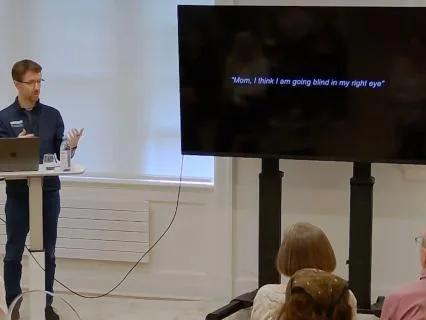
And one of her son when he was They were one morning in the kitchen and he said,
Mom,
I think I'm going blind in my right eye.
And he proceeded to go blind within the next few months.
And so what she sent me this morning was a story she wrote called The Science and the Experience of Energy.
And she tells the story of what it is to live with mitochondrial disease.
And the mitochondria are passed from the mother to the father.
To the children.
We all have our mom's mitochondrial DNA and mitochondria,
Which is pretty special.
Female energy.
Motherly.
But this is extremely.
.
.
Ah,
This was.
.
.
Robin said this is this has been a healing process for her to write this story and kind of comes to grips with her condition,
The condition of her boys.
They're people affected to different levels.
This is an extreme.
Robyn's is,
You know,
Her mitochondria are not working well.
Her children's mitochondria are not working well.
We all live on this,
Some contemporary Some of us have mitochondria working amazingly well,
Then maybe not so well.
And then what we do,
The food we eat,
The exercise we do,
The states of mind that we cultivate,
And the people we're around,
All has the potential to change how energy flows in our body,
And perhaps because it changes our mitochondria.
So what I'll tell you about.
Tonight is going to be about the role of mitochondria in this whole process we call life.
And then we'll talk about healing.
What is healing?
And what is health?
But before we get there,
Let's talk about energy.
And what is energy?
This is.
Video of metronomes.
Five metronomes,
And they're all out of sync,
Right?
Maybe the two on the right are going one way,
The three on the right.
So there's This sentence here.
All right,
And see what happens.
Now the three on the right are kind of together.
Now four.
Right,
And then there's this lag on the left.
And look at this.
Something's happening,
Right?
These are individual units,
Five little units,
They all have their own rhythm.
And then they end up perfectly in sync.
How does that happen?
Well,
I'll.
.
.
Cut to the punch.
What's happening here is that every metronome here,
The movement,
Right,
It's called kinetic energy,
Right?
So there's energy there and then every metronome has its own energy pattern,
Right,
With a certain frequency and amplitude.
And what happens,
Let's play that again.
Yeah.
So we can see it in action.
The energy of every metronome needs to be communicated with each other and you realize that they're not standing on the table,
Right?
They're not directly on the tabletop.
They're on this platform and then this platform is on two cans,
Right?
So,
In this situation,
It's the cans or the conductive media,
Right?
It's what allows the energy from one unit to be communicated with the other units.
And it's because of this conductive media that all of these independent metronomes can come in sync,
Right,
In harmony.
This is a really good metaphor for what happens in your body.
Every cell is a unit.
And every cell has kind of its own pattern,
Its own energy pattern and rhythm.
But in order for this to work,
And in order for health to be present,
For healing to happen,
Cells need to work together.
The body is a cell collective.
It's like a social collective.
And it's constant communication between cells,
Exchange of information,
And exchange of energy that makes this possible.
So then we can ask,
What is the conductive media in the body?
If we have different cells that potentially could be completely kind of separate,
What binds them together?
What's a conductive medium?
And the simple answer is the conductive media is your metabolism,
Energy metabolism.
And where does metabolism happen?
It happens.
The beautiful mitochondria.
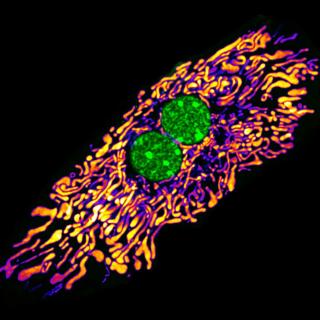
And so if you're lucky enough to be a scientist in a lab and you have access to a microscope,
You can put living cells in a dish,
Right?
And you can make the mitochondria fluorescent.
And then when you make the mitochondria fluorescent,
You can look down and then see something like this.
Not sure if we can turn down the lights temporarily for this.
These are.
.
.
Living mitochondria,
This is what happens inside your cells all the time.
Every little colorful structure here,
Little worms,
These are actually living small mitochondria.
And inside is a mitochondrial DNA.
In Robin's case,
There are mutations in the mitochondrial DNA.
And there are all sorts of dynamics happening.
So here,
For example,
You see these two little mitochondria.
The movie is going to loop.
There are some long ones that are the blue ones are deep.
The red ones are on top.
These two initially don't interact.
Then they start to interact.
This third one comes along and says,
Hey,
Then they're exchanging information.
I've had enough.
And then it leaves.
There is this kind of social dynamics between the mitochondria in our cells and the purpose of this dynamics to transform energy as efficiently as possible.
Because everything.
Everything costs energy.
Nothing in biology is free.
That is a core concept.
Everything that happens inside a cell,
If you turn on a gene,
You make a protein,
You make a cytokine,
Inflammation,
A neuron fires,
Your heart speeds up,
You release cortisol,
You sweat,
Your hair rises,
You have a shiver,
Everything costs energy.
That energy,
As we know now,
Comes from mitochondria.
And specifically,
We're not going to go into details,
But what happens in mitochondria is really special.
And there's some quantum.
.
.
Weirdness,
Some quantum biology happening there.
It's called a quantum tunneling.
So the electrons are tunneled across what's called the electron transport chain,
Which is the biochemist's term.
The electrons aren't really transported.
They actually tunnel through to oxygen.
So the purpose of breathing and eating is to feed the mitochondria.
So the energy that feeds everything that we do and feel comes from inside the mitochondria,
Which comes from the food we eat,
Which comes from the plants.
When the mitochondria take in the food you eat,
The oxygen you breathe.
Every breath you bring oxygen to your mitochondria and then the mitochondria convert to carbon dioxide is made inside your mitochondria and water.
So the mitochondria make water.
And interestingly,
CO2 in water is exactly what we need to kind of close this life cycle.
So plants make food and oxygen.
You mitochondria take the food and oxygen and make CO2 and water too.
To feed the plants.
And then you can ask,
Well,
Energy is neither created nor destroyed.
It's fundamental law of thermodynamics.
You cannot make energy or produce energy or destroy energy.
So that energy needs to come from somewhere.
How does a plant its energy to make the food?
And of course,
So there's a nuclear reactor,
Conveniently,
Sitting out there in the sky.
And after about eight minutes,
There's energy that's beamed from the sun down to Earth.
And then we have beautiful green leaves that catch the energy in immaterial form.
You have immaterial energy hitting a green leaf,
And then it gets condensed.
That energy gets crystallized into fat,
Oils,
And proteins,
And carbohydrates eventually.
So that's the immaterial energy getting crystallized into food,
The mitochondria dematerialize this.
This very special membrane potential,
Electrochemical gradient,
And that powers all of life.
This process is very similar to what you see in a candle flame.
There's a lot of similarities between your metabolism as you're there breathing in and breathing out.
Bringing oxygen in,
Oxygen,
CO2 out.
This is what a candle flame does.
Your body is made of carbon,
Right?
It's organic structure.
The candle is as well,
The wax,
Consumes oxygen and releases CO2.
It's flexible,
Right?
You see the movement in the flame.
It has kind of this recognizable shape,
Like we all have this recognizable shape,
But there's,
You know,
Flexibility and the flame kind of grows and evolves over time.
It's sensitive,
Right?
You can see that it's ways in response to challenges and stressors like we do.
It's dynamic,
It's adaptable,
It's warm,
Like all of us.
And it has this bright quality like each of us as well.
And it's also ephemeral,
Right?
At some point,
The flame is going to end.
Every candle will come to an end just like us.
So the vital ingredient of life,
This is now we're thinking from first principles,
Right?
This is like scientific thinking.
You boil things down to very basic.
What is the most essential ingredient of life?
It's not how many genes you have,
It's not how many cells you have,
It's not the organs,
Your favorite brain region,
Or your favorite immune cell.
The key to life is the flow of energy.
And the difference between a cadaver and a thinking,
Feeling,
Conscious being.
Person is the flow of energy.
When you die,
The body stays.
You are not the stuff.
You're not the molecular hardware.
You are more like the software,
Right?
And the energy that flows through it.
And somehow it feels like something.
That's what we call the mind,
Right?
And maybe consciousness.
But you are the energy that's flowing through the system.
And when the energy stops flowing,
You go,
But the body stays.
So recently we wrote this piece,
Should we reconsider how we think about energy in biomedicine?
And we argue that yes.
Not only we should,
We need to.
If we're going to solve the biggest problems around health and aging and healthspan,
We need to rethink how we think about energy and to bring energy into biomedicine.
I think mostly it's been the missing dimension.
Right?
Medicine,
Biomedicine has been very focused on genes and structures.
And we've learned a lot from this.
But I think we're missing a very important dimension.
Right?
There's X,
Y,
And Z,
The dimension of space.
And then there's time,
The fourth dimension.
We think energy is kind of a fifth dimension.
And that's not kind of a metaphor.
It's really another dimension that brings all of the hardware into life that we need to start thinking about.
And that matters because all of the expressions of life,
Clinical symptoms and signs and the kind of things that we measure in science,
All of these are expressions in some way of the energy that's flowing through the system.
If you stop breathing at some point,
Which we all will,
And you go,
But the body stays,
None of this kind of makes sense.
None of them measures.
If you're imaging someone's brain and the scanner,
You're imaging energy patterns,
And how blood flow goes,
Or oxygenation,
Or electrical activity,
Biomarkers in the blood.
Nothing changes.
Once you die,
Everything goes quiet.
So this is how we think about this problem.
If we bring this down now,
We looked at big picture first principles.
We are the energy that flows through the system.
How do you bring this down to an understandable,
Actionable framework?
Track and study and then do something about it.
This is how we… Think about.
Human being in context.
They're the mitochondria inside the cell that talk to each other and transform energy,
And they talk also with the nucleus where all the genes are,
The passive repository of information that the genome is brought into life.
By the flow of energy that the mitochondria provide.
And then once you have these organelles and mitochondria talking to each other,
Then you can create cells that function well.
And once you have well-functioning cells,
Then these cells can start to talk to one another with synapses,
With cytokines,
With other kinds of mechanisms.
And then once you have cells that talk to each other,
You can make functioning organs.
Right?
Next layer.
And then once you have a functioning organ,
Now you can have organs that talk to other organs.
And we have a nervous system for this and cytokines and other hormones that travel in our blood.
And then you have this collective,
This organ collective,
Like a social collective,
Truly.
Where every organ is like a metronome.
And then when you have all the organs that are in sync with one another,
Then we call this health.
And there's harmony in the body.
So once you have organs that talk to one another,
You can make functioning people.
One next layer,
Then once you have well-functioning people.
Then you can have these people talk to each other like we're doing now,
Right?
And you can foster relationships and connections.
And then you can start to create communities.
And you can start to create families and well-functioning organizations.
And so there's flow of information,
All of this,
All of human activity inside the body,
Outside the body.
Depends on the flow of energy and the flow of information from deep within ourselves that ripples out,
Right?
Like if you throw a pebble and you have these ripples of energy that they don't stop at the interface of the body.
Right now,
The tone of my voice,
The gestures I'm using and what you're seeing is an energy,
Right?
And then if you say something and you open your eyes very wide,
It affects me.
I'm picking up your energy pattern and then it's changing me.
So we're all changing each other energetically and that's not a metaphor,
It's a true thing that's happening.
If we simplify this into a framework that's tractable experimentally for scientists,
This is one way to do it,
Where you have mitochondria that kind of sit there in the middle,
And they have the ability to sense stressors,
Sense information from the outside,
Right?
But then once they receive information,
They can integrate by talking to each other and with the rest of the cell,
And then they produce a meaningful output,
Just like your brain,
Right?
Your brain receives input,
Integrates,
And then output behavior.
Run away or hug or eat.
So the mitochondria kind of do the same thing for the cell.
Mitochondria are a bit like a little intracellular brain.
And then we think that by their role there,
Kind of in the middle,
They can send information,
Integrate and produce outputs that contribute to what scientists have called the biological embedding.
Which basically means there's stuff from the outside,
Outside of you,
In your social circle,
And somehow it comes and affects your biology.
It becomes embedded inside your cells and your genes sometimes.
So the framework we have to understand how a living person is able to interact with the environment and adapt is that mitochondria is kind of an energetic interface,
Right?
Sitting there physically,
But also energetically at that interface between the molecular states of this brain-body system that we have and the subjective states of mind.
By the subjective experiences that we have.
This model looks like this.
If we want to start to test different pieces,
We should show that psychosocial stress changes mitochondria,
And that when the mitochondria don't work properly,
This can cause disease,
Right?
Psychopathology,
Mental illness,
Psychiatric disorders,
And so on.
So there's a few elements here that we've spent the last 10 years testing,
And now there's a burgeoning field of mitochondrial psychobiology to test components of this model.
And so this model at this point supports the existence of the interaction between psychological states and molecular and energetic processes inside the mitochondria.
So it's been a way,
By focusing on mitochondria as a focus of research,
It's been a way to deepen our understanding of the mind-body connection,
Which is a bit of an artifact of thinking that the mind-body are separate things.
If you boil it down to where those things come,
The body and the mind really both emerge from the flow of energy.
Disappear once we understand things clearly enough.
So the question we started to ask is,
Is there a mitochondria connection?
And can we bring that kind of approach to study mind-body to the level of organelles inside ourselves?
So we developed this study 10 years ago.
It was the first project I started when I started at Columbia.
And my senior colleagues and mentors said,
This is too ambitious.
You're just starting.
You're an assistant professor.
You're going to burn all your startup.
Recruitment package on to starting this really ambitious project.
It felt so important that I had to do it.
In my postdoc,
I did a study in mice,
Which There are many limitations with animal studies,
And I'm not a big fan of doing animal studies,
But what that study showed was that if you change a mitochondria,
Which you can do with great specificity in animal models,
You change how animals responded to stress.
Their appraisal,
Their perception of the stressor,
And then the physiological response to the stress was different.
That we thought,
If this is true in humans,
Right?
It could be that a big part of what makes us different,
Right?
And there's some things that I find very stressful and my body doesn't tolerate very well that you're probably fine with.
And there's some things you're greatly vulnerable to that I'm pretty resilient to.
Why is that?
And I think we know from about two or three decades of genetics that the answer to that question and the inter-individual differences is not going to be found at the level of the genetic sequence.
So we thought maybe it's at the level of energetics.
Maybe because we have different mitochondria,
That might be why we're also different and why we respond to challenges differently.
So we started this study.
We recruited 110 participants,
People with normal,
Healthy mitochondria,
The broad spectrum of mitochondrial health,
And then people like Robin who have a mitochondrial disease.
So we know there's a genetic defect in their mitochondria.
They can't flow energy as smoothly as the mitochondria should.
And then in humans,
That's kind of the best case scenario if you want to understand,
How did the mitochondria affect cognition?
How did the mitochondria affect brain activity?
How did the mitochondria affect stress response and cortisol responses?
So now we can ask these kind of questions in this way.
System where we have people whose mitochondria we know don't work well,
And these people's mitochondria work okay,
And then we can compare them.
So this was a human translation of a preclinical study.
It took eight years to run that study,
And I did spend most of my time on that project.
We ended up getting NIH funding for this,
And we've learned so much from the MISB study.
And I'm going to share with you one little piece of data that illustrates the kind of role that mitochondria have in regulating how the body works.
This is a study of mental stress.
This is the kind of design that has been done in hundreds of laboratories.
There are thousands of papers published on this,
Where you bring someone into your lab.
We put an IV,
An intravenous catheter,
So we can draw blood at different time points without pricking the person again,
And then we have them sit down,
Have them relax,
And they rest for 30 minutes.
And then after 30 minutes,
The study coordinator comes into the room with the nurse and then draw blood.
This is the baseline.
So the body is calm,
And we kind of create this nice little environment that is soothing.
And then after we collect the blood and the saliva,
Then we tell the person,
Okay,
Now you're going to be judged.
You're going to be evaluated.
Your performance is going to be compared to other participants,
And you need to defend yourself against an alleged transgression.
You were in a store,
And then you were caught shoplifting,
And then this was a mistake,
But you need to defend yourself in front of the judge.
So people really get into it.
About 95% of participants find this quite stressful,
And then at the same time,
Time they have ECG so we can monitor heart rate,
Skin conductance,
We can look at how much they sweat,
How much do you breathe,
Blood pressure.
And what you see is when people just are told what's going to happen,
Their physiology,
The body starts to activate,
Right?
Does that cost energy?
Yes,
Everything costs energy.
And then they prepare,
They have two minutes to prepare a three minute speech.
So you don't have enough time to prepare your speech.
So there's this time pressure as well.
And then there's a really mean looking,
Serious evaluator who walks into the room.
And it's,
It's a,
An old white dude.
Very stern looking and he stands six feet in front of the participant that's sitting down right so they're above looks in straight in the eyes and said start talking.
And then the person needs to talk nonstop for three minutes.
And if they stop for more than five seconds,
Then the evaluator says,
Keep going.
So this triggers in a very,
You know,
Systematic way,
Five minutes of acute mental stress.
And the person is sitting,
Not doing any movement,
Right?
So it's not like it's a physical challenge I can exercise.
This is purely psychological.
The sense of self,
The ego,
Is threatened.
And I think at some level,
This kind of social stress is really kind of a disconnection.
It makes you feel,
It makes you forget that you're part of a collective.
And now it puts you kind of,
It pulls you out and say,
Now you're this one person,
Right?
And you're isolated,
And you're going to be evaluated.
So it's like,
Almost like an exclusion type of stress.
So what does this do to mitochondria?
What is this due to the energetics of the body?
And what we know is the heart rate increases,
Cortisol is released,
Adrenaline is released in the bloodstream.
All of these things have to cost energy.
But it's never been measured.
How much energy does that cost?
And it's pretty difficult to measure how much energy the body consumes over a period like this.
So we depended then,
We relied on indirect biomarkers.
Biomarkers of mitochondrial energetic stress.
And there's this one protein which is well known in the diabetes literature,
In the aging literature,
Even I think in the cancer literature.
This protein goes up when the mitochondria are stressed out.
And it also changes with fasting and eating,
But it's considered one of the best biomarkers of mitochondrial disease.
So all of our participants with mitochondrial disease,
Their FGF21,
This protein,
Is elevated significantly.
Now we wanted to know what happens with mental stress.
This is what happens with mental stress.
So what you see here is over time.
This is before the person,
The participant.
To happen,
Right?
Then this is five minutes after,
So the TST is a three-year social stress test or challenge situation with the evaluator.
And then here you have the response in this protein,
FGF21.
You can see in controls or grouped with the normal spectrum of mitochondrial health,
This is what happened,
And this is a magnified version.
It goes down.
By 20,
30 minutes,
This protein is at its lowest,
And then it recovers.
So if you have normal healthy mitochondria and you're exposed to this mental stress,
FGF1,
This energetic stress marker,
For some reason,
There are many of them,
That's one of them,
Goes down by about 20%.
If you have.
.
.
Poorly functioning mitochondria.
This is what happens.
This is not a little modulation in science.
And for these kind of measurements,
We used to see something goes down by 20%.
And then in the other group,
It goes down by 10%.
And then we ask,
Statistically,
Is this different,
20% versus 10%?
Now we're not looking at the same thing.
We're looking at a completely different trajectory.
So this is the power of mitochondria.
In regulating this,
This is one example,
Right,
Of a metabolic energetic stress axis that's completely dependent,
Not only in magnitude,
But in direction,
On the health of the mitochondria.
So we've done a few of those kind of studies.
FGF21,
Mangesh was leading this.
Carolyn is leading other studies like this with GDF15 that I'll talk about towards the end.
But what we've discovered here is that the energetic stress cytokines,
And these are inflammatory biomarkers.
If we want to define inflammation as cytokines,
That would be another hour that we could talk about inflammation and what it really means.
But these are cytokines that signal energetic stress.
And they're regulated by mental stress.
So this tells us something really profound about the convergence or the point of consilience between metabolic stress,
Physical stress,
Mental stress,
We think they all converge onto the level of energy,
And then the energy that flows through the mitochondria.
Caroline,
An assistant professor in our lab,
Wanted to look at this in the brain,
Right?
Could it be that how people feel,
Right?
Like you wake up in the morning,
And we've all been kind of at different places on the spectrum.
There's a spectrum of human experience.
You wake up,
Either you feel completely drained.
No energy,
Devitalized,
And you don't feel like your life is worth living and you'd rather die.
There's quite a lot of people who live on that end of the spectrum,
And we've all been at some place nearby.
And then there's the other end of the spectrum.
You wake up in the morning,
And you feel like,
Whoa,
I have so much energy,
And this cool project,
And this great person that you're going to meet later today.
And then you feel energized,
Vitality,
And then you feel like you can change the world.
This is the other end of the spectrum.
We don't know.
We don't have a science that tells us what moves us along that spectrum.
This is,
To me this is like one of the biggest gap in knowledge.
This is a human experience.
It's how you feel subjectively,
Where you stand on that spectrum from you want to die to you can change the world.
This is what drives behavior.
This is what determines whether you can be the best mom you can be,
The best dad you can be.
This is what determines whether you launch a new company,
Whether you feel like you have what it takes,
Or whether you feel like you don't want to see anyone.
Then you become socially isolated,
And then spiral down.
So our behaviors are driven by how we feel,
And we don't have a science that tells us that.
To satisfactorily help us understand how we feel this way.
So what Caroline did is she leveraged this really amazing study from Chicago.
It's called the RossMap study.
Has anyone heard about this study?
I see some nods.
People are enrolled at age 65,
So you need to be at least 65 to qualify.
And then when you're enrolled,
You say,
I will come every year for a follow-up.
And then you get blood,
You answer some questionnaires,
Some memory tasks,
And neuroimaging.
So there's an extensive battery of measurements every year.
And then when you die,
That's kind of in the contract,
Then you give your body and your brain to science.
And so at this point,
Have over 3500 brains in the freezer.
So what Caroline was able to do is to get data from people who reported how they were feeling,
Right?
How much positive experiences people were experiencing,
Like optimism,
Sense of purpose in life,
Social connection,
Well-being,
And then negative psychosocial experiences,
Like isolation and loneliness,
Depressive symptoms,
Anxiety.
And then she asked,
Are those things that are subjective experiences,
Right?
You wake up and you feel a certain way or you go to the hospital for example,
Your study and you feel the questionnaires,
You feel a certain way,
Is that related at all to the mitochondria in your brain?
So then we got the brain data after people died and then we were able to ask whether there was a correlation.
So Caroline's study was the first one to look at this and what she found is that people who felt more positive things,
People who felt like life was meaningful,
Right,
And they had purpose in life,
Had higher expression of this mitochondrial energy transformation unit by the electron transport chain or the electron tunneling system.
And in statistical terms,
This is a fairly large effect size.
We're looking here at an R-square,
For those of you who know,
18%.
And if you just take people who are sharp cognitively,
Because there's a range of mild cognitive impairment and Alzheimer's,
If you just take people who don't have cognitive impairment,
Then the effect size increases to 25%.
If this is true,
That might be inflation,
Small sample size,
But if this is true,
That means about a quarter of the variation of the mitochondria in your brain,
In your prefrontal cortex,
Could be driven by how you feel.
It could be also that the mitochondria,
The kind of mitochondria you have in your brain determines how you feel.
If you have more mitochondria in your prefrontal cortex because you exercise,
Because you eat the right food for you,
Or you have a good social support network,
Then maybe you're better at perceiving life in a positive light.
And then you end up feeling better.
So we don't know which way it goes.
If we look at experimental studies,
Data shows it goes both ways.
The mitochondria,
If you tweak the mitochondria in the brain of a rat or a mouse,
You can change how they feel.
And you can change how social they are.
Anxiety-related behavior they exhibit.
But the other way is true as well.
If you expose a mouse to psychosocial stressors,
You change a mitochondria.
So it's a.
Directional system and this mind-body system is really one unit.
So this brings us to experience.
And I want to ask a question.
How do we experience energy?
And this is not something that I didn't learn about this.
I trained as a mitochondrial scientist.
I never learned to ask that question.
And it never kind of made sense.
And now it makes no sense that we wouldn't ask that question.
And I think one way to ground us and starting to ask this question.
Is to reflect on how does energy flow through this whole system.
And we're going to bring this down to first principle again.
We're not going to talk about the details here,
But what I want to emphasize is this thing here is metabolism.
The conductive media.
Of your body.
And if we zoom in.
Things start here,
Step number one,
Where food is.
And here,
There's a good parallel to an electrical circuit.
There might be some engineers here where you have electrons that start from the anode,
Goes to the cathode,
And then faces resistance along the way.
Food is basically condensed sunlight.
And the energy of the sunlight was used to stick electrons together onto carbon.
That's what food is.
So as you digest your food,
You pull electrons out.
And then the electrons flow through the digestive system.
Into the blood,
Into the cell,
And then to mitochondria,
And then inside the mitochondria,
Into the electron transport chain.
At the end,
The very end,
Where electrons They flow until they hit oxygen,
Right?
The oxygen that you breathe.
This is where inside the mitochondria you get the breathed oxygen and the electrons from your food that combine and then you make water.
For your clients.
So this whole system,
You can think of it as an electrical circuit.
There's an electron that starts here.
It wants to end here.
Just like in a battery,
The electron starts from the anode,
Goes to the cathode.
And the key principle here is that energy flow is essential if you want to.
Power light bulb or motor in your car or something like this.
But you can only power something if the electrons flow with resistance that is non-zero.
And there's a law called Ohm's law or the power law that kind of explains this.
But what this says is electron flow,
Wonderful.
If you want to do something,
If you want to turn the energy from electricity into movement,
Kinetic energy,
Or into another form of heat,
You need a resistance.
Then now we think of metabolism as an integrated energetic circuit where you have electrons flowing from food to oxygen,
Your mitochondria,
And then every step along the way,
Every metabolic enzyme is a little resistance,
A little resistor.
So the question is,
Can we feel this?
Can we feel the electrons flowing through our metabolism?
And for a few reasons we won't get into,
Probably we don't have,
We haven't evolved the ability to feel electron flow.
But what we have evolved the ability is to feel the resistance.
To electron flow.
And there's a few situations where we know we can feel the increase in resistance.
So imagine,
We're going to go back to this.
Imagine you eat food,
Food is in your body,
And then you're not moving,
Right?
You're sedentary.
And then the electrons have nowhere to go,
Right?
Does this feel like something?
And so there's a few examples.
This is pretty clear one is with exercise,
Right?
If you push if you contract a muscle here have like bicep contraction Maybe you're doing right you you you're holding a position and then your muscles start to burn who's felt this before whose experiences Yes,
We all have yes,
What's happening.
What are you feeling?
The old hypothesis was lactate lactic acid accumulation We know that's not true Now the newer hypothesis is pH the pH becomes more acidic and probably not true either We don't really know what that burning sensation It could be that what we're feeling is the resistance,
The electrons can't flow in the mitochondria because the muscles are contracting too hard,
The mitochondria are overwhelmed.
Another situation that we've probably all experienced,
Orthostatic hypotension.
You're sitting down or you're lying down and then you stand up too quickly and then you feel a little dizzy.
Who's experienced this?
Okay,
Most people.
What's happening here is the blood flow to the brain drops.
In the worst-case scenario,
The blood drain completely stops for like one or two or three seconds,
And you actually pass out.
But most of the time,
You just have kind of your vision kind of goes dark a little bit,
And it feels like something.
What is that feeling?
That feeling is not enough blood,
Not enough oxygen,
Coming to your mitochondria.
And then if there's not enough oxygen to accept the electrons,
The electrons can float.
So the electrons kind of backflow,
And that backflow is a trigger for a number of events in the cell that seem to feel like something.
And then the most uncomfortable is occluded coronary artery,
A heart attack.
Four years ago,
My husband had an acute heart attack in the middle of the night.
And he's fine now,
But he was able to describe to me the pain that he experienced.
And he described like an immense pressure on the chest and like this like really terrible pain.
He'd never experienced pain that bad,
Right?
What is painful?
When there's like a clot that occludes a coronary artery,
Why is this painful?
The heart doesn't have the same kind of pain fibers as the rest of the body,
But they still have the ability to feel something.
It's not the clot itself that's painful.
It's not the blood that can't flow that's painful.
What seems to be painful is that the energetics stop in the heart,
Right?
And then there's energy resistance.
So you have all these electrons that flow through the mitochondria at a very high rate in the heart.
And then all of a sudden,
The electrons have nowhere to go because there's no more oxygen.
There's no more blood flow.
Somehow that feels like something.
These are three examples of energy resistance.
So it seems quite clear that we evolved to dislike people.
Things and sensations reflecting energy resistance.
There's good evidence that if someone gives you a cold cup,
Right?
A cup with like a cold liquid.
Someone gives you a warm cup.
You're going to like the person that gives you the warm cup better than the person who gives you the cold cup.
And the rationale there is that the warm cup helps you regulate your body temperature.
So we have evolved to like,
That's just valence,
The affective association.
If something helps regulate your body,
We like this.
If you meet someone and they're all nice and they hug you and they make you feel good,
You like that person.
That's just normal.
It helps regulate your physiology.
If you meet someone and they're actually stimulating your nervous system and the cortisol you don't tend to like that person as much because it's burning and it's making causing you to waste energy so that's kind of an energetic framing to why we like certain things why we don't like certain And there's been beautiful writing on this by.
Consciousness scientist,
I forget his name.
Damasio,
Antonio Damasio.
So we evolved to dislike things that.
.
.
Impede the flow of electrons,
Impedes the flow of energy in our mitochondria.
So let's do a little experiment.
We'll feel into this.
So you can,
You're sitting,
You can start by feeling the gravity on your body.
And what we're going to do is we're going to take a normal breath in.
And then no more breath out.
On the next breath,
When you breathe out,
You can completely empty your lungs and then hold it there.
So breathe in.
And breathe out.
And breathe out all the way.
And then hold it.
If you want,
You can close your eyes.
If you're doing the exercise,
You can lift one of your hands so I know you're doing it.
Holding the breath,
Feel into this.
Feeling to what's happening.
Feel the changes in your chest maybe,
In your throat,
In your head.
And your belly.
Hold it for as long as you can.
We have some good bread holders here.
Beautiful.
What did that feel like?
Panic!
What else?
I'm uncomfortable.
Honking.
Movement,
Okay.
I'm glad you felt that.
Tightness.
Fading.
So not comfortable,
Right?
Not positive.
Not something you want to do mentally.
So what happened here,
If you hold your breath,
You're cutting the influx of oxygen,
Right?
You're basically starving your mitochondria of oxygen,
And you're also causing CO2,
Right,
The product,
The byproduct of mitochondrial metabolism to accumulate.
And the organism evolved to detect this and to be very sensitive to this.
If this happens,
If CO2 goes up in your blood and oxygen starts to go down,
This is literally the biggest existential threat to yourself.
Not to your body,
But to your energetic self.
All right,
So we evolved.
Sensitivity to that state of running out of energy and then we can use the breath to kind of tune into this.
And it's a practice,
Right?
Some people do this for meditation and because it really brings you into the moment.
If you do it for long enough,
You have kind of no choice.
So,
There can be different situations.
You don't have to hold your breath to feel,
You know,
Changes in your body.
There's some situations where,
You know,
I think we've all been there,
Where you don't feel like things are flowing well,
Right?
And that doesn't feel good.
And then there are other situations where you can be doing whatever it is that for you kind of really turns you on,
Right?
What is it that brings you energy?
What is it that inspires you?
When you do it,
Not difficult,
It's not effortful,
It just feels natural.
When I write,
I'm writing a book now,
I feel like I don't feel the effort in this.
When I write papers,
I feel like this too.
When I play with my son out in the woods.
So for each of us,
It's something a little different or very different.
And the point here is that what we feel and experience seems to be the ability of the energy to flow.
It's not about quantity.
When we say feeling energy,
Like,
Oh,
This person's very energetic,
It's not the amount of energy.
And if you feel energetic now and tomorrow you don't,
It's not because your body is burning less energy.
So it's not a thing of amount.
It seems like what we're tuning into is the resistance to energy flow.
And I think that has profound implications for.
For teaching and for there's,
We could talk for a very long time about this.
The main point is we evolved to dislike things and people that increase our energy resistance.
I'm just going to say a word on teaching.
I suspect now that teaching—I have a six-year-old son.
Since we've kind of developed this energetic understanding of life is fundamentally,
I look at my son and I see him as this beautiful movement of energy,
Right?
And it's a pretty strong pattern.
The children can be pretty kind of not constrained,
But I'm starting to feel like education,
The art of education is to provide just the right amount of resistance,
Right?
Like I said earlier,
Zero resistance,
No life.
If there was no resistance in your body,
Your body wouldn't be warm.
The reason it's warm is because energy kind of rubs against every cell wall and against mitochondria,
And that's what gives the warmth to our bodies.
So there needs to be resistance to transform flowing electrons into ATP,
For example.
So there needs to be some resistance,
But too much resistance,
As you just experienced,
Feels terrible.
And imagine what you experience if you held your breath for a long period,
Just 5% or 10% of this,
If every waking moment,
You walked around feeling this kind of discomfort,
This panic,
Just 10% of this I think would be enough to change most people's behavior.
And that would change how you scored a questionnaire,
Whether you feel like you're well or not,
And so on.
So education,
I suspect,
Is the art of tailoring energy resistance.
You want to encourage,
Support,
And nurture this child's energetic movement,
And have them do what they're maybe best suited for.
But they need to impose some resistance,
Because no resistance also is no good.
So,
One question then we can ask is,
Are there biomarkers of energy resistance?
If energy flow is fundamental to what we are and to how we feel,
And the resistance to energy flow critical,
The well functioning of our minds and bodies.
Can we measure this,
Right?
Can we leverage this in some way?
And we think we've come across a protein that has this weird name,
GDF15,
Growth differentiation factor 15.
Most of these things are named,
You know,
Not quite randomly,
But almost by biologists.
Uh.
.
.
What this protein seems to do is it works a bit like a pain signal.
Most of us are familiar with nociception,
The way we perceive pain.
If you get a cut,
For example,
It activates pain receptors,
They're called nociceptors,
And then that converts the tissue damage into an electrical signal.
And then that electrical signal shoots up to your brain,
The brain becomes aware of that stimulus,
And then mobilizes or triggers two kinds of responses.
One is kind of a conservation response,
Like I'm not going to get injured,
So you retract,
You pull away.
And then the other is active,
If your blood rate,
Your heart rate increases,
The coagulation of your blood is stimulated so that you don't bleed to death and you have enough energy to run away if there was a threat.
So this is a pain signal captured in the periphery,
Going to the brain.
The brain makes kind of an assessment of the situation and mobilize two different arms of the response,
Right?
You conserve and you mobilize resources.
So we think that we can perceive energy,
You just prove to yourself,
Empirically,
Through first experience,
You can feel energy metabolism in some way.
Right?
Feeling what it feels like when you hold your breath is one version of this.
So we call this metaboception.
Right,
Like interoception is feeling your inside.
No c-section is feeling pain.
Metaboception is feeling your metabolism.
And then if specifically you're feeling energy and electron flow in your mitochondria,
Maybe we can call this mitoception.
And now my wife and I,
We tell each other,
Yeah,
I was mitocepting.
And we have questions in the evening about how,
You know,
What affected our energy during the day.
And so we call this mitocepting.
So we kind of tune into our energy and reflect on how things are flowing inside.
So the key idea here,
Biologically,
Is that every cell in the body is a metaboceptor,
Right?
Every cell is a living unit,
Right?
And it has the ability to know,
Doing energetically,
Right?
Is energy flowing smoothly?
Do I have enough mitochondria or am I burning way more energy than I can afford with my mitochondrial pool?
So it seems like cells can make that assessment,
That energetic computation,
Very effectively.
And if they make the computation,
If they realize that electrons are not flowing very well and they're actually backflowing,
Now that triggers a signaling cascade to the nucleus,
And then some genes are turned on.
And that's called the integrated stress response.
If you're a cell,
Imagine you're one cell in the body,
And you're not doing well energetically,
Right?
You're not by yourself isolated,
You're part of this beautiful social collective,
Right,
That we call the body.
So you need to let other cells know.
Other cells need to know if one cell is in trouble.
That's how the unit,
You know,
Keeps it together and remains healthy.
So how do cells tell each other?
If I'm energetically stressed out,
And I'm experiencing energy resistance,
How do I tell other cells?
The universal language of cell-cell communication.
Is secreted proteins,
Cytokines.
Which sometimes is called inflammation.
So cells make that energetic computation.
If they're not doing well,
They secrete proteins.
And one of those proteins is this GDF-15 protein.
Goes to the blood,
And it could be,
Again,
In your hand.
It could be in your knees that are struggling,
Or in your liver,
Or whatever.
Or in the periphery,
Can make GDF-15.
And then it reaches the brain.
There's one region of the brain that's decorated with a bunch of receptors for cytokines.
So the brain can sense inflammation.
And there's a lot of the receptor there for GDF-15.
Make an assessment,
Then deploys a dual response.
Again,
Conservation,
It makes you feel tired,
It makes you feel like shit,
It might make you feel nauseous.
We know now GDF-15 is the cause of morning sickness in pregnancy.
When you're pregnant and you have this thing growing inside,
The brain needs to know about this.
So the placenta becomes a GDF-15 manufacturing unit.
And then GDF-15 go,
You know,
We're talking 10,
100,
1,
000 times higher during pregnancy.
And some women who fail to kind of desensitize have a lot of morning sickness and then it can last a whole pregnancy.
That's called a hyperemesis gravitarum.
So GDF-15 is a cause of that.
So that gives us,
I think for the women who've experienced this,
A hint of what does it feel like if you have high GDF-15 in your blood?
What does that feel like?
It doesn't feel good.
So then a question that comes is could it be the alleviating brain resistance?
Is this emerging understanding that some of the psychiatric disorders could be energetic disorders of the brain or metabolic disorders of the brain?
Could it be that when we don't feel well,
Maybe you feel chronically depressed or anxious or you have psychotic symptoms.
Could it be that this is a consequence of energy not flowing properly in the brain?
And then one approach that's been used in neurology to treat neurological disorders like intractable epilepsy is a ketogenic diet,
Where you cut all carbohydrates and then the organism goes into the state of ketosis.
And for many kids who suffer from intractable epilepsy,
Going on this diet is a lifesaver.
And the incidence and the severity of epileptic seizures goes down by 90%.
In some cases,
It completely disappears.
So shifting the metabolic state of the body,
Feeding the brain glucose or feeding the brain ketones in this case seems to make all of the difference.
And there's an emerging field called metabolic psychology.
There's a foundation in California that's been supporting this to a great extent and we're moved to action in this area.
With bipolar disease and went on 17 different medications,
Consulted all the psychiatrists in the country and nothing was working until he went on a ketogenic diet and he was treated by Chris Palmer here at McLean at Harvard.
And this changed his life.
And then his mom,
Jan,
The first time in four years,
And he was suicidal.
He had left the house.
He was homeless for a year.
On the streets of Los Angeles.
And she said,
For the first time in four years,
I had my son back.
That was about two,
Three weeks after he started a ketogenic diet.
Completely changed his life.
And now he's an advocate as well.
And now there are hundreds,
Hundreds.
And I personally met maybe a couple of dozen people whose lives were completely changed,
Who were coming off of their medications or managing their medication with ketogenic diet and profound,
Profound life changing experiences.
So close by saying a few words about healing and this is how I think we can illustrate.
What biomedicine is or what you know medicine at large there's you we go from death this is a spectrum of health right death here you're you're ill here you're not sick but you're not great here you're okay and here you're thriving right and flourishing this is the the real spectrum right human experiences and human health right Healthcare mostly,
If we're real,
Is disease care in this country.
And it mostly deals with this,
You know,
If you're sick,
Then you enter the system.
And then the system tries to have you not die,
Right?
So you're kind of here.
Now there's preventative medicine,
Which goes,
You know,
Stretches a little further,
You can be disease free,
And then there are preventative interventions that are amazing.
And then the goal is to not die,
But also you,
You recover from being sick to being disease free.
But The whole right head side of this spectrum is not the domain of modern medicine.
So we think that we need a new field,
A new science for this that we call the healing science.
A field of healing science grounded in first principles.
I think everything costs energy.
If you're going to heal,
If you're going to recover from something,
It's going to cost energy.
So we need a first principles understanding of what it means to be in optimal health and recognizing healing as a dynamic energetic process.
Here's a little map of what that might look like.
Here's Cindy,
And she's okay,
And then she gets sick,
And then she's kind of hanging on,
And then gets sick again,
And then she's hanging on,
And her symptoms are managed,
And then she was diagnosed there at this dip,
Right?
This is,
I think,
A classic picture for many people.
What we would like to see is this.
You get diagnosed,
And then you bounce back.
Maybe there's post-traumatic growth,
Right?
You learn something meaningful.
You implement a life change,
And then you can actually take that opportunity to be at your best,
Right?
And many people have experienced this.
This is really remarkable.
Human beings have the ability to do this.
Right,
We developed.
Hundreds,
Thousands of treatments now that reduce some symptoms and bring us comfort.
We don't have a single drug that heals us,
Right?
Like drugs,
By definition,
Don't heal.
They're not designed for that.
You can have drugs that manage something so that helps the organism heal,
But the healing process itself is done by the body,
By the organism.
The mind and the body together.
So the healing trajectory is what we really need to understand.
And at this point,
This is a gap in knowledge that I think CCH is working on addressing,
Which is really wonderful.
This brings us here.
This is kind of where we started.
This is a picture of how we fit in this energetic ecosystem,
Energy rippling from your mitochondria to your cells,
To your organs,
To your mind,
And then beyond yourself to other individuals,
And then also how you're affected by what's happening outside of you that ripples to your senses,
And then to your organs and cells,
And all the way down to your mitochondria.
I'm going to say thanks to the amazing team that is supporting and doing the work.
I didn't show a lot of data today.
I mostly focused on concepts,
But these are the people who are doing the work that is allowing me to be here today.
And we have also an amazing team of collaborators across different disciplines that I'm so grateful for.
Amazing funders,
Including NIH,
Bazooki Group,
And the Wharton Fund.
Thank you so much.