Welcome in.
We are here to grow your inner foundation one moment at a time.
Before we journey across centuries and continents,
Allow yourself to arrive fully where you are.
Get comfortable.
Get grounded.
Get in.
Close your eyes.
Then take a slow,
Steady breath in through the nose.
Become aware of the quiet movements happening without your effort.
Your heart beating.
Your lungs expanding.
Your breath entering and leaving.
This is your personal current of energy,
Steady and alive.
Before we widen our view to mountains rising and civilizations forming,
Anchor yourself in this moment.
Feel the steadiness beneath you.
Feel the fact that you are here,
Breathing,
Supported.
From this grounded place,
We will begin to expand outward.
Long before any human voice spoke the word civilization,
The Earth itself was already engaged in a vast,
Patient choreography of energy and transformation.
And that deeper rhythm is the quiet beginning of everything we later call history.
The Earth's crust was never truly still,
Even when it looks permanent.
Tectonic plates move only a few centimeters a year,
So you cannot feel it.
But over deep time,
They open oceans,
Close seas,
And push continents into mountain ranges.
The Appalachian Mountains,
Now worn down and forested,
Are the remains of an ancient range that once rose much higher.
Places that are desert today were once shallow seas,
And marine fossils in mountain rock still prove it.
Heat from deep inside the planet drives this slow motion,
While pressure bends,
Breaks,
And reshapes stone.
Wind and rivers keep sculpting the surface,
Not all at once,
But steadily over time.
Energy moves first through geology.
Civilization comes later.
And in that ordering,
There is a lesson that never stops being relevant.
Into this shifting terrain,
Human ancestry appears not as conqueror,
But as participant.
And for a long stretch of time,
Participation is the only viable posture.
For most of our species' existence,
Humans live as hunter-gatherers,
Moving in small bands across savannas,
Forests,
Tundra,
And coastlines that change with climate and season.
They track herds and learn migrations.
They gather plants and learn which roots nourish,
And which berries harm.
They study water without writing it down,
Reading the land the way later cultures read maps.
And they learn the timing of storms,
Not from forecasts,
But from the subtle changes in wind,
Cloud,
And animal behavior.
Energy at this stage is immediate and embodied.
It is muscle and motion.
It is calories gathered and burned.
It is endurance and restraint.
It is the capacity to walk,
To carry,
To wait,
To adapt.
The social form that grows out of this life is different from what comes later.
And it is worth seeing it clearly because it reveals something foundational about human coordination.
Decision-making is close to the ground.
Knowledge is distributed through story and practice.
Status is often shaped by competence and trust,
Rather than institutional role.
The group survives because it keeps learning.
And learning is inseparable from attention.
In that world,
Nature is not an external backdrop.
Nature is the schedule,
The boundary,
The teacher,
And the test.
Fire becomes the first profound human transformation of energy,
And it does more than warm bodies.
It extends the day into night,
Which quietly expands the usable hours of life and makes planning feel possible in a new way.
It transforms raw food into more digestible nourishment.
Changing biology over generations by shifting what the body can efficiently process.
It allows migration into colder climates,
Which expands territory and pushes human imagination outward because the range of possibility widens.
Around fire,
Something else begins to form as well,
Because warmth gathers people into a circle.
Memory organizes into narrative.
Language strengthens.
Knowledge survives beyond the individual.
And when knowledge begins to persist,
Identity begins to deepen.
A family becomes more than proximity.
A tribe becomes more than convenience.
A people becomes a story that can be carried.
As climate stabilizes after the last ice age,
The world becomes slightly more predictable.
That predictability is a form of energy in and of itself because it makes commitment rational.
Humans begin to experiment with planting seeds deliberately.
And what starts as a small act of observation becomes a massive shift in how time is experienced.
Agriculture emerges independently in multiple regions.
And the fact that it appears in many places is not an accident so much as a response to the same underlying conditions.
In Mesopotamia between the Tigris and Euphrates.
Along the Nile.
In the Indus Valley.
In the Yellow River Basin.
And in Mesoamerica.
People discover that if you invest labor today,
You can harvest stability later.
That single pattern changes everything.
The transition from hunter-gatherer to agriculture reshapes not only food systems,
But also psychology.
Because the future becomes something you can build rather than something you merely endure.
Instead of following food,
Humans begin to cultivate it.
Instead of wandering continuously,
They settle.
Fields require tending.
Which means attention must be sustained across weeks and months.
Rather than across a single hunt.
Irrigation channels redirect water.
Introducing the idea that nature can be guided through design.
Crops are harvested and stored.
Which introduces the concept of accumulation and makes planning tangible.
Surplus appears.
And surplus is one of the most consequential inventions in human history.
Because it creates a buffer between life and immediate scarcity.
Surplus changes time itself.
When food can be stored,
Not every member of the community must hunt or gather daily.
So time is released for other forms of work.
And specialization begins to emerge.
One person shapes tools.
Another builds dwellings.
Another manages storage.
Another keeps records.
Another learns the sky.
Not only for myth,
But for timing.
Division of labor increases output.
But it also increases complexity.
That complexity introduces the need for coordination beyond informal trust.
Hierarchy forms gradually to manage roles,
Settle disputes,
And organize shared projects.
Authority becomes institutional not only because someone wants power,
But because coordination at scale is difficult without structure.
Villages become towns.
Towns become cities.
And cities become engines that consume energy and produce culture.
Walk through ancient Mesopotamia in your imagination.
And treat it like a living system rather than a museum scene.
Clay bricks form walls along narrow streets.
Behind those walls,
Families manage grain,
Animals,
And obligations.
Markets develop.
Not as a single feature,
But as a central mechanism for distributing surplus.
And trade becomes an extension of agriculture's logic into broader networks.
In Babylon's marketplace,
Spices from distant lands scent the air.
Grain sacks are stacked in orderly rows.
Traders weigh silver carefully on scales.
Clay tablets are pressed with cuneiform symbols,
Documenting transactions and debts.
This is a turning point because writing is not only storytelling.
Writing is accounting.
And accounting is memory with enforcement.
Credit systems develop because merchants want speed and flexibility.
A trader receives goods now and promises repayment later.
Suddenly,
Value becomes abstract.
Exchange no longer requires direct swap of physical objects.
Exchange can be recorded obligation.
And recorded obligation can be transported through time.
Energy is no longer physical exertion.
It becomes economic memory.
Economic memory becomes power because it organizes behavior across people who do not know each other personally.
Look upward in these early cities and notice the architecture that rises.
Ziggurats tower above the rooftops.
Their height is not only spiritual theater.
Their height is a symbol of organized labor,
Stored food,
And coordinated planning.
Priests observe celestial movements,
First through the language of omen and later through the discipline of measurement.
The shift from omen to measurement is one of the most important cognitive transitions civilization makes.
Over generations,
Careful observation accumulates data.
Patterns repeat.
Predictions refine.
Astrology,
In many places,
Gradually evolves into astronomy as records become more precise and methods become more consistent.
The night sky transforms from mythic canvas to calculable systems.
And the very act of calculation changes how reality is perceived.
When you can measure,
You can standardize.
When you can standardize,
You can build systems that scale.
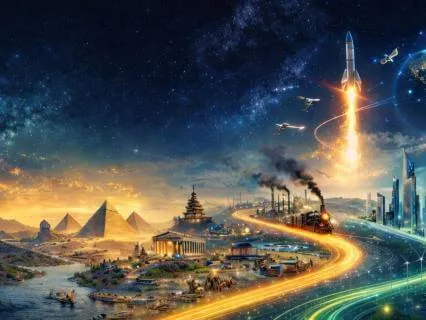
In Egypt,
Agricultural coordination along the Nile supports monumental construction.
The Nile itself is a kind of natural technology because its predictable floods turn scarcity into rhythm.
Stand before the pyramids and feel the heat reflecting off the limestone blocks.
Then consider what had to exist behind that stone for it to become possible.
Building a pyramid is not just stacking stone.
You need tools to cut it,
Logistics to move it,
And careful geometry to place it with precision.
A monument is really stored surplus turned into coordination.
When floods bring reliable harvest,
Food supports workers who are not farming.
And that freed labor can be organized into massive projects.
Planning turns effort into structure.
And structure becomes stone that lasts.
Civilization shows up in monuments.
But monuments only exist because of the invisible systems beneath them.
In the Indus Valley,
Urban planning reaches remarkable sophistication.
And what is striking is not only what they built,
But what they prioritized.
Streets are laid out in grids.
Drainage systems channel wastewater away from homes.
Wells provide cleaner water.
Sanitation is not spectacle,
But structure.
That choice reveals a different angle on energy.
Because energy is being organized not only for display and power,
But for daily stability.
A society's relationship to energy is expressed in what it chooses to maintain.
Not only in what it chooses to celebrate.
In China,
Dynasties rise with elaborate bureaucratic systems.
And bureaucracy is a technology of governance that organizes human energy through rules,
Records,
And rules.
Paper is invented,
Allowing knowledge to be recorded and transmitted more efficiently.
And when knowledge becomes lighter,
It becomes more mobile.
Printing multiplies text and makes ideas harder to contain.
Gunpowder reshapes military power and changes the balance between walls and force.
Engineering projects redirect rivers,
Build canals,
And create defensive works stretching across landscapes.
Those projects reveal the same pattern repeated at grand scale.
Energy is gathered.
Energy is directed.
Energy becomes structure.
Around the Mediterranean,
Greek city-states build a culture of philosophy.
And it is not a break from real life,
But a way of giving life meaning and structure.
In Athens,
People gather in the Agora to debate justice and leadership.
And those debates matter because reasoned argument becomes a tool for solving conflict without constant violence.
When a society can talk through problems,
It wastes less energy fighting itself and can use more energy to build.
The Parthenon,
Rising above the city,
Reflects not only beauty,
But the stability that makes beauty possible.
Over time,
Some communities move from raw force towards ethics and clear ideas about how humans should live.
Socrates presses questions.
Plato shapes dialogue.
Aristotle organizes the natural world.
And disciplined thinking becomes a kind of foundation that holds a civilization together.
Energy becomes intellectual order.
And intellectual order becomes a blueprint for what comes next.
Rome expands by turning ideas into systems.
Roads span the empire and keep trade moving.
Aqueducts carry water across valleys with careful gradients.
Concrete arches support bridges and buildings that outlast politics and generations.
Roman law sets shared rules and reduces friction across many regions.
The Colosseum looms over the city,
Using spectacle to create unity and reinforce power.
For a time,
This coordination brings stability and wealth.
As Rome stretches further,
Strain grows.
Supply lines lengthen.
Defense costs rise.
Leaders drift from local needs.
Corruption spreads.
Trust weakens,
Even in money,
As the currency is repeatedly debased and its value erodes.
When security declines,
Trade contracts.
Cities shrink.
And the empire fragments.
Not because energy disappears,
But because its systems cannot carry the complexity they created.
Civilizations expand and contract.
And the pattern is not a moral drama,
So much as a systems lesson.
Structures hold when incentives align.
Structures crack when reality outgrows governance.
In East Asia,
Dynasties rise and fall in cyclical patterns.
Each cycle refines administration even as it tests legitimacy.
Bureaucratic governance becomes more sophisticated.
And sophistication allows larger populations to be managed with fewer violent disruptions,
At least for a time.
In South Asia,
Philosophical traditions explore consciousness,
Ethics,
And metaphysics.
And those explorations shape cultural resilience because they provide frameworks for suffering,
Responsibility,
And meaning.
Across the Islamic world,
Scholars preserve and expand knowledge into mathematics,
Astronomy,
And medicine.
Often building on translated works and extending them through ordinary inquiry.
Algebra develops a formal language of relationship.
Observations track planetary motion with increasing precision.
Medical texts organize practical knowledge into repeatable methods.
Learning becomes a global relay,
Rather than a local flame.
And when knowledge travels,
Civilization deepens.
Alchemy starts as a mythical search to turn metals into gold.
But over time,
It becomes chemistry as people test ideas through repeatable experiments and careful records.
Across the world,
Civilizations encounter the same turning point in their own time.
As symbolism slowly gives way to method,
And wonder becomes something you can verify.
Belief systems spread too,
Uniting people under shared stories and building institutions strong enough to coordinate millions.
Yet those institutions are eventually tested when the ideals they proclaim drift from the realities of power.
Every civilization lives inside that tension,
Because humans need shared meaning to build together.
And they also push back when meaning hardens into control.
Agrarian societies in Europe evolve into feudal systems.
Feudalism is a way of organizing energy through land and obligation.
Land concentrates power.
Lords manage estates.
Farmers labor under layered commitments that define survival and identity.
Castles rise as defensive solutions to insecurity.
Cathedrals reach upward in stone and stained glass,
Expressing transcendence through architecture and reminding the population that life is part of a larger story.
Energy is structured through bonds of protection and loyalty.
And those bonds can create stability while also limiting freedom.
As time passes,
Maritime exploration begins to stretch civilization across oceans.
And the ocean itself becomes a new arena for the organization of energy.
Stand on the deck of a wooden ship crossing the Atlantic.
Feel the mixture of uncertainty and ambition that drive such voyages.
Some aboard seek trade routes to Asia.
Some seek land.
Some seek freedom from political or religious constraint.
They reach the Americas,
Lands already inhabited by complex societies,
Shaped deeply by forests,
Plains,
And rivers.
The meeting of these worlds becomes one of the most consequential and violent reorganizations of human history.
Trade networks among native civilizations already span great distances.
Farming supports large populations.
Governments take many forms,
From confederations to empires.
New populations arrive with different diseases,
Technologies,
And ambitions.
And the meeting of these worlds reshapes everything.
Forests are clear.
Towns are mapped.
Ports connect continents.
Seashells,
Found high in the Appalachian ridges,
Confuse early settlers,
Because they do not yet realize the land beneath them was once an ocean floor.
That small discovery is symbolic,
Because it shows how quickly the world can remind us that our understanding is still growing.
Energy reorganizes again.
And every shift carries both creation and disruption.
Then the Industrial Revolution ignites another transformation.
And it is difficult to overstate how dramatic this shift is,
Because it changes the scale at which energy can be harnessed.
Coal fuels steam engines.
Textile mills multiply output and concentrate labor in cities.
Railroads stitch continents together,
Collapsing distance into schedule.
Iron becomes steel,
And steel becomes a skeleton of modern infrastructure.
Banking systems finance expansion.
And finance becomes a mechanism for pulling future value into the present.
Insurance mitigates risk,
Allowing larger projects to proceed.
Each machine births new industries.
Each industry reorganizes labor.
Each invention reshapes time and space.
And the human day begins to revolve around clocks,
Shifts,
And production targets rather than sun and season.
Electricity floods cities with light.
And light changes the psychology of night because it reduces the boundary between day and darkness.
Telephones carry voices across miles,
Shrinking communities into networks.
Oil fuels engines for automobiles and aircrafts,
Transforming mobility into normal expectation.
Aviation shrinks oceans to hours.
And the planet begins to feel smaller,
More connected,
And more volatile because events in one region ripple quickly into others.
The 20th century oscillates between expansion and contraction.
Global conflicts redraw borders and accelerate technology through necessity.
Political ideologies rise and falter.
Colonial systems dissolve.
And newly independent nations navigate the difficult work of building institutions under pressure.
International bodies attempt coordination at global scale,
Seeking to reduce conflict even as power competition persists.
Medical science advances dramatically.
And this is another reorganization of energy because health is the baseline that determines how much human potential can be expressed.
Clean water infrastructure reduces disease.
Vaccines prevent widespread illness.
Antibiotics transform survival.
Life expectancy increases across generations.
And when a society expects longer life,
Its planning horizon changes.
People invest differently.
Governments structure differently.
Families imagine the future differently.
Today,
Energy moves in quieter,
Less visible ways,
Which makes it easy to forget how much we rely on it.
Electricity powers data centers nonstop.
And tiny microchips turn that current into computation.
What once filled a room now fits in your pocket.
Information now streams under oceans through fiber optic cables.
And across the sky via satellites.
Money is shifting as well as we move into a digital age.
In ancient countries,
We used to exchange a value through physical goods like salt,
Shells,
Silver and gold,
Then eventually through paper and modern fiat.
Finance is being disrupted as more activity moves onto blockchains,
Where ownership and exchange can be recorded directly on a shared ledger.
Some networks secure that ledger through proof of work,
Anchoring digital history to real world energy in a way that is costly to rewrite and simple to verify.
That matters in a world where so much can be copied,
Edited,
And rewritten.
Artificial intelligence is also reshaping civilization.
Not only by automating tasks,
But by giving humanity new tools to see patterns,
Translate knowledge,
And amplify creativity at a scale that once belonged only to institutions.
Used well,
It can widen access to learning and accelerate problem solving.
Even as it forces us to stay honest about dependence,
Control,
And the kind of future we are building.
Civilization has expanded into cyberspace.
And cyberspace has both become a frontier and a mirror.
Communication is immediate.
Markets operate in microseconds.
Identity exists both physical and digital.
And the tension between those selves can shape mental health and social cohesion.
Communities form without geography,
Which can be liberating and destabilizing at the same time.
Energy is now signal,
Code,
And computation.
Yet it still rests on physical infrastructure,
Mine materials,
Supply chains,
And the steady flow of electricity.
Beneath every server farm and satellite launch,
Tectonic plates continue their slow drift.
And the ancient truth remains that the human layer is built on older layers that do not negotiate.
The human layer remains foundational.
Even if it feels ordinary besides rockets and algorithms.
Biological energy fuels each breath.
Mental energy turns perception into innovation.
Emotional energy sustains endurance.
And social energy binds people together through trust and shared intention.
Civilization still depends on how wisely we organize these forces.
And when they fail,
The strain shows up everywhere,
From burnout and division to fragile systems and unstable markets.
Now humanity looks beyond Earth,
Carrying that same impulse to expand.
Not across oceans this time,
But into orbit and beyond.
Rockets launch.
Space stations circle.
Satellites circle.
And engineers design habitats for worlds that demand precision,
Because space allows no romantic shortcuts.
From fire to fields.
From cities to empires.
From industry to computation.
And now towards interplanetary ambition.
Energy remains a constant thread.
Continents drift.
Civilizations rise and fall.
Technology accelerates.
And the story continues.
Not as something finished behind us.
But as something we are shaping with every decision about how we gather energy,
How we direct it,
And how we treat one another in the process.
The future will not be decided only by the next invention.
The deeper question is whether we can build institutions worthy of the power we unlock.
And whether we can develop the inner discipline to use that power without losing ourselves.
History suggests that the strongest civilizations are not simply those with the most energy.
But those that turn energy into stable life,
Thoughtful culture,
And meaning that lasts.
Especially in ways that make ordinary days more humane and the generations that follow more secure.
Your life matters.
And it is already part of a story larger than you can see from inside a single day.
Civilization is shaped by countless quiet choices.
And when you add your work,
Care,
Restraint,
And courage to that unfolding story,
You help strengthen what comes next.
Let this settle as a question you carry forward.
With the time and energy you have,
What will you offer?
What will you strengthen?
What will you repair?
And what will you build that adds more trust,
Wisdom,
And stability to the world around you?
The world is still in motion.
And history is not behind you.
It is happening through you.
With every day inviting a little more compassion,
Clarity,
And responsibility into the human story.