Welcome to NIDRAworks.
This practice is a little different.
It's more stripped back with a bit more explanation along the way.
I'm hoping it might be a useful way in for people who are new to this kind of practice.
And if you've been practicing for some time,
Remember that a change of approach now and then can be a useful experience.
However you've arrived here,
I hope you enjoy.
This is non-sleep,
Deep rest.
NSDR for short.
It's based on Yoga Nidra,
A deep relaxation practice from the yogic tradition.
The term NSDR was coined by Dr.
Andrew Huberman,
A neuroscientist at Stanford,
To describe Yoga Nidra and related practices in plain scientific language.
Huberman is a huge believer in Yoga Nidra and he practices it himself.
He has described it as the most powerful tool that we can cultivate because it teaches you to turn off thinking and planning.
You don't need any experience and you don't need to do or know anything special to get the full benefit.
Here's the idea.
Your nervous system has two broad modes.
One gets you ready to act,
Heart rate up,
Attention narrowed,
Muscles primed.
The other handles recovery,
And most of us spend far too long in the first mode.
NSDR is a structured way to shift into the second while staying awake.
The method is simple,
Controlled breathing and moving your attention around your body in a set sequence.
Slow exhales are one of the few direct levers you have on your heart rate.
The body scan gives your mind a job,
So it stops running through tomorrow's to-do list.
Research on these practices is promising,
So treat this as an experiment.
Do it,
Notice what changes,
And draw on your own conclusions.
There'll be some silences along the way,
And that is intentional,
So there's no need to wait for the next invitation.
Just rest in the gap until my voice comes back.
Your only job is to follow the invitations,
And if your mind wanders,
Just come back to the next one.
And if you fall asleep,
Your body probably needed it.
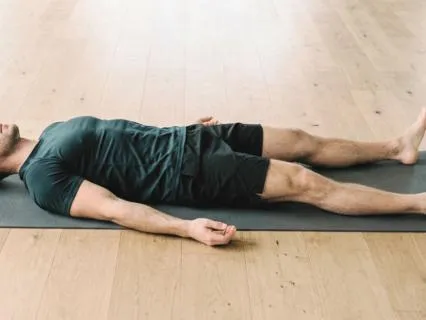
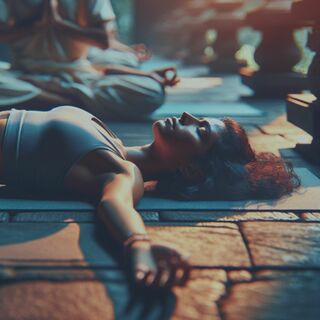
So lie down on your back.
On a bed,
A mat,
Or the floor.
Arms by your sides,
Palms facing whichever way feels natural.
And let your feet fall outwards.
If your lower back is uncomfortable,
Put a pillow under your knees.
And close your eyes,
Or you can rest your gaze softly on one point on the ceiling.
Take a moment to get still.
If you need to adjust anything,
Do it now.
After this,
The aim is to stay as still as you can throughout the practice.
We'll start with a breathing pattern called the physiological sigh.
It's a double inhale through the nose,
Then a long,
Slow exhale through the mouth.
Your body knows how to do this.
It does it when you're about to fall asleep,
And sometimes when you've had a lot of stress.
It regulates your body back to a state of balance.
We're simply inviting to do it here on purpose.
Here's how.
Inhale through the nose,
Deeply.
At the top,
Take one more short inhale to fully expand the lungs.
Then exhale slowly through the mouth all the way out.
Let's do it together.
Inhale through the nose.
And a second sip of air on top.
Now a long exhale through the mouth.
Again,
Inhale… Chop it up.
And slowly out.
One more.
A deep inhale.
Top it up!
And a long,
Slow release.
Now,
Let the breath return to normal.
We will move your attention through the body one point at a time.
When I name a body part,
Rest your attention there.
That's all.
You don't need to move it or relax it.
Just register it in your mind and move on when I do.
This sequence is quick.
Keep up with it.
Bring your attention.
Your full attention to your right hand.
And your right hand thumb.
First finger.
Second finger.
Third finger.
And Littlefinger.
The palm of the right hand.
Back of the hand.
Right wrist.
Forearm Elbow Upper arm,
Right shoulder,
Right armpit.
The right side of the ribs,
Right hip.
Right thigh,
Right knee,
Right shin,
Right calf,
Right ankle,
Right heel.
The sole of the right foot.
Top of the foot.
You're right,
Big toe.
Second toe.
Fur-toe.
Fourth Toe and Little Toe Now move your attention to your left hand and your left hand thumb.
First finger.
Second finger.
Third finger,
And little finger.
The palm of the left hand.
Back of the hand.
Left wrist.
Forearm.
Elbow Upper arm.
Left shoulder.
Left armpit,
Left side of the ribs,
Left hip,
Left thigh,
Left knee,
Left shin,
Left calf,
Left ankle,
Left heel,
Sole of the left foot,
Top of the foot.
Left big toe.
SECOND TOE Third toe.
Fourth toe and little toe.
Now move your attention to the back of the body.
Both heels against the floor.
Backs of the calves.
Backs of the knees.
Backs of the thighs.
Both glutes.
Lower back.
Middle back.
Both shoulder blades.
Upper back.
Back of the neck.
Back of the head.
Top of the head.
Far ahead.
Right eyebrow.
Left eyebrow.
Right eye.
Left eye.
Right ear.
Left ear.
Right cheek.
Left cheek.
Nose and the tip of the nose.
Upper lip.
Lower lip.
Jaw.
Let the jaw unclench.
The whole of your mouth.
Gotcha!
And your throat.
Your chest.
The right side of the chest.
The left side of the chest.
Your whole chest.
Upper abdomen.
Naval.
Lower abdomen.
Now the whole right leg.
The whole left leg.
Both legs together.
The whole right arm.
And the whole left arm.
Both arms together.
And the front.
To the bottom.
To the right.
The whole body.
The whole body.
Lying here.
At rest.
Now bring your attention to the breath.
Don't change it yet.
Just observe it.
Notice the air moving in and out through the nose.
Notice it's slightly cooler on the way in and slightly warmer on the way out.
Notice the movement of the abdomen.
As it rises on the inhale.
And falls away on the exhale.
Now make one adjustment.
Make each exhale slightly longer than the inhale.
Don't force it.
Just invite the out-breath.
A little slower.
Notice that your heart rate tends to drop slightly on the exhale.
That's your parasympathetic system.
The recovery side getting involved.
You don't need to do anything with that.
Just notice it.
Your body knows best.
Now let the breath go back to its own natural rhythm.
Allow everything to be just as it is.
Now bring your attention to where your body meets the floor.
Back of the head against the surface beneath you.
Feel that contact.
Both shoulder blades.
Elbows.
Backs of the hands,
Or the palms,
Depending on how they're resting.
The back of the pelvis.
Backs of the thighs.
The calves.
Both heels.
Now feel all of these points at once.
The whole back of the body.
In contact with the floor.
Notice where the pressure is strongest and where it's lightest.
You don't need to change anything.
Just notice it.
The support beneath you is taking your full weight.
There's nothing for you to hold up.
Here,
You can let go.
Next,
We'll work with opposites.
I'll name a sensation.
And see whether you can find it somewhere in the body.
Recall it.
Remember it.
Notice any part of the body that feels heavy.
Pressing down onto the floor.
Now lightness.
Find any part that feels light.
As if it had almost no weight at all.
Heaviness again.
Lightness.
Now hold both together in your mind's eye.
Heaviness and lightness at the same time.
And then let that go.
Now invite warmth in the body.
Find any area that feels warm,
Perhaps the hands.
The Chess or any place where your body is touching the floor.
And then coolness.
Perhaps the air at the nostrils on each inhale.
Or any exposed skin.
Warmth.
Coolness.
Coolness.
Warm.
Now warmth and coolness together,
Both at once.
And then let both go.
Go back to neutral.
You'll now count your breath backwards from 18 to 1.
Each exhale is a number.
Say silently to yourself.
Breathing in 18.
Breathing out,
18.
Breathing in 17… Breathing out,
17.
And so on.
If you lose count,
And most people do,
Start again from 18.
Losing count is a good sign.
This is not about the destination.
It's all about the journey.
Begin now,
At your own pace.
And whatever number you've reached.
Let the counting go.
From here on.
There's nothing left to do.
You can stop directing your attention and stop managing your breath.
Let the breath go back to find its own rhythm.
You can let go of trying to relax and of checking whether this is working.
Let go of doing it right.
The body is fully supported.
The mind doesn't need to be anywhere in particular.
Just lie here.
And resting.
If thoughts come.
Let them come and go like traffic passing outside a window.
You notice them.
But you don't follow them.
In a moment,
My voice will fade,
And you'll have some time to rest in silence.
I'll come back to guide you out,
So there's nothing to keep track of.
Just give way to rest.
Start to come back.
Take a slightly deeper breath in through the nose.
Notice the surface you're lying on and the sounds in the room.
Make small movements,
Move your fingers and toes,
And roll the hair gently from side to side.
And if you like.
You might want to stretch your arms above your head.
And lengthen through the whole body.
Them when you're ready.
Open your eyes.
That's NSDR.
Before you get up.
Take a few seconds to check in.
How does your body feel compared with when you lay down?
How clear is your head?
You don't need to judge it,
Just notice it.
If you do this a few times a week.
This shit.
Tends to come faster.
Because you're training a skill.
This has been Nitro-Wax.
Thank you so much for your time.
And for practicing today.
I hope it might have piqued a little interest.
To dive a little deeper into other practices on the channel.
Thank you.