It is a little after 11 at night and Nora has done the evening carefully.
The dishes were finished an hour ago.
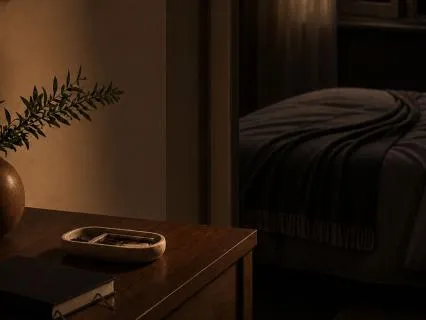
The room is dark and the air is cool.
Her phone is charging on the far side of the room,
Face down,
Because she read somewhere that this helps.
She gets into bed,
Pulls the blanket up over her shoulder,
And she is genuinely tired.
This is the part where sleep is supposed to happen.
For a few minutes,
Nothing much does happen.
She lies there,
The house makes its small,
Saddening sounds.
Then a thought arrives,
Quietly,
Almost politely,
And the thought is a question.
The question wants to know how long she has been lying there.
That question is where the night turns,
Because now Nora has something to do.
She rolls onto her other side,
And the new side feels better for about 40 seconds.
She lengthens her breathing because slow breathing is supposed to be calming,
And then she listens to her own breathing to find out whether the slow breathing is calming her.
She notices that her jaw is tight,
So she softens her jaw,
And a minute later she checks her jaw again to see whether it stayed soft.
If you have had a night like this one,
You know how reasonable each of those moves feels while you are making it.
Each of them is Nora being kind to herself.
Many evening tasks respond to closer attention.
Falling asleep goes its own way.
Each time Nora checks whether sleep has arrived,
Her attention returns to the waiting.
The check gives her the same answer,
So she looks for the next thing to adjust.
Nora knows some of this already.
Is easy.
Knowing it at 11 at night,
In the dark,
With tomorrow waking on the other side of the morning,
Is a different matter.
There is a good reason she is trying this hard.
Sleep matters to her.
She has a real day tomorrow and people who need her in it.
Gives the mind one more thing to stay busy with.
There is something available to Nora here and it is smaller than it sounds.
Some of the night is genuinely hers to arrange.
The dark room and the cool air and the phone across the floor are hers.
So is the hour before bed and what she puts into that hour and the time she decides to get into bed.
The moment sleep actually begins still arrives in its own time.
For Nora,
Waiting for it feels like trying to remember a name that sits just beyond reach.
She can feel how much effort she is bringing to the waiting.
So picture Nora at 11.
40,
Still awake,
Giving the next 10 minutes a different job.
For those 10 minutes,
Her job is to be comfortable and to let her body rest and to let sleep take whatever time sleep takes.
She still wants to sleep tonight.
She has simply taken sleep off the list of things she has to produce before midnight.
It is a small move and what it does is take away the question she has been asking herself every few minutes,
Which is whether this is working yet.
For those 10 minutes,
There is no result to check on and when there is no result to check on,
The checking part of her mind has nothing to do.
The clock is the next piece of this and the clock has to move.
When Nora looks at the time,
She gets more than a number.
She gets a forecast.
At 12.
50,
The arithmetic happens instantly.
12.
50 turns into 5 hours of sleep at the very best,
And the meeting at 10 turns into something harder than it needs to be,
And the evening is written off before the evening has happened.
In one glance,
Lying in the dark,
She has drafted the whole of tomorrow out of very little information.
So the clock turns to face the wall.
The alarm stays exactly where it is,
And she will still hear the alarm in the morning.
Looking at the time has become a decision she makes on purpose,
Instead of something her hand does while she is thinking about something else.
Around midnight the mind can become strangely responsible.
The mind remembers the email she meant to send,
And the form with the deadline on it,
And the thing she promised her brother she would sort out.
The mind is doing something protective here.
It is worried that she will forget,
And it has noticed that she is finally lying still and available.
So the notebook lives on the floor beside the bed.
Before she gets in,
Nora writes three lines.
The thing that needs attention tomorrow,
The first move she will make on it,
And the time she will sit down and deal with everything else.
Then,
At 12.
50,
When the email comes back to visit,
She has something true to say.
The email is written down.
The email already has a time.
If something genuinely new turns up,
She writes one short line and puts the notebook back on the floor.
That leaves the question of where her attention goes for those 10 minutes,
And the answer can be almost anything,
As long as the thing she picks is close and ordinary.
Nora picks the weight of the blanket across her chest.
The blanket is ordinary and already there.
She lets her attention rest on its weight.
She leaves the blanket as a place to rest rather than turning it into a way to measure sleep.
When she notices that her attention has wandered off to the meeting at 10,
She comes back to the blanket.
The return can happen at a gentle pace.
There is a version of this night where the mind gets restless with the whole idea and goes looking for a better method.
She could try counting,
And then a new position,
And then the app with the rain sounds,
And then the body scan she learned two years ago.
Each of those switches starts with the same silent question about whether the previous method was working yet.
And asking that question over and over is its own way of staying awake.
One ordinary thing,
Held loosely for a stretch of time,
Gives the night much less to assess.
Somewhere in here Nora might feel a small protest,
And the protest deserves an answer.
Letting go of the effort can feel like pretending she does not mind whether she sleeps.
She minds,
She has a day tomorrow that matters to her,
So both things get to be true out loud.
She wants to sleep tonight,
And she wishes tonight were easier,
And for these few minutes she is resting anyway.
Saying what she wants,
With some warmth,
Does more for her than trying to argue herself out of wanting sleep.
And there is a part of this that a recorded talk cannot reach.
If sleep has been hard for a long stretch or if the nights are affecting daily life,
The next useful step is a qualified person who can look at the whole picture with her.
Health concerns connected with the night deserve that attention too.
Bringing a simple account of when the trouble started,
What the nights look like and how the days feel can support that conversation.
A kinder way to meet a wakeful hour is worth having,
And that conversation is worth having too.
So what actually changes for Nora?
Maybe nothing on the first night.
Some nights she still lies awake for an hour.
What changes is what that hour is made of.
It becomes an hour of lying in a warm bed,
In a dark room,
Under a heavy blanket,
With the clock facing the wall and tomorrow already written down on a page beside her.
The wakefulness is still there.
What she has put down is the extra job she used to do on top of the wakefulness,
Which was watching it,
Correcting it and turning it into a forecast about tomorrow.
And when the morning comes,
She meets the morning with whatever energy she actually has,
Instead of the energy she predicted for herself at 12.
50 in the dark.
If tonight is one of those nights for you,
Give the first 10 minutes to resting where you are.
You could turn the clock toward the wall and leave the alarm exactly where it is,
And then you could let your attention settle on something plain and close by,
Like the weight of the blanket,
Or the warmth of the pillow under your cheek.
The room stays dark,
The night can carry its own time.
Sleep is welcome whenever sleep wants to arrive.
You are allowed to stop waiting up for it.