Hi,
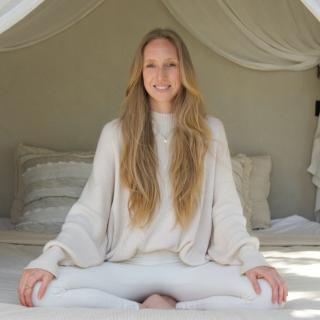
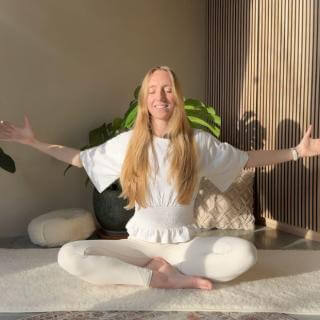
My name is Dieke and welcome to this yin yoga practice which is specifically designed to cultivate more of your feminine energy and to connect you to your feminine essence.
Now,
Yin yoga in itself,
As the name says,
It has the word yin in it,
Which stands for the feminine principle,
Is a beautiful way to connect you to your feminine side and to cultivate more of these feminine qualities and skills,
Like learning how to soften,
To slow down,
To truly relax.
To go inwards,
Learning how to listen to what's happening inside of your body,
Learning about the ability to truly feel again.
And so therefore practicing yin yoga is a beautiful way and naturally connects you to your feminine essence.
However,
Today's practice,
We're also specifically working with poses that connect to energy channels in the body that are connected to the water element and the winter season.
Are covering the kidney and the bladder organ systems.
And according to Chinese medicine,
It's these energy channels that specifically connect you to a very deep yin feminine space within.
And so basically this practice is a sort of double whammy where yin yoga in itself connects you already to the feminine and also the poses we're doing are specifically targeting that deep yin space within.
And so together they make the ultimate yin yoga practice to activate and cultivate your feminine energy.
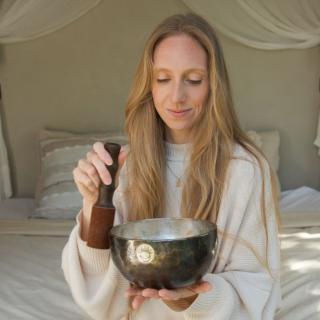
One bell marks the start and three bells mark the end of this practice.
So you know that there is this set container.
Lastly,
One good thing to know about a yin yoga practice is that we are going to be holding poses for a few minutes.
And the invitation in every pose is not to engage,
To be there in an activated space where you have to do the pose.
Instead,
The invitation is to really let go.
We're trying to find the space within that pose,
Within that asana,
Where you're not doing.
Where you're letting go of the muscle activation,
The muscle tension,
So that we can target a different type of tissue,
Which we call fascia or connective tissue in the body,
Which is a little bit more dense and plastic like,
And it takes a bit more time for that to open up and the stretch.
And that's why we soften into that pose.
We let go of the muscle tension so we can tap into that kind of tissue.
And it's believed that within that fascia,
Within that connective tissue,
The energy channels,
The meridians run.
Okay,
Besides that,
What can be handy to have close by is a little pillow or a bolster.
You might need it,
You might not,
But it's really good to have that option as the invitation also in every yin pose is to see what works for your body.
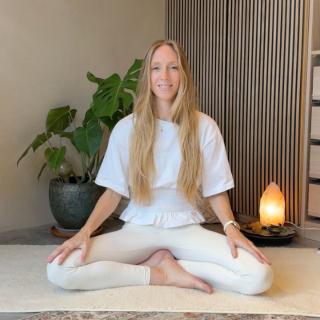
And so I'm personally now sitting on a little bolster,
So I like to use this,
But just any kind of random pillow that you have close by in your space is gonna be perfect.
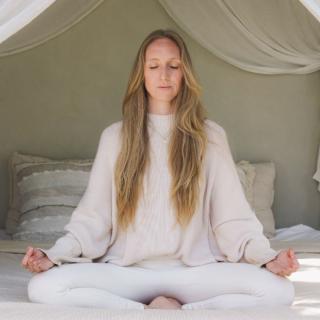
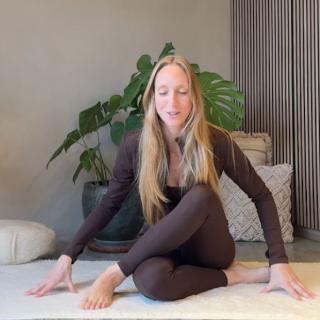
Then I'm going to invite you to come to a cross-legged seated position,
Just like I am.
Making yourself.
Cozy,
Comfy.
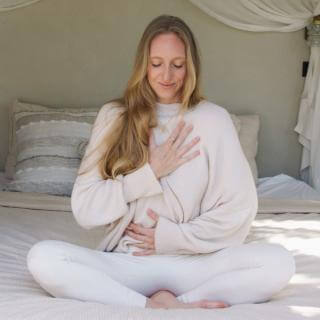
And then here you can place your hands in front of your chest in a little prayer pose.
And taking a moment to set that intention or to thank yourself for showing up.
And then we're going to begin.
You And then I'd like to start off by just taking three in and exhales together.
So taking an inhale through your nose and with a relaxed jaw,
Open mouth,
We're sighing it out.
Okay,
Gentle breath in.
Exhale,
Open mouth,
Relax your jaw,
Let it go.
And again,
Deep breath in.
Exhale,
Soften,
Let it go.
And once more,
Gentle breath in.
And exhale,
Side out.
And then from here,
Just picking up your hands,
I'd like to shake out my hands a little.
And from there,
Shaking out my shoulders and my arms,
Just giving my body a little shimmy and a shake.
Because maybe you've been busy doing lots of things.
Or just in general,
It's nice to start a yin practice where you're going to Stay put in one pose by just giving a little bit of freedom and openness to the body,
A little bit of space for energy to start moving.
Give your arms,
Your hands,
Your shoulders a little shrug,
A little shimmy.
And maybe moving out the arms a little left and right,
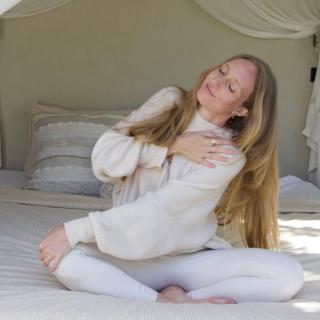
A gentle twist into spine.
Amazing.
And then from here,
We're going to roll forwards coming into a cat cow pose,
Just gently warming up the back line of the body,
Which we're going to be working with a lot.
So hands underneath your shoulders.
Knees underneath your hips.
And then from here,
Gently belly drops.
Just moves forward.
And eventually gently gazing up so you're arching the spine.
And then exhale,
Chin to chest,
Stomach in,
Rounding,
Pressing the mat away.
Rounding the spine.
And once you've got that movement,
You can close your eyes already.
Let your attention go inwards.
Inhale,
You're arching.
And exhale,
You're rounding the spine.
And I want you to bring the awareness.
To your spine here.
And without any judgment,
Just noticing,
Just witnessing,
How does your spine feel today?
And doing one more round of Cat-Cow Inhale.
Belly drops,
Chest moves forward.
Arching,
Opening up the front line of the body.
Exhale.
Belly in pressing them away rounding.
And then keeping your eyes closed here,
Keeping the attention within.
Just a minute or so here.
Free flow movement.
With the intention being just stretching out anything else.
And giving a bit of space to your body.
To tell you what it needs.
And also exploring how does your body feel.
So you can color outside of the lines of that normal cat cow movement.
I'm making it a little bit non-linear.
So you might be moving forwards,
Left,
Right.
Backwards.
Maybe sitting,
Rolling out your shoulders.
But the main intention here is to listen to your body,
So it's not so much about what I'm doing.
And that's my invitation is just keep your eyes closed.
And just stretch out your body.
Connect to your body.
Tuning in where is your body at in this moment.
Beautiful.
Last few moments here,
Maybe taking one more breath.
Hmm.
And then.
.
.
Coming back,
And from here,
I'm gonna be showing you the first yin pose we're gonna be working with,
Which is called the swings pose.
We're gonna come lie down on our bellies.
And from here,
We're going to come up onto the forearms.
And so we want to create a little bit of an opening of the front line of the body,
As well as connecting here to the kidneys,
Which are on either side of your spine,
Just below the rib cage.
And what's important in the first few moments of every yin pose is that you're just exploring how does this work for your body.
And we're trying to find that space where we're not actively doing the pose.
So this is not an active pose.
Muscle activation position here.
We're trying to find a space where we can just relax,
Where we can stack our bones.
So that we can really soften while at the same time holding the position so we can let our body tap into those connective tissues and those energy channels.
You might want to play with your legs being close or a little bit further out.
Also,
What can help is the position of the arms.
So maybe you want to come onto your elbows,
Placing your chin into your hands like you're sort of as a kid used to watch maybe television or something like that.
You might want to have the arms a little bit wider out or closer in.
And specifically in this posture,
Making sure that we're not doing too much in the shoulders.
So letting the shoulders just really sink.
You're not holding yourself up.
If you're noticing you're still having to do this too much and it's not really relaxing,
Then you can always place some pillows underneath your chest also and just holding the pose like that.
So play around a little bit.
And then once you've found your shape,
Just dropping into stillness.
And then at first.
Just want to make sure that your body.
Is as soft and relaxed as possible.
And so making sure that your jaw is relaxed,
That you're not clenching your teeth anymore.
Maybe letting your lips gently separate.
Maybe even relaxing your tongue.
And then from here noticing what's happening in your shoulders.
Let's see if you can let your shoulders.
Be as relaxed as possible.
And then making sure your bum is relaxed.
Your legs are soft and are not squeezing anymore.
And when you found that space of non-doing in this pose.
Just shifting your attention,
Your awareness.
Towards your breathing.
And see if you can just witness and notice.
Every inhale.
And every exhale.
That your body takes so naturally for you.
So in this pose,
We're working.
With the kidney meridian,
The kidneys.
As well as with the bladder meridian.
These energy channels are really connected to regulating our life force energy.
Connected to our nervous system.
And so this pose is designed to really rejuvenate your essence,
Your life force.
Taking three more in an excels here.
And then after your third exhale.
We're going to very slowly come out of this pose.
By lowering the upper body down.
And I want you to think about.
Moving through honey.
So in slow motion,
You're lowering all the way down.
Letting your head come to one side.
Arms can be down to body.
Or besides the body.
And taking a moment here of rebound,
As I like to call it.
So you're not straight away counter-stretching or doing anything.
But just dropping into stillness.
Letting the effects of that pose sink into your body.
And it's a beautiful moment to fully check in.
And see if you can notice what's happening in your body.
Maybe there is lots to feel.
Maybe there's not so much.
Both are perfectly all right.
Taking one more breath here.
And then bring the hands on either side.
The body fingertips in line with your shoulders,
Gently activating your core muscles and pressing up.
Keeping the movement slow.
But coming up to a seated position again so I can demonstrate the next yin yoga pose we're working with.
Which is going to be a forward fold.
So we're opening and connecting to the back line of the body.
We're going to do that one leg at a time.
So coming to sit,
Stretching one leg out in front and then bending the other.
So I have the left leg out,
Bending the right knee,
Placing that right foot on the inside of that left groin.
And from here,
We're gonna turn the upper body to face that leg.
And the intention is that we're gonna round and fold forwards.
Now,
Before we do,
A few adjustments here that you can make.
If this folded knee,
Bent knee is uncomfortable,
It might be nice to place a little bandage.
Bolster or a little pillow to have that support.
If you're noticing that you are struggling to round forwards,
Then it can be very helpful to sit on a little cushion or a bolster.
And that's gonna make it much easier to naturally fold forwards.
Another possibility,
If you're noticing it's really tight in the hamstrings,
You might want to place a little pillow underneath that knee.
So there's many different options to play with.
And this is one of the most important things in yin yoga that you learn to listen to and work with your body.
So there's no perfect alignment here.
It's more about how does this shape work for your body and how can you target that back line of the left leg as well as the back line of the spine.
Okay,
So finding your position and then in the forward fold before we fully round forwards,
It can be nice to initially create some length.
So inhale,
Lengthening forwards.
Exhale moving a little bit closer towards that leg.
And take one more breath,
Inhale lengthening.
And exhale,
Moving forwards,
Folding forwards.
And from here,
Gently starting to round the spine.
And so I'd like to place my hands on either side of that leg,
Palm faces up.
Or palms face up so I'm not really gripping or pulling.
It's really about letting go and surrendering.
And if you're noticing this is too much on your neck or your head,
You can always place a little pillow or a block underneath your head also.
And in that way,
Gravity won't be able to sort of pull you further into the pose.
And will help to support the neck.
And so once you.
.
.
And got that shape.
Just committing to the next few minutes here.
In this space.
And I'd like to start every Yin pose,
But just making sure that I'm not holding on,
Not gripping.
To any tensions.
And so I'm checking what's happening in my jaw.
I'm really making sure my shoulders are soft and relaxed.
And so it can help initially in this space to move your neck a little bit left and right.
Your head.
Making sure it's really dangling down.
And just checking that you're not having your left leg activated anymore.
There's no muscle tension.
And then from here.
Like to practice and invite you to cultivate this sense of awareness and mindfulness.
So bringing the attention towards your breathing initially.
And so while being in stillness,
See if you can stay present with your breath.
And see if you can witness how your body takes those inhales and exhales so naturally for you.
And once you can stay anchored in that presence,
In that connection to your breath,
Just starting to witness and see if you can tune in with what's alive in your body.
What sensations are there?
And can you witness those sensations?
Without any judgment.
Without any stories.
Without trying to distract yourself.
Taking three more in an excels here.
And then after your third exhale.
We're going to slowly come out of this pose,
Again,
Remembering Moving as if you're moving through honey So gently.
Rounding back up.
All the way back up to a seated position.
Maybe supporting that folded leg to stretch out.
And then placing your hands just behind you,
Sort of stacking your bones.
Leaning back and taking that moment of rebound.
This moment of integration afterwards.
Where the invitation is to really check in.
Maybe being curious whether you can sense a difference between your left and right side.
Gentle breath in.
And gentle breath out.
And then from here,
We're going to do that same pose on the other side.
And just knowing that your left and right side are never the same.
So maybe the shape on this side looks slightly different or you might need a different support.
Just truly being curious,
So bending that left knee now.
Right leg stretches out.
And again,
You might want to sit on a little pillow or have a little pillow under that folded leg or knee.
And then turning a little bit to face that leg,
Taking two breaths,
Initially lengthen before rounding down.
So inhale.
Lengthening forwards,
Creating a lift in the chest.
Exhale,
Hinging from that hip.
In breath.
Out breath and then from here slowly starting to round coming into that forward fold.
Taking those first few moments here to really fidget around,
Support yourself.
So that you have that space and that shape where you're like,
Yes,
I could hang out here for a few minutes without going anywhere or making any adjustments.
And then once you've found your shape,
You can close your eyes.
Letting the attention travel within.
And making sure that your body truly is soft and relaxed.
That you're not gripping or holding on trying to do this pose.
But instead you're finding this space of surrender,
Of non-doing.
Maybe moving your head a little bit left and right,
Up and down.
To make sure your head is really dangling down.
Your shoulders are soft,
Your jaws relaxed.
Letting your belly puff out naturally.
Relaxing in the hips and the legs.
And from here,
Bring the awareness towards your breathing.
And practicing this sense of mindfulness and awareness.
Can you stay connected,
Observant of your breathing,
Of your body?
You might notice that that works for a few seconds or moments.
You might also notice that at times your mind takes over and you find yourself lost in a story.
Lost in a judgment.
In a reminder of a to-do.
And so if that happens,
Just celebrate.
Congratulate yourself for becoming aware.
And shifting your attention back towards your breathing.
Towards your body.
You might have to do that every few moments or there might be longer pauses.
One is not necessarily better than the other.
It's just about that practice of witnessing or becoming aware.
And shifting the attention back.
Taking three more in and exhales here.
And after your third exhale.
As if you're moving through honey.
You're slowly unraveling your body,
Coming out of the shape.
Placing your hands behind you,
Stretching your legs out.
And taking that moment of rebound.
Which is a moment of checking in and being curious of what's alive in your body right now.
One breath in here.
Exhale,
Side out.
And then from here,
We're going to come into one more shape.
Of today's yin practice.
Crossing your legs,
We're going to fold forward.
Coming again onto hands and knees.
And then from here,
We're gonna get the big toes to touch,
Knees out wide to the outsides of the mat.
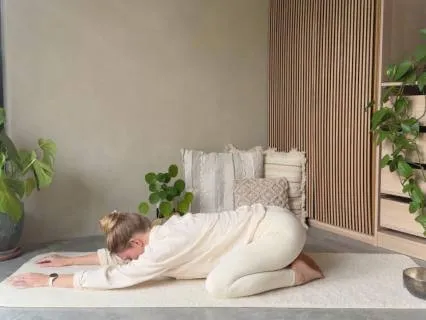
And we're gonna come into a child's pose.
Again here,
The target area is the inside line of the legs as well as the front and back line of the body.
And if you're noticing this is too much on your knees,
It's always possible to place a bolster or a pillow.
In between the knees or just below your bum.
And also the same thing goes for you might want to actually have a pillow to lie down on for your chest if there is otherwise too much of an opening.
So again,
Just fidget,
Move around,
Play around to see how can this shape work for your body.
And then once you've found that space,
Coming into stillness.
So in this shape,
You want your hips.
To move down towards your heels.
They might be close,
They might be far away,
That doesn't really matter.
Gravity will gently pull them there.
And at the same time,
Your forehead rests down and your chest will lower down towards the floor.
Really making sure,
Again,
Your face,
Your jaws relax.
There's no gripping into the arms,
Into the shoulders.
Letting your belly puff out naturally.
Eyes are closed,
Attention within.
And starting to practice your mindfulness,
Your meditation.
Either committing to following your breathing.
Or you might like to focus on the sensations in your body.
The raw sensations without the story,
Without the judgment.
Just being curious,
Can you feel what's happening?
What's moving in your body.
There might be lots to feel.
Maybe there's not so much.
Both are perfectly alright.
But the same invitation remains.
Can you stay present with yourself?
Open curious of what's happening,
What's alive in your body.
Taking three more in and exhales here.
Inviting you to see if you can be fully present.
Fully aware.
Of all three inhales.
And all three exhales.
And after that third exhale.
We're going to slowly move it in slow motion.
Come out of this pose.
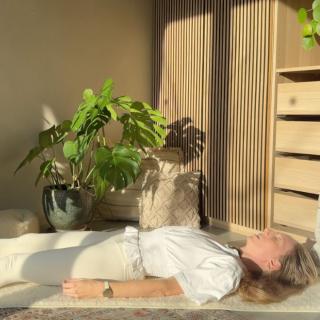
And finding our way into our Shavasana,
So coming to lie down.
On your back.
Legs can be out wide,
Letting the feet fall open naturally.
Arms down by your side.
Palms facing up.
Basically coming into this final rebound.
This final resting position.
Giving space to your body,
To your system to integrate this practice.
And these three bells mark the end of this yin yoga practice.
You can slowly bring a little bit of movement back into your fingers,
Into your toes.
Maybe you'd like to stretch your body out.
As if you're just waking up from the most rejuvenating nap of your entire life.
Maybe you'd like to hug your knees in towards your chest,
Giving yourself a loving hug.
And eventually just finding a way to thank yourself.
Either sitting or lying down.
Coming into a Namaste.
And thanking yourself for showing up.
And for taking this time to come back home to yourself and to your feminine essence.
Thank you.