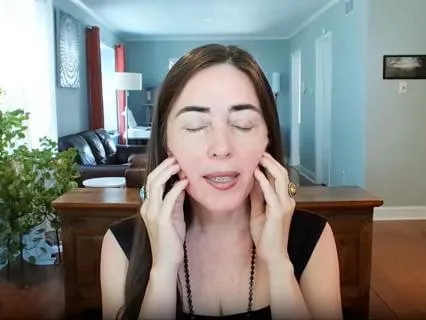
Feel the expansion of being together.
In different parts,
Different time zones,
Different hemispheres,
All here together in oneness.
And this makes my heart so happy.
So that's why I ask you.
You can hear my accent is Spanish.
So I'm originally from South America.
For those of you that don't know me,
I'm a Feldenkrais practitioner.
I am a body worker,
Healer,
I'm healing myself as well as I facilitate healing for others.
I have a beautiful session prepared for us and today we'll talk about why tension builds and why is it so important.
Actually even useful for the body to maintain that and how it creates an imbalance when it's carried for too long.
So it would be like something that you wanna have like an umbrella on a rainy day,
But you don't wanna have it open all the time because then it blocks the sun,
You have to hold it,
It's not useful.
So we'll talk about the benefits of holding tension in the upper back,
Shoulders,
Neck,
Jaw,
Even like the head itself,
Brain,
The head,
The headaches that come with that.
And then also why we don't want to hold on to it for too long.
So we can use it and let go of it if needed.
We can use it.
Otherwise,
Maybe we don't need it at all.
And I want to begin by saying,
Please don't feel that something is wrong with you or that something is broken or that there's a problem you need to fix.
Let's for a moment,
At least for the duration of this time together,
Make a bracket where we contemplate a different approach because sometimes if you see it like that and the things you've tried hasn't worked,
Sometimes it's a different way of looking at it that can begin to make the shift.
So consider that,
Just looking at it from a different angle.
And then maybe applying a new way.
Maybe the tool is similar.
Maybe what I share with you today in terms of movement,
You've heard it before.
But the way that I talk about it,
The way that I'm gonna ask you to do it is gonna be different,
Guaranteed.
Because Feldenkrais is different than anything else you've tried,
If you haven't tried it.
In sum,
It's the perspective,
It's how we do it,
So.
So looking at it with fresh glasses and then how we do it,
Taking a lot of rest during the practice.
And then integrating it,
So you say,
OK,
Maybe she shared 10 things that were interesting.
I'm going to take one or two,
Maybe three most,
And I'm going to use them as much as I can.
Why?
Because everything we do in this kind of work is brain-based.
And your brain,
Think of it as electric wiring.
So every time you make a new connection there,
The brain lights up.
But if you don't do that same connection again,
It disconnects,
Right?
It's almost like.
Two wires that they snap and they go through and you feel the fire,
You feel the light,
You feel the energy,
The difference.
And if you were not to repeat that same connection,
That same movement,
It will disconnect and you will forget it.
And so think of it as a bridge that the neurons,
The brain cells are making at the beginning is very,
Very fragile.
It's almost like made out of cobweb or like a very thin thread.
And the more you repeat,
There's something called my length.
Which becomes like electrical wiring that covers and surrounds that connection.
And over time,
That wiring becomes so strong that that bridge becomes made out of rope and then made out of metal and then made out of cement.
And that's why you have to.
Old habits,
Maybe non-serving habits that are so ingrained because you did that over and over and over again and that connection of that old habit got a lot of myelin surrounding it.
Now what we're going to do today,
Maybe it's new.
Or the way to do it is new,
And we need that repetition to create that strength in the new habit.
Otherwise,
You will forget it,
The old one takes over.
You understand?
Please let me know if this is wrong.
Clear for you because it's at the key of the work we do is that we take one or two things that make sense,
That feel different,
And then repeat them over like a broken record over and over again until your brain goes,
Wow,
That's new,
But that feels great and I'm going to keep doing that.
And that over time replaces the old habits that is less useful,
That is creating pain,
Tension and discomfort.
The main thing for me from all the things I could share with you today has been over time creating a little space.
Here and today we're going to practice that but I tell you from my own experience to make my default placement for my jaw Not here.
Like most people,
They rest here,
I rest there.
So you will always,
If you were to scan me,
X-ray me,
Always find me with a little space.
And why this became so useful for me is because I used to Brace.
Like some of you and then I would have this pain there and I could never let go of that pain there and I wanted to sing or I wanted to deliver like teaching content and it would be hard for me to articulate And then I realized.
.
.
I'm holding.
Too much tightness and creating awareness of that tightness and releasing and creating a little space.
Became the biggest up-leveling for me.
So I decided to become very aware,
Checking all the time,
Where's my jaw,
Where's my jaw,
And unlock,
Drop it,
Like a hammock,
Drop it.
And this is something you can do even with your mouth closed,
So you can practice it right now.
No one could tell.
It's not.
.
.
That is just.
The next one.
Remind yourself of the new little space there.
Now,
If you've carried tight job for many,
Many years,
This might be really hard to do,
So you don't begin there.
You maybe begin with something else I'll share today,
Okay?
I just want to give you first off.
My biggest tip for myself that has worked and for people I work with.
This today.
We're talking about this triangle of tension,
Upper back,
Neck,
And head,
Including the the jaw,
The throat,
And even like the back of the head sometimes.
As an upper triangle,
So an inverted triangle that you can draw.
That is being held by the body.
Brain,
Body,
Heart.
For protection.
That's the way the framing that I have for us today that I want you to consider to contemplate.
And I'll break it down into jaw.
Neck and shoulders but of course you can add more if you want to for yourself right more like eyes nose if that's the area where you feel like you resonate more with protection.
Maybe even yeah,
Words,
Specific words or feelings.
So let's begin with the jaw.
Like what does the jaw do to protect us?
Well,
The jaw is where we clench,
Where we hold back.
The jaw is connected to anger sometimes,
Or things that we want to say,
But we don't really say.
Connected to the throat,
Actually,
Even more than the neck,
Because it's what holds our words back.
So think about any time that you have something to say.
That you felt that you couldn't say because either was inappropriate could hurt,
You were afraid,
You would be punished if you say it,
And you held back.
And you closed your mouth.
Pull the tongue in and hold it.
And over time this protected you from The punishment,
The,
What is it called?
Like a whiplash back or the.
.
.
Whatever.
Unexpected feedback or something you are afraid to receive or something that you knew would come if you say that in overtime you got used to.
Holding back.
Cleanse your teeth.
Tighten the jaw.
Silence.
And that created this bracing.
Maybe it's connected with a little bit of anger because really that's not what you wanted to do,
But that's what you had to do to stay safe.
So that's one perspective,
Right?
One framing.
Of course,
There's conditions like physical conditions,
But today I want you to see this in this new light.
Let's think now about the neck.
The neck is the bridge between the head and the heart.
Is really the connecting at the spine,
The connecting area between head,
Mind,
Thoughts,
And heart feelings,
Emotions.
Anytime there was a little conflict between the head and the heart and you were like wow I really feel this way,
But I don't think it's safe to do that.
I don't think I should be doing that.
And the mind and the heart became in a little tug of war,
The neck.
Braced.
The neck held it.
The neck held it together and sometimes overrode the heart and went with the mind or sometimes the body.
Overrode the thought and said,
No,
It's okay,
We're gonna go with it anyway,
But the neck held all that conflict,
All that bracing and became the detail.
Tail sign.
What is that word?
Like you can see it in the neck.
You can see the conflicts in the neck.
You can see the resistance,
The holding back.
Now the shoulders.
Easy because it's where we carry the weight.
The shoulders mean responsiveness.
Every time the world asks something of you,
An email,
A person,
Work-related,
Situation-related,
Health condition,
Financial worry,
You're braced and I'm using the same word bracing because bracing means protection.
Brace for impact,
Right?
So you brace,
You raise your shoulders just a little bit and each time just a little bit more and then just a little bit more and then just a little bit more.
And it's almost like,
Think of a thermostat.
The temperature keeps rising,
Rising,
Rising,
Rising,
And you don't notice,
It's like the frog that is being boiled very slowly.
That's the bracing of the shoulders because you don't realize that every time you need a little more bracing,
A little more clenching to maintain that state.
And over time it becomes invisible.
You don't notice it anymore.
It's a signal that is being sent to the brain.
My latest video track.
I will share with you explains that at the neuron level and the muscle level.
How does it happen that we become so used to being here that we don't notice that we're raising the shoulders anymore and all that tension drops in the back especially and sometimes also in the front in the pectoralis muscles here and they get so jammed.
And so tight that no matter how much poking and pushing and massaging you do,
It doesn't go away.
Maybe for a little bit,
But not permanently,
Because the brain will bring that tension back.
And it becomes the neutral tone,
Instead of resting tone,
Neutral,
Tight tone,
Neutral.
Like if you had a fist permanently on your arm and then that arm is not available for anything else.
You can't hold,
You can't caress,
You can't grab because you're always tight.
Does that make sense?
You understand the explanation.
Collarbone,
Tension pain,
Right,
Because there's a front and back of the work,
The body,
They work together.
Flexors and extensors work together.
Belly and lower back work together.
The traps and the pectoralis work together,
The back here and the front here.
So you might not be feeling in the back,
Maybe a little bit hard to the touch,
But you feel it in the front and you feel the tenderness and that when you do that,
You can't go back or it hurts.
Okay,
So that's the framing for us today.
It's protection,
It served a purpose,
No problem.
We don't want to say,
Bad neck,
Bad job,
Why did you do that?
You couldn't help it.
And so nothing's wrong.
Except is not needed.
And we want to perhaps create a new option.
And so when faced with the same input.
The trigger comes in again.
And you feel like,
Oh,
I don't want to say that,
You find a way to still maintain that silence if that's your choice,
But you don't have to use your body for bracing.
Next time you have a conflict between the head and the heart.
And you're looking for your resolution,
You don't have to hold that conflict in your neck.
You can still maintain a free neck even though you're figuring out how to bring coherence between the heart and the head.
Does this make sense to you guys?
Please say in the chat if you're getting it because that gives me feedback that we could move on to the next section,
Which would be the practice.
When you lie down for 20 minutes,
Your nervous system resets automatically no matter what you're doing.
So that's why that's the go-to position for healing,
For recovery,
For rest.
Sleep okay and that's why I'm going to invite you next to go to lie down if you can we're going to work in sitting but if you can take your breaks lying down much better so if you can do that now bring me with you,
Take your device with you,
But you don't need to look at me because this felt-increase work is mainly guided.
Almost like a movement meditation,
Where you don't need to see the person,
You can hear it,
And you'll be guided,
And you'll find your own movement,
And that's why it's so efficient,
Because your brain wants you to find your own movement more than a copy of mine.
Trust me with that.
The brain uses different set of neurons,
Mirror neurons if it's copying,
But so many other motor cortex,
Prefrontal,
Even the amygdala,
All sorts of parts of the brain will respond to guidance.
More than copy and paste.
So please go ahead and lie down and we're going to go into about a 15 minute practice.
20 minutes maybe.
And then at the end,
We come back to the sharing,
Okay?
And so if you can lie down,
Stretch out fully.
If you can't because you're in a situation where you can't lie down and cross your legs at least and sit back and fully relax.
And first of all,
I like to always bring attention to the.
.
.
How do you feel?
What is the sensation?
Internally.
What kind of contact are you making with the place you're on,
The surface you're on?
Do you feel heavy,
Light?
Do you feel tight?
Expanded.
At the beginning.
And If you can close your eyes.
And imagine your body as if you were lying on a big piece of paper.
What is the outline?
Of your body.
How does it feel?
Connected,
The legs,
The spine.
The arms.
They have.
The jaw,
The pelvis,
How do they live there?
Or are they isolated parts?
And if you follow this idea all the way and think of you drawing yourself on a piece of paper what is the size if you could draw say a circle for your head the jaw inside the hand.
Align for the spine.
Circle for the pelvis.
Or the two hips.
What is the size of these circles and lines?
Because pain,
As a signal,
Has a funny way to sometimes enlarge an area that is not that big but is so dominant in your awareness that it becomes huge.
So say if you right now have a migraine or some neck pain.
Maybe that area of your body feels huge.
Heavy.
In comparison to your big toe.
Or your sternum.
I don't know,
Even some organs of your body that completely disappear.
You don't even notice.
And the painful discomfort.
This comfortable area,
Uncomfortable area is beating on your heart.
Attention like pay attention to me.
I'm here.
I'm here.
I'm here.
So notice that And that will probably change by the time we're done the practice.
If you're lying down also,
Notice the sensation of right and left side.
Sometimes it's different.
One side feels longer,
Lighter.
Closer to the ground.
And also notice the place where your head is touching.
If it's in the middle or you feel tilted or turned.
Right and left.
Just observe that.
And then gently Make a movement for your head to the right and to the left.
And see if you can keep your eyes closed.
How smooth is this movement?
Does it feel.
.
.
Tight,
Contracted,
Constricted,
Or free.
And if you open your eyes,
Looking around,
Is there a jumpiness where your head jumps or do you feel like a smooth gliding and your eyes go and your head follows?
Easily.
Is it the same to the right and to the left?
Is it a curve?
Or a straight line.
If it's a curve,
Does it go down?
Or up.
Those are all minor.
Pieces of information,
Indicators of what is going on in your neck.
In your eyes,
Head.
Fine.
And that changes as well as you practice.
So you want to take the temperature,
Say,
The beginning.
Before we make any changes.
And that's already giving your brain a little bit of sensory input,
Information from your senses.
And telling you where things are at at the beginning.
So now keep the head quiet and observe any sense of tension in your jaw.
You can feel it with or without your hands.
The space between upper and lower jaw.
And any sensation on your shoulders,
Contact with the floor,
Tightness,
Maybe one feels forward more than the other.
Maybe they touch the floor or maybe just the tips of the shoulder blades touch the floor.
And now make the movement of your head again,
Just take the head left and right slowly.
Slow is better for noticing than fast.
Very fast.
Think of your driving a car like 10 miles an hour versus 60.
So in 10 miles,
You can really see around you the landscape.
Like you're looking for that house.
Is it 60 or 65 or 71?
Like the number on the door of the house.
But if you're running 50 miles an hour,
You miss completely all the houses.
You can't find anything.
So you go slow enough that you can find out,
When I turn the head,
Is there any movement on the shoulders at all?
Are they free to move with the head or are they frozen in place and the head moves separately?
This is vital,
Crucial piece of information for you.
So notice again.
.
.
Right turning,
Left turning.
Do the shoulders move at all?
If you want to,
You can place the hands on the front.
The shoulders which is the sternum collarbone area and see do they move at all.
By themselves,
Without you.
Trying too hard to move them.
Good.
And then come back,
Let that be,
Rest again.
The resting time is the golden time.
Where you integrate,
You load in your brain's computer all this information.
So value,
Appreciate,
Respect.
Honor the rest.
As you would the movement.
Okay.
And also you can breathe and sense yourself,
Gather yourself.
Take a moment.
Now in just a bit,
We're going to get up and sit.
And then gravity comes up and there's a lot more effort.
Take your time with it.
Be gentle.
And don't sit and move for too long.
Whenever you want to come back to rest,
You can do that.
Even if I don't say that.
So come back to sitting.
You can bend your knees,
Roll to one side,
Come to sit.
If you're working on the floor.
You can put one leg in front and one leg behind or cross your legs.
Whatever is more comfortable.
You can sit on a pillow if you need to.
And now.
.
.
Take a moment to observe this state.
The position of your jaw.
And you can take your fingertips.
Like you were holding.
I think that.
.
.
Clearest image of holding something like this that I have,
But it's not a common experience is holding a bow.
An instrument bow and maybe like a stick.
Like something that you would hold gently and not grab tightly just gently hold and that's the kind of hold that we want here.
And observe when you hold your jaw from the bottom and from the top that there's a bony denting there like an indentation where you can hold put your thumb there And then use your other fingers to lightly catch the top.
Of that same bone,
The bone of the lower jaw.
And now gently.
Not pushing.
Very,
Very kindly lift it up.
As if you want to close the gap between upper jaw and lower jaw,
Just lift it gently.
And with that,
Look up with your eyes.
And hold it there.
And it's going to feel like such a tiny movement that doesn't make a big difference,
But it will in the end.
So just go with the process.
Lift it.
So you're creating the clenching with your hands.
Relax your tongue inside the clenching,
You're lifting.
Looking up,
And maybe if you're sensitive,
You can see your breath response by maybe holding maybe your your chest lifts just a bit it's very minimal but it happens that when you clench this whole thing becomes a chain reaction.
So if that happens,
You allow it.
Allow your shoulders to lift just a bit,
Your breath holds.
The whole body goes.
.
.
And that's.
Normal.
So do it.
And then slowly release and when you release create that little space I was talking about in the beginning just enough as if your lower jaw is now hanging on a hammock.
And you can drop the belly.
Drop your eyes.
Make a miniature rest,
Little break.
And then we're going to do it again.
Lift.
Hold.
Allow your emotional body to feel this.
There's a little safety here,
But there's also discomfort.
There's something about it that doesn't feel so good.
When you're in clenching mode,
When you're holding up and down.
And holding the breath.
But we do it all the time,
So it's familiar.
And now gently relax,
Drop,
Drop,
Drop,
Drop.
So levels.
You drop the jaw,
Drop the shoulders,
Drop the breath.
Pause there for a moment.
Allow your body to calibrate to the difference.
Even though That one is familiar,
This was.
.
.
The second state where you're dropped down.
Creating a little space,
Feel safe.
Easier.
Something here again.
Soften.
And now we're going to make it,
We're going to turn up the volume on this and going to make it a little bigger,
Not by pushing harder,
But by exaggerating.
So you're going to breathe in and then as you,
As you breathe in,
Hold,
Lift and hold.
And see that I'm lifting my shoulders as well and I'm holding the breath and everything is pulled up and you're holding it.
And here what we're saying is,
I get it.
This is what I do.
And I'm going for it full on.
Minus the emotional charge,
Minus the drama,
The trigger,
The stress,
Just the body.
But making it very clear,
So you're lifting.
Your shoulders,
Lifting your jaw,
Clenching,
And inhaling and holding your breath all at once.
And stay there for as long as it feels comfortable.
The moment it becomes uncomfortable,
Begin to release it.
As if you were like a wave now falling down,
Down,
Down,
Down,
Down,
Dropping,
Dropping,
Dropping.
There is nothing else that is holding up against gravity.
Melting down.
And do that maybe two more times.
I'm going to let you do it on your own now.
So you don't copy me you can close your eyes and the idea is to go with the So you're breathing in,
Lifting your jaw with your own hands.
Lifting your shoulders,
Lifting this sternum and holding.
In a mini clenching.
Bracing.
You're using your hands so you don't have to create effort.
On your teeth.
And everything is held.
Shut.
And almost maybe if you close your eyes you can feel that there's a miniature sense of safety there.
It's like,
Okay.
I'm tight,
I'm here,
No one can hear me,
See me.
I'm not creating any problems,
No waves.
And so the brain may recognize that safety response,
But it's so inefficient.
It's costing you so much.
You're working so hard for this.
So begin to slowly undo,
Unclench,
Release,
Drop,
Down,
Melt,
Down,
Down,
With a nice exhale.
In.
As if you can put a bag down on the floor.
They've been carrying a huge heavy backpack and go,
For now,
I'm just gonna drop that down.
Now lie down again if you can and let this go.
This is the first little movement sequence that I want to share with you today.
We're going to do two more.
As you lie down again and your body begins to integrate,
Notice what is shifting.
Some things begin to shift almost by magic,
Almost on their own.
Your weight drops,
Maybe you feel more relaxed.
Taking a deeper breath.
Maybe you.
Place your arms more spread out on the floor or can lean on your chair more easily.
Because your body is beginning to get the message that it's okay.
To drop the guard.
It's okay to put it down for a moment.
You're in a safe space.
So breathe and allow whatever comes up.
Sometimes comes tears.
Because you've been holding for so long.
And the moment you can relax is.
.
.
It feels like a big release.
Sometimes you're yawning or sighing.
Yawning or laughing or moaning.
All the sounds of the body are healthy.
Releases so you allow them.
Don't second guess by putting your mind in charge and say,
Why would I do that?
This looks silly.
This is weird.
Just allow what the body knows to come out.
Your body's intelligence.
Listen for that.
And then make a tiny little movement again with your head,
Left to right,
Just see what feels different,
If there's any.
No sensation anywhere,
Just turning the head on the floor.
Looking for Maybe one or two things that maybe feel different.
Direction,
Sensation,
Range.
And now give yourself permission for the next round of movement.
To go all in.
So not second guess,
Not hold back.
And fully go for the experience of it,
Because this is a highly experiential work.
It's not about what you hear and you understand,
It's more about what you do and you remember.
So now come back again.
If you remember which side you came up to,
Say you bend your legs,
Turn to the right,
Now bend your legs,
Turn to the left.
We engage the non-habitual.
Part of our brain.
Come and sit if you had your legs crossed.
See if you can cross the other leg on top or put the other leg in front.
If you had one in front,
One back.
If you're sitting on a chair,
Come to the front edge of the chair,
Keep your spine nice and long.
And now we're going to do the same thing first.
So remember,
Repetition is important.
And we're going to add something.
So let's say you want to do this daily,
You have five minutes,
You do the first thing we just did together.
That's enough.
But say you have a little more time,
So you will do that and a little more.
And so the first one we're going to add to was to gently hold your jaw.
And then move it up,
Remember?
So now we're gonna add to that,
That when you are up there,
When you are in the clenched,
Tightest position,
We're gonna make it a little easier for your body to feel okay there.
I know it's counterintuitive because first we go to the effort,
But that's okay.
So go first to the clenching.
Holding,
Lifting the shoulders,
Everything's tight,
And then you go a little left and a little right.
And your little side to side.
It's gonna feel so weird and that's what I said go all in no one's watching you so basically the principle here is you go with the effort And when you're there locked into the effort,
Just make it a little easier to feel freedom.
So you're going to move a little side to side or maybe a little forward and back.
Whatever you can in that area.
You're almost like in a straitjacket.
It's awful,
I know.
But still,
Find a little movement,
Side to side,
Maybe a little circle,
Whatever you can inside that bracing.
And then release,
Come back,
Rest.
You don't need to do it for too long,
But the brain gets it.
We're creating a sense of ease inside the constraint.
And it's doing something.
It's doing it gently,
But it's doing something.
So trust the process.
When you feel ready,
Do it again with the breath.
So you're going in with the inhale.
And then up there,
Whatever you can.
It's hard to speak and demonstrate,
So I'd rather not demonstrate.
Whatever you can up there.
In the tightness of that breathing,
Just look for a little freedom,
Maybe in your pelvis,
Maybe you're rounding or bending or something.
And then slowly release it.
And we're going to do it a third time before the big reveal.
I know we're making it easier and easier to go into that trap of that effort,
But it's okay because eventually you're going to see that it's so not necessary.
Your brain will say,
Why would I?
Spend time doing this.
Why would I waste energy holding this?
It's so inefficient.
So one last time with the breath,
Go up.
Pull.
And then do whatever you can up there,
Little circles,
Little bending,
Little left and right,
Even minimal only if it doesn't hurt,
Just in the sense of ease,
In the range of ease.
And then Slowly.
Stop that,
Come back,
Release everything.
And when you're in the most relaxed position,
Now you drop the shoulders and the jaw.
Hopefully,
There's a little space there.
Your tongue can rest.
Now look for the same movement you just did.
Whatever you just did,
Do it again.
Maybe it was turning or circles.
Or bending,
Whatever you did,
Do it again,
But do it in the free position.
And look for smoothness more than range.
So I don't need a huge movement.
I need something that feels like silk.
Like water,
Like honey.
Melting.
Dripping.
Running.
Flowing,
Just.
And let your brain feel the difference.
You're a highly intelligent being,
Trust that.
And now when we do again one last time the health movement versus this.
You know what you're looking for.
You're looking for how does it feel to do it when I'm tight.
To do live when I'm up there clenched and tight.
So one last time,
Go up.
Hold.
And try for look for that.
Free movement as free as it can be because you're you're not braced and really feel the cause.
And you don't have to do anything to stop it,
Your body will stop it on its own.
As you do this more and more.
Now come back to releasing everything,
You don't need to be there for too long.
And then when you're in a long spine,
Relax.
Free jaw as much as you can,
Look for the same movement,
Whatever you want.
My favorite sometimes is a figure eight.
Because the infinity,
Which you can do side to side.
Or front to back.
Is very very powerful but even if that's not available to you and you just want to do a circle or a little bending.
And breathe.
And let your body feel wow,
This is.
.
.
This is a lot better.
Isn't it?
And then rest again,
Lie down.
Let this settle,
Take it in,
Integrate it We hear often that our brain,
We use like 5,
10% of our brain's capacity.
And I know that with this kind of work,
Our brain engages.
Way more than 5%.
We are really using.
So much more of our brain potential because we're asking the brain to take in input and then calibrate and then make choices and let go of this and integrate that and connect that.
With death.
The motor cortex with the sensory,
With the emotions,
With the thinking.
Cortex and all of it is creating this bundle like neurons mapping in groups.
And so maybe sometimes when you do this work a lot,
You feel brain tired because we're really working hard.
But how does it feel at the physical level?
See if you feel more expanded.
Something feels easier.
Or maybe when you turn the head again,
There's a little more range,
A little more fluidity,
Or something a little lighter.
Beautiful.
Now you can rest for as long as you want to.
Taking in any information,
Sometimes your body gives you images or insights.
When you get to this.
And for the last movement,
Remember I said I want to give you two or three ways to do this often.
Again and again.
For the last one,
I want you to pick right now before you even get up.
One.
Daily thing something you do a lot could be walk around your house,
Grab a mug,
A cup.
Or reach down.
To pick up an object,
Or go to the bookcase,
Grab a book,
Or sit on a chair,
The sofa,
Grab the TV remote,
Whatever.
It's one daily action that you're very familiar with.
So pick right now.
What are you going to do?
And the instruction is when you get up,
You're going to become like a detective.
Of yourself.
Sherlock Holmes.
Feldenkrais called it and you're going to observe very Curious about how are you doing this activity?
And you're going to watch for three areas.
You're going to watch for your jaw.
You're going to watch for your neck.
You're going to watch for your shoulders.
And you're going to just observe yourself doing it without changing anything.
You're going to do it once and see,
How do I do it?
Maybe opening the door.
It's a really good one.
So please go ahead.
Come up to sit if you were lying down or stand up and go and do your thing,
Your one activity and observe yourself doing it as if you were a detective watching somebody.
Private detective watching.
How is that person doing that?
And catch yourself in whatever micro habits you have of holding.
Or maybe not.
Okay.
And then I want you to do it again.
Inflicting in yourself all that effort we've been working with today.
So something that you can do on purpose,
Like clench your teeth,
Lift the shoulders,
Hold the throat and the neck.
Rigid,
Just do one thing or two or three on purpose as you do the activity.
And maybe you recognize,
Oh yeah,
Like right now I'm in class and everything's great,
But when I'm under stress.
And I'm at work or I'm having a difficult conversation or I'm up in my head and disconnected from my body,
This is how.
And you recognize yourself in the habit.
Of clenching holding,
Embracing.
And that's perfect.
So do that a couple times.
To bring awareness.
And observe how it feels.
When you do it that way,
It's easy.
Highly energy-consuming.
It's using a lot of power,
Muscle tone.
Everything to maintain.
And then.
.
.
Reset.
I like this image of turning the page on your notebook,
Just clean slate.
And intentionally choose.
That as you're gonna do the activity again,
The action,
You're gonna keep that space here.
The first thing I share with you today,
You know,
Unlock of the jaw and you're going to drop the shoulders because that is Lengthens your neck.
So just those two things,
Almost like you choose to draw.
And you can call it unclick,
Drop.
Or just whatever,
Choose a word that you can use to remember this and do the thing,
The activity with that in mind,
Saying,
Okay,
This is my new default now,
My new standard.
I'm going to do it like this.
And it's gonna first feel very weird,
Very unfamiliar,
Like it's a different person.
But still,
I want you to do it.
Couple times.
Maybe simply just like holding the.
.
.
The jaw there.
And then see if you can introduce to that new way just a little more movement,
Exaggerate a little more whatever side to side movement you find,
Circular movement you find,
If you're walking even just the shoulders,
Just whatever there's movement,
You're the detective now,
You have the new standards.
Of you unclenched.
Turn up the volume of whatever movement you see,
Just make it a little bigger.
Your hips.
Swagger,
Some sort of like loose.
Looseness just whatever just make it a little bigger and let your brain recognize the power of movement So instead of holding up and bracing,
You're just dropping and engaging with more movement than usual.
Get your mind out of the way.
And yeah,
See how it feels.
And then pause and then make a choice to revert to the old way or maybe Do another action,
Something different,
But maintaining this new way of awareness of I can drop things,
I can unlock the jaw,
And I can create a little extra movement.
That will support me in staying free.
Staying in motion versus beginning to come back to the frozen state.
And maybe you can go for a third,
Because the principle here,
The sequence,
The movement I want to give to you is that of noticing the dropping.
The releasing and adding movement.
You can apply this to any action,
To cleaning the house,
Driving your car,
Sitting at the computer.
The it is the how.
We are doing it.
Beautiful so now come back and one more time just maybe sit with this for a moment you can lie down of course and now take it all in we're not folding everything together,
Connecting,
Allowing a moment for integration.
For breathing and receiving.
Maybe remembering one or two things that you liked from the session that you want to remember to do again.
And also gratitude towards yourself for being here,
That really goes a long way.
Thanking yourself for taking the time to engage,
To stay.
With this live session,
With me,
With this work.
With your capacity for learning,
For growing,
For expanding,
For letting go of.
.
.
These old habits are old ways of doing things.
And inviting in this moment as we close the practice,
Inviting this to become your new way.
Your new standard,
Your new approach,
Even if it's one tiny thing.
Just welcoming it again and again and again.
Like a new friend that you made that you really like and you want to see a lot,
Hear from a lot.
So that would be you with this new way,
This new attitude,
New perspective,
New practice,
New movement that you learned today,
New idea.
Could be more than one,
But at least one.
And I like to put that in a little safe spot.
Sometimes I imagine like a little treasure chest in my heart.
Or I save it in my solar plexus,
Like not in the head,
Like save it somewhere in your body.
Where you can come back to.
And recall,
Bring it back.
Beautiful.
And then when you're ready,
You can slowly let go of everything.
Just drop your body has it now.
We understood it,
We put it into the body,
Moved through it,
And now you saved it somewhere where you can come back to it.
So you can trust that it's yours now.
The way to keep this would be to do it again and come back to it.
So this is a great time to put notes in the chat,
Write in your journal,
Make a voice note,
Whatever,
However you can remember this.
I will do my best to.
.
.
Play this whatever screen capture and repost it.
Sometimes I get to it,
Sometimes I don't because of time constraints.
And so you have to also remember it.
And I would love to hear from you.
How was it?
How are you feeling?
Did you feel the difference?
Cheryl,
Thank you.
Shirley,
Thank you for your comment.
Yeah please let me know because that's how I know how I landed and I love to hear from you always.
I'm also going to share here a promotion card for donations,
If you can make a donation that would be amazing.
It really helps my work.
I'm a mother of two,
So I'm the income provider for my family and this is part of my work.
And I also want to invite you to take a look at my other work and my teacher's profile,
My website,
The offerings I have.
I know that this is a lot.
We're going through a lot as a collective,
Personally,
Globally.
Thank you so much for your support,
You guys.
And also,
Please put comments in the chat.
How did you find the session?
Did you like it?
Was it easy to follow?
We're so used to copying the person,
Right?
And having the demo and going along and feeling crazy.
It's really not like that.
It's hard for me not to demonstrate at all because I feel like It's against culture,
But really.
.
.
It does feel different.
Did you like it?
Yay,
Leon,
Thank you.
I would love to attend a workshop about this feminist work with attention.
Yes.
Yes,
I'm doing a five day course.
On this and it's going to be in depth.
So it will be a whole session for the jaw,
A whole session for the shoulders,
A whole session for the neck.
And one for the.
Whole body.
And that's coming soon.
It's in production right now.
Thank you so much for your help guys,
Supports Johnny,
Leanne.
Nita Shirley,
Thank you so much for your donations.
What is this in the chat?
I turned in very late,
About five minutes ago.
Oh,
Wow.
So you got something in five minutes.
Yay,
Rosanne.
Thank you.
That's awesome.
Yeah,
Typically.
We think maybe 15,
20 minutes of work is minimum.
But I'm glad that you got something.
Yes.
I will do my best to post this again.
Are 15 minutes good.
This session was so helpful.
Yay!
Thank you,
Martha.
That makes me really happy.
I feel incredibly relaxed and look forward to listening to your guided meditations,
Yes.
I don't have anything in Spanish,
Laura,
Sorry.
I tried some live events in Spanish,
But they were not very well attended.
And as you can imagine,
This takes a lot of work to prepare,
To sit here for an hour,
And then deliver.
And so I wanted to have a bigger audience.
So maybe Insight grows in Spanish.
I would love that,
It's my mother's tongue,
Spanish.
But I did learn most of Feldenkrais in English.
Sometimes it's hard to teach in Spanish.
My life's great question and thank you for that.
My lives are once a month.
So typically,
I would schedule the second.
Saturday of each month.
At 11 a.
M.
Eastern.
That's my proposed schedule,
So you know and you can plan for it.
So you can come back.
Yeah.
Thank you.
And thank you for why I don't know how to,
I don't want to kill your name.
Thank you for your donation.
Linda,
I noticed a relationship between the hip and the shoulder.
Yes,
Fantastic.
So pelvis and jaw,
Imagine they're connected through the spine.
Put your questions in if you have them,
By the way.
So yes,
Whenever you move your pelvis,
Your jaw can either free or unclench.
And one of the sessions I have for free on the Insight tracks is all about that.
So please look for that,
Yeah.
Today,
Because I wanted to concentrate on the upper triangle,
I didn't include so much,
But the moment you begin to move with the circles,
The hips and the pelvis come to play and that frees the whole spine really.
But the neck and the jaw will feel it.
Great observation.
Thank you so much,
Linda.
Bodies.
Oh,
Your neck is saying more,
More,
More.
Yes,
Of course,
Yes.
Yeah,
Definitely the body recognizes like good medicine,
Especially movement in general.
In this kind of movement,
Slow,
Small,
Guided with love and kindness the way I do.
I feel personally that the body really recognizes this as powerful.
Because we are such a culture globally of pushing harder.
Stretching,
Going for it,
And that has a place.
And it needs the balance of the other kind of movement that is more restorative and feel safe and where you can relax and almost feel lazy in it.
And it still has its place and it still works.
I know the body recognizes and it wants more,
More,
More.
That's why I made all these new videos you can look for here and that's why I have more content on my website to support you.
Johnny,
You notice a relationship between jaw,
Neck,
Shoulders and pelvis?
Exactly.
So if you think of the pelvis as a triangle,
Right when you I love to look at the body in architectural ways in like geometrical ways because Like the Leonardo da Vinci,
Right?
We know that the Vitruvian Man by Leonardo,
We know that there's all this hidden geometry and proportions built in the human body.
So you can see the pelvis actually as a triangle.
Yeah,
Or a butterfly.
A triangle.
And then you can see this as a triangle here,
The collarbones to the shoulder edges and then to the tip of the head.
And so these two triangles are inverted and they're connected through the spine.
And yes,
They love to work together and they love to hold together.
So chances are if you are holding your jaw a lot,
You're also holding your perineum,
Your pelvic floor.
And so you can work from either end,
And you can see how they move together.
And they affect one another.
Oh,
Nice.
So I learned basic Feldenkrais in group last month.
Yeah,
Perfect.
These are the times for Feldenkrais.
Because we're hearing so much about nervous system regulation.
Health and this is exactly what the work is designed for.
So I feel like the more people that can do it and then spread the word.
The more the world will benefit.
And my take on Feldenkrais is more about also connecting it with the emotions and the spiritual life,
Not only the physical life.
I feel like these are good times for failing Christ.
So anything else?
Any other questions?
I invite you to come back.
It's not scheduled yet,
But you know it will be the second weekend in August.
Eighth and ninth actually.
And August 8th,
It's a very powerful day,
So we're going to have a powerful session.
I don't know exactly what yet.
What is it?
Lionsgate.
And for those in the spiritual path,
You know the Lion's Gate is a magical portal.
8 8 on most years and this year is 888 because 2026 was 6 years.
7,
8,
9,
10.
Actually,
No.
I just made that up.
But yeah,
26 is 8.
But 2026 is 10.
So anyway,
8.
8 is a powerful portal.
So we're going to use that for sure.
We're going to do something really fun and empowering.
So save the date,
And it's always at 11 a.
M.
That's my perfect timing here on the East Coast.
I know some of you are in New Zealand or places,
I'm sorry.
I can't get all the time zones,
But this time seems to work for most people.
All right,
Last call for questions,
Comments,
Donations,
Requests,
And love in the chat,
Because we're going to wrap it up.
It's past time.
It's such an honor to be here.
I hope you can feel my love and how much I enjoy being with you.
And this has been a great session.
I will make a note to replay this on my profile so you have it for those of you that arrived late.
And thank you so much.
Thank you for your contributions.
In the chat,
In the donations,
And thank you especially for your presence.
It means a lot.
Means a lot to me.
And so I say thank you and goodbye and I will see you again next month.
Have a beautiful day.
Much,
Much love.
And please practice,
Okay?
You will do me the greatest gift.
You will give me the greatest gift if you practice and next time I see you,
You say,
It's a little better.
It's working.
Okay?
All right.
Namaste.
Thank you so much.
Love you.
See you next time.
Bye.