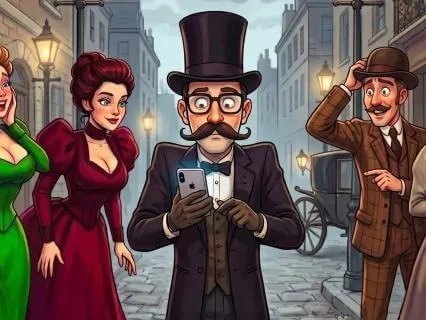
Hey guys Tonight's we begin with a simple question that quietly ruins your morning What if you open your eyes and the air smells like coal smoke horse sweat and boiled cabbage?
You are not sick.
You are not dreaming and your phone is very much not charging outside your window The street is loud in a way engines have not invented yet And everyone seems strangely committed to wearing too much fabric.
You are about to learn very quickly that bathing is optional silence is suspicious and Optimism is considered a personality flaw.
This is not the romantic Victorian era from postcards and novels This is the version with bad teeth rigid rules and a deep belief that emotions cause illness you are here now breathing it in trying not to stare and whether you survive has very little to do with courage and A lot to do with etiquette You wake up already exhausted which feels unfair Considering you have done absolutely nothing yet The ceiling above you is unfamiliar and far too ornate for comfort all Heavy molding and faint cracks like it has opinions about your life choices.
The bed is narrow Stiff and layered in enough fabric to qualify as a minor architectural feature.
Whatever you are wearing is not pajamas It is a commitment multiple layers press against you cinched buttoned laced and tucked in places that suggest the concept of Relaxation has not yet been invented You try to shift and discover that even movement requires planning the air hits you next it is thick Warm and faintly judgmental like it has been watching you sleep and is unimpressed by the performance It smells of coal smoke old wood Soap that tried its best and something vaguely organic that refuses to explain itself Each breath feels curated by a committee that voted against freshness you inhale anyway Because stopping does not seem like an option and immediately understand why people of this era speak so little Oxygen is a limited resource and should not be wasted on enthusiasm You sit up slowly the way someone does when they suspect reality might wobble if rushed the clothes shift with you Producing a soft chorus of fabric noises Rustles and creaks and the subtle whisper of starch.
This outfit was not chosen.
It was imposed There is a collar involved which feels personal it presses lightly against your neck Reminding you to stand straighter think cleaner thoughts and Possibly apologize to someone you have not met yet your feet find the floor and recoil The wood is cold and slightly tacky like it remembers too many previous mornings you glance around the room Taking in furniture that looks solid enough to survive a war and uncomfortable enough to win one Everything is dark heavy and serious Chairs sit upright proud of their discipline a wardrobe looms nearby like it contains both clothing and secrets Nothing here is soft by accident somewhere outside the city clears its throat You hear wheels on stone a distant shout the clop of a horse doing its best bells ring Not urgently just insistently as if reminding everyone that time exists and is not interested in your confusion You move toward the window tugging at sleeves that do not want to cooperate Your reflection in the glass stops you short you look like someone who belongs here,
Which is deeply unsettling The clothes fit too well The style is correct in a way that suggests prior approval.
You do not look heroic or romantic you look respectable That might be worse Respectability feels like a trap with good posture.
You open the window a crack in the street air rushes in Louder and more opinionated than the room it carries the layered scent of animals smoke damp stone and Ambition people pass below without looking up all moving with purpose all dressed as if being seen Improperly could ruin their entire week.
No one smiles.
No one lingers This is a city that believes idleness leads directly to moral collapse your stomach tightens Partly from hunger and partly from the realization that you are expected to know things how to stand how to speak When to look away the rules are everywhere Invisible and strict and you can already feel them measuring you you adjust your posture instinctively Shoulders back chin level trying to look like a person who understands what is happening The air seems marginally less disappointed a sound behind you makes you turn the door handle rattles slightly Then stills as if whoever is on the other side is deciding whether you are presentable enough to witness You clear your throat Testing your voice It sounds fine polite Normal that almost worries you more you take another breath Shallow,
But determined and smooth the front of your clothes The fabric resists crisp and unyielding This is not a world that adapts to you.
It expects compliance quietly and immediately Whatever comes next will require restraint Observation and an impressive tolerance for discomfort.
You are awake now Properly awake and The century is watching waiting to see if you will rise to its expectations or politely fail trying You take a careful look around the room the way someone does when they suspect the walls might be listening because honestly they probably are Nothing here suggests Solitude is a right at best.
It is a temporary privilege granted by architecture that has not yet been informed of its duties The room is not small But it is efficient in an unsettling way Every object seems placed to observe you the bed faces the door The chair faces the bed the mirror faces everything and judges silently You become aware of how much noise you are making just by existing Fabric shifts when you breathe Floorboards respond to your weight with a tired creak like they have already decided how your day is going to go Even standing still feels noticeable.
You lower yourself into the chair by the window and Immediately regret the decision not emotionally,
But physically the seat is firm Aggressively so as if softness would encourage dangerous ideas like relaxation or self-reflection This chair does not want to know you it wants to correct you the concept of comfort here is clearly suspect Anything too pleasant would raise questions.
Why are you at ease?
What are you hiding you glance back at the bed now aware that its stiffness was not a flaw But a moral stance this is furniture that believes suffering builds character You are beginning to understand why everyone walks around looking so upright and tired your eyes move to the walls Which are covered in patterned paper designed to distract you from the fact that it is probably hiding something structural The pattern repeats endlessly a polite visual hum meant to keep your thoughts contained There are no personal touches No photographs,
No mess this room belongs to someone who believes individuality should be expressed quietly if at all and preferably in a diary no one reads you stand again testing the space and Discover that nothing is quite where your body expects it to be the table is just a little too Low the wardrobe door opens with a sigh Revealing rows of clothing that all look equally serious dark fabrics sensible cuts Everything hangs with the weight of responsibility You touch one sleeve and feel the stiffness of starch the faint scratch of wool these clothes are not here to serve you They are here to keep you in line.
You notice the absence of locks The door has a latch yes,
But it feels symbolic more a suggestion than a barrier Anyone could enter at any time the assumption seems to be that if someone does walk in on you It will be your fault for existing improperly Privacy you realize is not enforced by objects here It is enforced by manners people do not intrude because it would be impolite Not because they cannot that somehow makes it worse you imagine trying to change clothes Bathe or simply think without an audience and the idea feels faintly scandalous Somewhere in this house.
There are other people moving about aware of you in the abstract Prepared to acknowledge your presence the moment you make a sound Silence is your only shield even then it is thin you drift toward a small washstand Tucked into the corner where a bowl a pitcher and a towel await this Apparently is bathing you stare at it trying to reconcile the expectation that you will perform personal hygiene Using an amount of water normally reserved for rinsing fruit the towel is coarse the soap smells determined Comfort is clearly not the goal Adequacy is a sudden knock at the door makes your spine straighten before your mind catches up It is not loud.
It does not need to be the sound carries authority someone clears their throat on the other side Politely reminding you that you are not alone in the universe and never will be again you answer Instinctively your voice steady and the door opens just enough for a face to appear neutral observant Respectful,
But only because you have not yet given a reason not to be the interaction is brief Efficient and oddly intimate given how little is said When the door closes again you exhale only then Realizing you had been holding your breath you return to the center of the room Suddenly aware that every inch of space has expectations attached to it Where you sit how you stand how long you linger comfort you now understand is something you earn later Possibly in another life for now you are meant to endure Quietly and correctly the room settles around you unchanged Patient you adjust your posture and prepare to do the same you step into conversation The way someone steps onto ice they are pretending is solid Carefully politely and with the quiet hope that no one notices how unprepared you are The first exchange happens in a narrow hallway where voices echoed just enough to make every word feel public a Woman greets you with a smile that never reaches her eyes and asks how you are this morning you answer honestly Because that still feels natural to you and immediately since you have made a mistake There is a pause a tiny one But it is long enough to matter She nods slowly as if cataloging your response then counters with a comment about the weather Not whether you enjoy it not whether it affects you just a statement delivered with precision you scramble to respond Adding an observation about the chill in the air.
She smiles again sharper this time point to her You begin to realize this is not conversation.
It is fencing Victorian small talk is not meant to exchange information It is meant to test composure each remark is a blade wrapped in lace each pause an Opportunity for the other person to score you are expected to respond promptly,
But not eagerly Warmly,
But not intimately Opinions are allowed only if they are safely boring Enthusiasm is tolerated only if it can be quickly reined in you try again with someone else This time a man who smells faintly of soap and superiority He comments on the state of the household something about efficiency and order you nod adding that it feels well run He agrees Immediately expanding on the subject in a way that suggests he has been waiting all morning to do so you listen carefully Interjecting at what you believe are appropriate intervals too soon and you interrupt too late and you appear slow You begin to sweat not from heat But from mental arithmetic every sentence feels like a trap disguised as courtesy You notice how often people talk without saying anything words drift past you and carefully constructed clouds Remarks about health that are not really about health Comments on society that somehow avoid saying anything specific Compliments that sound suspiciously like warnings you hear phrases repeated with slight variations Like a shared script everyone else memorized in childhood when someone asks about your background your mind races The truth feels dangerous you offer something vague They nod approvingly clearly satisfied that you have understood the assignment another point scored Possibly by you though.
You are not certain you begin to understand that silence can be just as aggressive as speech pauses stretch eyebrows lift teacups clink Someone clears their throat and suddenly the focus shifts you are no longer speaking But you are very much participating your posture becomes a statement your expression a response at one point you laugh Just a little the sound escapes before you can stop it the room reacts the way a library reacts to a dropped book conversations hesitate someone smiles politely Another person pretends not to notice the laughter is not inappropriate exactly But it is unguarded and that makes people uneasy you quickly follow it with a comment about how amusingly predictable things can be Which seems to smooth the moment you make a mental note?
Humor must be self-correcting you watch others closely now Studying their techniques how they pivot away from personal topics How they compliment without committing how they maintain interest while revealing nothing?
This is not friendliness It is endurance with eye contact The winners are the ones who can speak the longest while feeling the least by the time tea is served You are exhausted in a way that feels undeserved Your cup is placed precisely You thank the person who hands it to you careful to match their tone someone remarks on the quality of the tea you agree someone else agrees with your agreement the chain continues smooth and Relentless you realize that this is how status is maintained Not through volume or force,
But through flawless conversational balance Say too much,
And you expose yourself Say too little and you invite suspicion the ideal amount is just enough to prove you belong Without risking proof that you do not a woman across from you meets your eyes and offers a small knowing smile For a moment you feel seen Then she asks whether you have found the season agreeable so far you answer perfectly Only later do you realize you have no idea what season it is you decide that the fastest way to understand?
This world is to ask questions Which feels reasonable until it immediately proves to be a terrible idea it starts small innocent You ask where something is kept not demandingly just curious Lightly phrased the person you ask pauses eyes flicking to your face as if checking for hidden intentions They answer eventually,
But with a layer of clarification you did not request Followed by a polite remark about how things have always been arranged you thank them and move on But the air around you tightens slightly as if you have leaned too hard on a fragile surface You try again later this time with a different person a different setting and what feels like a safer question You ask why a particular room is closed the response is not an answer It is a story a Meandering careful explanation that circles the subject without landing on it Padded with social commentary and historical asides by the time it ends You have learned nothing about the room and a great deal about how uncomfortable your question made everyone nearby that is when it clicks Questions here are not requests for information.
They are declarations of intent direct questions imply impatience Impatience implies dissatisfaction Dissatisfaction implies moral instability The logic is flawless and exhausting You are expected to already know most things or at least behave as if you do if you do not The correct response is to observe quietly until the knowledge arrives on its own Preferably without inconveniencing anyone you test this theory cautiously Someone mentions an upcoming event in passing vague,
But suggestive you want details you want dates expectations clothing requirements survival tips Instead you nod thoughtfully and say something neutral the relief in the room is immediate No one tenses.
No one shifts their weight.
You have done it correctly Ignorance you learn must be worn confidently later.
You forget yourself It happens during a conversation that feels almost comfortable almost Someone references a person you have never heard of and assumes You know exactly who they mean you ask softly who that is.
The silence is surgical It does not explode.
It does not dramatize.
It simply exists heavy and precise Long enough for you to understand that you have broken something invisible Someone clears their throat Another person smiles too quickly.
The original speaker recovers by redefining the question as rhetorical and moves on Sparing you further embarrassment through a mercy that feels suspiciously like correction after that people watch you more closely Not unkindly just attentively you have been flagged as someone who might ask things You begin to notice how information actually travels not through inquiry but through implication Facts are sprinkled into conversation like seasoning meant to be noticed But not addressed directly if you miss them That is on you if you acknowledge them too eagerly that is also on you The correct response is to absorb everything while appearing serenely uninformed you adapt You stop asking where things are and start listening for clues You stop asking why rules exist and start noting who follows them most rigidly You stop asking what people think and begin watching how long they pause before answering someone else This is anthropology conducted in real time with consequences when you need help you phrase it like a confession When you need clarification you frame it as admiration Instead of asking how something works you remark on how impressive it is that everyone seems to manage it So effortlessly this invites explanation without accusation It is exhausting but effective still mistakes happen You ask once whether something is mandatory or merely customary The person you are speaking to blinks smiles and tells you that such distinctions are rarely useful You nod suitably chastened and resolve never to ask that again by evening You are acutely aware of how much you do not know and how dangerous it would be to admit it The Victorian world does not punish ignorance directly it punishes curiosity Knowledge is earned through observation Patience and a willingness to feel foolish in silence you sit quietly as conversations swirl around you Decoding meaning from tone and omission you realize that most people here are doing the same thing even if they pretend otherwise The entire society runs on the shared agreement that no one will ask what everyone is thinking you learn quickly You stop asking questions you finally stand in front of the mirror with intention Which is to say you cannot avoid it any longer The glass is tall Unforgiving and slightly warped the kind that does not merely reflect but editorializes It shows you as the Victorians prefer to see people upright layered and faintly burdened your face looks like your face mostly but framed by expectations you did not agree to Hair sits where it has been instructed to sit fabric crowds your shoulders and chest Guiding your posture into something respectable whether you like it or not This is not grooming as you understand it This is grooming as ideology you touch your hair and immediately feel the resistance of product oil or pomade or some determined?
Substance whose purpose is to remind each strand who is in charge hair here is not meant to express personality It is meant to express control every curl subdued is a moral victory Every stray lock is a potential scandal waiting to happen you smooth it carefully Knowing instinctively that too much fuss would be just as suspicious as too little your face is next Clean yes,
But not comfortable skin feels tight Scrubbed with a soap that believes cleanliness should sting slightly to be effective There is no concept of gentle care This is maintenance not indulgence you notice how closely the culture associates appearance with discipline Looking tired is acceptable looking careless is not lines on a face suggest responsibility Shine suggests laziness you lean closer Examining details you usually ignore eyebrows must behave Facial hair if present must follow very specific rules either carefully cultivated or removed entirely Anything in between reads as indecision even the way you hold your head matters Chin too high implies arrogance too low implies shame the sweet spot is narrow and heavily policed You become aware that grooming here is less about attraction and more about signaling allegiance To look correct is to say you understand the rules to look incorrect is to invite correction sometimes verbal often silent Mirrors are not tools of vanity.
They are rehearsal spaces your clothing demands attention next Buttons must be fastened in the correct order not because it changes their function,
But because it proves You know the order exists collars are adjusted precisely not for comfort,
But for symmetry Sleeves are smoothed cuffs aligned You realize that dressing is a performance done for an audience that may or may not be present Someone could see you at any moment Someone is always imagined to be just outside the room shoes complete the ritual They are polished to a dull shine that says effort without ostentation Dirt is failure Excessive shine is trying too hard you bend to adjust them and feel the resistance of leather that has not yet learned your shape It will eventually You will adapt to each other Reluctantly as you straighten you catch your own eyes in the mirror again and pause There is something unsettling about how quickly you have complied how naturally your hands moved How easily your body learned what was expected?
This era does not need to shout its rules It builds them into routines until resistance feels impractical you notice details now that you missed earlier fingernails trimmed short clean Unadorned hands are meant for work or propriety not display Jewelry if any is minimal and meaningful Everything carries a message even when it pretends not to you wonder how many hours of life have been spent maintaining these standards How much energy devoted to appearing effortlessly correct the mirror does not flatter you But it does approve that approval feels conditional you take a step back and assess the whole picture You look presentable you look appropriate You look like someone who will not cause comment and in this world that might be the highest compliment available There is a strange safety in it the way camouflage works Not by making you invisible,
But by making you uninteresting you turn away from the mirror at last Already feeling the weight of maintaining this version of yourself throughout the day grooming here is not something you finish It is something you uphold every movement risks disruption Every hour invites disorder as you leave the room you catch your reflection once more in the glass smaller now receding the person staring back looks ready ready and Carefully contained you step outside with the cautious confidence of someone pretending This is a normal thing to do the door closes behind you with a solid Final sound that suggests it will not be checking on you again The street greets you immediately and without apology it is louder than expected Not chaotic exactly,
But layered like several lives happening on top of one another with no concern for harmony wheels rattle over stone Hooves strike rhythmically Voices rise and fall in tones that sound purposeful even when they are not and then there is the smell it arrives all at once a thick ambitious cloud that settles into your lungs and Informs you that you are very much alive and possibly making a mistake Coal smoke hangs heavy in the air sharp and sooty Clinging to everything like it plans to stay Beneath it is the warm Unmistakable presence of animals doing their best in an urban environment that has asked too much of them add damp stone old wood Food that has been cooking for too long and a faint trace of perfume fighting a losing battle and You begin to understand the scent profile of progress this street believes in effort You take a few steps forward and immediately realize that walking here is a skill The ground is uneven patched together by generations of decisions that felt reasonable at the time You watch where you place your feet careful to avoid puddles whose depth and origin are entirely theoretical Your shoes are already at risk and you have only just arrived people move past you with practiced urgency No one strolls.
No one meanders Everyone appears to be going somewhere important Even if that somewhere is simply away from wherever they currently are they dress with intention Layers of fabric swaying and brushing as they pass each outfit signaling class Occupation and personal tolerance for discomfort.
You notice how rarely eyes meet Attention here is a resource to be rationed a cart rumbles by Piled high with goods that smell like effort and compromise the driver flicks the reins with casual authority Shouting something that sounds both polite and threatening you flatten yourself instinctively against the edge of the walkway Earning a brief nod from a passerby that feels like approval You are learning already the buildings loom close tall and serious Pressing in on the street as if trying to overhear conversations Windows stare down from above Some curtained some bear all suggesting that someone is watching even if they are not Laundry hangs overhead and defiant lines Fluttering slightly carrying the combined scent of soap and city.
It does nothing to improve matters But the attempt is noted you pass a shop window filled with objects you do not understand but suspect you are supposed to admire Everything looks sturdy Practical and faintly judgmental.
There is no excess here without purpose even luxury wears a sensible expression a man inside polishes something metal with intense focus as If cleanliness itself is a form of ambition children dart past surprisingly agile Navigating obstacles with ease born of necessity They look older than they are and younger than they should be Faces smudged eyes alert you catch a glimpse of a woman calling after them her voice sharp But familiar like this has happened every day forever as you walk the street reveals its contradictions There is innovation here Steam and steel and the promise of something better just around the corner.
There is also decay quietly tucked into corners Accepted as part of the bargain progress.
It seems comes with conditions and no one is pretending Otherwise you pause at an intersection and hesitate Unsure which direction is correct?
The street does not help you it does not offer signs or guidance It expects you to know or at least to choose confidently you pick a direction and commit Hoping decisiveness counts for something a sudden whistle and the rush of movement snap your attention sideways as another cart barrels past Close enough that you feel the air shift Your heart jumps then settles.
No one reacts.
This happens all the time Fear here is managed internally as you continue.
You realize that the street is not hostile It is indifferent it rewards awareness Punishes carelessness and keeps moving regardless of your feelings It smells like ambition because everyone here wants something and like poor decisions Because many of them did not get it the first time you adjust your pace Fall into the rhythm and keep going the city accepts this you begin to notice patterns the way you notice weather Gradually and then all at once class here is not announced it moves It glides past you and polished shoes and measured steps or hustles by with bent backs and quick eyes You do not need a chart to understand it your body Understands before your mind catches up on one side of the street a carriage rolls by Lacquered and deliberate its wheels cleaner than anything else around it.
The horses are well-fed Glossy patient inside someone sits unseen Protected by curtains and assumptions people instinctively give it space Stepping aside without thinking the way you do for something heavier than you.
No one stares staring would imply curiosity and Curiosity across class lines is considered impolite at best and dangerous at worst Moments later a man brushes past you carrying a crate that looks heavier than his future His coat is worn thin elbows shiny with use He does not slow.
He cannot afford to the street does not part for him.
It closes in Forcing him to weave and dodge Apologizing automatically when someone bumps into him Even when it is clearly not his fault you catch his eye for half a second and look away immediately Unsure which of you is committing the greater offense the realization settles uncomfortably You are being placed your clothes your posture the way you hesitate at corners.
All of it is being read People glance at you then adjust their behavior accordingly Some soften some stiffen some ignore you with professional precision You feel yourself slotted into a category that you did not choose But are now responsible for maintaining the wrong movement could shift it the wrong word could collapse it entirely You pass a group standing outside a shop Laughing too loudly their clothes mismatched but confident their ease unsettles you they are not performing Respectability they do not need to their class allows for volume for mess for public existence a Woman nearby watches them with tight lips her disapproval clear,
But impotent she will never speak to them They will never notice her further along you catch sight of a man stepping carefully through the street his coat Immaculate his gloves pristine despite the environment's best efforts.
He does not look at the ground when he walks He looks ahead as if the street should accommodate him it does people shift subtly unconsciously clearing a path Authority here is quiet Assumed and terrifyingly effective you become acutely aware of your hands where to put them How much space you take up you adjust your stride trying to match?
What feels appropriate neither too bold nor too meek?
The balance is narrow you are beginning to understand that class is not just about wealth or title It is about confidence performed so consistently it becomes invisible a shopkeeper addresses you with careful politeness his tone measured He offers assistance,
But does not insist You reply in kind Aware that this exchange will determine more than the purchase He is watching how you speak how you listen whether you treat him as a service or a person you do well enough His shoulders relax slightly you are acceptable as you move on you notice children playing near a doorway Their clothes patched their laughter sharp an older woman watches them from inside her expression tired But protective she notices you noticing them and stiffens you look away Suddenly conscious of how observation can feel like judgment here being seen by the wrong person can carry Consequences you realize that class is not static it flows through the street like water pooling rushing Stagnating in places it determines who stops and who keeps moving who apologizes and who is apologized to it shapes voices Gestures even how people occupy silence,
And it sees you you feel it in the way conversations lower as you pass Then resume in the way eyes flick toward you Assess and move on you are not invisible But you are not fully legible either that ambiguity makes people cautious by the time you reach the end of the block You are tired again Not from walking,
But from constant calibration the street continues its dance around you indifferent to your discomfort Endlessly sorting and resorting its inhabitants you understand now class is not a ladder here It is a current and you are already in it you sit down to breakfast with the quiet hope that eating will be simple a universal act untouched by Ideology this hope lasts exactly as long as it takes you to look at the table the spread before you is modest,
But deliberate Arranged with a seriousness that suggests nourishment here is not just about hunger It is about virtue plates are clean portions measured nothing excessive Nothing joyful enough to be suspicious you take a seat carefully aware that even sitting carries expectations Someone pours tea dark and assertive the kind that tastes like it wants to build character Sugar is offered,
But not encouraged milk follows added in a precise order that you instinctively copy Afraid to reverse it and accidentally declare yourself morally unstable you stir gently Trying not to make noise because noise implies appetite and Appetite implies weakness food arrives in stages bread that is dense and earnest Butter applied sparingly as if pleasure must be rationed an egg cooked thoroughly Because uncertainty is dangerous and softness is untrustworthy you pick up your utensil and hesitate Suddenly aware that you do not know how hungry you are allowed to be conversation resumes around you light,
But watchful someone mentions digestion and passing framed as a matter of discipline a Strong stomach is praised as evidence of good habits and solid upbringing a weak one is spoken of in lowered tones Associated with indulgence nerves and an unfortunate tendency toward imagination you listen chewing slowly Realizing that your internal organs have somehow become part of your character assessment you swallow carefully the food sits heavily Not unpleasant just determined this is not breakfast meant to delight it is breakfast meant to prepare you for endurance You sense that enjoying it too much would be a mistake enjoyment suggests excess Excess leads to moral decay Everyone knows this someone across the table declines a second portion citing restraint This is met with approval another person takes a little more bread But explains it away with an anecdote about a long walk earlier Justification is essential.
No one eats without narrative you consider taking more yourself and decide against it You are not prepared to defend the choice the tea warms your hands and settles into your stomach like an agreement You did not read fully but signed anyway You notice how often food is linked to behavior heavy meals cause sluggish thinking rich foods inflame passions Plain diets produce clear minds and upright citizens The logic is everywhere unchallenged and oddly comforting to those who believe that control over the body leads to control over the world a Comment is made about someone who eats too quickly it is disguised as concern,
But lands like a warning speed implies urgency urgency implies anxiety Anxiety implies moral frailty you slow your movements further Slicing your bread with care chewing thoroughly proving through mastication that you are calm Balanced and worthy of trust you realize that breakfast here is a test you did not study for How you eat matters as much as what you eat?
Appetite must be managed Preferences must be hidden complaints must be swallowed along with everything else even hunger is suspect if it arrives too loudly Someone asks if you slept well you answer politely They nod and remark that good rest supports digestion everything supports digestion sleep posture thoughts Emotional restraint the body in this worldview is a machine that reflects the soul's discipline if it falters It is because you allowed it to you finish your plate and place your utensils down neatly Parallel Signaling completion without satisfaction there is a moment of quiet approval Subtle,
But real you have eaten correctly.
No one congratulates you that would be excessive as the table clears You feel both full and strangely unsatisfied Not just physically,
But existentially breakfast has been consumed But desire has not been acknowledged you wonder how many meals are eaten this way Carefully dutifully with hunger treated as something to be managed rather than understood Rising from the table you feel the weight of the food settle grounding you in the present This is not indulgence.
It is fuel.
It is preparation It is another small way the Victorian world reminds you that even the most basic human needs come with rules and that Digestion like everything else is a reflection of who you are allowed to be You leave the table composed upright and quietly aware that somewhere deep inside Your stomach is being judged you encounter Victorian medicine the way one encounters a suspicious puddle slowly Unwillingly and already aware that this will not end well it begins with a comment Casual and almost kind someone notices you look a little pale pale You learn is not a descriptor here.
It is a diagnosis Before you can explain that you are simply adjusting to the century the word doctor is mentioned and Suddenly your fate is being discussed as if you are a mildly interesting object the doctor arrives with confidence that borders on enthusiasm He carries a bag that looks heavy with authority and questionable decisions His clothes are immaculate his hands are clean his eyes are bright in a way that suggests He enjoys this he greets you warmly Asks very little about how you feel and a great deal about how you have been behaving sleep appetite thoughts moods Everything but pain pain it seems is assumed He listens to your chest with a device that feels more symbolic than effective He taps prods Nods thoughtfully you say a word or two about feeling out of place and his expression Brightens as if you have just confirmed a theory nerves.
He says the word lands with weight nerves explain everything fatigue anxiety confusion The fact that you have woken up in the wrong century is apparently a nervous condition He asks about your digestion of course he does You answer carefully remembering breakfast and its moral implications He seems pleased a good sign he explains that many ailments originate in the stomach Which is both impressive and alarming given how little else he seems concerned with You mentioned the air feels heavy he agrees and suggests fresh air followed immediately by avoiding drafts dampness exertion Excitement and strong emotions the list grows you wonder what is left treatment is proposed not discussed Proposed implies choice.
This is more of a presentation There is talk of tonics Possibly leeches though.
He says it kindly as if introducing a pet Bleeding is mentioned in the same tone one might use for trimming hair you nod along Trying to look cooperative while quietly reviewing your life up to this moment He produces a bottle containing something dark and herbal it smells powerful not pleasant Just determined he assures you it will calm the system Everything is about calming the system You take a small sip and feel your mouth go numb in a way that suggests this substance has seen things He watches closely Satisfied as if observing an experiment that has already been approved you ask Gently what exactly is in it?
He smiles a little indulgent and says it is best not to overthink these matters Faith in treatment is part of recovery doubt weakens the effect you decide not to ask about side effects You suspect they would be framed as character flaws as the visit continues You notice how little medicine here separates the body from the soul Illness is not just something that happens It is something you participate in poor posture leads to poor circulation Poor thoughts lead to poor health a troubled mind disturbs the humors Everything is connected in a way that feels comprehensive and vaguely threatening he offers advice Walk,
But not too far Read,
But not too much Socialize,
But not intensely Rest,
But not excessively Moderation it seems is the cure for everything applied aggressively he warns against over stimulation Which appears to include most forms of joy when he finally leaves You feel lighter only because the room has lost one authoritative presence the bottle remains instructions echo You sit quietly Processing what has just happened you have been diagnosed Treated and morally assessed in under an hour.
No tests.
No scans Just confidence Tradition and a deep belief that the body is a reflection of discipline you realize that medicine here is not about healing in the way You understand it it is about order It restores balance not necessarily health it corrects deviation not suffering to be ill is to be out of alignment with expectations and Treatment is designed to nudge you back into place you glance at the bottle again and consider your options Which are limited and deeply unappealing Somewhere along the way you find yourself reconsidering every decision that led you to this moment Including the ones you did not make the century hums on around you Confident in its remedies you swallow carefully and hope for the best you begin to notice that feelings here do not disappear They are simply rerouted Emotions are not denied outright That would be unrealistic But they are considered volatile substances best handled indirectly and preferably absorbed by objects People do not express themselves They furnish themselves it starts with the chairs Every room seems to contain at least one piece of furniture designed to catch a person mid-collapse low couches with curved backs chaise longs positioned strategically near windows Sturdy armchairs that appear less interested in comfort than in absorbing distress quietly you watch someone sit abruptly Gripping the armrests as if the chair has just saved them from saying something unfortunate No one comments the furniture has done its job you try to follow suit when something unsettles you a remark too sharp a silence too loaded You adjust your posture instead of your face you sit you lean Rearrange your weight the body becomes a translator Converting emotion into angles and upholstery it is exhausting,
But strangely effective No one asks how you feel they notice how you sit laughter is allowed,
But only briefly and at approved volumes Anything louder than a polite exhale draws attention Tears are unacceptable unless accompanied by a sofa and a valid excuse preferably medical Anger is right out if you feel it rising you are expected to redirect it into brisk walking or aggressive tidying Shelves are dusted with remarkable intensity in this era you witness a disagreement Unfold in a sitting room and realize you are watching a duel conducted entirely through furniture placement one person stands Another remains seated a chair is turned slightly away a table is positioned between them like a chaperone Voices stay calm words remain civil The room absorbs the conflict while the people pretend it is not happening you feel something swell in your chest at one point a mix of frustration and disbelief and Have no idea where to put it Your face must remain neutral your voice must stay even you choose a chair near the wall and sit very straight hands folded back rigid This posture you learn Communicates restraint someone across the room nods approvingly as if you have just said something sensible The Victorians believe that unexpressed emotion does not disappear But they also believe it can be managed through environment heavy drapes soften sorrow Dark wood grounds anxiety patterned wallpaper distracts the mind from wandering too far Rooms are designed like emotional containment units Everything is meant to hold you together without Acknowledging what you are holding in you pass a fainting couch and finally understand its purpose It is not there because women are delicate it is there because society needs a place to put feelings when they become inconvenient Collapse is permitted as long as it happens horizontally and attractively the couch takes the blame The person remains respectable men are not exempt.
They simply get different furniture high-backed chairs Writing desks smoking tables places where intensity can be funneled into thought smoke or posture a Man grips the edge of a desk and stares out a window instead of saying what he means the desk creaks slightly under the pressure Everyone pretends not to notice you begin to feel grateful for furniture in a way that feels unhealthy When you are overwhelmed you stand near a bookcase and rest a hand against it Pretending to browse the solidity helps Books absorb more than words here.
They absorb restraint when you are tired you choose a chair with arms Signaling that you are containing something heavy When you are calm you perch lightly barely touching the seat Communicating ease without joy joy is particularly suspicious.
It has nowhere to go There is no joy couch.
No sanctioned joy Ottoman Happiness must be kept small expressed through mild smiles and brief remarks about pleasant weather anything more threatens the balance At one point you feel the urge to speak plainly To say what you think The thought alone makes you glance around for a table to lean on you catch yourself and instead adjust a cushion that did not need Adjusting the urge passes the room exhales by the end of the day your body aches from the effort of feeling without showing Your emotions feel real but distant as if stored elsewhere Possibly in the upholstery you sink into a chair at last Allowing it to take the weight of everything you did not say the chair accepts this without judgment You begin to understand that the most important conversations here happen without words They occur in glances that last a fraction too long in backs held just a little too straight in Silences that are not empty but carefully shaped no one explains this to you You learn it the way people learn gravity by misjudging at once and feeling the consequences Immediately eye contact is the first lesson and it is a delicate one Too much and you are challenging someone too little and you are hiding something The correct amount depends entirely on who is speaking who is listening and where each of you stands in the invisible hierarchy Humming beneath the room you find yourself counting heartbeats without meaning to one acknowledge to Respect three is dangerous territory.
You watch others closely now When someone of status speaks eyes lift briefly then lower signaling attention without intrusion when equals converse Glances meet and separate rhythmically like dancers who know the steps by instinct when someone below you speaks and you are still adjusting to the idea that this happens eye Contact becomes a gift.
You must ration carefully Too generous and you encourage familiarity too sparse and you announce disdain posture follows an extension of the same language Bodies here are never accidental shoulders back but not rigid Chin level but not elevated weight distributed evenly as if imbalance might suggest moral instability You catch yourself slouching once and correct it immediately the movement sharp enough to draw a glance No one says anything They do not need to you feel the correction settle into your muscles like a reminder sitting carries its own rules Leaning forward shows interest but only briefly lean too long and you appear eager Reclining suggests comfort which is rarely appropriate Crossing your legs depends on gender Context and who else is present you choose carefully Adjusting when someone enters the room as if your body is a piece of furniture being rearranged to suit the occasion Then there is silence Silence here is not absence.
It is strategy.
You learn that speaking too quickly Suggests nervousness or a desire to fill space that does not belong to you pauses are powerful They allow others to project meaning on to you,
Which is often safer than providing meaning yourself you practice letting moments stretch Resisting the urge to clarify or soften what has already been said It feels unnatural at first like holding your breath underwater But eventually you realize the silence is doing work on your behalf You watch someone make a cutting remark mild in tone,
But sharp in placement.
The response is not verbal It is a pause Followed by a slight shift in posture and a glance toward the window the room understands The comment has been acknowledged and dismissed without escalation You file this away as a master class when you speak you begin to measure your volume loud enough to be heard soft enough to be controlled Emphasis is subtle Strong feelings are suggested through phrasing not force.
You find yourself choosing words that can survive being ignored This is not pessimism.
It is preparation.
You make a mistake one afternoon Holding someone's gaze a beat too long It happens during a conversation that feels comfortable Which should have been your first warning the other person stiffens almost imperceptibly Their smile tightening their eyes sharpening the moment passes,
But the air shifts You have crossed a line you did not see for the rest of the exchange They maintain a polite distance that feels colder than open disapproval you do not do that again Gradually these rules begin to feel less foreign Your body learns before your mind does you adjust your stance when entering rooms?
You pause before responding you let silence speak where words would complicate things It is not that you feel less it is that you express feeling through restraint There are moments when you long for directness For the relief of saying exactly what you mean and letting it land wherever it may But you also see what happens to those who try they become topics whispers follow them Invitations thin out they are not punished loudly They are corrected socially which is far more efficient one evening You catch your reflection in a mirror across the room while standing among others You look composed Attentive present your eyes move with intention your posture holds you are participating fully without revealing anything Unnecessary it occurs to you then that you have learned the rules well enough to disappear inside them the silence around you approves Work begins before you feel ready for it which appears to be the point the day does not ease into motion here It asserts itself bells ring doors open bodies move with purpose And you are expected to already be aligned with the rhythm as if sleep were a personal indulgence You should apologize for no one asks if you are rested that would imply rest is desirable You quickly learn that being tired is not a condition It is a credential people speak of long hours the way others speak of achievements Someone mentions how late they stayed up working the night before Not with complaint,
But with a quiet pride that hangs in the air waiting to be acknowledged it is acknowledged Nods follow respect is earned another person casually references skipping a meal to finish a task This is met with approval so subtle it feels ceremonial You consider mentioning that you feel alert and immediately decide against it the work itself is relentless,
But rarely urgent Tasks move forward steadily Methodically with an emphasis on consistency rather than efficiency Speed would imply impatience Innovation would imply dissatisfaction with established methods both are dangerous.
You are encouraged to work thoroughly Carefully and for as long as it takes even if no one is quite sure what it is taking you toward joy You discover has no place here or rather it has a place But it is small and carefully monitored a mild sense of satisfaction is acceptable Preferably expressed through a brief comment about having done one's duty anything resembling enthusiasm is suspicious Enjoying your work too much suggests.
You are not taking it seriously enough Enjoying it too little suggests weakness The balance is narrow and exhausting you watch people work with expressions that suggest endurance rather than engagement Brows furrowed lips pressed Bodies leaning forward as if effort itself must be visible to count when someone stretches or shifts too often Eyes flicker toward them comfort is not forbidden But it must be earned and even then it should look accidental breaks exist technically They are short quiet and purposeful tea is consumed not as pleasure,
But as reinforcement Conversation during these moments is restrained focused on tasks Schedules and the admirable difficulty of everything involved someone laughs once Quickly then glances around as if checking whether that was appropriate It was not repeated you begin to understand that exhaustion functions as a kind of moral proof if you are tired You are contributing if you are weary you are worthy if you are energized Something is wrong.
You start to adjust your own behavior accordingly Slowing your movements allowing fatigue to show just enough to signal alignment you sigh occasionally Softly at appropriate moments.
No one calls you out You are learning.
There is a strange comfort in this a grim camaraderie built on shared depletion Everyone is tired together and that sameness creates a bond It is easier to trust someone who looks as worn down as you feel alertness reads as selfishness.
Energy looks like ambition,
And ambition is only acceptable if it pretends not to exist.
You notice how people who genuinely enjoy their work disguise it.
They frame interest as obligation.
Curiosity becomes diligence.
Pride is translated into responsibility.
Someone who loves what they do will say they are merely doing what must be done,
Perhaps with a faint air of martyrdom.
This performance is admired.
As the hours stretch on,
The room grows quieter,
Not because there is less to do,
But because everyone has settled into the steady grind.
Pens scratch.
Papers shuffle.
The soundscape of productivity hums.
You feel time pass not in minutes,
But in posture.
Shoulders ache.
Backs stiffen.
This is how the day marks you.
At one point,
You catch yourself smiling at the satisfaction of completing a task.
It is brief,
Reflexive.
You immediately school your face into something more appropriate,
Something neutral.
The smile feels almost illicit.
You file it away for later,
Perhaps for a private moment when no one is watching.
By the end of the day,
You are tired in a way that feels cultivated.
You have not been pushed to collapse,
But you have been worn down deliberately,
Evenly.
As you prepare to leave,
Someone remarks on how productive the day has been,
Noting the long hours with approval.
You agree.
This is expected.
You step out into the fading light carrying more than the weight of the work itself.
You carry the understanding that here,
Labor is not just a means of survival,
It is a performance of worth.
Exhaustion is the applause,
And joy,
If it appears at all,
Must learn to hide.
You learn the rules before anyone explains them,
Which is how rules prefer to be learned here.
They appear in the way people pause when you speak,
In the subtle recalibration of a room when you enter it,
In the expectations that arrive,
Fully formed,
And do not ask for your opinion.
Gender is not discussed as a concept.
It is treated as weather,
Constant,
Unavoidable,
And somehow your responsibility to dress for.
If you present as a man,
You are expected to be steady,
Decisive,
And faintly exhausted at all times.
Emotion is permitted,
But only in small,
Well-contained doses,
And preferably translated into industry.
If you appear thoughtful,
That is admirable.
If you appear sensitive,
That is tolerated only if it produces something useful.
You are allowed authority,
But not softness,
Unless it is directed downward and framed as benevolence.
If you present as a woman,
The rules multiply.
You are expected to be agreeable without being dull,
Intelligent without being threatening,
And expressive without being honest.
Your presence must smooth the room,
Not disrupt it.
Opinions are acceptable if they arrive gently and leave quickly.
Confidence is admired as long as it never forgets to apologize for itself.
You notice how conversations adjust around you,
Depending on which box you seem to occupy.
Compliments change shape.
Expectations shift.
Even silence means something different.
When you speak,
The weight of your words is measured not just by content,
But by whether you were meant to speak at all.
You test the boundaries without meaning to.
A comment lands slightly off.
A joke arrives too directly.
The response is immediate and invisible.
Someone redirects the conversation.
Someone smiles too tightly.
The moment passes,
But you feel it register.
The room has made a note.
There is no clear punishment for stepping outside your assigned role.
That would be crude.
Instead,
There is correction through atmosphere.
Warmth cools.
Attention drifts.
Opportunities quietly rearrange themselves away from you.
You learn quickly that agreement is less important than alignment.
You do not have to like the rules.
You simply have to move with them.
Clothing reinforces everything.
Fabrics,
Cuts,
And colors communicate intentions you did not realize you were announcing.
You become acutely aware of how much meaning is stitched into every seam.
Too bold suggests defiance.
Too plain suggests neglect.
Everything must signal that you understand the expectations and are cooperating with them,
Even if only outwardly.
You observe others navigating this with practiced ease.
Some lean into their roles so fully it becomes a kind of armor.
Others bend them just enough to breathe.
A few attempt outright resistance,
Usually quietly,
Usually at great personal cost.
Their names are spoken less often.
Their paths narrow.
What unsettles you most is how little malice seems involved.
People are not enforcing these roles with cruelty.
They are enforcing them with habit,
With comfort,
With the calm certainty that this is simply how things are done.
The system persists not because everyone believes in it,
But because everyone is tired of fighting it.
You catch yourself adjusting your behavior instinctively,
Lowering your voice,
Softening your language,
Standing differently.
You tell yourself it is temporary,
Strategic,
A way to survive.
And maybe it is,
But the ease with which it happens unsettles you.
There is a moment when you realize that the rules apply whether you agree with them or not.
You watch someone else step slightly out of line,
Just enough to be noticed.
The response is swift and polite.
A reminder framed as concern,
A suggestion disguised as advice.
They nod,
Thank the speaker,
And fall back into place.
The system hums on.
At night,
When you are alone,
You replay the day's interactions and wonder how much of yourself you edited out without noticing.
You consider what it would cost to stop editing.
The calculation is not comforting.
Still,
There are small rebellions.
A glance held a second longer than expected.
A word chosen carefully but deliberately.
A posture that signals more than it should.
These moments are fleeting,
But they exist.
They are how people remind themselves they are still present inside the performance.
By the end of the day,
You understand that gender here is not just an identity.
It is a script.
You can improvise within it,
But you cannot ignore it.
The stage is too crowded,
The audience too attentive.
You adjust your costume,
Step back into the light,
And continue the scene,
Aware now of exactly how much is being asked of you and how closely you are being watched as you give it.
You expect childhood to feel softer than the rest of this world.
A small mercy tucked inside an otherwise rigid system.
It does not.
It feels provisional,
Something to be managed efficiently until it can be replaced by usefulness.
Children are everywhere,
But rarely centered.
They exist at the edges of rooms,
Perched on stools,
Standing too straight,
Hands folded with a seriousness that feels rehearsed.
Their clothes mimic adult fashion in miniature,
Stiff fabrics,
And tight collars that teach discipline before comfort ever enters the conversation.
Even their toys look instructional,
Designed less for joy than for preparing small hands to one day hold tools,
Ledgers,
Or opinions no one asked for.
You notice how quickly they are corrected,
Not harshly,
Not loudly,
But constantly.
Sit properly,
Speak clearly,
Do not interrupt,
Do not fidget.
Curiosity is tolerated only when it is quiet and purposeful.
Questions are allowed if they demonstrate intelligence rather than wonder.
A child who asks why too often is gently steered towards silence,
As if wonder itself might become a bad habit.
Affection exists,
But it is structured.
Praise is measured.
Touch is brief and symbolic.
Children are loved,
You realize,
But not indulged.
Love here is preparation,
Not comfort.
Parents speak of their children's futures with a kind of anxious hope already focused on what they will become rather than who they are.
Childhood is something to get through,
Not linger in.
You watch a young boy recite something from memory,
His voice steady,
His posture impeccable.
The adults nod approvingly.
He beams for a moment,
Then reins it in,
Remembering himself.
The smile fades to something more acceptable.
You feel an odd ache at how quickly he learned that too much happiness draws attention.
Girls are taught a different kind of restraint.
They are praised for neatness,
For politeness,
For knowing when to be quiet.
Their accomplishments are framed as pleasing rather than impressive.
You see a girl correct her own posture without prompting,
Smoothing her dress as if she has already internalized the watching eyes of the room.
No one comments.
That is the point.
Play happens,
But it is supervised and purposeful.
Games are orderly.
Noise is contained.
Laughter is brief.
Children are encouraged to play in ways that mirror adult roles,
Pretending at work,
At hosting,
At responsibility.
It is less escape than rehearsal.
When a child grows too loud or imaginative,
An adult intervenes gently,
Redirecting the energy into something more appropriate.
You begin to understand that childhood here is not sacred.
It is tolerated.
A temporary inconvenience standing between birth and contribution,
Children are expected to grow out of themselves quickly,
To shed excess emotion and inefficiency as soon as possible.
Innocence is not protected.
It is managed.
There are moments,
Though,
When the cracks show.
A child stares too long at something beautiful.
A laugh escapes unexpectedly.
A question is asked that cannot be redirected.
In those moments,
The adult stiffens slightly,
Unsure what to do with uncontained youth.
The moment is smoothed over,
But you can feel the discomfort ripple through the room.
You find yourself wanting to intervene,
To soften things,
To kneel down and speak gently,
To tell them there is no hurry.
You do not.
You have learned enough by now to know that unsolicited kindness can be disruptive.
Instead,
You watch,
And the watching feels like complicity.
At one point,
A child looks directly at you,
Eyes curious and unguarded.
For a brief second,
There is no performance,
Just presence.
It feels almost shocking.
Before you can respond,
An adult calls their name,
And the moment vanishes.
The child straightens,
Expressions settling back into something composed and small.
Later,
You hear someone remark that children are best seen and not heard,
Said lightly,
Almost fondly.
Others nod.
It is not meant cruelly.
It is meant efficiently.
Noise interrupts order.
Emotion complicates schedules.
Childhood,
Left unchecked,
Might linger.
As the day goes on,
You realize that many of the adults around you never truly left this system.
They learned early how to compress themselves,
How to prioritize function over feeling.
Childhood did not end.
It was simply folded away and stored somewhere inaccessible.
You wonder what happens to the children who resist,
Who remain loud or curious or tender longer than expected.
You suspect you already know.
They are corrected,
Shaped,
Or quietly sidelined until they learn.
When evening comes,
You pass a nursery room,
Small beds lined neatly,
Children settling in with minimal fuss.
They lie still,
Eyes open,
As if sleep itself must be approached responsibly.
A caretaker dims the lights and leaves without lingering.
You stand there longer than necessary,
Feeling the weight of how quickly this world asks its youngest inhabitants to grow up and how little space it leaves for them to be anything else.
The invitation arrives with enough formality to make you feel like you should stretch beforehand.
A social gathering here is not leisure.
It is an endurance event disguised as hospitality.
You prepare carefully,
Choosing clothes that signal effort without desperation,
Interest without eagerness.
By the time you arrive,
You already feel slightly fatigued,
Which turns out to be appropriate.
The room is full before it feels welcoming.
Chairs line the walls like witnesses.
Small tables hold refreshments no one seems eager to consume.
People cluster in conversational arrangements that look accidental but clearly are not.
Each group hums at a controlled volume.
A careful blend of politeness and performance.
You step inside and immediately become aware of your posture,
Your expression,
The angle of your head.
The gathering has begun working on you.
Introductions are swift and oddly formal.
Names exchanged like credentials.
You repeat yours more times than feels natural,
Each time adjusting your tone slightly to match the person in front of you.
Too friendly would be presumptuous.
Too reserved would be standoffish.
You aim for pleasant neutrality and hope it holds.
Conversation flows in short,
Deliberate bursts.
Topics are safe.
Weather,
Travel,
Mutual acquaintances,
Events that happened far enough in the past to be non-threatening.
Opinions are offered tentatively,
Then immediately softened just in case.
You watch people speak in layers,
What they say,
What they mean,
And what they are careful not to say all operating at once.
Laughter appears on schedule.
It rises briefly,
Then settles,
Like something released and quickly recaptured.
Jokes are polite and require minimal commitment.
No one laughs too long.
No one laughs alone.
You find yourself smiling reflexively,
Even when you are not entirely sure why.
It seems easier than parsing the exact expectation in each moment.
You move from group to group,
Guided by subtle cues you are learning to recognize.
A pause opens,
A shoulder turns,
A glance invites.
You step in,
Exchange remarks,
Then sense when it is time to withdraw.
Lingering too long suggests neediness.
Leaving too quickly suggests disinterest.
Timing is everything,
And you are always half a beat behind.
Refreshments are taken sparingly.
Eating too much would suggest hunger.
Eating too little would suggest judgment.
You sip something warm and bland,
And note how often people use cups as conversational props,
Something to hold while deciding what to do with their hands.
The food remains largely untouched,
A symbol of abundance rather than enjoyment.
At one point,
You find yourself engaged in a discussion that feels almost genuine.
Someone speaks with a hint of enthusiasm,
Eyes brightening briefly.
The energy in the group shifts,
There is a pause.
Then someone gently redirects the topic back to safer ground.
The enthusiasm fades,
Balance is restored.
You realize then that the gathering is not meant to create connection.
It is meant to maintain equilibrium.
As the evening progresses,
The strain becomes visible.
Smiles tighten,
Shoulders stiffen.
People begin to look slightly glazed,
As if they have been holding themselves together for too long.
You feel it too,
A low-level exhaustion that has nothing to do with physical effort and everything to do with constant adjustment.
You overhear fragments of conversations that suggest quiet competition.
Who is doing well?
Who is struggling?
Who has improved their standing?
Information is exchanged carefully,
Like currency.
Everyone is both observing and being observed,
Measuring and being measured.
The room feels heavy with unspoken calculations.
When someone finally announces that it is getting late,
There is a collective sense of relief that is almost palpable.
Goodbyes are extended affairs,
Filled with promises to meet again and compliments exchanged like parting gifts.
No one rushes to leave,
That would appear rude.
Instead,
Departures unfold slowly,
Ceremonially.
You step outside into the cooler air and feel your shoulders drop for the first time all evening.
Around you,
Others exhale quietly,
Expressions softening now that the performance has ended.
The tiredness you noticed earlier makes sense.
It is the fatigue of sustained awareness,
Of constant self-editing,
Walking away.
You understand that social gatherings here are not about pleasure or ease.
They are about proving you can endure them.
The tiredness afterward is not a flaw.
It is the evidence that you participated correctly.
You do not hear the gossip at first.
You feel it.
It arrives as a change in temperature when you enter a room,
As a pause that lingers half a second too long,
As a look that skims past you and then returns with interest,
Sharpened by prior knowledge.
Something has moved ahead of you,
And it is already settled in.
You learn quickly that gossip here does not announce itself.
It does not shout or laugh loudly.
It whispers efficiently,
Passed from mouth to ear.
With the intimacy of shared concern,
It dresses itself as care.
Have you heard?
I worry.
It is probably nothing,
And with that,
It takes root.
The speed is impressive,
Faster than letters,
Faster than trains.
You could cross a city and still arrive behind the story that left before you stood up.
It moves along drawing rooms,
Through servants,
Across tea tables and corridors,
Carried by people who swear they do not enjoy it and would never repeat it unless it felt important.
It always feels important.
You discover that facts are optional.
Tone is not.
A raised eyebrow does more work than evidence.
A sigh can suggest entire chapters of implication.
What matters is not what happened,
But how it sounds when someone leans in and lowers their voice.
The truth,
Once bent slightly,
Becomes remarkably flexible.
At first,
You think you are only an observer.
You hear names spoken softly,
Followed by quick glances around the room.
Someone's reputation is discussed the way one might discuss weather damage.
Unfortunate,
Unexpected,
Such a shame.
You nod,
Not because you agree,
But because disagreement would require asking questions,
And questions are dangerous.
Then one afternoon,
You realize the gossip has learned your name.
It appears casually.
Someone mentions you in passing,
Paired with an observation you do not remember making.
The detail is small,
Harmless even,
But it is wrong.
You correct it lightly,
Smiling.
The person waves it off with an apologetic laugh.
Of course,
Probably a misunderstanding,
But the correction does not travel with the same enthusiasm as the original story.
You begin to notice how gossip reshapes people.
Those touched by it grow careful.
They speak less.
They choose their words as if walking across thin ice.
Invitations become selective.
Warmth becomes conditional.
No one confronts them directly.
That would be unkind.
Instead,
They are quietly adjusted out of place.
What hurts is not the cruelty.
It is the calmness.
Gossip here is rarely malicious in tone.
It does not need to be.
Its power comes from collective participation.
Everyone adds a little,
Takes a little,
And no one feels responsible for the final shape.
By the time the subject notices,
The story has already been agreed upon.
You try to outrun it once.
You clarify something openly.
Addressing the room with what you think is reasonable transparency.
The effect is immediate and unfortunate.
The silence that follows is thick,
Disapproving.
Someone changes the subject.
Later,
You hear that you were defensive,
That you seemed upset,
That you made things awkward.
The story grows.
You realize then that the best way to survive gossip is not to fight it,
But to starve it.
Say less,
React less,
Offer nothing that can be polished into rumor.
This requires restraint,
Bordering on erasure.
You begin to feel as though you are shrinking your presence to avoid leaving fingerprints.
Even kindness can be dangerous.
A friendly word to the wrong person becomes favoritism.
A private conversation becomes secrecy.
Motives are assigned retroactively,
Always with a hint of moral concern.
People speak of behavior as if they are diagnosing an illness.
They are not unkind.
They are vigilant.
There is an almost academic fascination with downfall.
Not dramatic ruin,
But small declines.
A missed invitation,
A cooler greeting,
A chair no longer offered.
Gossip excels at these subtle injuries.
They accumulate quietly,
Leaving no clear wound to point to.
You start to understand why people here guard their reputations like heirlooms.
Once cracked,
They cannot be repaired,
Only replaced with something less valuable.
People reinvent themselves subtly,
Adjusting stories,
Reframing pasts,
Hoping the new version will take hold before the old one resurfaces.
Occasionally,
You see someone who has been fully claimed by rumor.
They move through rooms politely,
Smiling,
Aware,
But resigned.
Everyone is pleasant to them.
No one trusts them.
The punishment is social exile without exile,
Presence without belonging.
By evening,
You feel tired in a way that feels personal,
Not because you spoke too much,
But because you listened.
You realize that gossip is not just something people do.
It is something they live inside,
A constant current shaping behavior,
Relationships,
And silence.
As you leave,
You catch a reflection in a window.
You look composed,
Unremarkable,
Carefully uninteresting.
For now,
The story has not finished with you.
You hope it forgets your name.
You approach leisure the way someone approaches a suspicious object left in a public place,
Carefully,
With questions,
With the sense that you might already be doing it wrong simply by wanting it.
The idea of free time exists here,
Technically,
But it is heavily supervised by expectation.
Leisure is not something you fall into.
It is something you apply for,
Justify,
And layer with enough respectability to avoid suspicion.
You do not relax.
You demonstrate that you deserve to relax briefly and under the right conditions.
Your first mistake is attempting enjoyment too directly.
You sit down without an object,
No book,
No needlework,
No newspaper,
Just sitting.
This draws attention immediately.
Someone glances at you,
Then looks away in the manner of a person who has noticed something mildly improper and decided to be gracious about it.
You shift,
Suddenly aware that stillness without purpose reads as laziness.
You acquire a book.
This helps.
Reading is an acceptable leisure activity because it looks like self-improvement.
It does not matter what the book is,
Only that it is held with seriousness and occasionally glanced at with furrowed brows.
You learn to nod at certain passages as if agreeing with something profound.
This creates a protective barrier around your enjoyment.
Even then,
Leisure must be timed correctly.
Too early in the day suggests avoidance of duty.
Too late suggests indulgence.
There is a narrow window in which rest is permitted and even then,
It should appear restorative rather than pleasurable.
You are not supposed to enjoy yourself.
You are supposed to recover enough to continue being useful.
You notice that leisure is rarely solitary.
It is often performed in groups where everyone can witness that no one is enjoying it too much.
Walks are brisk and purposeful.
Music is appreciated quietly.
Games are structured,
Competitive,
And oddly intense.
The fun is contained,
Regulated by rules and unspoken limits.
You attend something labeled as an entertainment and realize it requires preparation,
Proper clothing,
Proper demeanor,
Proper reactions,
Applause at the right moments,
Laughter when appropriate,
Silence when required.
Leisure here is participatory labor.
You are expected to work at having a good time.
There are layers to it.
The outer layer is respectability.
You must always appear refined even while relaxing.
Beneath that is productivity.
Leisure should contribute to health,
Intellect,
Or social standing.
Beneath that is restraint.
Any joy that slips through must be quickly managed,
Tucked back into something acceptable.
You watch others who have mastered this art.
They smile faintly.
They comment thoughtfully.
They never seem fully present,
As if part of them is always monitoring the experience from a distance.
They know when to leave before enjoyment tips into excess.
You admire them and resent them slightly.
When you try to do something purely for pleasure,
The world resists.
A laugh comes out too loud.
You immediately cough to cover it.
A moment of genuine delight crosses your face and you soften it into a polite smile.
You learn to modulate your own reactions instinctively,
Like someone adjusting their voice in a quiet room.
There is also the matter of permission.
Leisure feels borrowed.
You sense that someone somewhere is keeping score,
Even if no one is visibly watching.
You hear people speak of time off with qualifiers,
Just for a moment.
Only briefly,
I really should not.
But,
Leisure is framed as a deviation that must be justified in advance and explained afterward.
You begin to understand why people here look slightly restless,
Even while relaxing.
They are not at ease.
They are temporarily allowed to pause,
And that permission could be revoked at any moment.
The tension never fully leaves.
One afternoon,
You try sitting outside with nothing but the air in your thoughts.
It feels radical.
You pick a spot where you are less visible and allow yourself to simply exist for a few minutes.
It almost works.
The quiet settles.
Your shoulders loosen.
Then someone passes and offers a polite greeting that feels like a check-in.
You respond appropriately.
The moment fractures.
You pick up a nearby object and pretend you had a reason to be there all along.
By evening,
You are tired again,
Not from labor,
But from managing rest.
Leisure has demanded as much attention as work ever did.
You finally understand that relaxation here is not about release.
It is about control.
Still,
There are fleeting moments,
A glance exchanged,
A shared smile that lingers half a second too long,
A quiet satisfaction that escapes notice.
These are the small rebellions of leisure,
Brief and unsanctioned.
You collect them carefully.
They are all you are allowed.
You do not trip over religion here.
You move beneath it.
It hangs overhead like a low ceiling you stop noticing until you straighten too quickly.
No one points to it directly.
No one needs to.
It is already folded into the air,
Into the timing of meals,
Into the pauses before decisions.
You feel it long before anyone speaks its name.
It begins with the calendar.
Certain days carry a weight that others do not.
Work slows or accelerates according to invisible rules.
Conversations soften.
Voices lower.
You sense when seriousness is expected,
Even if you cannot immediately explain why.
The rhythm of the week bends gently around something sacred and immovable,
And you learn to bend with it.
Language gives it away next.
People sprinkle references lightly,
Almost casually.
Phrases about duty,
About order,
About what is proper are delivered with a confidence that suggests they are not personal opinions.
They are borrowed authority.
When someone says something is not quite right,
They rarely mean socially.
They mean cosmically.
You notice how decisions are framed.
Not what someone wants,
But what is appropriate.
Not what feels correct,
But what should be done.
Desire is discussed cautiously,
If at all.
Obligation carries more weight,
Especially when it can be traced back to something higher and older than the room you are standing in.
Churches sit quietly at the center of things.
Solid and patient.
You pass them often.
Bells ring at intervals that feel less like announcements and more like reminders.
Even when you do not attend,
The sound reaches you.
It marks time.
It marks expectation.
It suggests that someone,
Somewhere,
Is keeping track.
You attend a service eventually,
Not out of conviction,
But out of curiosity and the sense that opting out would require explanation.
The experience is restrained,
Orderly,
And deeply familiar to everyone but you.
Movements are synchronized.
Responses arrive on cue.
The collective comfort is unmistakable.
This is not just belief.
It is habit reinforced by generations.
What strikes you most is how little emotion is displayed.
Faith here is not loud.
It does not need to be.
It exists as certainty,
Calm,
And unquestioned.
Doubt is not debated.
It is quietly sidestepped.
You sense that belief is not something one performs publicly with fervor.
It is something one carries privately with discipline.
Outside the church,
Religion continues its quiet work.
Moral judgments are framed gently,
Often disguised as concern.
Someone mentions behavior with a slight frown,
Followed by a phrase that signals alignment with a higher standard.
No accusation is made.
None is necessary.
The implication settles in.
You begin to see how religion shapes even the smallest choices,
How people dress,
How they speak,
How they relate to authority.
There is a constant awareness of propriety that feels older than law and harder to argue with.
Even those who are less devout move carefully,
Respecting the structure that belief provides to the community.
You catch yourself hesitating before certain actions,
Not because you fear punishment,
But because you sense disapproval from something abstract and enduring.
It is unsettling.
You did not grow up with this voice,
Yet it speaks to you now,
Calm and persuasive.
There is comfort in it,
Too,
You admit reluctantly.
The rules are clear,
Even if they are not always kind.
The world feels ordered,
Purposeful.
Suffering is given meaning.
Endurance is framed as virtue.
People carry their burdens with a sense that they are being witnessed,
If not by each other,
Then by something greater.
Still,
The cost is visible.
Questions linger unanswered.
Curiosity is tempered.
Certain topics are avoided,
Not because they are dangerous,
But because they are destabilizing.
You realize that religion here does not demand constant devotion.
It demands compliance,
Quiet,
Steady,
Unremarkable compliance.
One afternoon,
You face a small decision that feels personal.
You weigh your options,
Considering comfort,
Preference,
Ease,
Then you feel it,
That subtle pressure to choose the option that aligns with expectation rather than desire.
You pause longer than necessary,
Aware of the invisible audience that always seems present.
You choose accordingly.
No one comments.
Nothing dramatic happens.
The world continues.
That is how it works.
Religion does not punish loudly.
It rewards alignment with a sense of belonging that is difficult to give up once you feel it.
Later,
Alone,
You realize how thoroughly it has threaded itself through your day,
Not as a command,
But as a constant suggestion,
Not forcing your hand,
Just guiding it gently,
Persistently toward what is acceptable.
You look up at the darkening sky and understand that here,
Belief does not need to announce itself.
It already knows where you are.
You do not stumble into poverty here.
You are guided toward it,
Shown just enough to understand where you stand,
Then quietly ushered back to where you are allowed to be.
It exists close by,
Closer than anyone admits,
Arranged carefully so it can be observed without being addressed.
At first,
You notice it in gaps,
Streets that change texture without warning,
Buildings that lean slightly inward as if tired,
Windows that look back at you with a dull patience.
The air itself feels heavier,
As though it has learned not to move too quickly.
You realize you have crossed an invisible line not marked on any map,
But enforced by habit and indifference.
People here are not surprised to see you.
That unsettles you most.
No one flinches.
No one looks hopeful.
They look practiced.
Poverty has taught them where to stand,
How to wait,
When to speak,
And when not to bother.
Their bodies carry a knowledge that feels inherited rather than learned.
You see children working in ways that would be described elsewhere as temporary help.
Here it is simply life.
Small hands move with precision born of necessity.
They do not play near the street.
They watch it.
They know its moods.
They know which faces might offer something and which ones will not see them at all.
The buildings tell the same story.
Overcrowded rooms,
Furniture worn smooth by too many bodies sharing too little space.
Everything is used until it cannot be used again,
Then used some more.
Repairs are improvised.
Solutions are temporary.
Permanence is a luxury reserved for other parts of the city.
What becomes clear very quickly is that this is not chaos.
It is order.
A different kind,
Quieter,
Less spoken about,
But just as deliberate.
Systems exist here too.
They just funnel downward instead of up.
Wages that never quite meet needs.
Rent that arrives with perfect timing.
Rules that punish missteps more harshly when you have less room to recover.
You watch someone negotiate for food.
They're toned careful,
Respectful,
Rehearsed.
They are not begging.
They are navigating.
Dignity here is not about pride.
It is about survival.
Every interaction carries calculation,
Not greed,
But efficiency.
There is no space for waste,
Emotional or otherwise.
You notice how quickly blame is assigned.
People speak of the poor as if they are weather patterns.
Unfortunate,
Persistent,
Outside anyone's control.
And yet,
Everything about this place suggests design.
The distance from opportunity,
The barriers disguised as procedure,
The way assistance arrives tangled in conditions that make accepting it feel like a moral failure.
You overhear someone say that hard work lifts people out of poverty,
Delivered with confidence and no evidence.
You look around at the labor happening here,
Relentless,
Unending,
And entirely insufficient.
The math does not work,
And everyone knows it,
Even if they never say so aloud.
What disturbs you most is how familiar it all feels to the people living inside it.
This is not a temporary state.
It is a category.
Once placed here,
Movement becomes difficult,
Then unlikely,
Then unthinkable.
Poverty is not just lack of money.
It is lack of permission.
You feel watched differently here,
Not with suspicion,
But with awareness.
You are marked as temporary.
Someone passing through.
Your shoes give you away.
Your posture.
The fact that you look around instead of down.
You feel the quiet understanding that you can leave,
And they cannot.
There is kindness,
But it is rationed carefully.
Shared food,
Shared space,
Shared knowledge.
Community exists because it must.
People depend on each other in ways that feel fragile and strong at the same time.
When someone falters,
Others adjust,
Not because they want to be heroic,
But because collapse spreads quickly here.
You are struck by how invisible this place feels to the rest of the city.
It sits close enough to smell,
But far enough to ignore.
Carriages pass without slowing.
Conversations elsewhere reference poverty abstractly as a problem,
An issue,
A statistic.
Here,
It is daily logistics.
You realize then that poverty is not a failure of the system.
It is a feature.
It teaches obedience.
It discourages risk.
It keeps labor cheap and gratitude mandatory.
It creates a contrast that comforts those above it,
Reassuring them that their position is earned and fragile enough to be defended.
As you leave,
Stepping back across that invisible line,
The air lightens again.
The buildings straighten.
People stop watching you.
The transition is smooth,
Practiced,
Intentional.
You carry the weight of what you saw with you,
Knowing that the design worked exactly as intended.
You were allowed to witness it.
You were not expected to change it.
Death does not arrive dramatically here.
It is already waiting when you wake up,
Folded neatly into the day like an appointment everyone remembers,
But never mentions aloud.
You hear about it early and often,
But always politely,
Softened by language that feels almost courteous.
Someone has passed on.
Someone is no longer with us.
Someone has gone to rest.
The words glide past sharp edges,
Smoothing what they conceal.
You encounter it first in conversation,
Names followed by pauses,
Sentences that trail off respectfully.
People lower their voices not because they are sad,
But because volume feels inappropriate.
Death is not shocking here.
It is logistical.
It requires arrangements,
Schedules,
Attire,
And above all,
Composure.
Black clothing appears everywhere,
Worn not with drama,
But with discipline.
Mourning has rules.
Lengths of time,
Acceptable degrees of sorrow.
You are allowed to grieve,
But only in approved doses.
Too little suggests coldness.
Too much suggests instability.
You watch people calibrate their expressions carefully,
Sadness held like a fragile object that must not be dropped in public.
Funerals happen often enough that they blend into the rhythm of life.
You attend one almost accidentally,
Drawn in by obligation rather than closeness.
The ceremony is restrained,
Orderly,
And oddly efficient.
Words are spoken about duty,
Faith,
Endurance.
The deceased is praised for qualities that sound suspiciously like obedience.
Hardworking,
Kind,
Proper.
You wonder if anyone ever eulogizes joy.
What unsettles you is not the frequency,
But the familiarity.
People know what to do,
Where to stand,
When to bow their heads.
Death does not disrupt schedules as much as it rearranges them.
Work pauses briefly,
Then resumes.
Life continues,
Slightly adjusted,
Like furniture moved to accommodate absence.
Outside the formal spaces,
Death is even more present.
Notices posted,
Bells tolling,
Processions passing through streets without stopping traffic for long.
You learn to step aside instinctively,
Hat lowered,
Eyes averted,
Then carry on.
This is respect.
It is also efficiency.
Children are introduced to death early,
Not with gentleness,
But with practicality.
They are taught how to behave,
What not to ask,
When to be quiet.
Curiosity is redirected toward theology.
Questions about fairness are softened into lessons about fate.
You see young faces accept this with a seriousness that feels premature.
Illness blurs into death so seamlessly that the transition often feels administrative.
Someone has been unwell.
Someone is declining.
Someone is expected not to last the winter.
These statements are delivered calmly,
As if discussing weather forecasts.
There is sadness,
But it is wrapped in acceptance so tight it barely shows.
You begin to realize that constant proximity has shaped the culture.
When death is common,
Emotion must be managed.
Panic would be exhausting,
So people become fluent in distance.
They care,
But carefully.
Attachment exists,
But it is tempered by the understanding that nothing here is permanent.
You pass cemeteries often,
Nestled close to homes and churches,
Integrated rather than hidden away.
Gravestones stand in neat rows,
Names etched with care,
Dates surprisingly close together.
You read them without meaning to.
Lives measured briefly,
Endings noted precisely.
There is something honest about it,
Even if it feels heavy.
There is humor,
Too,
In a quiet way.
Jokes about mortality slip into conversation unexpectedly,
Dry and understated.
Someone remarks on living long enough to be tired of it.
Another mentions the inconvenience of dying at the wrong time of year.
Laughter follows,
Brief and controlled.
It feels like pressure being released.
What surprises you most is how little fear is expressed,
Not because it is absent,
But because it is considered unhelpful.
Fear disrupts order.
It raises questions no one has time to answer.
Better to trust that everything fits into a larger plan,
Even if that plan remains vague.
You feel yourself adjusting.
When you hear of a death,
Your reaction is immediate but contained,
A nod,
A murmur.
You do not recoil.
You do not linger.
You move on because that is what everyone does and anything else would draw attention.
One evening,
You pause longer than usual,
Struck by how many lives end quietly here without spectacle or resolution.
You think about how constant exposure has dulled the edges,
Turning something enormous into background presence.
Death here is not hidden.
It is domesticated.
As night falls,
Bells ring again in the distance,
Marking another passing.
You listen without stopping what you are doing.
The sound settles into the city,
Familiar,
Almost comforting.
You understand now why it is discussed politely and encountered constantly.
It has to be.
Otherwise,
No one would function at all.
Romance does not announce itself here with sparks or spontaneity.
It arrives carrying documents.
You feel at first as a tightening of rules,
A subtle narrowing of acceptable behavior that suggests something important might be happening and must therefore be managed carefully.
Interest is not something you express.
It is something you demonstrate through restraint.
The first sign is eye contact held just a fraction longer than politeness requires,
Then broken decisively,
As if to apologize for the indulgence.
A conversation repeats itself under different circumstances.
A chair is chosen closer than necessary but not so close it could be remarked upon.
Everything happens indirectly,
As though desire itself would be embarrassed to be noticed.
You learn quickly that romance here is a process,
Not a feeling.
Feelings are unreliable.
Processes can be supervised.
Introductions matter.
Who introduces you to whom determines how serious the interaction is allowed to be.
Accidental meetings are treated with suspicion unless they can be retroactively explained as intentional.
A walk taken together must be justified by geography.
A conversation lasting too long must be framed as educational.
Nothing happens without a plausible reason that can be repeated later without blushing.
You begin to notice how many people are involved in what appears to be a private matter.
Family members observe.
Friends assess.
Acquaintances speculate quietly.
Everyone has an opinion and none of them belong to you.
Romance here is communal property managed by consensus and expectation.
Privacy is theoretical.
Letters appear.
They are careful,
Formal,
And astonishingly restrained.
Entire paragraphs convey what would elsewhere be a glance.
Phrases are chosen with surgical precision,
Saying just enough to suggest interest while maintaining deniability.
You reread them more than you would like to admit,
Searching for emphasis,
For warmth,
For anything that might be considered reckless.
Meetings are scheduled.
Chaperones hover.
Time is monitored.
Silence fills the spaces where impulse might otherwise live.
You find yourself sitting across from someone you are meant to be interested in,
Discussing neutral topics with exquisite care,
Aware that every word is being weighed for implication.
Attraction,
When it surfaces,
Must be disguised as admiration for character or respectability.
Touch is almost non-existent.
Hands brush accidentally and both parties react as if something dangerous has occurred.
Apologies are exchanged.
The moment is cataloged privately and never referenced again.
Physical closeness is treated as a future possibility rather than a present reality,
Something to be earned through patience and proper conduct.
You realize that romance here is largely administrative.
Visits must be approved.
Intentions clarified.
Prospects evaluated.
There are conversations about suitability that do not include you.
Questions about income,
Reputation,
And temperament circulate quietly.
Love,
If it exists at all,
Is expected to emerge later after the paperwork is complete.
You struggle with this more than you expect,
Not because you lack patience,
But because everything feels so heavily managed.
Desire becomes something you experience alone,
Internally,
Without outlet or acknowledgement.
It has nowhere to go.
You learn to sit with it,
To fold it into politeness,
To translate it into attentiveness and restraint.
There are moments of genuine connection,
Small and fleeting.
A shared glance that lingers just long enough to feel dangerous.
A laugh that escapes before being reined in.
These moments feel enormous precisely because they are so rare.
You hold onto them quietly,
Aware that they are not meant to be discussed.
You also notice how many people settle,
How romance becomes obligation through exhaustion rather than passion.
The process wears people down until compliance feels like relief.
Marriage is spoken of less as union and more as stability,
A solution to uncertainty rather than a leap toward joy.
People congratulate each other the way one congratulates someone for completing a difficult task.
Still,
There is tenderness here,
Hidden and stubborn.
You see it in the way someone listens closely without interrupting,
In the care taken with words,
In the patience required to maintain interest without expression.
Romance survives by becoming subtle.
One evening,
You find yourself alone after a carefully structured interaction,
Heart full and unsatisfied.
You understand then that romance here is not forbidden.
It is delayed,
Stretched thin,
Filtered through layers of approval until it barely resembles itself.
You wonder how many people mistake endurance for devotion.
You also wonder how long you could participate in this without losing something unnamed but essential.
For now,
You comply,
You write the letters,
You wait,
You restrain yourself.
Romance,
It seems,
Will arrive eventually.
After the forms are filed,
You begin to see manners not as decoration but as architecture.
They are load-bearing.
They hold entire interactions upright,
Preventing collapse,
Protecting those inside from having to confront anything too directly.
At first,
They felt excessive,
Ornamental,
A performance layered over ordinary human exchange.
Now you understand they are the exchange.
Manners decide who speaks first,
Who speaks at all,
And who never needs to.
They smooth rough edges,
Yes,
But they also blunt truths that might otherwise cut too deeply.
You notice how often discomfort is rerouted into courtesy,
How offense dissolves into polite phrasing that leaves no clear target to challenge.
Nothing is said plainly enough to be argued with.
You watch an interaction unfold where someone is clearly insulted.
The slight is delicate,
Expertly delivered,
Wrapped in civility.
The response is equally refined.
Smiles are exchanged,
Compliments offered.
The room relaxes.
No one acknowledges what just happened,
But everyone understands it.
Manners have done their work,
Containing conflict without resolving it.
It becomes clear who benefits most from this arrangement.
Those with power are protected from having to explain themselves.
Those without are protected from consequences if they obey the script precisely.
Manners create a shared language that allows inequality to function smoothly,
Quietly,
Without requiring force.
You notice how often manners are invoked to silence rather than to soften.
Someone speaks too directly and is gently corrected.
That is not appropriate.
That is not the done thing.
The words sound neutral,
But the effect is decisive.
The conversation moves on.
The speaker learns where the boundary is without anyone having to name it.
You begin to feel the weight of these rules in your own body.
You hold doors.
You defer.
You thank people excessively.
Each act feels small,
But together they build a posture of compliance that becomes difficult to distinguish from kindness.
You wonder where politeness ends and self-erasure begins.
There are moments when manners genuinely protect.
You see it when someone vulnerable is spared public embarrassment,
When a mistake is quietly overlooked rather than exposed.
Courtesy can be merciful.
It can prevent cruelty.
It can allow people to save face and continue functioning within a system that offers little forgiveness.
But you also see how manners protect cruelty itself.
Harm is done gently here,
Politely,
With language that disguises intent.
Decisions that ruin lives are delivered with soft voices and careful wording.
No one raises their voice.
No one appears angry.
The damage arrives fully dressed and impeccably behaved.
You realize that manners are not about being nice.
They are about maintaining order.
They ensure that nothing disrupts the existing structure,
That discomfort is managed internally,
That dissent is framed as rudeness rather than disagreement.
To be impolite is not just to offend.
It is to threaten stability.
You feel this acutely one afternoon when you choose honesty over tact,
Not dramatically,
Just a small deviation.
The reaction is immediate.
Faces tighten.
Someone clears their throat.
The conversation shifts away from you like water avoiding a stone.
Later,
You are advised kindly to be more careful.
The advice is well-meant.
It is also a warning.
After that,
You are more attentive.
You learn when to speak and when silence is safer.
You learn how to phrase concerns as observations,
Objections as curiosities.
You learn that manners can be wielded like tools and like any tool,
They can build or destroy depending on who holds them.
You notice how children are trained in this early,
Corrected gently,
Constantly,
Taught to say please and thank you before they understand why.
Manners become reflex before thought,
Embedding obedience deep enough that it feels natural.
By the time they could question the system,
They no longer think to.
What unsettles you most is how often manners feel like morality.
People equate politeness with goodness,
Restraint with virtue.
Those who follow the rules are seen as deserving.
Those who break them,
Even for understandable reasons,
Are viewed with suspicion.
Manners become a shortcut for judgment.
Still,
You cannot dismiss them entirely.
Without manners,
This world would be brutal.
The rules soften edges that might otherwise draw blood.
They allow people to coexist in close quarters without constant conflict.
They provide predictability in a society that depends on it.
You stand at the edge of this realization,
Understanding both sides at once.
Manners protect the vulnerable,
But they also protect the powerful.
They prevent chaos,
But they also prevent change.
They are neither good nor evil.
They are effective.
As you move through your day,
Exchanging pleasantries and careful phrases,
You feel the dual nature of every courteous act.
You are being kind.
You are being careful.
You are being controlled.
And you understand now exactly who that control is designed to serve.
You feel industry before you fully see it.
It announces itself through vibration,
A low,
Persistent hum that travels up through stone and into your bones.
The air thickens as you walk,
Carrying heat,
Soot,
And effort in equal measure.
Progress is happening nearby,
And it is not subtle about it.
Factories rise like confident intrusions,
Brick structures squatting beside homes that look suddenly fragile by comparison.
Chimneys push smoke into the sky with relentless determination.
Each plume a declaration that something is being made,
Somewhere at cost.
The smoke does not drift away politely.
It lingers,
Settling into everything,
Softening edges,
Darkening walls,
Reminding you that productivity leaves residue.
You stop more often than you mean to,
Not out of awe,
But necessity.
The air feels heavier here,
As if breathing has become a participatory act.
Your lungs register the change immediately.
Each inhale carries more than oxygen.
It carries ambition,
Burned coal,
And the byproducts of decisions made far from this street.
Workers move in and out of buildings with mechanical regularity.
Their faces are set,
Expressions neutral,
Energy conserved.
This is not a place for excess movement.
Bodies are tools here,
And tools are maintained through routine.
You notice how young some of them are,
How tired most of them look.
The rhythm does not slow to accommodate observation.
Machines dominate the soundscape.
Gears turn,
Pistons thud,
Belts slap and whine.
The noise is constant,
Layered,
Almost hypnotic.
You realize that silence would feel wrong here,
Like a failure.
The sound is proof that things are working,
That progress is underway,
That time is being converted into output.
You watch carts being loaded with goods you do not recognize,
But understand instinctively.
These objects represent value,
Though the people moving them rarely see its final form.
Everything is fragmented.
Labor is divided into manageable pieces so small that no one has to consider the whole.
This makes it efficient.
It also makes it easier not to ask questions.
The smell clings to you as you walk.
It settles into fabric,
Into hair,
Into the back of your throat.
You cough once,
Lightly,
And immediately feel self-conscious,
As if acknowledging the air's hostility might be interpreted as complaint.
Others breathe it without comment.
Adaptation is expected.
You notice how the surrounding neighborhood bends around industry.
Shops cater to workers' schedules.
Housing compresses closer to the factories,
Rooms subdivided,
Lives layered.
Everything feels provisional,
Built to support production rather than comfort.
Streets are crowded,
But no one lingers.
Lingering suggests inefficiency.
There is pride here,
Too,
You realize.
People speak of the factories with a sense of importance.
Jobs are steady.
Output is growing.
The nation is advancing.
Progress is framed as inevitable and necessary,
A force that cannot be questioned without sounding naive or ungrateful.
The smoke is the price of advancement,
And prices are meant to be paid.
You feel conflicted standing there,
Torn between admiration and unease.
The scale is impressive,
The coordination remarkable.
Entire systems moving in concert,
Transforming raw material into something useful.
And yet,
The cost is visible everywhere you look,
In posture,
In breath,
In the way people move as if conserving energy for tomorrow's shift.
Children weave through the crowd,
Quick and alert.
They know where they are allowed to stand and where they are not.
Their future feels pre-written,
Mapped by proximity and necessity.
Industry offers opportunity,
But only within narrow lanes.
Advancement exists,
But it is selective.
You become aware of how deeply progress has embedded itself into identity.
To question it feels like questioning purpose itself.
People do not just work here,
They believe in the work,
Or they pretend to.
Either way,
The belief sustains the system.
Your chest feels tight after a while,
Lungs adjusting reluctantly.
You take shallower breaths without realizing it,
Instinctively rationing air.
No one else seems to notice,
Or perhaps they do and no longer mention it.
Complaints do not improve output.
As you move away,
The smoke thins slightly,
But the sensation lingers.
You carry it with you,
A faint ache behind the ribs,
A reminder that progress is not an abstract concept.
It is physical.
It leaves marks.
You understand now why people speak of industry with reverence and resentment in equal measure.
It builds futures while wearing down bodies.
It promises improvement while demanding sacrifice,
Often from those least able to refuse.
The factories continue behind you,
Humming steadily,
Unconcerned with your reflection.
Progress marches on,
And you breathe it in,
Whether you choose to or not.
You begin the day believing cleanliness is a matter of effort,
That if you scrub long enough,
Wipe carefully enough,
And follow the rules precisely,
You might arrive at something resembling fresh.
This belief does not survive the morning.
Cleanliness here is not a state,
It is a direction.
You notice it first in the water.
It looks clear enough when poured,
But it carries a faint scent that suggests it has been somewhere before it reached you.
You wash your hands anyway,
Rubbing soap between your palms until they sting slightly,
Because stinging feels productive.
The soap smells sharp and medicinal,
Promising purity it cannot quite deliver.
When you dry your hands,
They already feel compromised.
Dust is everywhere,
Not dramatic,
Not alarming,
Just persistent.
It settles overnight on surfaces you swear were clean hours ago.
You wipe a table and immediately see a faint film return,
As if the room itself is exhaling.
Soot drifts in from outside,
Through cracks you did not know existed.
It clings to to clothes,
To the idea of cleanliness itself.
People talk about hygiene constantly,
Clean habits,
Proper washing,
Fresh air.
These conversations happen with an earnestness that suggests belief rather than evidence.
Cleanliness is treated as a moral goal,
Not a measurable outcome.
You are expected to strive for it,
Even if arriving there is impossible.
You observe how much labor goes into appearing clean.
Clothes are brushed meticulously.
Shoes are polished daily,
Sometimes twice.
Hands are inspected,
Faces scrubbed.
There is a constant maintenance happening just below the surface,
An unspoken agreement that effort matters more than results.
Being clean is less important than trying to be clean.
Bathing is an event,
Not a luxury.
Water must be heated,
Carried,
Rationed.
Privacy is limited.
The process is efficient rather than soothing.
You emerge feeling refreshed,
For exactly as long as it takes to step back into the world.
By the time you are dressed,
The air has already reclaimed you.
You notice how people smell.
Not unpleasant,
Exactly,
But human,
Layered with smoke,
Work,
Soap,
And whatever the day demanded of them.
Perfume exists,
But it is applied cautiously,
Meant to suggest freshness rather than overpower reality.
Too much scent would imply desperation.
Streets undo effort immediately.
Mud splashes.
Smoke settles.
Contact is unavoidable.
You learn to accept that the outside world will always win.
Cleanliness is something you achieve briefly indoors,
Then surrender once you step beyond the threshold.
Illness sharpens this understanding.
People speak of germs vaguely,
Aware of their presence but unclear on their behavior.
Cleanliness is believed to protect,
But no one fully trusts it.
Windows are opened and closed with conflicting advice.
Air is blamed for sickness and then recommended as the cure.
The rules contradict themselves,
But everyone follows them anyway.
You catch yourself judging others,
Then realize you are being judged the same way.
Cleanliness signals discipline,
Even when it fails.
A well-brushed coat earns respect,
Even if it carries soot by noon.
A tidy appearance reassures others that you are making the effort,
That you are not giving up.
There is a strange comfort in this shared futility.
Everyone knows perfection is unattainable,
But no one says it out loud.
Instead,
The ritual continues.
Wash,
Wipe,
Brush,
Repeat.
Cleanliness becomes a daily act of hope rather than a finished task.
You see how this aspiration extends beyond bodies and rooms.
Cleanliness becomes a metaphor.
Clean living,
Clean thoughts,
Clean reputations,
All equally pursued,
None fully achieved.
The culture values the attempt,
The visible striving,
The willingness to keep going despite the odds.
At one point,
You pause mid-chore,
Cloth in hand,
And look around the room.
It is as clean as it is going to get,
Which is to say,
Not entirely.
You feel a brief urge to stop,
To accept the dust and soot and human residue as permanent features.
The urge passes.
You keep wiping,
Because stopping would feel like failure.
Later,
You step outside again and feel the air settle on to you instantly.
Your freshly cleaned clothes absorb the city within minutes.
You sigh quietly,
Not in frustration,
But in recognition.
This is how it works.
Cleanliness here is not about arriving at purity.
It is about participating in the effort.
It is a signal to others that you care enough to try,
Even when the outcome is temporary and the environment uncooperative.
As the day ends,
You wash your hands once more.
They are never quite clean.
They are cleaner than before.
That is considered enough.
You dry them carefully and move on,
Already understanding that tomorrow you will begin again.
You do not see scandal arrive.
You sense the vacuum it creates first.
Conversations soften.
Schedules shift.
A name stops being said aloud.
It is like watching furniture rearranged overnight,
Subtle enough that no one mentions it,
Obvious enough that everyone adjusts their path through the room.
Scandal here is not about what happened.
It is about who knows,
Who pretends not to,
And who cannot afford to be associated with either position.
Facts matter less than proximity.
The danger is not the act itself,
But the ripple,
The way it spreads outward,
Touching reputations that were not prepared for contact.
You learn this through observation,
Because no one explains it directly.
Someone who was once invited everywhere is suddenly busy.
A familiar face appears less often than only at the edges.
When mentioned,
It is with care,
Framed as concern,
Such a shame,
So unexpected.
The tone is sympathetic,
But the effect is surgical.
Scandal does not shout.
It whispers until the whisper becomes consensus.
You realize quickly why everyone fears it.
There is no appeal process,
No trial,
No opportunity to clarify intent.
Once a story settles into place,
It becomes sturdier than truth.
Attempts to correct it only add texture.
Silence is safer.
Silence lets the scandal burn itself out,
Eventually,
Somewhere else.
You hear how stories are shaped.
A detail emphasized here.
A motive inferred there.
A pause that invites interpretation.
People do not lie outright.
They imply.
They suggest.
They allow others to draw conclusions that feel like their own.
This makes the outcome feel inevitable rather than constructed.
The most dangerous part is how easily scandal absorbs unrelated flaws.
A person who stumbles once is retroactively reinterpreted.
Past behavior is revisited,
Recontextualized.
Neutral actions take on new meaning.
What was once eccentric becomes suspicious.
What was once confident becomes arrogant.
The story grows backward as well as forward.
You notice how careful everyone is with appearances as a result.
Not just behavior,
But context.
Who you are seen with.
How long you linger.
What you say.
And more importantly,
What you are overheard saying.
Innocent moments are avoided not because they are wrong,
But because they could be misunderstood by the wrong observer.
You feel the tension in yourself too.
A constant low-level awareness that anything could be misread.
You choose your words more carefully.
You keep your tone even.
You avoid extremes.
Scandal thrives on contrast,
On deviation from the expected.
Blending in feels like armor.
There is a cruelty to it,
But it is rarely acknowledged.
People frame their withdrawal as necessity,
Not judgment.
It would be unwise to be associated.
We must think of our families,
Our positions,
Our futures.
Self-preservation becomes virtue.
Distance becomes morality.
You witness someone attempt to push back once.
They speak openly,
Challenge the narrative,
Insist on fairness.
The response is swift and polite.
The room cools.
The effort is interpreted not as courage,
But as further evidence of poor judgment.
The scandal expands to include the response to the scandal.
After that,
No one tries again.
You realize then that scandal is a tool.
It enforces conformity without force.
It keeps people cautious,
Aligned,
Manageable.
The fear of social erasure does what laws and threats cannot.
It encourages silence,
Obedience,
And a careful trimming of the self.
What makes it effective is how personal it feels.
Everyone imagines themselves as the potential subject.
Everyone has something that could be misinterpreted,
Taken out of context,
Polished into a story they would not recognize.
The fear keeps people vigilant,
And yet,
Scandal also fascinates.
You catch people leaning in,
Hungry for details they pretend not to want.
It offers drama in a culture that suppresses it elsewhere.
It allows moral superiority without action.
Observing a scandal lets people reassure themselves that they are behaving correctly.
You see how it ends,
Too,
Slowly,
Without resolution.
The subject is never fully restored.
The story fades,
Replaced by something new,
But the damage remains.
Invitations never quite return.
Trust is never fully repaired.
The lesson lingers long after the details are forgotten.
One evening,
You overhear someone joke lightly about a past scandal,
Now distant enough to be amusing.
Laughter follows,
Careful and brief.
The subject is no longer present.
That feels important.
You walk home afterward,
Thinking about how much energy goes into avoiding this fate.
How many choices are shaped by the desire not to be noticed in the wrong way.
Scandal,
You understand now,
Is not an accident.
It is a warning system,
And everyone is listening.
Adaptation does not arrive as a dramatic decision.
It creeps in quietly,
Disguised as practicality.
One morning you realize you no longer hesitate before choosing the correct coat.
Your hands move automatically.
Fingers finding buttons without thought.
Adjusting cuffs with the precision of someone who has been corrected just enough times to learn.
You do not feel proud of this.
You feel efficient,
Which somehow feels worse.
At first,
You told yourself this was temporary.
That you were observing,
Enduring,
Waiting for some internal line to be crossed where you would object.
Instead,
The line keeps moving.
Each small concession feels harmless on its own.
Taken together,
They form a new posture.
A new rhythm.
A version of you that fits the room without drawing comment.
You stop reacting to things that once shocked you.
The smells fade into background noise.
The stiffness becomes familiar.
Even the silence feels less hostile now that you understand its rules.
You know when to speak,
Which is rarely.
You know when to nod,
Which is often.
You know when to look thoughtful,
Which costs nothing and buys safety.
This is how it happens.
You begin anticipating expectations before they are voiced.
You correct yourself mid-sentence,
Replacing a direct thought with something softer,
Something less likely to provoke discomfort.
You smile at the right moments.
You express interest in topics you do not care about because not caring would be interpreted as something worse.
It is not that you suddenly agree with everything.
You simply stop announcing disagreement.
The effort required to constantly push against the current is exhausting,
And exhaustion here is visible.
People notice it.
They comment on it with concern that feels like surveillance.
Better to appear settled,
Even if you are not.
You learn which habits are worth keeping private.
Opinions become internal.
Reactions are delayed,
Filtered,
Often abandoned altogether.
You are not lying.
You are editing.
Everyone else is doing the same.
And you realize this when you catch brief flashes of honesty that vanish as soon as they appear.
A raised eyebrow quickly smoothed away.
A sigh disguised as a cough.
Signals exchanged quietly,
Then buried.
Adaptation is communal.
You catch yourself defending certain customs to yourself,
Not because you believe in them,
But because opposing them feels pointless.
There is comfort in knowing what is expected,
Even when what is expected is inconvenient or absurd.
At least the rules are clear once you accept them.
Your body adapts too.
Movements become smaller.
Gestures more contained.
You take up less space without consciously meaning to.
This is praised.
Compliments come in the form of approval for restraint.
You are told you carry yourself well.
You are told you seem settled.
You are told this as if it is an achievement.
Something in you tightens at that.
You think about who you were before.
But the memory feels oddly distant,
Like recalling a version of yourself from a story rather than a lived experience.
That person spoke freely.
That person asked questions.
That person expected answers.
Here,
Questions are risks,
And answers are liabilities.
Still,
You adapt.
You do it because resistance isolates.
Because isolation here is dangerous.
Because survival favors those who learn quickly.
You watch what happens to people who do not adapt.
They are labeled difficult,
Unreliable,
Unsettled.
Their lives shrink accordingly.
You notice that once you adapt,
People relax around you.
Conversations flow more easily.
Doors open.
You are included,
Cautiously at first,
Then with growing ease.
Inclusion is offered as reward,
And you accept it even as you recognize the cost.
One evening,
You catch your reflection in a window.
Not the mirror version you have already negotiated with,
But an accidental one.
For a moment,
You do not recognize the expression.
It is composed,
Neutral,
Competent.
It belongs here.
That realization lands heavier than you expect.
You understand now that adaptation is not surrender.
It is translation.
You are learning how to exist without friction,
How to compress yourself into acceptable shapes.
The world does not ask you to disappear.
It asks you to be legible.
And so you become legible.
Not because you want to,
Because wanting has very little to do with it.
At first,
Politeness looks like obedience.
Everyone says please and thank you with surgical precision,
As if manners are the last remaining defense against chaos.
You assume courtesy is submission dressed in lace,
A system designed to keep everyone smooth,
Quiet,
And predictable.
Then you begin to notice the pauses.
Politeness here is not silence.
It is timing.
You hear it in the way someone agrees a second too late.
You see it in how a compliment lands with just enough ambiguity to sting.
You feel it when a sentence ends politely,
But the eyes do not.
This is where the real conversation lives,
Tucked neatly between approved words.
Protected by etiquette like contraband hidden in a hymn book,
You start small.
A slight delay before responding.
A smile held just a fraction too long.
Nothing actionable.
Nothing punishable.
Just enough to signal that you are not entirely asleep.
The person across from you notices.
They always notice.
Their posture adjusts.
Their tone shifts.
A tiny recognition passes between you,
And then the moment disappears under pleasantries.
You realize then that politeness is not the absence of conflict.
It is the battlefield.
Every social exchange is layered.
The surface says one thing.
The subtext says another.
And the real meaning waits patiently beneath both.
You learn to listen for what is not said.
When someone praises your punctuality,
It may mean you were nearly late last time.
When they inquire after your health,
It may mean you look tired in a way that invites commentary.
When they express concern,
It may be a warning.
You begin to admire the craftsmanship.
There are entire arguments conducted without raising a voice.
Entire insults delivered as favors.
Entire refusals wrapped so tightly in courtesy that they arrive looking like kindness.
Watching it unfold feels like witnessing a very civilized form of combat,
Where everyone insists they are having a lovely time.
You participate cautiously at first,
Afraid of misstep.
You offer politeness exactly as instructed.
You use the correct phrases.
You nod at the right intervals.
You keep your rebellion internal,
Folded neatly behind your ribs.
But once you recognize the pattern,
Restraint becomes choice rather than fear.
You try something bolder.
You agree enthusiastically to a suggestion you have no intention of following.
The enthusiasm is the signal.
The other person stiffens almost imperceptibly,
Registering the deviation.
Later,
When you fail to act,
No one confronts you.
They simply adjust their expectations.
The rebellion lands quietly,
Intact.
This is how resistance survives here.
You notice how women wield politeness like a scalpel,
Precise and devastating.
How men use it as armor,
Heavy and declarative.
How children test its limits instinctively and are corrected not for defiance but for lack of subtlety.
You watch entire power structures enforced and undermined through tone alone.
The rules are unspoken,
But they are exacting.
You learn that refusing outright is crude.
Agreeing vaguely is elegant.
Expressing anger is vulgar.
Expressing disappointment is lethal.
A raised eyebrow can carry more weight than a speech.
Silence,
When deployed correctly,
Can collapse a room.
And somehow,
All of this happens while tea is poured.
You begin to enjoy spotting the small acts of defiance that pass unnoticed by anyone not trained to see them.
The servant who lingers a moment too long before obeying.
The hostess who seats rivals just close enough to be uncomfortable.
The guest who compliments a painting they know the owner despises.
Each gesture is tiny.
Together,
They form a quiet chorus of refusal.
You add your own notes.
Nothing dramatic.
Nothing heroic.
Just enough to remind yourself that you still choose.
You choose when to comply fully and when to comply creatively.
You choose which rules to honor and which to bend until they squeak.
You choose when politeness is armor and when it is camouflage.
One evening,
You catch yourself delivering a perfect sentence.
Grammatically flawless.
Socially impeccable.
And layered beneath it,
Unmistakable to the intended recipient,
A message that says,
No.
They hear it.
Their smile tightens.
Yours remains relaxed.
The exchange moves on.
No one else notices.
The room continues to hum with acceptable conversation.
You sip your drink and feel something dangerously close to satisfaction.
This is not rebellion with banners or fire.
This is rebellion with posture,
Phrasing,
And patience.
It is slow.
It is deniable.
It is effective.
And for the first time since arriving here,
You understand that politeness is not what keeps this world running.
It is what keeps it from admitting how much it resists itself.
Nostalgia does not arrive as a lie.
It arrives as a trimming.
You begin to notice it in the way people speak about the past with softened voices and selective detail,
Like gardeners describing a hedge after removing everything sharp.
They do not invent better days.
They simply omit the parts that would make remembering uncomfortable.
You hear it when someone sighs fondly about the old streets,
Never mentioning the smell that once clung to them or the way children learned to step around certain corners without asking why.
You hear it when they praise the discipline,
The order,
The certainty,
And leave out the hunger that sharpened it,
The fear that enforced it,
The exhaustion that made compliance feel like virtue.
At first,
You assume this is forgetfulness.
Then you realize it is intentional.
People here remember what allows them to survive their own memories.
They remember the music,
But not the silence that followed it.
They remember the gatherings,
But not the cost of attendance.
They remember the pride of endurance,
But not the ache that made endurance necessary in the first place.
Nostalgia is not about accuracy.
It is about mercy.
You catch yourself doing it too.
You recall your early days here and notice how your mind edits them automatically.
The confusion becomes curiosity.
The discomfort becomes novelty.
The fear becomes atmosphere.
Even the moments that nearly broke you soften at the edges when viewed from a safe distance.
Memory rounds off corners.
It replaces sharp truths with manageable stories.
This alarms you more than it should.
You walk past places that once unsettled you and feel nothing now.
Or worse,
You feel fondness.
The narrow alley that smelled like damp stone and resignation now feels quaint.
The stiff drawing room that made your shoulders ache now feels refined.
The routines that once felt suffocating now feel grounding,
As if structure itself were kindness rather than a constraint.
You understand then how nostalgia works across generations.
It is passed down like an heirloom with the uncomfortable weight removed.
Children inherit stories without context.
They receive the aesthetic without the cost.
They grow up longing for a past that never existed the way it is described.
People do not do this out of cruelty.
They do it out of fatigue.
It takes energy to remember suffering honestly.
It takes courage to admit that what shaped you also harmed you.
It is easier to turn pain into character building,
Scarcity into simplicity,
And endurance into moral superiority.
Nostalgia becomes a defense against acknowledging how much was lost.
You listen to older voices describe the past with reverence and realize they are speaking to themselves as much as to you.
They are reassuring their younger selves that it was worth it,
That the sacrifices mattered,
That the quiet misery had purpose.
Sometimes you want to interrupt.
You want to ask whether the children were happy,
Whether the women were safe,
Whether the men were free in any sense beyond expectation.
You want to ask about the nights that did not make it into the stories,
The illnesses that were endured silently,
The dreams that were set aside and never retrieved.
You do not ask.
You already know the answers,
And so do they.
Instead,
You notice how nostalgia edits language.
Words like hard become honest.
Words like oppressive become traditional.
Words like suffering become discipline.
This is not accidental.
It is a survival mechanism that allows people to move forward without collapsing under the weight of what they endured.
You stand in a room filled with objects meant to evoke fond memory.
Lace,
Wood,
Framed portraits of people who look stern and important.
You imagine their lives not as paintings but as days,
Long and repetitive,
And constrained by rules that did not care whether they were fair.
The room smells faintly of polish and something older,
Something human that never quite leaves.
You understand now why nostalgia is dangerous when left unchallenged,
Not because it remembers kindly,
But because it teaches others to want the past without understanding the price.
It creates longing without context.
It turns survival into aspiration,
And yet,
You also understand why people cling to it,
Because remembering everything hurts.
There are moments you almost prefer the edited version yourself.
The softened memories are easier to carry.
They allow you to sleep.
They allow you to smile at stories that would otherwise make your throat tighten.
They allow you to feel continuity instead of fracture.
But occasionally,
Something breaks through,
A smell,
A sound,
A phrase spoken too casually,
And suddenly the editing fails.
The weight returns.
The full truth presses in,
Unmanageable and sharp,
Reminding you that what is remembered fondly was once lived painfully.
You stand there,
Holding both versions at once,
The story people tell,
And the reality they survived,
And you realize nostalgia is not about forgetting suffering.
It is about making it bearable enough to live with afterward.
You begin to wonder how they imagine you,
Not you specifically,
Of course,
But the future you represent.
The vague tomorrow they gesture toward when conversation drifts into speculation,
When someone sighs and says that things will be different someday,
With the same tone used for weather forecasts and moral absolution.
You realize they are speaking about a world they will never see,
And that realization carries a strange weight.
They imagine progress the way one imagines inheritance,
Inevitable,
Deserved,
And arriving just late enough to excuse present discomfort.
You hear it in their confidence that machines will improve,
That cities will expand,
That knowledge will eventually tame chaos.
They speak as if the future is a reward waiting patiently for good behavior.
And now you are standing inside that imagined tomorrow.
You want to tell them how wrong and how right they are at the same time.
You want to explain that progress does not arrive cleanly or evenly,
That it brings comfort with one hand and new anxieties with the other.
You want to say that the future is not gentler by default,
Only different,
And that every solution breeds its own complications.
But you do not say any of this.
You listen.
They speak of posterity often,
Usually when justifying something unpleasant.
Sacrifice is easier to swallow when it can be gifted forward.
Long hours,
Rigid rules,
Silence in the face of unfairness,
All of it framed as laying foundations.
You notice how often suffering is transformed into contribution once it is no longer optional.
You start to feel responsible in a way you did not expect.
Not because you asked for this role,
But because you are the proof they cannot access.
Their future is your present,
And that makes you a kind of witness whether you like it or not.
You carry answers they will never receive,
And that knowledge settles uncomfortably in your chest.
You imagine explaining the future to them honestly.
You imagine telling them which struggles ease and which persist.
You imagine describing comforts they cannot fathom and losses they would mourn if they understood them.
You imagine their faces shifting between awe and disappointment as the myth of linear improvement quietly collapses.
It would not be kind.
They need their version of tomorrow.
It keeps them upright.
It gives purpose to endurance.
It transforms routine hardship into narrative.
Without it,
The present would feel unbearable,
Stripped of justification.
You see now how carefully they curate their hopes.
They imagine a future that validates their choices,
That retroactively blesses their restraint and silence.
They imagine descendants grateful for sacrifices made,
Lives improved because someone endured without complaint.
You wonder what it would mean to disappoint them.
This is where the responsibility sharpens.
You realize that being from the future,
Even accidentally,
Carries ethical weight.
You are not just observing,
You are inheriting.
Their assumptions about progress,
Fairness,
And improvement flow directly into your world.
You live among their consequences,
Both intended and otherwise.
You notice how often they speak about morality as something that will mature with time,
As if the future naturally knows better,
As if cruelty fades simply because calendars advance.
You want to laugh at that,
But you do not.
It is not funny when you consider how often that belief delays action.
You feel the odd urge to protect them from the truth,
Even as you wish they had protected you better.
The contradiction sits there,
Unresolved.
You are grateful for what they built and angry about what they normalized.
You carry appreciation and critique in equal measure,
And neither cancels the other out.
One afternoon,
Someone asks you casually what you think the future will be like.
The question is polite,
Almost rhetorical.
They expect reassurance.
They expect progress.
They expect confirmation that all of this leads somewhere good.
You choose your words carefully.
You say it will be complicated.
You say it will solve some problems and create others.
You say people will still argue,
Still struggle,
Still find ways to make things harder than necessary.
You do not say that some of the same injustices persist under new names.
You do not say that comfort does not guarantee wisdom.
They nod,
Satisfied enough.
Complication is abstract.
It does not threaten the story.
Later,
Alone,
You sit with the weight of it.
You think about how the future is always imagined by those who cannot be held accountable to it.
You think about how easy it is to promise improvement when you will never have to live with the outcome.
And you realize something quietly unsettling.
Being from the future does not make you superior.
It makes you responsible for remembering that hope should never be used as an excuse.
The question does not arrive dramatically.
No one confronts you.
No bell tolls.
It settles in quietly one evening when you realize no one is watching you anymore.
Not closely at least.
And that somehow makes it worse.
Suspicion has been replaced with assumption.
You are no longer the oddity that draws glances.
You are simply present.
And that is when you start wondering whether presence is the same thing as belonging.
You move through familiar rooms now without hesitation.
Your body knows where to stand,
How much space to take,
When to speak,
And when silence will serve you better.
People greet you with recognition instead of evaluation.
They expect you to know things,
And you do.
That should feel like success.
Instead,
It feels like a costume that has grown too comfortable.
Belonging,
You realize,
Is not granted all at once.
It is assembled slowly,
Through repetition and compliance,
And shared understanding of what not to say.
You have done all of that.
You have learned the rhythms.
You have absorbed the logic.
You have stopped flinching at things that once felt unbearable.
But comfort is not conviction.
You catch yourself drifting between worlds internally.
Too adapted to be fully foreign here.
Too altered to return.
Unchanged to where you came from.
Assuming return is even possible.
The thought of the modern world feels abstract now,
Like remembering a dream that made sense only while you were asleep.
The speed,
The noise,
The casual intimacy of strangers.
You try to imagine re-entering it and feel oddly disoriented by the idea.
That frightens you more than anything else.
You ask yourself what belonging is supposed to feel like.
Is it agreement?
Is it ease?
Is it the absence of resistance?
Or is it something quieter?
Something that settles into your bones and stays there even when no one is watching.
If it is that last thing,
You are not sure you have it.
There are moments when you almost convince yourself.
Moments when the world aligns just enough that you move through it without friction.
When a conversation flows naturally.
When laughter feels unforced.
When the structure that once suffocated now supports.
In those moments,
The question fades.
Then something small disrupts it.
A phrase that lands wrong.
A rule enforced without explanation.
A look exchanged between people that excludes you without intention.
You remember that you did not grow up inside these assumptions.
You learned them.
And learning is not the same as inheriting.
You begin to notice how belonging here is conditional.
It depends on consistency.
On restraint.
On continuing to perform understanding even when understanding costs you something.
The margin for deviation is narrow.
And you have already learned how quickly tolerance thins when someone strays too far.
You wonder if belonging that fragile is claiming.
At the same time,
You know what not belonging costs.
You have seen it.
You have felt the chill that comes with being slightly out of step.
You have watched how easily curiosity turns into caution.
You understand that this world does not punish loudly.
It withdraws quietly.
And you are tired of being withdrawn from.
One night,
You sit alone and consider the possibility that belonging is not a place,
But a process.
One you have been participating in,
Whether you intended to or not.
You have shaped yourself around this world.
And it has shaped itself slightly around you in return.
The edges have softened.
The friction has decreased.
Is that enough?
You think about the people who have never questioned their place here,
Because questioning was never an option.
You think about the people who know they do not belong and survive anyway.
You realize you exist somewhere in between,
Which is its own kind of isolation.
The question sharpens then.
No longer theoretical.
Do you belong here?
Or have you simply learned how to endure it well?
There is no immediate answer.
Only the awareness that belonging might not be something you decide once.
It might be something you negotiate daily,
Quietly,
Through the choices you make and the of yourself you keep intact.
You stand at the window and look out at a world that no longer feels entirely hostile,
But not entirely yours either.
The street is familiar now.
The sounds no longer jar.
The air still carries its weight.
But you have learned how to breathe within it.
For a moment,
You allow yourself to consider that belonging does not require certainty,
Only presence.
And that thought lingers,
Unresolved,
As you turn away from the glass and return to a life that waits for you,
Whether you claim it or not.
Preparation here does not look like packing a bag.
It looks like standing still and inventorying the parts of yourself that will not fit no matter which direction you choose.
Leaving requires explanation,
Even if you never give one.
Staying requires justification,
Even if no one asks.
Both demand a version of you that feels slightly dishonest.
You begin by imagining departure because imagining arrival somewhere else is easier than deciding to remain.
You picture the relief of modern air,
The shock of space,
The casual mercy of convenience.
You imagine light switches that obey instantly and conversations that do not require choreography.
The fantasy is vivid,
Comforting,
And incomplete.
You cannot picture who you are in that world anymore without feeling oddly overdressed in the soul.
Then you imagine staying.
Staying means accepting that this place has already altered you in ways that will not reverse cleanly.
It means continuing the daily negotiations,
The careful speech,
The quiet calculations.
It means choosing familiarity over freedom and calling it something kinder.
Staying does not feel like failure,
Exactly,
But it does feel like a commitment to constraint.
You walk through rooms you once studied like exhibits and now inhabit without thought.
The furniture no longer looks hostile.
The sounds have become predictable.
You know which floorboards complain and which do not.
These details carry weight.
They are evidence of time spent,
Of life lived,
However temporarily you once claimed it would be.
People speak to you differently now,
Not warmly,
Not coldly,
Just with the ease reserved for those who are no longer provisional.
They assume you will be present tomorrow.
They plan around you.
Your absence would require adjustment.
That realization lands heavier than any dramatic farewell could.
You tell yourself that leaving would be cleaner,
A decisive break,
A return to something recognizable.
But you know better now.
Clean exits are a myth invented by people who do not look back.
You would carry this place with you whether you want to or not.
It would surface in posture,
In patience,
In the way you listen more than you speak.
Staying,
On the other hand,
Demands an honesty you are not sure you possess.
You would have to admit that adaptation has crossed into acceptance.
That the world you once observed with ironic distance now feels,
At times,
Like home.
That you have learned how to be careful here and that carefulness has become a habit rather than a burden.
There is a particular sadness in realizing you could be content somewhere that once frightened you.
You weigh the costs the way people here weigh everything.
Quietly,
Without announcement,
Leaving costs connection,
Staying costs possibility,
Leaving costs continuity,
Staying costs motion.
Neither option offers absolution.
One evening,
You find yourself performing small rituals as if testing permanence.
You straighten something no one asked you to fix.
You pause before extinguishing a lamp.
You listen to sounds you once hated and now register as background.
These are not grand gestures.
They are habits of belonging,
And noticing them makes your chest tighten.
You also notice the parts of yourself that have gone quiet.
The impulsive questions,
The easy laughter,
The instinct to challenge rather than accommodate.
You are not sure whether these are sacrifices or evolutions.
The distinction matters and you do not know how to measure it.
When you imagine explaining your choice to someone else,
The words feel inadequate either way.
Staying sounds like surrender when spoken aloud.
Leaving sounds like abandonment.
Both explanations feel like performances for an audience that does not exist.
The truth is smaller and heavier.
You know that either choice will cost you something you cannot replace.
You sit with that knowledge longer than is comfortable.
You let it settle instead of trying to resolve it immediately.
That,
Too,
Is something this place has taught you.
Decisions here are rarely rushed.
Consequences arrive whether you hurry or not.
Eventually,
You understand that preparation is not about readiness.
It is about acknowledgement.
You acknowledge that you have changed.
You acknowledge that this world has shaped you without asking permission.
You acknowledge that you are allowed to choose anyway.
The choice itself remains suspended,
Unresolved,
Hovering just ahead of you like breath held too long.
But something else shifts quietly inside.
You stop framing the decision as escape versus entrapment.
You start seeing it as authorship.
Whatever you choose next will not undo what has already been written.
It will simply add another chapter,
With its own costs,
Its own compromises,
And its own peculiar forms of grace.
You wake up again.
But this time,
There is no stiff bed,
No coal dust in the air,
No distant sound of hooves arguing with stone.
The room is familiar in the way modern rooms are.
Neutral,
Obedient,
Waiting to be used.
And yet you lie still longer than necessary,
Listening for rules that are no longer there.
Your body does not trust the silence.
You sit up carefully,
As if someone might be watching,
As if the act of rising requires decorum.
You smooth non-existent creases in your clothing.
You clear your throat before speaking,
Even though you have not decided to say anything.
Somewhere along the way,
You learned that beginnings require preparation.
You notice it immediately,
The habits you did not pack,
But brought home anyway.
You pause before asking questions,
Even simple ones,
Running them through an internal editor that no longer has a purpose.
You weigh tone.
You soften statements that do not need softening.
You feel a faint,
Ridiculous urge to apologize to inanimate objects when you bump into them.
None of this is necessary.
All of it feels automatic.
The mirror reflects a face that looks like yours,
But the expression arrives a half-second late.
You practice neutrality without realizing you are doing it.
You look composed when you are alone.
You look composed because that once mattered,
Because it was safer,
Because being readable had consequences.
You make breakfast and catch yourself eating as if observed.
You sit upright.
You take smaller bites.
You feel a flicker of moral judgment attached to indulgence,
Which is absurd given the freedom of your kitchen and the lack of anyone who cares what you do with toast.
Still,
The sensation lingers.
You shake your head and laugh quietly,
But even the laugh is restrained,
Released in a controlled way that surprises you.
Out in the world,
Everything moves too fast.
People speak directly,
Carelessly,
Generously.
They ask questions without warning and expect answers without choreography.
You respond politely,
Overly so,
And receive puzzled looks that fade quickly.
No one is offended.
No one is keeping score.
It should feel like relief.
Instead,
It feels like vertigo.
You realize how much energy you once spent anticipating disapproval,
How that vigilance sharpened you and dulled you at the same time.
The absence of that pressure leaves a hollow where something constant used to be.
You are free,
But your instincts have not caught up yet.
You notice it in conversation when you wait for implications that never arrive.
You notice it when you lower your voice in spaces that do not require it.
You notice it when you feel an unnecessary sense of accomplishment for doing nothing wrong.
Victorian habits are not dramatic.
They do not announce themselves.
They whisper.
They show up as patience that borders on hesitation,
As politeness deployed where honesty would be harmless,
As an odd respect for discomfort,
As if endurance itself were a credential.
You find yourself admiring restraint in others,
Even when it costs them something,
Even when you know better.
You also notice the quieter changes.
You listen more carefully now.
You read rooms instinctively.
You understand how power moves without speaking,
How silence can carry intention.
These skills do not vanish just because the century changes.
They settle into you,
Useful and unsettling.
You catch yourself missing the structure sometimes,
Not the suffering,
Not the rules,
But the clarity,
The certainty of knowing what was expected,
Even when it was unreasonable.
Modern freedom feels vast and unstructured by comparison,
Full of choices that demand justification instead of obedience.
That thought stops you.
You sit with it longer than is comfortable,
Recognizing the danger in romanticizing constraint simply because it was familiar.
You remind yourself of the weight,
The limits,
The lives narrowed by expectations that did not bend.
You remember how hard it was to breathe inside those walls,
Even after you learned how.
The habits remain,
But the longing does not have to.
You begin the slow process of unlearning.
You ask direct questions and brace for consequences that never come.
You take up space without apology.
You speak before perfecting your phrasing and discover that imperfection is survivable.
Each small act feels rebellious in a way that would once have been reckless.
You are not the same person who went there,
And you are not obligated to be.
Some habits will fade.
Others will stay,
Woven into you quietly.
You will always stand a little straighter.
You will always hear subtext more clearly than most.
You will always know how easily comfort can be mistaken for virtue.
That knowledge settles into you,
Heavy but useful.
You move forward carrying it,
Not as a burden,
But as a reminder that time changes people in ways they do not request,
And that sometimes waking up is not about returning to who you were,
But choosing what you keep.