The Harriman Estate Written and narrated by Anna E.
Kravis Opening music by Anna E.
Kravis and closing music by Mozart The Harriman Estate January 1915 She was accustomed to elegant living,
To sumptuous rugs from the Orient that shimmered with design and color,
To crystal chandeliers that sparkled over Limoges Place settings causing highly polished silver to catch light.
She especially loved the carved stone fireplace that kept the family cozy on a winter's night,
As snow settled on trees outside diamond-shaped window panes.
After all,
She lived in the Harriman Mansion on a hill overlooking the bay in Glen Cove,
Long Island.
It was the Gilded Age that for a shining time glowed with great and extravagant wealth.
The mansion was built in 1915 in the style of an English 16th century Elizabethan country home.
It was commissioned by the elegant Mr.
Harriman as a gift for his new young wife,
Laurel.
Doors,
Carvings,
And statuary were imported from England to cause the estate to resemble Lauren's childhood home in Surrey.
The Harriman Estate was known throughout the East Coast for its exquisite gardens.
Roses were Laurel's favorite flower,
And at a perfect moment in spring,
The rose garden glowed like a living sunrise.
Down a garden path was a glass structure kept at tropical temperatures.
It housed plants which looked like exotic birds and served as habitat for bright green and yellow parrots.
Iguanas with spiky crests changed their colors to blend with their surroundings,
And a family of small monkeys chattered in conversation only they could understand.
Mr.
Harriman had builders create a child-sized pink-and-white thatched roof cottage for their beloved daughter,
Natalie May.
She and her friends had frequent tea parties at the little table and chairs in the cottage.
They sipped pretend tea from fine miniature tea cups.
The cups had been purchased by Natalie May's father on one of his many trips to Europe.
Each delicate teacup was adorned with cherry blossoms,
Its rim lined in red and gold.
Natalie May's Gibson Girl doll sat at the head of the table in a blue satin gown with upswept hair and pearls.
One day I will be a Gibson Girl too,
Natalie May frequently told her friends.
The small cottage featured window boxes and a miniature garden for the children to tend.
The little girls especially favored pansies.
They believed the blossoms were actually fairies due to the flowers' little smiling faces.
A distance away was a pond edged with weeping willows whose branches fluttered in any errant breeze.
It was home to a number of white swans.
On occasion one could encounter peacocks roving at the water's edge,
Parading and spreading their iridescent blue plumage.
The Harriman children were Livingston,
Age twelve years,
Nathaniel,
Age ten,
And Henry,
Age eight,
And little Natalie May was the youngest and at age seven already an avid reader.
Her favorite book that January was The Secret Garden.
The children dressed in fine clothing even when playing at home,
Knickers and jackets for the older boys,
Short pants and a sailor top for Henry,
Ruffled organza dresses with a large bow for her hair and little flat shoes for Natalie May.
One spring morning Natalie May rushed into the music room where her teacher awaited the children.
She exclaimed in her breathless way,
I love you as much as Mary in The Secret Garden,
So I will call you Lady Mary from now on.
Each morning Lady Mary awaited the entrance of the children for their lessons.
Gentle morning light from the nearby window shone upon her.
The children would rush into the music room,
Each barely containing their desire to push ahead of the others and to get to her first.
She loved the children,
Adored playing with them,
Loved their ways,
Each one of them so unique.
Livingston's touch told her that he was quiet,
Sensitive and attentive.
Nathaniel was brash,
Tough and very funny.
He often catapulted into the finely appointed room laughing like the braying donkey that lived on the estate nearby.
But not when he touched her.
He was surprisingly caring and gentle then.
Henry was quick to learn,
A genius to be sure.
And little Natalie May,
Ah,
Little Natalie May was light as gossamer in her ways.
Lady Mary knew deep within her heart that she was loved by these children.
She was here to help them in their musical studies and the development of their aesthetic sensibilities.
She allowed each child free expression of their individual gifts.
Livingston found Chopin to be a good expression of his frequent moodiness.
Nathaniel enjoyed jazz because it was fun,
Erratic and new.
Henry,
Both methodical and brilliant in his thinking,
He preferred Bach's well-tempered clavier for his studies.
And little Natalie May loved to create her own songs.
She would make up verses and music about her favorite characters in the books she loved.
Sometimes they would have recitals and each child would play the pieces they studied and recite a short background they had written for the piece they performed.
In this way,
The children learned about different types of music from each other and offered entertainment to their proud parents' invited guests.
When sunrays slanted through swirly windowpanes,
Making patterns on the burnished wood floor,
She awaited especially long for the children.
They would be out riding on sunny mornings and would arrive,
Faces flushed and nearly breathless from exertion.
On other days,
When gray mist veiled the gardens,
She knew they would come earlier.
And the days traveled through time and the children grew.
Each had their grand wedding on the Harriman Estate with Lady Mary in proud attendance.
And by 1930 they had left her,
Gone to mansions and families of their own.
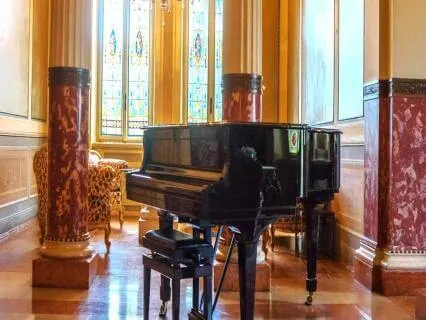
Lady Mary stayed behind in the now silent music salon,
In a room redolent with shades of time's past and children gone to adulthood and on to their old age.
And Lady Mary remained,
Awaiting the next phase of her own existence.
She knew she had outlived them all.
She had been tuned religiously each season.
She had been polished faithfully.
Her ebony finish still glowed in the dim light of an evening.
After all,
She was a Steinway,
An extraordinary piano of fine pedigree built in 1913 to last over a hundred years.
And she knew she would be restored with great care for a hundred more.
The Harriman Estate,
1965.
And now,
Fifty years later,
The mansion had become a museum.
Strangers wandered through every day except Mondays.
They were dressed in bright colors,
Tie-dyed t-shirts with fringe vests and bell-bottom jeans.
Often they carried transistor radios that blared Sam the Sham's Wooly Bully or I Can't Get No Satisfaction by the Rolling Stones.
Or any number of songs by the Beatles.
Until the docent on duty requested that they silence their radios and respect their surroundings.
For they had come to admire and imagine an age gone by,
To vicariously experience the Golden Age.
They viewed photographs of the Harriman family,
Father,
Mother,
And children,
And made their way through the painstakingly restored mansion.
And they came to see Lady Mary,
A velvet rope separating her from curious fingers of wayward children.
She now stood near the stone fireplace,
Away from the morning light that poured in from the nearby window.
She still missed the Harriman children.
The laughter of Livingston,
Nathaniel,
Henry,
And of course little Natalie May was still a vivid melody that played on her golden heartstrings.
Invisible hands playing music only she could hear from a time long ago.