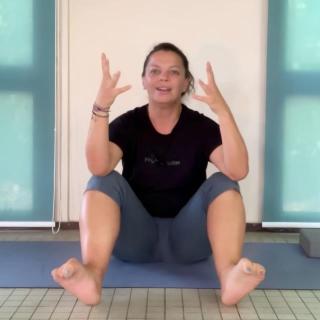
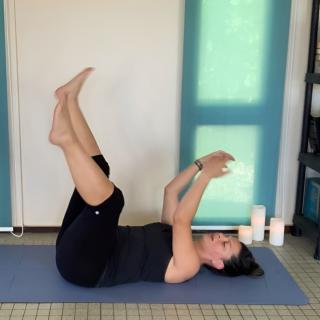
I'm going to show you now how to reinforce.
Your neck.
After you stretched.
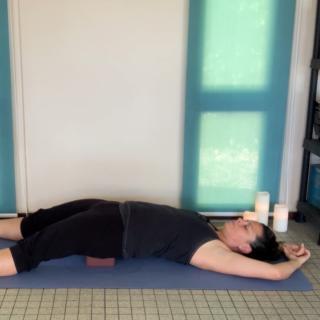
You can use a block or a bolster.
I'll show you.
With the block first.
And this is when your bed can come in and be helpful.
Because so it's supported fish okay you place.
The block like this in the middle and it's the high five high dimension like this,
You place.
The back on it.
And then the head drops back.
The first part of this exercise is to stretch.
You're going to open up the chest.
It's very nice.
The second part,
You want,
As I said at the beginning,
We are going to reinforce.
So to reinforce,
We're going to lift the head,
But don't lift,
Don't bring the chin just to the chest and be like,
I can't breathe.
Keep the neck as long as you can.
And try to lift and to create,
Like you mobilize the neck muscles,
Slowly,
Softly.
As soon as it hurts,
You drop it back,
You relax.
And you start again.
You can do a few repetitions of that and you count each time how long you stay with the head up without feeling too much tension.
The goal here is not to feel too much pain.
It's like 3-4 maximum on a scale to 10.
0 being no pain,
10 being maximum pain.
So go ahead,
You can try and start feeling the reinforcement of the neck muscles.
Same,
You come back very slowly.
I was saying with the bolster you can pretty much do the same.
Like this.
So that's where you can lie down on the bed.
And you just lay back and the head drops completely in the void.
And even the upper shoulders can be in the space,
Not held back by the.
.
.
By the bed so that is one okay and same when you come back up you keep the neck long and you try to stay there for as long as you can,
It's going to reinforce the neck muscles.
What I like.
I'd like to share with you now is also how to do the side one.
So try to find the position.
Where you can do it.
And you're on the side.
Yeah,
That monster is nuts.
Practical.
Try with them.
Block.
You're on the side and you try to lengthen and be off the block,
You know?
And like this,
You're going to strengthen the left side of your neck.
And you'll come back.
Go again.
And done.
Come again.
Hold a bit more.
Listen to the pain.
It should not be more than 2-3 technically.
If it's 4,
Really stop and relax the head on the block.
So you can do that on the pillow of course.
And you do both sides.
Let's do together.
So you really feel the difference and you balance it out.
So this is the good equivalent to what we did before when we were sitting on the chair,
Right?
Because we stretched out the sides here and this is going to reinforce.
I don't know if you can feel it on both sides.
It works,
But not in the same way.
Because the gravity is not working the same way.
Breathe,
Hold,
Relax when you need to.
The goal is not to create more tension,
So be very mindful not to hold on tight and be like,
I can hold more and time yourself.
Oh,
It's.
.
.
Please feel good.
Okay.
Relax,
Come back up,
Lengthen your neck.
Okay,
Do it a few times.
Then you can do the same on your bed.
This time the bolster is better.
The microphone like this is going to be there so you can.
Lengthen your.
Neck forward and instead of dropping forward you're going to hold Nicely.
And it's going to strengthen.
The neck muscles.
Here at the back and also you may start filling it here.
If you do,
Tilt the pelvis.
Okay,
So navel in,
Tailbone down.
And there you're just going to work on the neck and eventually the core.
But it's not going to damage your lower back.
Okay,
Very good.
Next one.
We're going to do Superman.
It's a bit similar,
But you're directly onto the mat.
Superman when he flies he goes one hand like this and he is flying so he is very light and he is balancing on the belly.
So he goes like this.
And you change.
One fist up.
The other one.
So here you are supposed to mobilize the whole chain of your back,
But always belly in.
And you should feel in your shoulders by moving like this.
It's working.
I like with my students to say ok now let's do superwoman because she's even tougher.
So it's not just one at a time,
It's all four together.
Both feet and hands and arms are lifted up and keep looking down.
If you look up you're going to just crush your cervicals.
So you keep the nose down.
And you stay there.
And you relax.
You breathe.
You go back at it.
Then it's up to you to measure how many repetitions you can do.
While you stay in the comfort zone.
Okay,
For the next one,
We're going to do rotated cuffs.
So I invite you to take a bottle of water or wait if you have one at home.
You can place yourself.
In a very comfortable way,
The pillow or block underneath the head,
Like this.
I need to actually.
So you can either roll a towel to keep it between your elbow and the waist,
The ribs,
Like this.
Well,
Maybe we will see better if I use the red one.
So you keep that like this.
So it's for the rotator cuffs,
Right?
So it's the front part here of your shoulders.
And you go up and down.
Endel.
It should never feel.
.
.
Like pain,
No more than three,
Four.
You do like 10-15 repetitions,
You let go.
You relax.
And then you do again,
At least three series.
And the thing is,
It's not like about race,
Right?
You're supposed to control Going up.
Control going down.
So it's a bit slow.
It's a bit annoying,
I have to admit.
But we are doing it together,
So it's fine.
As soon as you've done it on one side,
Please do it on the other side.
Let's do it right away.
So there is no imbalance in the body.
Position yourself.
End.
And down.
Try to keep your wrist Fixed because you want to work the shoulder,
Right?
So it would be inefficient if you were to move the wrist more than the arm.
Shoulder itself.
Then if you're comfortable with just that weight,
Add weight,
Okay?
So it's not add blue,
It's add white.
Add weight so you reinforce progressively,
Right?
Don't start with 5 kg right away,
Test with 1 kg.
If it's fine try one and a half Still fine,
Try two.
Etc.
But you should be able to do many repetitions.
If you're not able to do repetitions,
Don't add more weight because you're just going to injure yourself and the pain will go away.
Is just going to stay there and it's going to worsen.
The situation.
Okay,
That's it for me.
I can't do more.
But there is another way to activate your rotator cuffs,
Because you can also do it with your arms straight.
It's a slow movement because you want to control the speed.
On the way up and on the way down.
Keep it at 90 degrees at first.
And then we can go up like this.
This movement is more for the.
.
.
Shoulder blade movement.
This is very difficult for me.
I can't do too many,
But I hope.
You can do more.
Let's do the same on the other side.
So first we do arm straight,
Slow and steady,
Controlling.
The way up and the way down.
So you have here different exercises that a physio might be doing.
Uh huh.
Making you try.
Those are for different diagnosis.
And they may not be for everyone.
If you don't have any pain.
Most probably that Those exercises are doing nothing for you.
If you don't feel any pain,
Well,
Good for you.
A lot easier for me on that side.
Up and down.
Boys.
This is very good.
I can feel the muscles being contracted.
So this guy,
Major movement,
He says that sometimes people are so unused to moving muscles and contracting them.
That suddenly they feel pain,
But it's just muscle being contracted.
It's not the body saying,
Oh,
You should stop working out.
It's not because you have different kinds of pain.
And it's too easy to just say,
Oh,
I feel pain,
I'm stopping.
No,
Sometimes you need to feel a bit of pain.
The whole question is,
How much pain are you feeling when you do this?
And exercise.
Okay,
Next up,
Let me clear a bit.
We're going to take an elastic band or a strap if you have one and we're going to do the triple H.
So this is H1.
This is H2.
And we just go from one to the other,
Trying to push away.
And then we lift the arms up.
So let me come there.
Arms straight.
This is also very intense.
So you can do So it's 1,
2,
3,
Technically.
Or go straight from 1,
Arm straight,
Down.
Basically that's 1,
2,
3.
If it's too much,
Do with the elbows bent.
One,
Sorry,
One,
Two,
Three.
It's weird to explain.
Okay.
I hope you discovered something here.
Last one I would like to show you on the wall.
So you stand.
Facing Award.
Stretch your arms out straight,
Thumbs pointing behind.
And you're going to slide your arms up.
Like this,
Along the wall,
And you come down.
And down.
It's a bit like the rotator cuffs and then you can move the directions of the thumbs.
So pointing toward each other.
And then towards the wall.
This is the most difficult one.
And you can do this one,
The thumbs are.
So you can do this.
Back and door with the thumbs forward.
Yes.
Okay.
Now,
Enough for now.
Another exercise that he's suggesting is deadlift.
So you can just use bowls of water like this.
I don't have a.
.
.
Second one,
Sorry,
But imagine you do it symmetrically,
Right?
And you like do squats and you lift and you lift,
It's good for the thighs to do the squats.
But mainly for the arms,
If you do like this.
It's going to help.
Create some more muscles and you It's a habit that you.
.
.
Relearn your body to take.
Basically,
Everybody.
Everybody shape.
Is able to carry,
Right?
And when you lose the habit of carrying,
Well,
You can't carry anymore because your muscles get weak.
And You just need to retrain your muscles to carry in order to be able to carry again.
So do it progressively,
Not for too long.
Do enough repetitions,
But don't go beyond the pain.
It's always the same thing.
Last one.
There is also the shrugs.
So you carry things heavy and you come up like this and down.
I find this is so contracting.
Honestly,
It hurts me more than anything.
So that's one of the exercises I've read about.
I know for some people it works,
For me it doesn't.
So I'm not practicing it.
I just felt like I should mention it here with you.
Then OK,
Very,
Very last one.
We have protraction.
Protraction is moving the shoulder blades.
So when you're.
Extending your arms forward and you separate your shoulder blades,
This is 1.
And then you bring your shoulder blades close,
This is 2.
And you go from 1 to 2.
You can do it like push-ups on the wall.
Away.
And in the way forward.
You can do it on the floor.
All the.
It's not cat and cow,
Right?
Cat and cow,
It's about the spine moving like this.
Here,
It's protraction.
It's cool.
So it's just the shoulder blades moving.
Okay,
Saying that,
This is good also to reinforce the.
.
.
Muscles around the shoulder blades.
Another one that he was showing is you take one hand and you place it like this and you try to keep your back straight and your elbow up.
Let me do it with the other side.
He calls that bird dog.
Her dog is something else,
So I don't know.
Just so you know,
This is also some kind of workout that you can do to prepare yourself and to improve your push-ups.
If you have tendonitis or a frozen shoulder,
Maybe a push-up is not yet the right exercise for you to do,
But to prepare yourself to do it,
Those protraction exercise,
Very good.
I think that's all for now.
You know at the end of a yoga class we do shavasana,
Right?
This shavasana is in order to help your body integrate whatever the postures you took throughout the class.
So the same way.
I don't know if you took notes throughout the video.
I mean the video is up there so you can always go back and scroll and check and take notes and say like,
Okay,
This is the one I preferred.
I'm going to do this tomorrow.
Keep changing,
Keep improving,
Keep doing more and more repetitions.
So you really strengthen once you stretched.
I think when muscles are so contracted because they've been asked to do too much and they are hurt and they are painful.
First step is to stretch to lengthen and then to work on that you contract mindfully.
Then again,
You can stretch.
Go back to,
Okay,
Did I contract too much?
Is it time for me to release and to let go?
So.
.
.
Let's do a bit of integration after this.
Video.
Because we're also going to reset our posture.
Legs crossed or symmetrical,
Like knees up,
Legs straight in front of you,
I don't care,
But back as straight as you can.
If you want to sit on a chair,
No worries for me.
But sit comfortably,
You can even stand if you want.
But as tall as you can.
So roll the shoulders up.
Back and down.
Inhale,
Exhale.
Breathe.
Slowly,
Peacefully.
Imagine the crown of the head lifting towards the sky.
Exhale and feel the shoulder blades slide towards your back pockets.
Just notice how open.
Light.
And alive.
Your upper body feels now.
Now,
As a conclusion.
.
.
Strong shoulders are not just about lifting heavy weights.
They're about balance,
Because you want balance.
Mobility and stability.
This is what will bring you freedom of movement.