Hi,
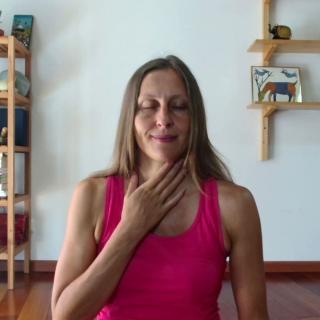
I'm Veronika and I would like to show you today a 360 degree breath.
So this is a breath which expands.
In all directions.
And we could access it in a couple of ways.
Look at all few dimensions.
Up,
Down,
Sideways.
Front back first and then combine it into a one whole.
So maybe let's start with placing the hands on the belly in such a way that the fingertips join at the navel center.
And you can start directing your breath.
In such a way down to your lower part of the body so that when you inhale the fingers slide away from each other,
They don't touch each other anymore and when you exhale the fingertips join again You can try it a couple of times.
And if you find it very challenging,
You could first practice that lying down on the back.
And then lift the belly up on the inhale and let it drop automatically on the exhale.
Now it's a little bit easier because you're working with the gravity.
Once you've got hold of that you could try it in this relation to gravity.
Now the curious thing about the breath is that it doesn't necessarily move the parts of the body that are in the front or the parts of the body that you might think that are moving but the entire body reacts to the breath and all the bones move you breathe in and as you breathe out.
So you could place one hand on the belly and the other one between the shoulder blades if you reach that far or just a little bit lower and that's fine as well.
So that you could tune in to that sensation of Everything expanding and moving away from the central axis on the inhale.
And everything coming back towards the central axis on the exhale.
So you might notice that it's not only the belly that is moving away.
But also that back of the hand which is resting on your back.
I'm going to show it from the side as well.
So it's both hands,
That's more.
It might be slightly more difficult to tap into that back of the body.
But if you watch me you'll see that that back hand moves as well.
If you swapped over and had one hand on the chest and the other one on the lower back.
Surprise,
Surprise,
You can lower the lungs.
Are not where her lower belly is,
There will be still movement there.
So both ends move away on the inhex.
One expanse forward,
The other backwards.
And both come towards each other on the X.
So once you've got hold of that.
.
.
We can have a look at the sideways movement.
And that one is most visible in the lower ribs area.
So when you have a rib cage,
You go towards those lowest ribs.
And you can place four fingers from the front and thumbs from the back so that your hands really rest on the sides of the ribcage on either side of the body.
Check that you're not tensing up your arms so you're just resting The hands on the ribcage but the shoulders stay relaxed.
Now you can try to direct consciously your breath to the lower part of the ribcage and you're going to notice that on the inhale the hands move away from each other,
On the exhale they come towards each other.
So again it's going to be very visible on this video.
One inhalation,
Hands move away.
On the exhalation.
They come back towards each other.
Breath directed to the lower ribs to the face of the mat.
And if you pay attention,
You're going to feel that Those fingers and the thumbs may also move away from each other.
This is our 360 degree movement.
Not only sides but also front and back.
And then you could still add one more dimension to that.
It's something that is not as visible from the outside.
But you could still visualise it and feel it in your body that the inhalation is a lift,
It's a lengthening.
And exhalation everything comes back in so now we're moving in this dimension up down inhale We're going slightly up.
Exhale,
Everything settles light.
On the inhale it's the diaphragm that pushes all the internal organ,
Pushes into the pelvic floor.
On the exhale.
Everything releases back to neutral.
If you can imagine that you're breathing in through the top of the head and sending your breath as if you could do that sending the breath down along the spine all the way to the base of the spine that's the inhale And if you want to add that other dimension,
Imagine that exhale.
Move sideways.
Through in between of the ribs.
And that's how you're experiencing It's 360 degree breath.
Using entire lung capacity.
Nothing forced,
Nothing really big.
This breath doesn't need to be big to be really whole.
To move the entire body.
Notice that I'm not using the top of the chest,
I'm not Letting my arms lift when I inhale,
This is relaxed,
Everything remains more within the lower and central part of the ribcage,
Also the abdomen.
And the movement of the shoulders is slow.
Just stand still.
Reaction.
Just the consequence of that breath,
It's the breath that moves the bones.
Still imagine that expansion On the back.
Sideways.
Up,
Down and everything in between.
You could keep the inhale and exhale.
More or less even.
And make sure that you're not straining yourself.
It's a comfortable breath.
It doesn't need to be very deep.
Maybe three more breaths like this.
And then you could use your inhale to help you lift your arms.
So if you really go with the breath,
You're going to notice that arms become light and that movement becomes really,
Really easy.
And organic.
So on the inhale Let's alternate.
And on the exhale.
You're kind of a semi-cosa.
You can try it again.
And exhale.
All along the central axis.
And then you can come back to your comfortable breath,
To your natural breath.
And perhaps you've noticed that even though you don't control it in any way.
If they've changed.
You could use this breath anytime.
Around the day.
I hope they enjoy it.
Thank you.