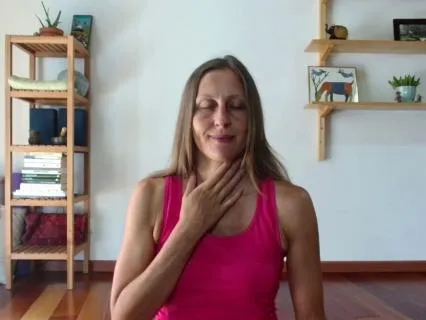
Hi,
I'm Veronika and welcome to my channel.
Today I would like to show you a couple of sounding breaths.
Now,
What are those sounding breaths?
It's basically when you exhale and at the same time create a sound.
And this kind of breathing techniques are usually quite easy to follow and they are also usually rather pleasant.
And they have a couple of benefits.
So if you have a breathing pattern where the inhalations are more dominant,
Or the breath that is very shallow.
This kind of breathing will slowly reintroduce you to the idea that your exhalation can be longer in an effortless way.
And this is important because every time you extend your exhalation,
It turns on your parasympathetic nervous system response so that rest and restore response.
Furthermore,
It will invite you to start using your diaphragm more.
So if you tend to overuse your neck muscles or the accessory muscles and have a shallow upper chest breath,
This kind of breathing technique will invite your breath to go deeper so that your diaphragm can start moving properly up and down as you inhale and exhale.
And there is one more additional benefit of that.
So whenever you create a sound,
It will make your vocal cords move and shake.
And because the vagal nerve,
So the vagus nerve is the longest nerve in the body.
And it is the one that is mostly responsible for turning on that parasympathetic response,
That rest and restore response.
It travels through the throat and very close to the vocal cords.
Every time you create this kind of humming,
Deep,
Vibrating kind of sound,
It tones that muscle.
So again,
You become a more parasympathetically dominant.
And it's so important in the days where most of us are stuck in the fight and flight in that stress response.
So there are many ways you can create these sounds,
And I will give you just a few ideas today.
You can do this practice standing or seated in any comfortable position.
Once you got seated,
Take some time to take care of your posture.
So if you're going to do this practice hunched and rounded.
Then you won't be able to have the same effect.
Everything will be compressed in the front of the chest and the diaphragm won't be able to move freely.
The relationship between the throat and the diaphragm and the pelvic floor will be disturbed.
So you won't get that much out of it.
And similarly,
Try not to overdo it.
So if you're trying to sit really tall and pull the shoulders down,
It might happen that you're pushing your ribcage forward in space.
And that equally doesn't allow the diaphragm to move that freely,
And it doesn't let you have those deep breaths either.
So find something in between where the breath can travel easily.
And the same goes for the head.
If you're gonna do it with your chin upwards,
The sound won't travel the same way.
If you're gonna have your chin too much down,
You won't give yourself space for that either,
So try to have your head straight forward.
Okay,
And another thing is that even before you start making a sound,
Check if your breath can travel.
More towards the upper,
To the upper abdomen and to the lower rib cage.
I mean your breath cannot literally travel to your abdomen because it obviously travels only to your lungs.
But the movement that you're gonna feel,
The movement of the body underneath the hands.
Let it be mostly in that section.
Around here,
While The shoulders don't lift that much and the muscles in the neck don't turn on or squeeze too much either as you inhale.
So you can have a few of breaths like this.
Checking that upper section can be quite relaxed.
If there can be some movement around the lower end of the ribcage of the abdomen.
If you can have your jaws relaxed.
And once you establish that,
We can start with the sounds.
And the first thing will be something really simple that you can do many,
Many times a day.
It's going to take you just a couple of seconds and it already kind of introduces you to that extended exhalation.
And it's the mmm breath.
So imagine that you're eating something really delicious or you see something in front of you that is delicious and you make that sound,
Mmm.
So this is exactly what I'm talking about,
That kind of M sound that is extended.
And imagine that it travels through you and it kind of can make your way all the way down somewhere to your belly.
So let's give it a try.
A couple of mmms as if you could see over and over again amazing dish right in front of you.
Mmmmmmmmm.
Hmmmm.
You could even place a hand on your throat if you do that.
Mmmmmmm.
And maybe you feel that vibration underneath your hands.
Okay,
So it's very simple.
You can also try another sound.
It's called VooBreath.
It was popularized by Peter Levin.
And some people call it also a folk horn breath,
Just because of the sound,
The sound that you create is quite low,
It's quite deep.
So here.
You're creating this kind of humming sound.
That would be like,
As if you say,
Woo,
D-O-O-O,
Woo,
Woo.
And you focus on that V rather than on the O.
Oh.
And when you make that sound.
.
.
Maybe you already can feel kind of a vibration happening somewhere inside your skull or maybe deep in the viscera.
Think of it of starting it not somewhere from the nose or really high up,
But really beginning deep in your belly.
And the idea is that the inhalation to start it is always from down below,
Not by lifting the shoulders,
Not by tensing your neck.
And the acceleration is extended as you make that steady sound.
But it's not forced,
So you're not getting to the point when you're completely out of air and you're squeezing everything out and all your abdominal muscles really tense up a lot.
You don't want that.
Let it be still a comfortable exhalation.
So you might notice some engagement happening at the end of your VU,
But it's not that full squeeze,
All right?
Now you can do it with your eyes open,
You can do it with your eyes closed,
It really doesn't matter.
But maybe you can notice how you're feeling,
How your breath rate is and how you're feeling in general.
Even before you begin and then do the round of six.
Obviously you can always take a break whenever it becomes overwhelming,
It becomes really tiring,
You need,
You have to take a breath in You can always stop.
But see if you can go for the six rounds of continuous inhalations,
That would be inhalations where your diaphragm moves,
And that steady exhalation with a sound.
All right,
So let's give it a try.
Recheck your position.
Where is your pelvis?
Where is your ribcage and head?
Take the first inhale.
To the lower part of the ribcage.
Blue.
Mmmmm.
Music.
Aum.
Om.
Music.
And then after you've taken the last exhalation,
You can let your breath flow freely.
Notice what is there to notice,
Maybe some sense of calm,
Maybe a little bit of softness in the body,
Maybe some interesting sensation inside the thorax or in the head or deep in the belly.
So stay with it for a while.
And know that you can repeat it for another round of six,
If that was making you feel really good.