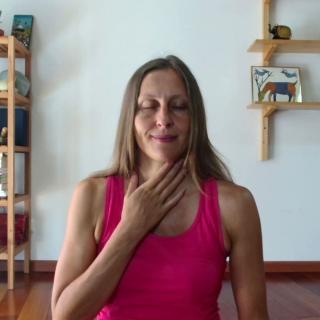
You can find any comfortable position.
And look straight ahead or close your eyes.
And start noticing your breath.
Try not to paint it in any way.
There is no point in controlling it Start noticing whether you breathe through the mouth or through the nose and eat the breakfast fast.
Shala.
Notice what is the proportion between the in-breath and out-breath Which one is longer?
And now notice in which part of the body do you feel your breath What is moving when you take an inhale and what is moving when you take an exhale?
It's moving when you exhale.
It might be difficult to feel so go ahead,
You can place one hand on the belly,
One hand on the chest.
And perhaps now it's easier to feel the movement underneath your hand.
Do you feel any movement underneath that hand that lies on the belly?
How about the one on the chest?
In which part of the chest do you feel the breath?
And then you can release your hands.
Just take a mental note of whatever you notice And before we even start our breathing practice,
We're going to prepare the body for it.
Because what often happens is that we spend the whole day in a rounded posture where the lungs are compressed,
Where the diaphragm is compressed.
So it's nice to make a little bit of movement to create space in the upper body.
And to release the tension that we might be holding in various parts of the body.
And we'll begin with stretching and yawning.
Simply that,
Nothing complicated.
Starting in the awning!
Just as if you woke up from a long sleep.
Ahhhh!
Ahhhhhhhhh It might seem simple but the cats and dogs do it all the time and this is the natural system of finding the right tone in the mask.
And then we'll do one simple movement to create a little bit of space.
So you can get hold of your elbows.
And the movement we're going to do is related to the upper body.
So the lower body will stay still.
That's why it's easier when we sit it.
And it's a rotation around your own axis.
Which means that it should not be confused with swinging the arms right and left.
That's a very different movement.
It's a rotation of the entire torso.
The shoulders,
The arms,
The spine and the head move together.
A little bit like when you're in an outdoor gym and you stand on that spinning plate You can start making this movement at your own pace,
Whatever feels comfortable for you.
If for any reason that doesn't feel right for you,
Remember you can always stop And it might not be super comfortable,
I'm warning you,
Just because we are purposefully squeezing the diaphragm to release it And gradually.
.
.
You can start lifting your arms still as you rotate around your own legs.
So all done.
Will be moving higher and higher,
Rest to the level of the shoulders Now worry about that weird sensation in the chest.
Gradually higher.
You decide how high.
You don't want to feel any pain or discomfort in the shoulders.
It doesn't matter how high they will fly.
Lift them just a bit higher than the shoulders,
That's enough.
And gradually.
.
.
Make your way down,
Same way.
Rest at the level of your shoulders.
Then to your waist level and it's all released.
Notice how does it fit.
Perhaps there's already some difference in the way you perceive your breath,
In the way the breath flows.
Just to give that message to the shoulders to release a little bit more,
Bring the shoulders up to the ears.
Purposefully contract everything,
Squeeze everything together as you inhale.
And as you exhale,
Slowly release your shoulders away from the ears.
So don't put them down,
Just let them think wherever they want to.
Keep your hands rested on your thighs so that you don't really need to carry the weight off the shoulders.
You can also check Where is your spine?
If you're rounding the back?
Or maybe you're trying too hard to reach high and everything is very contracted.
See if you can find some place in between.
Somewhere where the spine has all the natural care.
And it feels effortless.
But there is a little bit of space in the upper body Okay,
So now we're set up for the breathing practice to begin you're going to take a breath in through the nose Normal,
Calm breath in.
And breathe out through the mouth Pressing your lips.
What if you wanted to kiss someone?
And as you press the lips,
You make an exhale through the mouth.
Creating a sound.
And that sound is similar to the sound you hear when you place a seashell to your ear.
It's like this humming sound or like a sound of the wind in the branches of a tree.
You could think of it as.
.
.
The first.
.
.
Part of the word who that I am.
At the beginning.
And as everybody has completely different lung capacity,
There is no point to do it together.
So do it at your own pace.
And again,
It has to be comfortable breath.
So no tension in the belly,
No tension in the shoulders or in the face.
And if you feel it's becoming too much,
So we'll do it for around one minute,
Something like six rounds.
You can start anytime you're ready.
Breathing in comfortably,
Slowly,
With a nose.
And breathing out through the mouth or the first lips with a sound.
You can look straight ahead or have your eyes closed.
Long but relaxed exhale with the sound Keep on going at your own pace.
Maybe one more.
Whenever you finish.
Come back to your natural breath.
How do you feel after that?
How does the breath flow?
Has the breathing rhythm changed?
That would be a fail.
Somehow a little bit calmer after that.