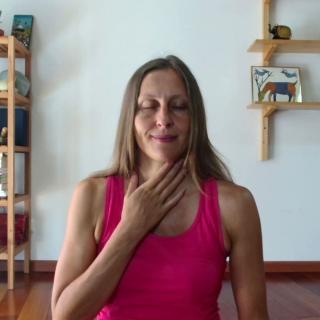
Hi,
I'm Veronika.
I would like to show you how you could spiral through your legs.
Using all the joints from your toes all the way to the hips.
And we're going to begin lying down on the mat.
So you can roll down.
Perhaps begin with rolling around.
Involving in that your legs already.
So you could move your knees in the air.
And that's sort of asymmetrical.
Unstructured way.
So I could give it a few seconds.
And then let your feet land on the mat.
And a constructive rest,
So with feet on the ground.
Nishtha.
Let's start the exploration by lifting one foot off the mat.
Drawing some small circles with the knee in the air so the lower part of the leg is relaxed And it's the knee that is drawing those circles.
It's better if there's more.
What interests us here more than the size of these circles is the sensation of the thigh bone.
Lubricating the Think giant.
And after you've done it for a while,
You could say.
Focus now on your thoughts.
And actually.
.
.
On the heel itself.
And we're going to make a spiraling movement that maybe first it would be easier to show it on the wrist so that you get an idea.
So it's a similar movement that my wrist now makes in the air.
It's a spiral that starts from one point and then it allows the entire limb to rotate around its own axis.
So in case of the leg,
It starts from the heel and there is this.
A spiraling motion that starts from the foot and it travels down the leg.
So it goes down the lower leg.
And if you will notice what your knee is doing now,
You will see that it draws small circle.
In the air as if it was going around the clock face.
And that movement goes farther down,
Farther down the side.
And again if you pay attention you will notice that the thigh bone is moving in the hip joint.
Keep on going like that.
It might feel a little bit tiring.
Until you find a place where the leg wants to stay for the time being.
So do not worry about the knee,
It doesn't need to be straight at all,
But you want to find a place for your leg where it feels the lightest.
So you want to find a place for the leg where you can give the entire weight of it deep into the hip joint.
So it becomes weightless as if floating in the water.
And now let's start paying attention to the toes.
So it's a good position because you can have a look at your toes very easily.
Pay attention that you move your toes only,
So you don't want to see your ankle moving,
You don't want to see any other part of your leg moving,
It's just the toes.
It's just the toes that are now moving and you could try to spread them apart and then curl them under towards the sole of the foot.
So it's again the same movement as I'm making with the hand.
You're going to do with your foot.
And you could now point the whole foot more towards the ceiling and repeat that movement of the toes and then flex the foot.
So reach more with that.
So of the foot towards the ceiling and you could still come down.
Keep it a little bit more pulsating.
Um,
And work on the toes one more time,
Curling them under and spreading them wide You can let go of the toes,
So the toes don't move anymore.
But start making circles with the ankle instead.
Slow,
Large circles with the ankle and again watch that it's only the ankle moving,
Not the rest of the leg.
And now reach with that heel forward.
Let's hang on up more forward and keep on reaching forward.
Keep on reaching with that heel forward.
So that in the end your leg will land on the mat and once it lands you could let it go you could relax it completely,
It probably will rotate outwards a little bit for a moment and then bend the knee,
Slide the outer edge of the foot along the floor and rest the foot on the mat.
So I could stay here for a couple of breaths.
Noticing the difference in the sensations in the entire leg from the toes to the feet.
All the way to the hip,
Adding the hip in the buttock on that side you worked on as compared to the other side.
And after that short rest let's do the other side First lift the foot off the mat and that lower leg stays relaxed.
While the knee draws small circles in the air.
Lubricating the hip joint.
And then pay attention to your heel.
And start that spiraling motion.
It might be much more difficult than the other side.
Start a spiraling motion.
Coming from the heel,
Moving upwards.
Rotating your leg around its own axis.
So it's very different from making big circles with the whole leg and keeping it still.
The leg rotates around its own axis but almost doesn't move in space.
And if you had your hands on the thigh you would feel that it's um all the time changing Changing the angle.
That there,
That there.
Front of the side turns outward and then comes back inward.
So there's that.
That rotation around its own axis going on all the time.
And then you could let the leg stay.
Where it feels the lightest,
So where you put a minimum effort to keep it in the air and you're keeping the weight of the leg deep into the hip so that it's even lighter but at the same time There is that wish.
Awesome.
Reaching towards the ceiling with the entire sole of the foot,
As if,
More in a kind of pulsating way,
As if you wanted to suck with the sole of the foot to the ceiling.
So you could try this for a moment and then you could start moving your toes.
Only the toes,
Not the ankle,
Not the rest of the legs.
And you could move the toes when you're pointing the foot.
And when you're flexing the foot.
And you can go for full rotations in the ankle.
In one direction and in the other there might be some noises.
So I'm clicking.
Don't worry about that.
And then again.
See if you can Reach.
With that.
Whole sole of the foot and maybe even more with the heel upwards,
But at the same time still keeping that connection with the hip joint.
And then move that heel away without losing the connection with the hip joint.
Lower the leg and only once it's down and straight you could release Relax it,
Let it roll out.
And then bend the knees,
Slide the foot along the floor and lower both feet to the ground.
So the next thing we're going to do.
.
.
Sliding the legs but this time not in the air and this time on the floor.
So let's begin with moving the feet maybe slightly wider apart.
And then let your knee drop out to the side so that you stay on the outer edge of the foot.
The other leg doesn't move so the knee is still pointing up.
And then you can let it come back so the whole foot rests on the mat.
Again move the knee out staying on the outer edge of the thigh.
One more time,
Return.
And that third time.
Once the knee is out,
And you're not forcing it,
It just happens.
Drops wherever it wants to drop you're going to slide that foot away from you until the leg is straight and then relax that leg.
You could roll it in a little bit and then again roll it out towards the outer edge of the foot,
That little toe side of the foot.
Slide the foot along the mat,
Bringing the heel somewhere towards the buttocks.
And then land with the foot on the mat And you could repeat it a couple more times.
But for now,
It's going to be enough.
And we'll try now the internal rotation.
The other leg stays still and then we're still working on the same leg.
Let the knee drop in so you need to have enough space for that movement.
And then return with the whole sole of the foot.
And again,
Let the knee drop inwards.
And come back with the sole of the foot.
Let the knee drop in,
You're staying on the inner edge of the foot.
And then.
Slide that foot forward until the leg is straight.
Once it's straight you can rotate it outward and now start drawing sort of large circles.
So sliding that outer edge of the foot along the floor,
Place the foot on the mat and then let the knee drop in and slide the inner edge of the foot along the floor until the leg is straight.
Let it roll out and so on.
So you keep on drawing those large circles alternately,
Internally and externally rotating the leg and sliding the foot along the mat.
You could repeat it again as many times as you wish and align it with the foot on the mat.
One more time,
You can compare the right and the left side.
The right and the left leg.
Let's repeat on the other side.
So first is the knee moving out.
So you're coming to the outer edge of the foot and then you can repeat.
And one more time,
Let that knee drop out.
And return.
Last time,
The knee moves out,
Slide the foot along the mat.
Until the leg is straight And then again bend the knee,
Slide the outer edge of the foot along the floor and let that foot return to the floor.
And if you repeat that and practice with this movement a lot,
Each time you could focus on different part of the body.
For example,
You could initiate this movement from the foot,
You could initiate from the hip,
And each time it will be a different sensation.
So you could play with that.
And now we're gonna do the internal rotation so that other leg stays still and drop the knee towards the head.
Midline of the body slide the inner foot along the mat until the leg is straight once it's straight you can let it roll out okay and then you can go for a circular movement sliding the outer edge of the foot along the floor the foot lands let the knee drop in and slide the inner edge of the foot along the floor and keep on going.
Noticing if it's any easier or more challenging on this side.
Whether the external or internal rotation is easier.
So keep on observing all those things.
And remember,
There are no goals here,
You're just curious.
And then you can land with that foot on the mat as well Stay for a moment.
Come back.
And you could move your arms slightly out to the sides and let both knees drop to the side,
Allowing the head to roll in opposite direction.
And then do the same on the other side.
And again with this movement you could.
.
.
Focus on starting it from the foot,
So it's rolling on the inner edge of one foot and outer edge of the other,
And then sucking everything back to the soles of the feet.
Or you could start it with the knees.
Knees dropping from side to side,
You could also start it from the hip.
Each time it's going to feel different.
Very differently depending on the place you initiate the movement from.
And as a final move to relax everything,
You could let your limbs,
Maybe not just legs,
Why not to join with the arms as well,
Let them float so you're gonna give again the weight of your legs deep into the hips and the weight of your arms deep into the shoulders and you could either pause for a moment or again move your toes and ankles in a kind of relaxed way or you could shake it,
Shake it with Give all your energy,
Let it all wobble and shake and move.
Shake it,
Shake it,
Shake it,
Shake it,
Shake it.
And then.
.
.
Let one foot drop and the other foot drop.
Actually,
If you want to fully let your legs rest.
Um.
.
.
Instead of choosing a constructive rest or lying down with legs straight.
You could use the wool if you have it handy.
And turn yourself so that your upper body is perpendicular to the wall.
I come close enough so that you have a full support for your legs.
But not so close that you would feel uncomfortable pull at the back of the legs.
So if you feel a lot of pulling,
That means you should move your hips a little bit farther away.
So depending on what your sensations are at the back of the legs,
That will be the distance of your hips from the wall.
And just see if you can let your legs rest against the wall.
So the full support is there,
They don't need to do anything.
If you have that feeling that they're going to slide apart completely,
You might consider using a loose strap around them,
But if they're stable enough,
They will most probably stay where they are.
Here is just a relaxing restorative pose.
You don't really want to do anything.
And if it doesn't feel comfortable,
If it doesn't feel good for your legs,
Choose a different version.
So you only want to let them rest for some time.
And you could stay here even up to 5-10 minutes.
So long as it remains comfortable.
So if there's any sign of numbness or other form of discomfort,
You know that you definitely want to bend the knees,
Bring them in for a moment.
And to come up,
You're going to roll to one side.
And only from there,
Slowly come up.
I hope you enjoyed and that your legs feel different now.
Thank you very much.