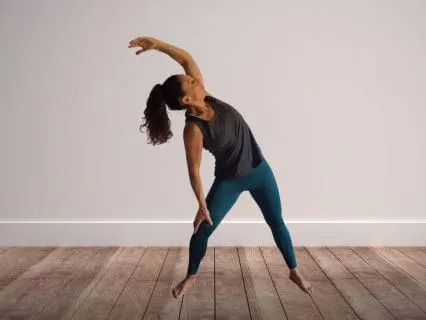
Sitting for a while and feeling stiff?
I'm Verena,
A physiotherapist and movement teacher.
Let's move together.
But before we get moving,
I would like you to check in just for a moment.
Find a comfortable standing position You can keep your eyes open,
Soften your gaze or close them for a moment while we are standing still.
Notice where your feet meet the ground.
And take a natural breath without changing anything.
For a few moments,
Notice how you're feeling.
Maybe tired.
We're excited!
Maybe stiff.
May we come.
Maybe something completely different.
Open your eyes if you close them.
And now let's turn from one side to the other,
Just checking in how the movement feels today.
So you turn one side,
The hips can move,
The head,
Even your legs can.
Lift up for normal from the mat.
How does the movement feel today?
Effort does it take.
How far can you move?
Just a quick check-in.
Come back to center.
Now we are coming to do some spinal waves.
You can soften your knees and we initiate the movement from the chest.
So you bring your chest forward.
And your hips follow.
Like a wave for your spine,
The head can move.
Chest,
Hips,
Knees.
Show you from the side for a moment.
Play with the movement,
You can make it smaller or bigger.
You can close your eyes if you like.
Here's a point where you want to stay and explore.
We can make it a little bit faster.
Then we move directions.
We start from the center.
Pelvis from the hips.
Initiate the movement from down to up.
Also here.
Flowered.
The speed Take it slow.
The amplitude how big the movement is.
Playing here for a moment.
Can change directions.
Really let your heart and tips and knees.
Join the movement and make it bigger.
Really slow and big.
Let me get off the trays for a moment.
Draw the sides as well.
Some side movements and rotations to the waves.
One more.
And granny Just find stillness.
Next let the arms swing from side to side.
You can start really slow.
And with a small movement Make the movement bigger if you feel like.
You can speed it up.
You're letting your arms loose like two noodles.
Making it faster,
Making the movement easier.
Smaller.
Really playing with a rhythm that feels good for you today.
Keep eyes open or closed.
Come back to center.
Next we come to a squat and reach.
You find a comfortable position.
Can be a bit wider,
Can be closer together.
That feels comfortable for you.
And for the depth,
Really figure out what works for you.
If you need some support,
You can also hold on to a wall or a chair to come down and up.
I want you to counterweight your arms if you can.
So you come back,
You sit back,
As you are sitting into a chair and the arms can be either forward or up.
We have a movement for the whole body.
And even if you do movement,
It can also be.
.
.
Smaller.
Don't need to come all the way down.
And again,
You can hold on to a wall if this is what you need to.
You can have a chair in front of you.
You can play with the stance,
Having it wider and coming further down,
Arms in front,
Or bringing them closer together.
Coming to a squat like this.
Can stay for a little moment.
Coming up.
And change the stance.
Comes overhead.
Forward playing what works for you,
Really sitting back.
And smaller and bigger.
Faster and slower.
You can keep your arms below shoulder height.
And different.
If in case you have problems with the hips,
The knees or the shoulders,
Just adapt the movement how it works for you.
Next we come into a split stance.
One leg comes forward,
One leg comes back.
We want to shift our weight forward and back.
And here again,
You can play with what works for you.
Like how far apart are the legs in terms of to the side?
Do you have a more stable stance if they're further apart?
You can bring them closer to one line.
And also you can play with how far apart they're front to back.
Just to see how it works.
And then we want to come forward and back.
Here you can play what happens.
Even just having the whole foot on the ground.
What works here coming forward and back.
It happens if you.
Come onto your heel.
And lift the front of the foot.
Or even lift the leg completely,
You can move forward.
Your arms,
You can bring the arms into the movement.
Playing what's.
It's working here for you.
So you can come into a writer's stance if you need to.
You can also hold onto a wall.
If this is what you need.
Or a chair in front of you again.
You can come up and lift your heels.
And back.
Or keep the whole foot.
You can make the movement really small.
Or bigger.
And then we change sites.
And we do the same here.
Maybe this side feels a bit different.
And also here,
If you can't bring your hands above your shoulder,
You can either not use your arms or springing as far as you can.
Moving back and forth.
Playing with the movement.
With the stance.
Again,
If you need a wall,
You can use the wall as well.
Seeing what happens if you bring them close together on one line.
And then shifting the weight back and forth.
Keeping the whole foot.
Bring some movement into the ankles.
Next we will do step backs or reverse lunges.
So I'm coming a bit forward on my mat.
And here also finding what works for you.
We'll make a step back with one side.
We make a step back with the other side and come back forward.
You can also here again,
Use your arms,
Bring your arms up.
And down.
You can stay up,
Like the heel lifted,
You can bring the heel down.
It's really,
There's no wrong and right.
You can play with both.
If you want.
.
.
A different version,
You can come into a reverse lunge.
Here you can play with how far the leg is going behind you.
And how deep you're going down and also how far apart.
The legs are to the sides and then coming down.
Can be just a small movement,
You can bring your leg up,
Down to the mat.
And then also at the arms here.
Switch the sides.
You can only step with arms,
Without arms.
Arms can be in front of you or over your head.
You can come down.
You can have a really,
Really small step.
And bring your Leg down and your arms up.
Find what works for you here.
We can play with the speed.
You need just a small movement.
For the legs.
Focusing more on the arms like bring the arms up and over it's kind of like getting some movements in the shoulders as well.
Like this.
A couple of more.
You can combine both.
Next,
We will do some lateral shifts and reaches,
Which will look like this.
We will shift from one side to the other.
And then we will add a reach.
So the reach will be up and over.
Alright,
You are- shifting to one side and you will reach the opposite arm to the same side.
The arm can either come in front of your body or if you need,
You can even like turn your foot a little bit out and have support on the leg.
So kind of also want to try to stay open.
Up and over and reach.
Shift from one side to the other.
Over and reach up.
Over really lengthening the side and reach keeping keeping the chest open.
So you don't want to collapse.
Onto the ground.
You don't need to rotate completely over,
Just kind of staying in the plane.
Up and over.
Here also you can play,
You can keep your legs further together,
You can make the reach on the arm movement a bit smaller,
Just have a small bend.
Can make the movement faster.
Are slow as well using the hand of support.
The feet are pointing forward or you can open the toes a little bit to the sides.
You'll be finding what works for you today.
I would like to invite you to play a little bit with the rotation if he rotates towards the ground and up towards the ceiling,
Which works if you have a smaller stance.
You can rotate,
You can have the support.
It can also work with the writer's stance if you have the.
.
.
Toes rotated outward,
You reach up and over,
The hand can have support and you're really opening up.
And letting it,
Looking towards the ground.
The sealing and change.
Hand to support on the leg,
Opening up,
And closing now,
Really rounding and coming back.
Okay Back to center.
Before we finish,
I would like to invite you to choose a movement of today's practice,
Or even a combination of it.
Just explore it and do it a while for yourself.
Could be the squat,
Could be the side shift,
It could be the reversed stepping or the reversed lunge,
Or a combination of the things we just did,
And just explore the movement for yourself.
We did also the arm swings,
Really.
It could be anything where you feel like your body needs right now,
Or you can combine the things.
Like you could come in a squat,
And then do some swings.
You can combine the swings with the.
.
.
The sides should Just take a moment to yourself.
Now let's come back to the turn we did at the very beginning.
Come into more or less the same stance and turn gently from side to side.
And just see how it feels now.
Maybe there's something different.
Perhaps the range?
The smoothness,
On an effort.
Maybe yes?
Maybe no,
There's no particular result we're looking for.
It's just about checking in.
Come to a comfortable standing position.
And if you would like,
You can briefly close your eyes,
But you can also just soften your gaze or keep them open.
Notice how you're feeling compared to the beginning without needing to change anything.
Take one natural breath.
Hello God.
You can come back to any of this movement or this practice next time you have been sitting for a while.
Thank you for moving with me.
See you next time.