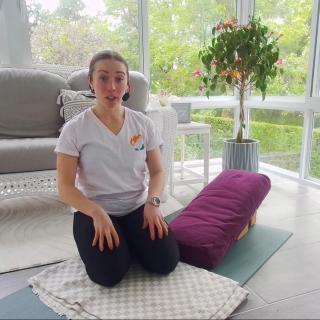
So now that we've understood all of the possible positions you could take during meditation,
It's now time to pick your favorite and we're going to prepare for our breath awareness meditation.
So the first thing to do is to remove all the distractions in the room,
All the distractions possibly in your mind.
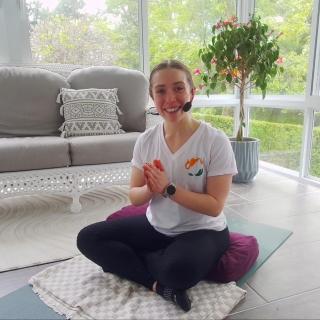
Take the position you've chose and settle in.
And with any meditation,
It's really vital to just,
As you settle,
Begin to focus on the breath.
I know we're doing a breath awareness meditation today,
But the breath can be the center of any meditation practice.
It could be the beginning.
So we'll settle in,
We'll focus on the breath.
And then together,
We're going to work with understanding whether or not if we can fully breathe using the lungs and diaphragm.
And if not,
We'll work together to get there so that you can feel successful during our breath meditation coming up.
So,
Together.
Breathe all the air out of your lungs.
We're going to inhale and exhale through the nose.
If you prefer to exhale through the mouth,
You could.
But using the nose and keeping the mouth shut and the jaw unclenched is a really great way to find calmness in the body.
So I'm going to leave that up to you.
The meditation will be asking you to breathe from nose to nose.
So if it's something you're not used to,
You can try that right now.
So,
Breathing in through the nose.
Sending the air down the throat,
Into the lungs,
And then deep into the belly through the diaphragm.
Pause at the top.
As you exhale,
Try to control the breath and notice how it exits the belly first,
Then the lungs,
Then the throat as it comes out.
Nice.
Let's try it again,
This time really accentuate the expansion of the lungs and the belly.
And exhale with control.
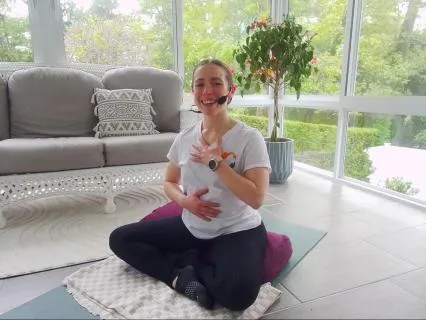
You could even check on it by placing a hand here and a hand here.
So let's try it one more time,
Inhaling.
Now you can really see how my belly has expanded.
And exhale with control.
Maybe one more time for good measure.
Inhale.
Exhale.
I can't help but close my eyes during this because I'm starting to feel so calm.
So something I will cue you on during the practice is yes,
We're expanding forward but we're going to also try to expand outward and even from the back with our inhale.
So think about yourself almost like a sphere.
Expanding and contracting with every breath.
And if it's something that you have to work towards,
That's cool.
But that's really what we're looking for,
To expand and take up as much space as we can,
Fill in with as much air as we can,
And then gently deflate with every breath cycle.
OK,
Finally,
I'm going to discuss the distractions that are inevitably going to pop up during your meditation.
So there is this concept of being the observer.
And what that means is,
Yes,
The thoughts are going to pop up.
Maybe even an emotion might pop up or your to-do list for later.
And your goal is to.
.
.
Look at it.
Observe it.
Notice it.
But don't act on it.
Let it float by.
Think of it as just a leaf floating in the breeze.
It just keeps going.
This keeps going.
And really like that is going to be an inevitable thing that will happen,
But it's your job to When that happens,
Come back to the breath.
When that happens,
Come back to the breath.
And you might have to do that multiple times during a practice.
Know that that is normal.
Know that that is OK.
It doesn't make you bad at meditating.
It makes you a human being.
So the more you can practice going from distraction back to center,
Distraction back to center,
The easier it's going to become to come back to yourself and into your meditation.
Doesn't mean the distractions will go away.
You're just going to get stronger in your practice and able to find center and let those things float by more often,
Which is really great.