The world’s largest free audio library for everyday wellbeing
Movement-Integrated
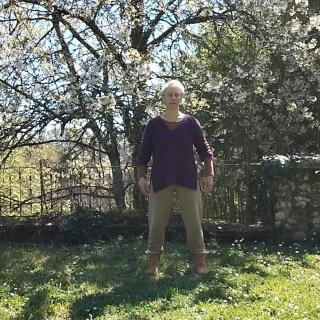
Wuji Standing is the basic Tai Chi standing posture, held with a relaxed but upright body, and it is the starting point for all Tai Chi practice.
Last Updated
4 Jul 2026
We are still reviewing this page. Our research team checks every technique page for accuracy and evidence quality before final release. Details may change as that review completes. The evidence badge shows our current reading of the published research.
RECOMMENDED DOSE
No direct dose evidence; editorial synthesis. A short 5–10 minute hold a few times per week lets newcomers build postural endurance and comfort with the still standing position before increasing commitment.
No direct dose evidence; editorial synthesis. Once the posture feels stable, extending toward 15–20 minutes on most days reflects a typical established standing-meditation rhythm and is offered as a general practice convention only.
No direct dose evidence; editorial synthesis. A daily 20–30 minute hold represents a committed maintenance level drawn from general standing-practice conventions; progress at a pace that stays comfortable and pain-free.
Session length
Session length: 5–10 minutes
5
MIN
How long each individual practice session should last from start to finish.
Frequency
Frequency: 3–4 days
3
DAYS
The number of days per week to fit a session into your routine.
Session length
Session length: 15–20 minutes
15
MIN
How long each individual practice session should last from start to finish.
Frequency
Frequency: 4–5 days
4
DAYS
The number of days per week to fit a session into your routine.
Session length
Session length: 20–30 minutes
20
MIN
How long each individual practice session should last from start to finish.
Frequency
Frequency: 6–7 days
6
DAYS
The number of days per week to fit a session into your routine.
About this card. No direct dose-response literature exists for Wuji Standing; these ranges are conservative starting points based on general standing-meditation practice conventions, not clinical trial data. These recommendations are not a substitute for personalised guidance from a qualified practitioner.
Quick answers to what people most often ask. Each card links to the deeper section below.
evidence
Evidence for Wuji Standing is indirect, drawn from general standing-balance research rather than trials of the posture itself. A meta-analysis of 25 studies and 877 participants found that under threat people sway faster and stiffen, while attention and the body's sense of its own position measurably shape how steady standing feels. No controlled trial of Wuji Standing exists yet.
good for
Wuji Standing suits adults who want to feel more grounded and steady on their feet, who tend to stand braced and tense, or who want a simple, still entry point into Tai Chi and body awareness. It supports steadier balance and sharper body sense, not treatment for any diagnosed condition.
Read moresafety
Most healthy adults can practise Wuji Standing safely on their own. Because you hold a still, bent-knee stance for several minutes, blood can settle in the legs and leave you briefly light-headed, and the knees and lower back can ache. Take extra care with low blood pressure, dizziness, inner-ear conditions, fall risk, pregnancy, or knee and back problems.
Read morehow it works
Staying upright in Wuji Standing relies on small, constant stiffness adjustments at the ankles and hips rather than one braced muscular hold, so standing gradually feels supported by your own structure. A steady stream of position signals from the legs sharpens balance, and where you rest attention measurably changes how steady you feel.
Read moreWuji Standing is the foundational Tai Chi standing posture, held with a relaxed yet upright body for several minutes while releasing unnecessary tension and attending to balance and gravity.
You stand with feet about shoulder-width apart, knees slightly bent and unlocked, arms hanging relaxed at your sides, and the spine naturally upright, then hold the stance quietly for several minutes. The work happens inwardly, releasing muscular tension that is not needed for support while keeping the skeleton aligned, and letting attention rest on balance, the feet, and the body's relationship with gravity. There is no movement, no breath count, and no goal beyond settling into a stable, effortless upright stance.
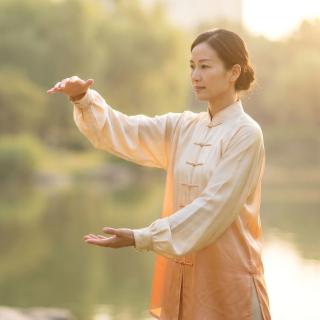
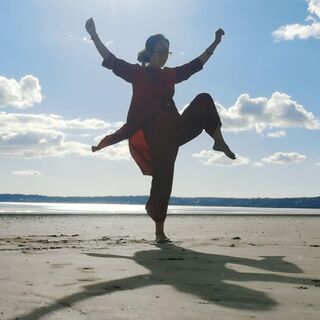
Wuji Standing is a still, upright standing posture, not a moving Tai Chi form, a seated meditation, or a strength exercise; the stance is held rather than flowed through. Though 'Wuji' translates as 'primordial emptiness,' the practice is a concrete postural discipline rather than a purely contemplative one, and it is the starting point from which Tai Chi's moving sequences begin. It is also distinct from Zhan Zhuang postures that raise the arms into holding positions; classic Wuji keeps the arms relaxed at the sides.
Not to be confused with
Zhan Zhuang (standing-post practice)
Wuji Standing is often the most relaxed, foundational posture within Zhan Zhuang, the broader family of standing-post training. Full Zhan Zhuang also includes more demanding held shapes, such as holding an imaginary ball at chest height, that build standing endurance beyond Wuji's settled, neutral stance.
Tai Chi moving form
Wuji is the stillness that precedes movement, not the flowing Tai Chi routine itself. Where the form involves continuous stepping, turning, and weight transfer, Wuji is held in place, cultivating the aligned, released base from which the moving sequence is meant to emerge.
Ordinary standing still
Wuji Standing is not simply standing around. It is actively organised: the knees stay soft, unnecessary tension is released, and attention rests on alignment, weight through the feet, and the body's relationship with gravity rather than drifting.
Wuji Standing works by keeping the body quietly, continuously active. Staying upright relies on fine stiffness adjustments at the ankles and hips rather than one braced muscular hold, so over time standing can feel less like propping yourself up and more like being stacked and supported by your own structure (Winter et al., 1998). It also depends on attention, because where you rest your focus while standing measurably changes how steady you feel (McNevin & Wulf, 2002). And because balance control and emotional state travel through overlapping brain pathways, a settled, grounded stance may help the nervous system shift more easily between alertness and rest instead of staying locked in one gear (Balaban, 2002), (Taylor et al., 2022). These links come from general standing-balance research rather than trials of Wuji Standing itself, so they are best read as plausible rather than proven.
You may notice that staying upright starts to feel less like effort and more like being stacked and supported by your own structure, standing with noticeably less strain. The body holds its balance through continuous, fine stiffness adjustments at the ankles and hips rather than one large, braced muscular hold (Winter et al., 1998).
That grounded, physically 'here' feeling, a clear sense of where your body is in space, comes from proprioception, the steady stream of position and movement signals sent by receptors in your muscles, joints, and tendons. Holding the Wuji posture keeps that stream active, because staying upright relies on fine stiffness adjustments at the ankles and hips rather than rigid holding (Winter et al., 1998), and where you rest your attention while standing can change how steady you feel (McNevin & Wulf, 2002).
If being upright tends to leave you wired but tired and unable to downshift, the quiet attention of Wuji Standing may help you settle. Balance control and emotional state run through overlapping brain pathways, so a grounded stance may support autonomic flexibility, the nervous system's ability to move between alertness and rest instead of staying stuck in one gear (Balaban, 2002), (Taylor et al., 2022).
The most reliable change is in how the body senses itself. Standing quietly keeps a steady stream of position signals flowing from receptors in the leg muscles, joints, and tendons, and studies of standing subjects have measured these proprioceptive reflexes actively adjusting to keep the body upright (Fitzpatrick et al., 1992). In the body this can feel like becoming more planted, with a clearer, more grounded sense of where your feet meet the floor. Research on standing also shows the opposite pattern under stress: when standing feels threatening, people brace at the ankles and the body sways faster, a measured increase in muscular engagement that Wuji practice works to unwind (Wissmann et al., 2025), (Carpenter et al., 2001). All of this is measured in general standing rather than in Wuji Standing itself, so the shift is inferred rather than directly tracked.
Standing quietly can leave you feeling more grounded and physically "here," with a clearer sense of where your feet meet the floor and how weight settles through the legs. That steadiness leans on proprioceptive accuracy, the precision with which the nervous system reads position signals from receptors in the leg muscles, joints, and tendons; in studies of standing subjects, these proprioceptive reflexes were measured actively adjusting to keep the body upright (Fitzpatrick et al., 1992).
The steadying sense of the ground through your feet comes from proprioceptors, the position sensors in muscles, joints, and tendons that continuously report where your body is. During quiet standing these signals have been measured feeding fast reflex adjustments that keep the body upright (Fitzpatrick et al., 1992), and attention to them tends to grow as you settle into Wuji, which practitioners often feel as a clearer, more physically present sense of balance.

Standing in Wuji can feel less like holding yourself upright and more like being quietly steadied from underneath. That steadiness runs on lower-limb proprioceptive reflexes, the fast position-sensing signals from muscles, joints, and tendons in the legs; in studies of quiet standing, these reflexes were measured actively correcting the body's small sways (Fitzpatrick et al., 1992). Many practitioners feel it as becoming more planted and physically present, with balance that takes less conscious effort.
In Wuji Standing you may feel a clearer, more grounded sense of where your body is and how weight settles through your feet. That steadiness draws on proprioceptive reflexes, the position signals your legs and feet send continuously during quiet standing, which the nervous system blends with vision and inner-ear balance to keep you upright, a contribution researchers have measured directly in standing adults (Fitzpatrick et al., 1992).
The muscles that hold you upright work harder the moment standing feels unsafe. When a sense of threat rises, people brace at the ankles and the body sways faster, a measured rise in how hard the postural muscles are working (Wissmann et al., 2025), (Carpenter et al., 2001). Wuji Standing works the other way, giving you time to notice that bracing and release the parts you don't need, so being upright can start to feel supported by your own structure rather than held up by effort.
Emerging, indirect evidence stands behind Wuji Standing's likely benefits: steadier balance and sharper body awareness through the feet and legs (Fitzpatrick et al., 1992), more efficient upright posture that leans on structure rather than muscular gripping (Winter et al., 1998), and a plausible grounding, settling effect drawn from the shared brain pathways that link balance and emotion (Balaban, 2002), (Taylor et al., 2022). The clearest support is for how standing balance is controlled and sensed. What is not yet supported: any controlled trial of Wuji Standing itself, long-term follow-up, or claims that it treats a diagnosed condition (Wissmann et al., 2025).
Research on standing shows that upright balance is held by small, constant adjustments at the ankles and hips (Winter et al., 1998), guided by the body's ability to sense itself through the feet (Fitzpatrick et al., 1992), and shaped by where you place your attention (McNevin & Wulf, 2002), (Woollacott & Shumway‐Cook, 2002). Balance and anxiety also run along shared neural pathways, which is part of why a grounded stance can feel steadying (Balaban, 2002), (Taylor et al., 2022). A meta-analysis of 25 studies and 877 participants found that when standing felt threatening, sway size dropped only slightly, a small standardized mean difference of about 0.20 versus safe, ground-level standing, while sway speed rose sharply, a large standardized mean difference of about 1.06 versus the same comparison, meaning the average threatened stander swayed faster than roughly 85 percent of those standing safely (Wissmann et al., 2025). The main limit is that all of this studies standing balance in general, not Wuji Standing, and how anxiety affects sway varies from person to person (Sturnieks et al., 2016), (Sklare et al., 2001).
1
Meta-analyses
0
RCTs
0
Systematic reviews
0
Observational
10
Pilot
Outcomes measured
The impact of anxiety on postural control: <scp>CO<sub>2</sub></scp> challenge model
2022
Finding: In this small feasibility study, healthy adults briefly breathed air enriched with carbon dioxide, a laboratory method for triggering short-lived anxiety, and their standing balance shifted measurably: their bodies swayed over a longer, less stable path while the anxious feeling lasted. This points to a real physical link between emotional state and how steadily we stand, likely because balance and anxiety draw on overlapping brain pathways. For someone drawn to a standing practice like Wuji Standing, it offers a plausible reason why steadiness and calm might travel together, but the study looked only at anxiety's effect on balance in healthy volunteers and did not test Wuji Standing itself or show that the practice eases anxiety.
See full citation in referencesNeural substrates linking balance control and anxiety
2002
Finding: This research maps out how the brain's balance system and its anxiety circuits run through shared territory, including a region deep in the brainstem that talks directly to the amygdala and the hormone and alertness systems tied to stress. In experiments where anxiety was deliberately provoked, people's standing became measurably less steady, with more sway and wandering as they tried to hold still, showing that emotional state and physical balance are genuinely wired together. For someone drawn to a standing practice, this helps explain why steadiness on your feet and a settled mind might travel together. It is worth being clear, though, that this work studied the underlying biology and did not test Wuji Standing itself, so it points to a plausible link rather than proving the practice changes anything.
See full citation in referencesWuji Standing comes from Tai Chi and the wider family of Chinese internal martial arts, where 'Wuji' names 'primordial emptiness' or the state 'before differentiation.' In this Daoist frame the still, undifferentiated posture is understood as the receptive ground from which all movement later emerges, which is why it opens Tai Chi practice. These roots help explain the practice's form, its stillness, its softening, and its patient attention through the feet, rather than proving any clinical effect.
For most healthy adults, Wuji Standing is a low-risk practice you can begin on your own. Because it means holding a still, upright posture for several minutes, two situations call for a little care. First, blood can pool in the legs during sustained quiet standing, so you may feel briefly light-headed or swimmy when you finish, a mild effect inferred from how the body behaves during still standing rather than from any study of harm. Second, the soft-knee stance quietly loads the knees and lower back, which some people notice as tiring or aching legs; this is a practical caution drawn from experience of the posture, not a measured risk. Both cautions come from the physiology of standing still, not from trials of harm, and the balance research linked to this technique looks at standing in general and has never tested Wuji Standing itself.
Take extra care if you are prone to dizziness, or live with low blood pressure or orthostatic intolerance, the tendency for blood to drain from the head on standing and leave you faint, because holding still can bring this feeling on. The same applies if you have a vestibular or inner-ear condition, or a raised risk of falling, since staying balanced leans on exactly those systems. And if you are pregnant, or manage a knee or lower-back problem, a sustained bent-knee stance adds steady load that may feel like too much. None of these rule the practice out. They are practical reasons to keep sessions short, let the knees stay soft, and stand within reach of something to hold.
Blood can pool in the legs during several minutes of still, quiet standing, so you may feel briefly light-headed or swimmy as you finish. Keep the knees softly bent rather than locked, let the breath stay easy, start with short holds, and step or sit down slowly rather than straightening up fast so your circulation has a moment to catch up. This is inferred from how the body behaves during sustained standing, not from a study of harm in Wuji Standing itself.
| Technique | Best for | Use with care | Evidence strength | Distinction |
|---|---|---|---|---|
| Tai Chi moving form (the flowing sequence) | Building flowing coordination, dynamic balance, and weight-shifting skill once standing stillness feels settled and stable. | EVIDENCE | Wuji Standing is the still posture that opens Tai Chi; the moving form is the slow, choreographed sequence of stepping, turning, and weight transfer that follows it. Wuji trains alignment and quiet sensing in place, while the form carries that same structural awareness into continuous movement. | |
| Mountain Pose (Tadasana) | Practitioners already in a yoga practice who want a standing alignment anchor between poses. | EVIDENCE | Both are quiet standing postures built on upright alignment, but Mountain Pose comes from yoga and usually holds the legs straight with an emphasis on lengthening the spine, while Wuji Standing keeps the knees softly bent and the whole body released toward gravity, with attention resting on sensing balance rather than holding a shape. |
Not quite. Wuji Standing is an actively organised Tai Chi posture, not idle standing: the knees stay softly bent, unnecessary tension is released, and attention rests on alignment, the weight through your feet, and how the body meets gravity.
+
Not quite. Although it looks like standing still, Wuji Standing is the basic Tai Chi standing posture, held with a relaxed but upright body as the starting point for the practice. What sets it apart from ordinary standing is intention: you keep the knees unlocked, let go of tension you do not need, and rest attention on structural alignment and the body's relationship with gravity. This describes the practice form itself rather than any clinical or therapeutic effect.
'Wuji' is a Daoist term meaning 'primordial emptiness' or the state 'before differentiation.' In Tai Chi it names the still, undifferentiated ground from which movement is understood to emerge, and it gives the opening standing posture its name.
+
'Wuji' is a Daoist term meaning 'primordial emptiness' or the state 'before differentiation.' In this framing, the still, receptive posture is treated as the ground out of which all movement later arises, which is why Wuji Standing opens Tai Chi practice. This is lineage and tradition meaning that shapes how the practice is performed and understood; it explains the posture's stillness and softening, but it is not evidence of any clinical or therapeutic effect.
A Daoist term meaning 'primordial emptiness' or the state 'before differentiation.' In Tai Chi it names the still, undifferentiated ground from which movement is understood to emerge, and it gives the opening standing posture its name.
Literally 'standing like a post,' a family of stationary standing postures from internal martial arts, held for several minutes to build alignment, body sense, and standing endurance. Wuji Standing is its most foundational, relaxed posture.
The body's ongoing sense of where its parts are in space, drawn from receptors in muscles, joints, and tendons. It is what lets you feel your balance and position without looking, often experienced as feeling grounded and physically 'here.'
Kinesthetic awareness mediated by muscle spindle, joint, and tendon receptors; lower-limb proprioceptive reflexes contribute measurably to the control of postural sway during quiet stance.
The ability to sense and interpret signals from inside the body, such as breath movement, heartbeat, tension, or temperature. Heightening it often shows up as noticing early stress signals sooner and feeling more embodied.
The aligning of the body's segments, head, spine, pelvis, and limbs, into balanced, efficient relationships so that upright posture takes less muscular effort. It typically feels like being stacked and supported by structure rather than held up by strain.
Coordination of deep postural musculature and skeletal alignment; quiet stance is regulated largely through fine ankle and hip stiffness adjustments rather than continuous large corrections.
The nervous system's capacity to shift smoothly between activation and rest instead of getting stuck in high alert or shutdown. It is often felt as being able to downshift, the body settling rather than staying braced.
Alexander N.W. Taylor, Daniel C. Low, Gregory S. Walsh, Nigel Holt (2022). The impact of anxiety on postural control: <scp>CO<sub>2</sub></scp> challenge model. https://doi.org/10.1111/psyp.14192
Cited in: Benefits, How it works, Research
Carey D. Balaban (2002). Neural substrates linking balance control and anxiety. https://doi.org/10.1016/s0031-9384(02)00935-6
Explore guided sessions to deepen your Wuji Standing technique.
Standing can feel like bracing against gravity or settling into steady balance, and the difference comes from neuromuscular coordination, the constant small muscle adjustments at the ankles and hips that keep you upright, measured directly as proprioceptive reflexes during quiet standing (Fitzpatrick et al., 1992). Under a sense of threat this coordination shifts toward stiffening, with sway becoming smaller in size but faster (Wissmann et al., 2025).
| Outcome | Effect size | 95% CI | N | Comparator | Source |
|---|---|---|---|---|---|
| sway amplitude (static balance) under postural threat | SMD = 0.20 | — | 877 | — | Wissmann et al., 2025 |
| sway frequency (static balance) under postural threat | SMD = 1.06 | — | 877 | — | Wissmann et al., 2025 |
The research is useful for setting expectations, but study methods and participant groups vary. Treat the findings as general guidance rather than a promise about any single session, and not a replacement for clinical care.
The influence of age, anxiety and concern about falling on postural sway when standing at an elevated level.
2016
Finding: When older adults stood on a raised platform, this study found that anxiety changed how they balanced, but not in a single, predictable way: more anxious people swayed faster, yet they did not reduce how far they swayed, while calmer participants actually tightened their control. A person's general worry about falling, on its own, did not shape the balance response. The practical takeaway is that standing practice does not reliably steady everyone in the same way; how nervousness affects your balance appears to differ from person to person, and this was a specific test on an elevated platform rather than a study of long-term practice.
See full citation in referencesThe influence of postural threat on the control of upright stance
2001
Finding: Across 25 studies covering 877 healthy adults, this meta-analysis found that standing in a threatening situation, such as at a height, shifts how the body balances: people sway a little less far but noticeably faster, a bracing pattern that comes with rising anxiety and physical arousal. In plain terms, feeling unsafe on your feet makes the body stiffen up and make quicker, tighter corrections rather than settling into an easy stance. This is important background for anyone exploring Wuji Standing, but note the scope carefully: the research describes how ordinary standing changes under threat, not any effect of the Wuji practice itself, so it neither shows the technique causes this bracing nor that it relieves it.
See full citation in referencesEffects of height-induced postural threat on static and dynamic balance performance in healthy individuals: a systematic review with meta-analysis
n = 877
Finding: Pooling 25 studies of 877 healthy adults, this meta-analysis found that when people stand somewhere that feels threatening, such as at a height, their bodies shift into a protective "stiffening" mode: they sway a little less from side to side but sway much faster, alongside rising anxiety and physical arousal. In practical terms, feeling unsafe on your feet changes how you balance, tightening your control rather than letting you settle. One important caveat: these results describe general standing under threat, not Wuji Standing itself, so they explain a mechanism that may be relevant rather than a proven benefit of the practice. The review also noted a lot of variation between studies, so the exact size of these shifts should be read with some caution.
SMD = 0.20
Postural control is scaled to level of postural threat
2000
Finding: Combining results from 25 studies of 877 healthy adults, this analysis found that standing in a threatening situation, such as at a height, changes how people balance: they hold their body more still overall but make faster, smaller corrections, a self-protective "stiffening" that comes with rising anxiety and arousal. The shift toward faster swaying was strong and consistent, while the reduction in overall movement was slight. This is worth knowing for anyone exploring standing practice, because it shows how much a feeling of insecurity can tighten the body, but it describes general reactions to threat rather than anything specific to Wuji Standing, so it should not be read as a measured benefit or drawback of the practice itself.
See full citation in referencesAttentional focus on supra-postural tasks affects postural control
2002
Finding: This balance experiment found that where people directed their attention while standing changed how steadily they held their position: keeping attention on something outside the body improved static balance, while focusing inward on the body itself made balance worse. For a standing practice like Wuji, that hints that resting your attention on a point beyond yourself may help you feel more grounded than closely monitoring your own posture. Worth keeping in mind, though, that this was a general study of standing balance and attention, not a test of Wuji Standing itself, so it points to a principle rather than proving how the practice works.
See full citation in referencesSpecial issue on the interface of balance disorders and anxiety: an introduction and overview
2001
Finding: In a study of older adults, anxiety changed how people held themselves while standing, but not in a single tidy direction: more anxious participants made faster, smaller corrections to stay balanced, yet did not actually reduce how far their body drifted, while calmer participants steadied themselves more tightly. Worry about falling, on its own, did not reliably shift the balance response either way. For anyone taking up a standing practice like Wuji, the practical takeaway is that how a nervous mind affects your balance varies from person to person, so this study does not support the idea that standing quietly will automatically steady your sway or ease anxiety. Because it looked at a specific group of older adults at one point in time, it tells us more about the anxiety–balance link than about the long-term effects of regular practice.
See full citation in referencesAttention and the control of posture and gait: a review of an emerging area of research
2002
Finding: This review of postural-control research found that simply staying balanced while standing or walking uses mental effort, not just muscle, and that the harder the task or the older the person, the more attention it takes. For someone practising Wuji Standing, that helps explain why quiet standing can feel surprisingly engaging: holding a still, upright posture is an attention-demanding task, not passive rest. The important limit is scope, this is general balance research rather than a study of Wuji Standing itself, so it supports the idea rather than testing the practice directly.
See full citation in referencesStiffness Control of Balance in Quiet Standing
1998
Finding: This study looked at how the nervous system keeps us balanced during quiet upright standing, and found that it relies mainly on fine stiffness adjustments at the ankles and hips, with the muscles behaving like springs that keep the body's weight centred as it sways. In practical terms, staying comfortably upright is less about consciously holding still and more about small, automatic corrections your body makes moment to moment, which is exactly what a standing practice like Wuji trains you to notice and settle into. It's worth being clear about the scope: this research explains the general mechanics of balanced standing rather than testing Wuji Standing directly, so it describes the "how" behind effortless stance rather than proving benefits of the practice itself.
See full citation in referencesPostural proprioceptive reflexes in standing human subjects: bandwidth of response and transmission characteristics.
1992
Finding: Studying people during ordinary quiet standing, this research found that sensory feedback from the feet and ankles, responding to tiny movements at the ankle joint, plays a major role in keeping the body upright. Notably, this reflex response grew stronger when people actively tried to hold themselves still and reduce their swaying, showing that steadying yourself draws on a quick, largely automatic sensing-and-correcting loop between the lower limbs and the nervous system. For anyone practising a standing posture like Wuji, this points to why attentive, minimal-sway standing can engage the body's balance system so closely. Keep in mind this was measured in general quiet stance rather than in Wuji Standing itself, so it explains the underlying mechanism rather than testing the practice directly.
See full citation in referencesThe soft-knee stance quietly loads the knees and lower back, which some people notice as tiring or aching legs during and after a hold. Keep the knees gently bent rather than gripped, begin with one to three minutes, and build the hold only as your legs settle. This is a practical caution drawn from experience of the posture, not a measured risk.
If you are prone to dizziness, or live with low blood pressure or orthostatic intolerance, the tendency for blood to drain from the head on standing, holding still can bring on a faint or swimmy feeling. Keep sessions short, let the knees stay soft, stand within reach of a wall or chair, and come out of the posture slowly. This does not rule the practice out; if fainting or dizziness is a serious or recurring concern, work with a qualified clinician.
Staying balanced while standing leans on the inner-ear and balance systems, so take extra care if you have a vestibular or inner-ear condition or a raised risk of falling. Keep holds short, stay within arm's reach of something sturdy to hold, and stop if you feel unsteady. It is not a substitute for care where dizziness, falls, or balance-related conditions are a serious concern.
A sustained bent-knee stance adds steady load that may feel like too much if you are pregnant or managing a knee or lower-back problem. Keep sessions short, let the knees stay soft, and stand within reach of support. This is a practical adjustment based on the physiology of standing still, not a measured risk from trials of Wuji Standing.
Wuji Standing is best approached gently, treating it as a still, upright posture you ease into rather than push through. A sensible starting format is a short hold of just a few minutes with your knees kept soft and something steady within arm's reach, letting your breath stay slow and easy the whole time. Pay attention to how your legs and head feel as you go, and extend the length only as the posture becomes more familiar.
Stand near a wall, rail, or sturdy chair so steadying help is an arm's length away, especially in your first sessions or on days you feel unsteady. This is a sensible precaution, not a sign anything is wrong.
Let the knees stay gently bent and unlocked rather than braced straight. Locked joints strain the knees and can make light-headedness more likely.
Begin with one to three minutes and extend the hold only as your legs and attention settle over repeated sessions. Standing still is quietly demanding, and easing in gives the body time to adapt.
Keep breathing slow and unforced throughout. Holding or straining the breath can add to any feeling of dizziness.
Treat a swimmy or warm-headed feeling, shaking legs, or a rising urge to sway as signals to pause. These are the body's cues that you have reached your limit for now.
If you feel faint or your legs tremble, bend the knees a little more, then step or sit down gently rather than straightening up fast, so your circulation has a moment to catch up.
This information is educational and is not medical advice. This practice is not a substitute for professional care and should not replace prescribed medication or treatment for any medical or mental-health condition. If you are managing a health condition or taking medication, talk with a qualified health professional before changing your practice. If you are in distress or crisis, seek professional support.
| Seated meditation | Cultivating sustained attentional stillness when leg fatigue or unsteadiness makes standing difficult. | If your aim is embodied balance and grounding through the feet, seated practice trains that far less directly. | EVIDENCE | Seated meditation and Wuji Standing both cultivate quiet attention, but seated practice removes the postural load of standing so awareness can rest on breath or thought, while Wuji keeps the body actively upright so attention stays tied to balance, weight, and structure through the legs and feet. |
Neither fully proven nor just tradition. No controlled trial has tested Wuji Standing itself, so it can't be called clinically proven, but it isn't empty ritual either. Its support is indirect, drawn from general research on how quiet stance is controlled through the ankles and hips and sensed through the feet (Winter et al., 1998), (Fitzpatrick et al., 1992).
+
No controlled trials of Wuji Standing exist, so calling it clinically proven would overstate the case, yet the tradition rests on measurable physiology rather than belief alone. General standing-balance research shows that upright stance is held by fine stiffness adjustments at the ankles and hips (Winter et al., 1998) and guided by position sense flowing from the feet and legs (Fitzpatrick et al., 1992), and a meta-analysis has quantified how people's sway shifts under stress (Wissmann et al., 2025). The Daoist roots shape the practice's form and meaning, not its clinical proof; the evidence is best read as suggestive groundwork, and none of it tested Wuji itself or shows it treats any diagnosed condition (Wissmann et al., 2025).
No. No controlled trial has tested Wuji Standing itself; the supporting evidence comes from general standing-balance and postural-control research in healthy and older adults, applied to this posture only by inference (Wissmann et al., 2025).
+
No. What is cited is laboratory research on how people control quiet standing in general: how balance is held through fine ankle and hip adjustments (Winter et al., 1998), how sensing the body through the feet keeps stance steady (Fitzpatrick et al., 1992), and how a felt sense of threat makes people stiffen and sway faster (Wissmann et al., 2025), (Carpenter et al., 2001). These findings are best read as biologically plausible foundations rather than proof of a specific Wuji benefit, and none show the posture treats any condition.
Because standing still keeps a steady stream of position signals flowing from your feet, ankles, and legs, which helps stabilise your stance and can feel like being more planted (Fitzpatrick et al., 1992). Where you rest your attention while standing also shapes how steady you feel (McNevin & Wulf, 2002).
+
The grounded feeling has a plausible body basis rather than being mysterious. Quiet stance is held by fine, constant stiffness adjustments at the ankles and hips rather than one braced muscular hold, so over time standing can feel supported by structure instead of effort (Winter et al., 1998). At the same time, proprioceptive position signals from receptors in the leg muscles, joints, and tendons keep balance stable, and where you place attention measurably changes felt steadiness (Fitzpatrick et al., 1992), (McNevin & Wulf, 2002). These links come from general standing-balance research rather than trials of Wuji Standing itself, so they are best read as a plausible basis, not proof (Wissmann et al., 2025).
Plausibly, but not proven. Balance control and emotional state share overlapping brain pathways, so a settled, grounded stance may help your nervous system shift more easily between alertness and rest (Balaban, 2002), (Taylor et al., 2022). This is a biologically plausible link, not a demonstrated calming effect.
+
Plausibly, but the link is suggestive rather than confirmed. Balance and emotional or autonomic state travel along shared neural routes, such as the parabrachial network, which offers a believable path by which a steady, grounded stance could help you settle instead of staying braced (Balaban, 2002), (Taylor et al., 2022). Importantly, this comes from general standing-balance research rather than trials of Wuji Standing itself, so read it as a reasonable hypothesis, not proof that the posture calms the nervous system or treats any condition (Wissmann et al., 2025).
Usually because blood pools in your legs during still standing, so finishing can leave you briefly swimmy-headed. It is typically mild; keeping the knees soft, breathing easily, starting short, and coming out slowly all help. Persistent or severe dizziness is worth checking with a clinician.
+
Usually this is a mild, expected effect of holding still: blood tends to settle in the legs during sustained quiet standing, so cerebral blood flow can dip for a moment when you finish, leaving you light-headed. Locking the knees or holding the breath can add to it, so keep the knees softly bent, let the breath stay easy, begin with just one to three minutes, and step or sit down slowly rather than straightening up fast. Take extra care, and consider professional advice, if you have low blood pressure, orthostatic intolerance, a vestibular or inner-ear condition, or dizziness that is strong or persistent. This explanation is inferred from how the body behaves in ordinary quiet standing rather than from trials of Wuji Standing itself, so treat it as a practical, physiology-informed caution.
Use care. If you have low blood pressure, dizziness, or orthostatic intolerance, the tendency for blood to drain from the head on standing and leave you faint, holding a still upright posture can pool blood in the legs and bring on light-headedness. It is not ruled out, but keep sessions short, knees soft, stand near support, and come out slowly.
+
Use care. Standing quietly for several minutes can let blood settle in the legs, which for people prone to dizziness, low blood pressure, or orthostatic intolerance may cause a brief swimmy or faint feeling. This caution is inferred from the general physiology of sustained standing rather than from any harm study of Wuji Standing itself, so treat it as a practical adjustment, not a clearance: shorten your holds, keep the knees gently bent, stay within reach of a wall or chair, and bend and step out slowly rather than straightening fast. If dizziness or fainting is a serious or recurring concern, work with a qualified clinician.
Start with about one to three minutes, and extend the hold only gradually as your legs and attention settle over repeated sessions. Keep the knees soft, stand within reach of support, and pause if you feel light-headed, your legs shake, or you feel a rising urge to sway. This is practice-informed guidance, not a trial-tested dose.
+
Begin with roughly one to three minutes. Sustained quiet standing is quietly demanding, so easing in lets your legs and attention adapt before you lengthen the hold. Keep the knees gently bent rather than locked, stand near a wall or sturdy chair, and treat a swimmy or warm-headed feeling, trembling legs, or an urge to sway as signals to stop for now. This range is practice-informed, drawn from how the body behaves during standing rather than from dose-response trials of Wuji Standing itself, so read it as a safe starting point you self-pace, not a proven optimal duration.
Wuji Standing is the still opening posture of Tai Chi, held quietly with feet shoulder-width, soft knees, and an upright spine; the moving form is the slow, choreographed sequence of stepping, turning, and weight transfer that follows. Wuji trains alignment and sensing in place, while the form carries that same awareness into continuous movement.
+
The core difference is stillness versus motion. Wuji Standing is the basic Tai Chi standing posture, held with a relaxed but upright body, and it is the starting point for all Tai Chi practice, where you settle, soften, and sense balance through the feet without moving. The moving form is the flowing routine that grows out of that base, turning the same aligned, released structure into a slow sequence of steps, turns, and weight shifts. This is a descriptive distinction about how each is practised, not a claim that one works better than the other or that either treats a condition.
The small, continuous swaying the body makes to stay balanced while standing. Its size and speed shift with attention, arousal, and a sense of threat, which is part of why standing can feel steadier or more effortful at different moments.
Center-of-pressure movement during stance; postural threat is associated with a reduced sway amplitude alongside an increased sway frequency.
A felt sense of danger or instability while standing, such as standing at a height, that changes how the body balances. People tend to stiffen at the ankles and sway faster, an effect used in research to study how emotion shapes balance.
A set of brainstem pathways that links balance control with emotional and autonomic responses, offering a plausible route by which steadier standing and calmer states may connect.
Cited in: Benefits, How it works, Research
D. Sturnieks, K. Delbaere, M. Brodie, S. Lord (2016). The influence of age, anxiety and concern about falling on postural sway when standing at an elevated level.. https://doi.org/10.1016/j.humov.2016.06.014
Cited in: Research
Mark G. Carpenter, James S. Frank, Cathy P. Silcher, Gary Peysar (2001). The influence of postural threat on the control of upright stance. https://doi.org/10.1007/s002210100681
Cited in: What happens in the body
Anna Maria Wissmann, Thomas Muehlbauer, Mathew W. Hill (2025). Effects of height-induced postural threat on static and dynamic balance performance in healthy individuals: a systematic review with meta-analysis. https://doi.org/10.3389/fnhum.2025.1705947
Cited in: Benefits, Research, What happens in the body
Allan L. Adkin, James S. Frank, Mark G. Carpenter, Gerhard W Peysar (2000). Postural control is scaled to level of postural threat. https://doi.org/10.1016/s0966-6362(00)00057-6
Cited in: What happens in the body
Nancy McNevin, Gabriele Wulf (2002). Attentional focus on supra-postural tasks affects postural control. https://doi.org/10.1016/s0167-9457(02)00095-7
Cited in: How it works, Research
Daniel A. Sklare, Horst R. Konrad, Jack D. Maser, Rolf G. Jacob (2001). Special issue on the interface of balance disorders and anxiety: an introduction and overview. https://doi.org/10.1016/s0887-6185(00)00039-6
Cited in: Research
Marjorie Woollacott, Anne Shumway‐Cook (2002). Attention and the control of posture and gait: a review of an emerging area of research. https://doi.org/10.1016/s0966-6362(01)00156-4
Cited in: How it works, Research
David A. Winter, Aftab E. Patla, François Prince, Milad G. Ishac, Krystyna Gielo‐Perczak (1998). Stiffness Control of Balance in Quiet Standing. https://doi.org/10.1152/jn.1998.80.3.1211
Cited in: Benefits, How it works, Research
Richard C. Fitzpatrick, Robert B. Gorman, David Burke, Simon C. Gandevia (1992). Postural proprioceptive reflexes in standing human subjects: bandwidth of response and transmission characteristics.. https://doi.org/10.1113/jphysiol.1992.sp019406
Cited in: Benefits, Research, What happens in the body
Editorially curated. Tracks are not themselves clinically studied; evidence on the page applies to Wuji Standing as a technique.
Beginner content for Wuji Standing

★ 4.8
·
Guided
·
14 min
Juli Kramer
How hard is Wuji Standing?
Wuji Standing should stay below Zhan Zhuang on baseline effort, but it still needs higher duration sensitivity because sustained standing changes the load materially.
2
Mental Effort
2 / 4
▾Emotional Depth
1 / 4
▾Physical Intensity
2 / 4
▾Prior Knowledge
2 / 4
▾