The world’s largest free audio library for everyday wellbeing
Sound-Based
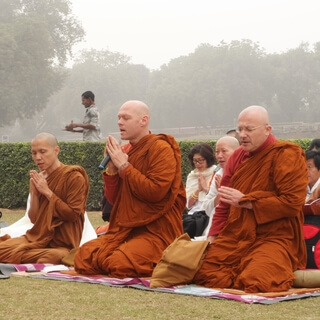
Buddhist Sutra Chanting is the rhythmic recitation of Buddhist scriptures, usually voiced in a steady monotone and kept in time with a bell or wooden fish.
Last Updated
4 Jul 2026
We are still reviewing this page. Our research team checks every technique page for accuracy and evidence quality before final release. Details may change as that review completes. The evidence badge shows our current reading of the published research.
RECOMMENDED DOSE
No direct dose-response literature exists for this technique. These recommendations are based on general practice conventions for contemplative chanting and should be treated as starting points only. No direct dose evidence; editorial synthesis.
Session length
Session length: 5–10 minutes
5
MIN
How long each individual practice session should last from start to finish.
Frequency
Frequency: 3–4 days
3
DAYS
The number of days per week to fit a session into your routine.
Session length
Session length: 15–20 minutes
15
MIN
How long each individual practice session should last from start to finish.
Frequency
Frequency: 4–5 days
4
DAYS
The number of days per week to fit a session into your routine.
Session length
Session length: 25–40 minutes
25
MIN
How long each individual practice session should last from start to finish.
Frequency
Frequency: 6–7 days
6
DAYS
The number of days per week to fit a session into your routine.
About this card. These recommendations are not a substitute for personalised guidance from a qualified practitioner. No direct dose-response evidence exists for Buddhist sutra chanting; the durations and frequencies below are conservative starting points drawn from general contemplative-practice conventions.
Quick answers to what people most often ask. Each card links to the deeper section below.
evidence
Research on Buddhist Sutra Chanting is early and sparse: a single temple-based pilot study in older Japanese adults explored effects on wellbeing and swallowing, while broader reviews of chanting across traditions link it to sharper focus and calmer states. No controlled trials confirm benefits for anxiety, depression, or any medical condition.
Read moregood for
Buddhist Sutra Chanting suits people who want a structured way to steady a restless mind, settle a keyed-up body, or share a devotional rhythm in a group. The only technique-specific study involved older adults in a Japanese temple, where chanting sustained motivation better than plain articulation drills. It supports settling and focus, not treatment.
Read moresafety
Most healthy adults can practise Buddhist Sutra Chanting safely as a low-risk, gentle activity. Sustained voicing can tire or strain the throat, so rest at the first sign of hoarseness. People with voice, respiratory, or breath-control conditions should keep passages short. The devotional Buddhist content may not suit every belief system, and chanting should complement, not replace, professional care.
Read morehow it works
Buddhist Sutra Chanting appears to work by giving attention something steady to hold. Voicing memorised text syllable by syllable anchors focus on the sound, leaving less room for worry. The steady cadence draws breath and heart rate into an even rhythm, while sustained voicing and slow breathing tone the vagus nerve, shifting the body toward rest and recovery.
Read moreBuddhist Sutra Chanting is the rhythmic recitation of Buddhist scriptures, usually voiced in a steady monotone and kept in time with a bell or wooden fish.
A practitioner recites memorised passages of scripture, such as the Heart Sutra or Metta Sutta, in a sustained monotone, moving syllable by syllable while a wooden fish, called a mokugyo, or a bell keeps a steady beat. Sessions may be solitary or communal, and the recitation can run through short texts or long passages depending on the tradition and lineage.
Unlike kirtan or devotional call-and-response singing, sutra chanting is typically a steady, near-monotone recitation of scriptural text rather than melodic song, and it centers on the words of the sutras themselves rather than a repeated short mantra or a musical setting. It is a contemplative and devotional practice, not a vocal-performance or music technique.
Not to be confused with
Mantra repetition (japa)
Mantra practice repeats one short sacred sound or phrase, often silently and sometimes counted on beads. Sutra chanting voices long passages of scripture aloud, so it engages the reading-and-reciting mind and the voice, not just a single repeated syllable.
Kirtan (call-and-response devotional singing)
Kirtan is melodic, emotive group singing that rises and falls with the music. Sutra chanting is usually a level monotone kept steady by a wooden fish or bell, prizing even articulation over melody.
Sound baths and singing-bowl meditation
Sound baths are received passively: you listen while bowls or gongs are played. Sutra chanting is active, you produce the sound yourself, so it engages the voice, breath, and articulation rather than only the ears.
Buddhist Sutra Chanting appears to work by giving attention something steady to hold. The precise, syllable-by-syllable articulation of memorised text is a form of attentional anchoring, holding focus on the sound so the mind has less room to drift toward worry. The steady cadence adds rhythmic entrainment, the tendency of body rhythms like breath and heart rate to fall into step with a repeating pattern, which many people feel as being carried and settled. Sustained voicing also engages what researchers call vocal vagal stimulation, in which the vibration and breath control of long passages tone the vagus nerve, the pathway that shifts the body toward rest and recovery. These are plausible explanations rather than confirmed findings for this particular practice.
What sutra chanting is thought to do in the body begins at the voice, where sustained phonation and the slow, regulated breath needed to carry long passages are believed to increase vagal afferent signalling, the nerve traffic that shifts the body toward its rest-and-recovery mode, felt as a loosening in the chest and a slower, steadier breath. The repeating rhythm may also draw breath and heart rate into a more even pattern, experienced as the body settling without effort. These changes are proposed from how the practice works rather than measured in trials of sutra chanting itself, so they describe a plausible direction rather than a confirmed result.
Emerging–Limited evidence to date is all that exists for this practice. Technique-specific research on Buddhist Sutra chanting is confined to early work, including a single temple-based study in older Japanese community-dwelling adults that looked at wellbeing and swallowing function (Edahiro et al., 2024). Broader reviews of chanting across many traditions, not Buddhist sutra chanting specifically, associate the practice with sharper focus and calmer, more absorbed states, which points toward possible benefits for present-moment focus, a quieter mind, and nervous-system settling. Not yet supported are large or controlled trials, long-term follow-up, or any claim that sutra chanting treats anxiety, depression, trauma, or a medical condition.
Research on Buddhist Sutra chanting is still at an early stage. The most direct study, a temple-based project in older Japanese adults, explored chanting as a way to support mental health and swallowing function in people who found conventional exercises hard to stick with (Edahiro et al., 2024). Wider reviews of chanting across traditions, rather than sutra chanting on its own, link the practice to cognitive benefits and shifts into calmer, more absorbed states. The main limit is that these broader studies rarely separate Buddhist sutra chanting from other vocal or contemplative methods, so outcomes like focus and calm remain plausible for this technique rather than firmly established.
0
Meta-analyses
0
RCTs
0
Systematic reviews
0
Observational
1
Pilot
Studied populations
Outcomes measured
The research is useful for setting expectations, but study methods and participant groups vary. Treat the findings as general guidance rather than a promise about any single session, and not a replacement for clinical care.
P12: Buddhist temples are promising social resources in secular community-based integrated care (3): The Effects of Buddhist Sutra chanting on swallowing function and mental health
2024
Finding: This conference report set out to explore whether group sutra chanting, offered through Buddhist temples as part of community care for older adults, might support swallowing function and mental wellbeing. Only the study's aims were available to us; no participant numbers, measurements, or outcomes could be retrieved, so it marks a line of active investigation rather than a proven benefit. If you're drawn to chanting, it's reasonable to see it as a promising avenue being studied, but there's no evidence yet that it improves swallowing or mood, and this single early report can't tell us whether it works.
See full citation in referencesBuddhist Sutra chanting comes from long-standing monastic and devotional traditions that recite sacred scriptures such as the Heart Sutra, Lotus Sutra, and Metta Sutta, voiced in Pali, Sanskrit, Japanese, Chinese, or Tibetan depending on lineage. The steady monotone and the timekeeping bell or wooden fish are inherited features of these traditions, and the scriptures' themes of impermanence and non-attachment frame the recitation as a devotional act. These roots help explain the practice's form, the memorised text and patterned cadence, not its clinical effects.
For most healthy adults, Buddhist Sutra chanting is a low-risk, gentle practice. The research so far is early and tied to specific settings, so it is best treated as supportive practice rather than treatment (Edahiro et al., 2024). A few situations still call for care, and these come from practical experience and from how the practice works rather than from safety trials. Sustained phonation, the steady voicing of long passages, can tire or tighten the throat, so ease off and rest if your voice feels strained. Because the content is explicitly devotional and rooted in Buddhist scripture, it may not sit comfortably with every belief system. And it should complement, not replace, professional care for anxiety, depression, trauma, or any medical concern.
People with voice, throat, or vocal-fold conditions should adapt duration and volume, since the prolonged laryngeal engagement of long recitation, the continuous work of the muscles that produce sound, can aggravate an irritated or recovering voice. Those with respiratory or breath-control conditions such as asthma or COPD should keep passages short and breathing comfortable, because holding steady phonation across long text asks for sustained breath regulation. Anyone working through anxiety, depression, trauma, addiction, or a perinatal or pain-related condition should treat chanting as an adjunct alongside appropriate professional support, not a substitute for it.
Sustained phonation, the steady voicing of long passages, asks continuous work from the muscles that produce sound, so the throat can feel tired or tight after extended sessions. If your voice feels scratchy, hoarse, or fatigued, soften the volume, pause, and sip water rather than chanting through the discomfort. Start with short recitations and build gradually.
| Technique | Best for | Use with care | Evidence strength | Distinction |
|---|---|---|---|---|
| Mantra Meditation (japa) | People who want a portable, silent anchor for focus that needs no memorised text and can be done anywhere without voicing aloud. | moderate EVIDENCE | Mantra meditation repeats a single short sacred sound or phrase, often silently or under the breath, so attention rests on one compact anchor. Sutra chanting instead voices long memorised passages of scripture aloud in a steady monotone, so the conceptual mind follows the unfolding text while sustained phonation works the breath and voice. Both use repetition to steady attention, but chanting adds the vocal, rhythmic, and communal dimensions that a silent single-word mantra does not. | |
| Kirtan and Devotional Chanting (bhakti) | People drawn to expressive, musical, uplifting group singing and an emotionally warm devotional atmosphere. | emerging EVIDENCE |
No. You do not need to hold Buddhist beliefs to chant sutras. The scriptures and devotional framing are the tradition the practice comes from, not a requirement to take part, though belief-alignment may deepen engagement for some.
+
No. Sutra chanting grows out of long-standing Buddhist monastic and devotional traditions, and that scriptural context is best understood as the practice's origin and vehicle rather than a belief you must adopt. For people whose worldview aligns with it, the Buddhist framing can add coherence and help sustain motivation to practise. Where the devotional content does not fit your beliefs, a more secular chanting or toning form can share the same rhythmic and vocal mechanisms while offering a different frame.
No. Traditional sutra chanting is often recited from memory, but you do not need to memorise a whole sutra to begin. Most people start with short passages or simply read from the text, letting memory build with repetition.
+
No. Buddhist Sutra chanting is the rhythmic recitation of scripture in a steady monotone, usually kept in time with a bell or wooden fish, and while long-standing monastic traditions often recite from memory, that is not a prerequisite for beginners. A common way to start is with a short passage, reading from the text and letting familiarity deepen through repetition rather than memorising an entire sutra first. The point is a comfortable, steady recitation, not a feat of memory.
A Buddhist scripture, traditionally regarded as a discourse of the Buddha. Well-known examples chanted aloud include the Heart Sutra, the Lotus Sutra, and the Metta Sutta.
A hollow wooden percussion instrument struck to keep a steady beat during recitation, giving chanters a shared rhythm to move through the text together, syllable by syllable.
Chanting on a single, level pitch rather than a rising and falling melody. It keeps the sound even and steady, which many practitioners find settling and easy to sustain over long passages.
The way sustained voicing and breath can gently activate the vagus nerve, the body's main calming pathway, which tends to feel like grounding, slowing, and a settled sense in the body.
Use of vocalization (chanting, humming, toning) to engage laryngeal and vocal-fold vibration, increasing vagal afferent signalling and parasympathetic regulatory tone.
The tendency of body rhythms like breathing and heartbeat to fall into step with a steady external beat, so chanting can feel like being carried along by the rhythm with little effort.
Synchronisation of physiological rhythms (neural oscillations, respiration, heart rate) to an external rhythmic stimulus such as repetitive chanting or drumming.
Resting attention on a clear, ongoing target, here the sequence of syllables, so the mind wanders less. It tends to feel like sharper focus and fewer spiralling thoughts.
Stabilising focused attention on a defined perceptual or cognitive target to reduce mind-wandering and attentional shifting.
Stepping back to watch thoughts and feelings come and go rather than being swept up in them, which can loosen the grip of automatic reactions. The sutras' themes of impermanence support this shift.
Ayako Edahiro, Chiaki Ura, Tsuyoshi Okamura, Ryosho Shoji, Yukan Ogawa, Akinori Takase (2024). P12: Buddhist temples are promising social resources in secular community-based integrated care (3): The Effects of Buddhist Sutra chanting on swallowing function and mental health. https://doi.org/10.1017/s1041610224001959
Cited in: Benefits, Research, Use with care
Explore guided sessions to deepen your Buddhist Sutra Chanting technique.
People with a voice, throat, or vocal-fold condition should adapt duration and volume, since the prolonged laryngeal engagement of long recitation can aggravate an irritated or recovering voice. Shorten passages, lower the volume, and check with your clinician before extended sessions.
Those with respiratory or breath-control conditions such as asthma or COPD should keep passages short and breathing comfortable, because holding steady phonation across long text asks for sustained breath regulation. Take a full, unhurried breath before each phrase and never push a passage past a comfortable exhale.
The content of sutra chanting is explicitly devotional and rooted in Buddhist scripture, so it may not sit comfortably with every belief system. Where the devotional framing does not align with your worldview, a more secular chanting or toning form can share the same rhythmic and vocal mechanisms while offering a different frame.
The research so far is early and tied to specific settings, so sutra chanting is best treated as supportive practice rather than treatment. Anyone working through anxiety, depression, trauma, addiction, or a perinatal or pain-related condition should use chanting as an adjunct alongside appropriate professional support, not a substitute for it.
Buddhist Sutra chanting is best approached as a gentle, supportive practice rather than a performance, so let comfort guide you and treat it as something that sits alongside any professional care you may need. A sensible starting point is a few relaxed minutes at an easy volume and pitch, with your breath leading the way and plenty of room to rest your voice. If the devotional content does not fit your own worldview, or if you live with a voice, throat, or breathing condition, it is worth adapting the form and length so the practice stays kind to you.
Begin with a few minutes of recitation rather than a full sutra, letting your voice and breath find a comfortable rhythm before you lengthen sessions over days and weeks.
Chant in a relaxed monotone at an easy volume. If your throat feels tight or your voice tires, that is your signal to soften the sound or pause.
Take a full, unhurried breath before each passage and never push a phrase past a comfortable exhale, so sustained voicing never turns into straining for air.
If your throat feels scratchy, hoarse, or fatigued, stop, rest, and sip water. Do not chant through vocal discomfort.
Shorten passages, lower the volume, and check with your clinician before extended sessions if you live with a laryngeal, respiratory, or breath-control condition such as asthma or COPD.
If the devotional Buddhist content does not align with your own worldview, a more secular chanting or toning form can offer the same rhythmic and vocal effects.
Use chanting alongside professional care for any mental-health or medical concern rather than as a replacement for it.
This information is educational and is not medical advice. This practice is not a substitute for professional care and should not replace prescribed medication or treatment for any medical or mental-health condition. If you are managing a health condition or taking medication, talk with a qualified health professional before changing your practice. If you are in distress or crisis, seek professional support.
| Kirtan is melodic, often call-and-response devotional singing drawn from Hindu bhakti traditions, carried by emotion, melody, and sometimes instruments and movement. Sutra chanting is typically a level monotone kept in time with a wooden fish or bell, prizing precise articulation over melody. Both are vocal, communal, and rooted in a devotional meaning system, but kirtan leans into musical expression while sutra recitation holds a bounded, even acoustic space. |
| Silent Buddhist meditation (Zazen, Vipassana) | People seeking cultivation of quiet, wordless awareness and comfortable sitting with silence for longer stretches. | moderate EVIDENCE | Silent seated meditation from the same Buddhist lineages works through wordless attention to breath, sensation, or awareness itself, with no vocalisation. Sutra chanting shares the tradition and the aim of a settled, decentered mind, but it occupies the conceptual mind with recited text and adds the physiological calming of steady voice and breath. Chanting can be an accessible on-ramp for people who find open silence restless or hard to sustain. |
| Humming and vocal toning (e.g., Bhramari) | People who want the calming vocal-vibration effect without any religious or scriptural content, in short, simple sessions. | Offers the vocal mechanism without the meaning-rich text that helps some people stay engaged and motivated to practise. | emerging EVIDENCE | Humming and toning practices use sustained wordless sound, a hum or a single tone, to create vocal vibration and engage the vagus nerve for calming. Sutra chanting produces similar vocal and breath effects but wraps them in meaningful scriptural text and a devotional frame, so attention and belief are engaged alongside the physiology. Toning offers the same nervous-system mechanism stripped of any religious content. |

Partly, and honestly the evidence is still thin. Only one direct study exists, temple-based, in older Japanese adults, on wellbeing and swallowing, so calm and focus are best seen as plausible and mechanism-based rather than proven (Edahiro et al., 2024).
+
Partly. Technique-specific research on Buddhist sutra chanting is emerging and limited: the only direct study is a small temple-based project in older Japanese community-dwelling adults that looked at wellbeing and swallowing function (Edahiro et al., 2024). Broader reviews of chanting across traditions, not sutra chanting specifically, link it to sharper focus and calmer, more absorbed states, which makes those effects plausible here rather than established. No large or controlled trials support sutra chanting as a treatment for anxiety, depression, trauma, or any medical condition.
Limited. Only one technique-specific study exists so far, and broader chanting reviews don't isolate sutra chanting from other vocal methods, so focus and calm are plausible and mechanism-based rather than proven (Edahiro et al., 2024).
+
Limited. The most direct research is a single temple-based study in older Japanese adults that looked at wellbeing and swallowing function, not focus or calm specifically (Edahiro et al., 2024). Wider reviews link chanting across many traditions to sharper attention and calmer, more absorbed states, but they rarely separate Buddhist sutra chanting from other vocal or contemplative practices. Treat the benefits for focus and nervous-system settling as suggestive rather than confirmed, and not evidence that chanting treats any condition.
Plausibly, through three linked pathways: sustained voicing may tone the vagus nerve, the body's main rest-and-recovery pathway; the steady cadence can draw breath and heart rate into an even pattern; and syllable-by-syllable focus gives a busy mind less room to wander. These are mechanism-based explanations, not confirmed findings for sutra chanting itself.
+
Plausibly, sutra chanting settles the body through several proposed mechanisms rather than one measured effect. Sustained phonation, the steady voicing of long passages, is thought to engage vocal vagal stimulation, where vibration and slow breath tone the vagus nerve and shift the body toward rest and recovery. The repeating cadence may add rhythmic entrainment, drawing breath and heart rate into a more even pattern, while precise syllabic focus works as attentional anchoring, holding attention on the sound. These pathways are reasoned from how the practice works, not measured in trials of sutra chanting, so they point to a likely direction rather than a confirmed effect, and not a treatment for any condition.
Plausibly, yes. Sustained voicing and the slow, regulated breath needed to carry long passages are proposed to engage the vagus nerve through vocal-fold vibration and long exhalations. This is a mechanism-based explanation for sutra chanting, not a measured effect confirmed in trials of the practice.
+
Plausibly, yes. When you chant, sustained phonation, the steady voicing of sound, and the slow, controlled breathing that long passages demand are thought to increase vagal afferent signalling, the nerve traffic that shifts the body toward its rest-and-recovery mode. This pathway, called vocal vagal stimulation, is inferred from how the voice and breath work rather than measured in trials of sutra chanting itself, so it describes a likely direction of effect, not a proven one. Treat it as a mechanism-based expectation rather than confirmed nervous-system regulation.
It can. Sustained phonation, the steady voicing of long passages, may tire or tighten the throat, so soften your volume, pause, and sip water at the first sign of hoarseness. This is a mild-to-moderate caution based on how voicing works, not on documented harm from chanting itself.
+
It can, though this is a mechanism-inferred caution rather than a finding from safety studies. Keeping steady phonation across long passages asks continuous work from the muscles that produce sound, so a scratchy, hoarse, or tired voice is your signal to lower the volume, rest, and sip water rather than push on. Start with short recitations and build gradually, and if you live with a voice, throat, or breath-control condition such as asthma or COPD, shorten passages and check with your clinician before extended sessions.
Start with just a few minutes rather than a full sutra, then lengthen gradually over days and weeks. Keep the volume, pitch, and breath comfortable, and rest at the first sign of vocal strain.
+
Start short: a few minutes of recitation lets your voice and breath find an easy rhythm before you build up to longer passages over days and weeks. Chant in a relaxed monotone at a comfortable volume, take a full breath before each phrase, and stop to rest and sip water if your throat feels scratchy or tired. This is practical starting guidance rather than an evidence-based optimal dose, since no trial has established an ideal session length for outcomes.
The main difference is form: mantra meditation, sometimes called japa, silently repeats one short sacred sound or phrase, resting attention on a single compact anchor, while sutra chanting voices long memorised scripture aloud in a steady monotone, adding sustained voice, breath, and often a communal dimension.
+
Both practices use repetition to steady attention, but they differ in vehicle and form. Mantra meditation typically repeats a single short sound or phrase, often silently or under the breath, so attention rests on one compact anchor you can carry anywhere. Sutra chanting instead recites long passages of Buddhist scripture aloud, usually in a level monotone kept in time with a bell or wooden fish, so the conceptual mind follows the unfolding text while sustained phonation, the steady voicing of long passages, works the breath and voice. Evidence for both remains emerging and mechanism-based, so choose by the form that fits you rather than any claim of treating a condition.
A cognitive shift from immersion in mental content to observing thoughts and emotions as transient events, reducing reactivity and identification.
The act of producing voiced sound as the vocal folds vibrate. Long chanting keeps phonation going steadily, which is why the throat and voice can feel tired after extended sessions.
Beginner content for Buddhist Sutra Chanting

★ 4.8
·
Music
·
12 min
Jim Rajan
How hard is Buddhist Sutra Chanting?
Buddhist Sutra Chanting sits above the simple chant baseline because accurate scripture recitation requires more formal familiarity and pacing discipline.
3
Mental Effort
2 / 4
▾Emotional Depth
1 / 4
▾Physical Intensity
2 / 4
▾Prior Knowledge
3 / 4
▾Editorially curated. Tracks are not themselves clinically studied; evidence on the page applies to Buddhist Sutra Chanting as a technique.