The world’s largest free audio library for everyday wellbeing
Sound-Based
Taiko Meditation is a contemplative form of Japanese taiko drumming that centers attention on the movement, vibration, and sound of each slow, deliberate strike.
Last Updated
4 Jul 2026
We are still reviewing this page. Our research team checks every technique page for accuracy and evidence quality before final release. Details may change as that review completes. The evidence badge shows our current reading of the published research.
RECOMMENDED DOSE
Short, brief meditation sessions of roughly 10–12 minutes have shown measurable benefit in related mindfulness meditation trials (10-minute guided videos for teachers, 12-minute neurofeedback-assisted sessions), and daily practice over a 30-day period was used in an app-based randomized trial. These doses are extrapolated from general meditation research rather than Taiko-specific studies, so a short daily start is a conservative, achievable entry point.
A daily cadence sustained over several weeks reflects the 30-day daily protocol used in a related app-based meditation trial. The step up to 20–30 minute sessions is an editorial extrapolation beyond the shorter durations reported in the cited studies, offered as a natural progression once a daily habit is established.
No direct dose evidence; editorial synthesis. Longer maintenance sessions and continued daily practice are suggested for committed practitioners based on general meditation-practice conventions, as no Taiko-specific or related trial reported this dose.
Session length
Session length: 10–15 minutes
10
MIN
How long each individual practice session should last from start to finish.
Frequency
Frequency: 5–7 days
5
DAYS
The number of days per week to fit a session into your routine.
Session length
Session length: 20–30 minutes
20
MIN
How long each individual practice session should last from start to finish.
Frequency
Frequency: 5–7 days
5
DAYS
The number of days per week to fit a session into your routine.
Session length
Session length: 30–45 minutes
30
MIN
How long each individual practice session should last from start to finish.
Frequency
Frequency: 5–7 days
5
DAYS
The number of days per week to fit a session into your routine.
About this card. Dose guidance here is drawn largely from research on related mindfulness meditation practices rather than Taiko meditation specifically, and higher-tier durations are editorial estimates. These recommendations are not a substitute for personalised guidance from a qualified practitioner.
Quick answers to what people most often ask. Each card links to the deeper section below.
evidence
No trial has tested Taiko Meditation directly, so its evidence is borrowed from seated meditation research. A meta-analysis of 47 trials found meditation programs produce small-to-moderate reductions in anxiety and depression at eight weeks. Results are mixed, and these numbers may not transfer to loud, high-exertion drumming.
good for
Adults who find stillness-based meditation frustrating and prefer an active, embodied route to focus and calm may suit Taiko Meditation, especially those drawn to communal, physical drumming. Supporting evidence comes from stressed professionals and students practising seated meditation. It is not a substitute for care when stress, mood, or trauma symptoms are severe.
Read moresafety
Most healthy adults can practise Taiko Meditation at low risk, though two aspects warrant sensible care: sustained high-volume sound can strain hearing, so wear ear protection, and vigorous full-body striking is real exertion for shoulders, arms, and heart. People with heart conditions, high blood pressure, injuries, hearing loss, or pregnancy should seek clinician advice first.
Read morehow it works
Taiko Meditation gives attention a single, unmistakable target, the moment of each strike, leaving the mind less room to drift into worry or planning, which research on focused-attention meditation links to steadier attention. The driving rhythm and full-body exertion raise heart rate and energy, an experience many describe as energising and cathartic rather than sedating.
Read moreTaiko Meditation is a slow, contemplative form of Japanese taiko drumming that rests attention on the movement, vibration, and sound of each deliberate strike.
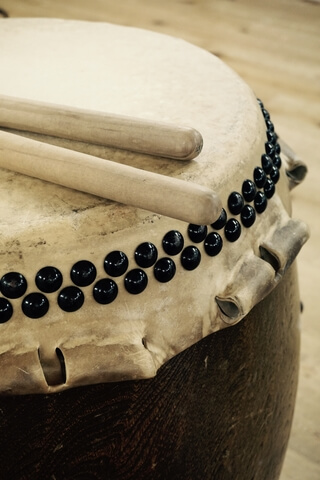
The practitioner plays a large drum, an odaiko or chu-daiko, with full-body movements at a slower, more intentional tempo than performance taiko. Attention rests on three things: the physical act of striking, the low-frequency vibration traveling through the body, and the expanding sound wave. Stance and breath support a steady, driving rhythm that becomes the object of practice, so the aim shifts from musical execution toward absorbed, embodied presence.
This is not performance or ensemble taiko aimed at an audience; the goal is meditative presence rather than musical execution, and the tempo is deliberately slower. It differs from still, seated meditation in being loud, physically strenuous, and arousing rather than quiet and sedating, and from passive sound-bath listening in that the practitioner actively produces the sound and vibration through effortful striking.
Not to be confused with
Performance Taiko (Kumi-daiko)
Performance taiko aims at musical mastery, precision, and spectacle for an audience. Taiko Meditation uses the same drums but slows the tempo and shifts the aim from performance to moment-to-moment presence, treating each strike as a place for attention to land.
Shamanic or Ecstatic Drumming Journeys
Shamanic drumming uses steady drumbeats to induce trance and guided inner journeying within a spiritual framework. Taiko Meditation keeps attention on the present physical act of striking and its vibration, without the visionary or journeying intent.
Taiko Meditation appears to work by giving attention a single, unmistakable target, the moment of each strike, so the mind has less room to drift into worry or planning. Research on focused-attention meditation, not Taiko itself, links this kind of anchoring to steadier attention and less mind-wandering, the felt sense of thoughts settling and the beat becoming easy to stay with (Jensen et al., 2011), (Zanesco et al., 2016). The driving rhythm and full-body exertion add a second layer, a mobilizing arousal that many practitioners experience as energized and cathartic rather than sedating.
Each powerful strike gives attention one clear, unmistakable place to land, so the mind has less room to drift into worry or planning. Meditation research links this kind of focused anchoring with steadier attention and less mind-wandering (Jensen et al., 2011), (Zanesco et al., 2016), which practitioners often feel as a quieter, more present state while playing.
When your mind keeps drifting into worry or planning, the demand of each drum strike gives attention a clear, repeating target to land on and return to. In broader meditation research, this kind of focused practice has been linked to steadier attention and less mind-wandering (Jensen et al., 2011), (Zanesco et al., 2016), which many practitioners notice as feeling more present and less mentally scattered.
During play, striking a large drum is real physical exertion: heart rate climbs and the sympathetic nervous system, the body's mobilizing branch, ramps up, felt as heightened energy and alertness rather than drowsiness. The calmer changes measured for meditation appear over time and after practice, not in the thick of drumming, so research on meditation broadly, not Taiko specifically, links regular practice to lower long-term cortisol, a slow-acting stress hormone whose decline tends to feel like recovering from stress more easily (Puhlmann et al., 2021). One trial in Chinese nursing students found a small drop in systolic blood pressure of about 2.2 mmHg after brief meditation, roughly the sense of internal pressure easing as you rest afterward (Chen et al., 2012).
That wired, can't-wind-down feeling that lingers long after a stressful stretch is shaped partly by cortisol, a slow-acting stress hormone. In one controlled trial, months of meditation-based mental training were linked to lower long-term cortisol (Puhlmann et al., 2021), a shift many people feel as a body that recovers from stress more easily and spends less of the day on high alert. This was measured in general meditation practice, not in Taiko itself.
That wrung-out, wired-but-tired feeling of being under stress for a long stretch is tied partly to cortisol, the body's main long-term stress hormone. In meditation-based mental training, long-term cortisol has been measured to fall (Puhlmann et al., 2021). Taiko itself has not been tested this way, but it shares the same settling pathways, and that change is often felt as the body downshifting out of high alert and finding it easier to rest afterward.
When stress builds, you can feel your pulse pounding and a sense of pressure rising inside. In one controlled trial of brief meditation, systolic blood pressure, the higher of the two readings and a measure of how hard blood pushes against artery walls with each heartbeat, dropped by a small amount (Chen et al., 2012). A slight drop like this tends to feel like that internal pressure easing as the body settles once you rest after focused, rhythmic practice.
Indirect–Emerging evidence to date supports Taiko Meditation, all of it borrowed from research on meditation and mindfulness rather than drumming: broader meditation programs show small-to-moderate reductions in anxiety and depression (Goyal et al., 2014), and controlled trials in stressed professionals report lower perceived stress and anxiety (Warnecke et al., 2011), (Rezvan et al., 2020), (Tsubono & Mitoku, 2025). The clearest signals across this wider literature are for stress and anxiety. What is not yet supported: any trial of Taiko itself, effects tied to the loud-sound or high-exertion elements unique to it, or any claim that it treats a diagnosed condition.
A meta-analysis of 47 trials with 3,515 participants found meditation programs produced small-to-moderate reductions in anxiety (standardized mean difference 0.38, 95% CI 0.12–0.64) and depression (0.30, 95% CI 0.00–0.59) at eight weeks, meaning the average participant improved more than roughly six in ten people who received no such program (Goyal et al., 2014). Controlled trials add lower perceived stress and steadier attention (Warnecke et al., 2011), (Jensen et al., 2011), though the picture is not uniform: a meta-analysis of neurofeedback-assisted meditation found no meaningful gain in cognition (Hedges' g = 0.07, a negligible difference versus control) or physiological health (Hedges' g = 0.11, also negligible), and a pilot in hemodialysis patients saw no significant change in depression or anxiety (Treves et al., 2025), (Thomas et al., 2017). The central limitation is that all of this comes from seated meditation, not the loud, high-exertion drumming that defines Taiko, so the numbers may not transfer.
1
Meta-analyses
4
RCTs
0
Systematic reviews
0
Observational
7
Pilot
Studied populations
Meditation Programs for Psychological Stress and Well-being
n = 3,515
Finding: Across 47 randomised trials with about 3,500 adults in clinical settings, this review found that eight weeks of mindfulness meditation produced small but consistent improvements in anxiety and depression, with weaker signals for everyday stress. Importantly, all of this evidence comes from seated mindfulness practice rather than Taiko drumming, so it speaks to what meditation programs generally can do, not to the rhythmic, physical experience of drumming itself. For someone drawn to Taiko, it is a reasonable reason for cautious optimism that a regular meditative practice may ease anxious or low mood over a couple of months, while keeping in mind that the drumming-specific effects have not been tested here and that many of the underlying studies were of modest quality.
reported narratively
Consumer-Grade Neurofeedback With Mindfulness Meditation: Meta-Analysis
2025
Finding: This meta-analysis looked at devices that read your brain activity and give real-time feedback during mindfulness meditation, and it found no measurable edge over meditating without one: across seven trials each, thinking skills and physical-health markers barely budged, and the devices did not reliably shift the brain patterns they were designed to target. For anyone drawn to meditation for its mental or physical benefits, the takeaway is that clip-on brain trackers do not appear to add anything you couldn't get from the practice itself. This work centres on neurofeedback gadgets rather than Taiko drumming, so it speaks only indirectly to Taiko Meditation, and its main value here is a caution against assuming meditation reliably rewires the brain or changes body measures.
Taiko drumming grew out of Japanese festival, shrine, and ensemble traditions, the ensemble form known as kumi-daiko, where the drum marks presence and binds players together in communal ceremony. The contemplative version keeps that embodied, collective resonance but reorients it from performance and spectacle toward moment-to-moment presence. These roots help explain the practice's form, its full-body striking and driving communal rhythm, not its clinical effects.
For most healthy adults, Taiko Meditation is low-risk, and broad reviews of meditation and mindfulness programs describe them as generally well tolerated, with adverse events uncommon and usually mild. Two features of the practice call for sensible care, and both are practice-informed precautions rather than risks measured for this drumming form specifically. First, the sustained high-volume sound can strain the ears over time, a mild-to-moderate noise-induced hearing risk that hearing protection largely addresses. Second, the vigorous full-body striking is real physical exertion: it feels like a workout for the shoulders, arms, and heart and carries the same everyday musculoskeletal and cardiovascular load. Neither exposure was assessed in the available evidence, so treat this as common-sense caution, not a documented finding.
A few groups should check with a clinician before starting. People with a heart condition or uncontrolled high blood pressure, a recent musculoskeletal injury, or existing hearing loss or tinnitus face genuine load on the ears, heart, and joints from the loud drum and strenuous striking, load that can show up as a pounding pulse, breathlessness, or ringing in the ears. Pregnancy, and any condition that limits vigorous exercise, also warrant individualized advice on pacing and intensity. These are practice-informed precautions drawn from the acoustic and physical demands of the form, not established contraindications from Taiko-specific safety research.
Taiko's high-volume, low-frequency drumming can strain the ears over time, carrying the same noise-induced hearing risk as other loud sound exposure. Wear earplugs or over-ear hearing protection when playing near large drums, and ease off if your ears feel muffled or you notice ringing afterward. This is a common-sense precaution drawn from the acoustic demands of the practice, not a hearing risk measured for Taiko specifically.
| Technique | Best for | Use with care | Evidence strength | Distinction |
|---|---|---|---|---|
| Seated Mindfulness Meditation | Quiet, low-exertion settings, or anyone who wants a portable practice with no equipment and the largest body of supporting evidence. | Its stillness may feel understimulating for people who settle more easily through vigorous, rhythmic movement. | moderate EVIDENCE | Seated mindfulness holds attention on breath or body in stillness and quiet, while Taiko Meditation anchors attention to the movement, impact, and low vibration of each drum strike. Almost all of the research cited for Taiko actually comes from seated mindfulness, where a meta-analysis of 47 trials found small-to-moderate reductions in anxiety and depression; the drumming form is inferred to share these effects rather than measured directly. |
| Progressive Muscle Relaxation | People who want a quiet, structured way to release physical tension without noise, exertion, or equipment. | It offers little of the communal, high-energy engagement that draws many practitioners to Taiko. |
Taiko Meditation is a slow, contemplative form of Japanese taiko drumming that rests your attention on the movement, vibration, and sound of each strike. Unlike performance drumming, the aim is moment-to-moment presence rather than musical mastery or spectacle.
+
Taiko Meditation is a slow, deliberate form of Japanese taiko drumming in which you play a large drum such as an odaiko or chu-daiko with full-body movements, keeping attention on the physical act of striking, the low vibration moving through you, and the expanding sound wave. What sets it apart from regular or performance taiko is intent and tempo: it slows the pace and shifts the goal away from precision, mastery, and audience spectacle toward embodied, present-moment awareness, treating each beat as a place for attention to land.
Yes, but not by calming you in the moment. Taiko is an active meditation: the loud, physical drumming raises energy and alertness while you play, and the meditative quality comes from anchoring attention on each strike. Research on focused-attention meditation, not Taiko itself, links this anchoring to steadier attention and less mind-wandering (Jensen et al., 2011), (Zanesco et al., 2016).
+
Yes, though the calm arrives differently than in stillness-based practice. Taiko Meditation rests attention on the movement, vibration, and sound of each slow, deliberate strike, so the loud, effortful drumming becomes the object of focus rather than a distraction. During play you may feel energized and alert rather than sedated; the quieter, settled feeling many describe tends to come after the sticks are set down. This calming picture is inferred from broader focused-attention meditation research, not measured for Taiko, so treat it as a plausible route to focus rather than a proven treatment (Jensen et al., 2011), (Zanesco et al., 2016).
Holding attention on one clear target, here each drum strike, so the mind has less room to drift into worry or planning. It tends to feel like a quieter, more present state while playing.
Focused-attention regulation in which awareness is stabilized on a chosen sensory object to reduce mind-wandering and sustain present-moment focus.
Sensing and staying attentive to the outer world through the senses, especially sound. In taiko this shows up as heightened alertness to the sound field filling the room.
Conscious perception and monitoring of external environmental stimuli received through the sensory modalities, distinct from interoceptive sensing of internal body states.
The body's tendency to fall into sync with an external beat, so heartbeat, breath, and movement settle into the drum's pattern. It often feels like being carried by the rhythm and slipping into flow without effort.
Synchronization of physiological rhythms, including neural oscillations, heart rate, respiration, and motor patterns, to an external rhythmic stimulus such as drumming.
A rise in the body's fight-or-flight branch, which mobilizes energy and alertness. The explosive effort of striking taiko can produce this as a faster heartbeat and an empowering, cathartic surge of energy.
Increased activity of the sympathetic branch of the autonomic nervous system via adrenal and adrenergic pathways, driving heightened arousal, energy mobilization, and readiness for action.
The transfer of sound vibration directly into body tissue through contact with a powerful sound source. With taiko this feels like a deep hum or buzz reaching into the chest and belly, sometimes with a sense of muscular release.
Transmission of acoustic vibration into body tissues, producing mechanical oscillation at the tissue and cellular level via bone conduction and visceral resonance.
Madhav Goyal, Sonal Singh, Erica Sibinga, Neda F Gould, Anastasia Rowland-Seymour, Ritu Sharma (2014). Meditation Programs for Psychological Stress and Well-being. https://doi.org/10.1001/jamainternmed.2013.13018
Isaac N. Treves, Zia Bajwa, Keara D. Greene, Paul Alexander Bloom, Nayoung Kim, Emma Wool (2025). Consumer-Grade Neurofeedback With Mindfulness Meditation: Meta-Analysis. https://doi.org/10.2196/68204
Explore guided sessions to deepen your Taiko Meditation technique.
Outcomes measured
| Outcome | Effect size | 95% CI | N | Comparator | Source |
|---|---|---|---|---|---|
| anxiety at 8 weeks | SMD = 0.38 | 95% CI 0.12-0.64 | — | — | Goyal et al., 2014 |
| depression at 8 weeks | SMD = 0.30 | 95% CI 0.00-0.59 | — | — | Goyal et al., 2014 |
| perceived stress (PSS) | mean change difference = -3.44 | 95% CI -6.20 to -0.68 | — | — | Warnecke et al., 2011 |
| hair cortisol reduction | reported significant; p<.001 to p=.010 | — | — | — | Puhlmann et al., 2021 |
| depression (PHQ-9) | reported narratively; P=0.45 | — | — | — | Thomas et al., 2017 |
| anxiety (GAD-7) | reported narratively; P=0.91 | — | — | — | Thomas et al., 2017 |
| cognition | Hedges' g = 0.07 | — | — | — | Treves et al., 2025 |
| physiological health | Hedges' g = 0.11 | — | — | — | Treves et al., 2025 |
The biggest gap is that no trial has studied Taiko Meditation itself; the evidence is entirely extrapolated from seated meditation, in populations such as students, teachers, and healthcare workers, and says nothing about Taiko's distinctive loud sound and physical exertion. Some findings are significance-only rather than full effect-size estimates, several samples are small, and results are mixed, all of which keep confidence modest (Goyal et al., 2014), (Zhang et al., 2021).
Hedges' g = 0.07
Mindfulness training affects attention—Or is it attentional effort?
2011
Finding: In a carefully controlled trial, 48 young, healthy people new to meditation were randomly assigned to either mindfulness-based stress reduction or a comparison stress-reduction program, then tested on tasks that measure focus. When the researchers accounted for how hard people tried on the tests and for general stress relief, the sharper attention often credited to mindfulness looked less clear-cut, hinting that some of that benefit may come from effort and relaxation rather than mindfulness itself. It's worth knowing this was a small study of beginners doing seated meditation, not Taiko drumming, so it speaks to how attention research should be interpreted rather than to what drumming does for focus.
See full citation in referencesMeditation training influences mind wandering and mindless reading.
2016
Finding: Across two longer-term studies, people who trained in mindfulness meditation held their focus more steadily and got pulled away by wandering, off-task thoughts less often, pointing to attention itself as something the practice can strengthen. For anyone drawn to a focus-based practice, that lends weight to the idea that regularly anchoring your attention can make it easier to stay present. Two important limits, though: this work looked at seated meditation rather than Taiko drumming, and some of the attention gains may reflect general stress relief or simply trying harder on the tests, so the results shouldn't be read as proof that drumming sharpens attention.
See full citation in referencesContemplative Mental Training Reduces Hair Glucocorticoid Levels in a Randomized Clinical Trial
2021
Finding: In this controlled trial, healthy adults who kept up several months of secular meditation-based mental training showed steadily lower levels of long-term stress hormones, cortisol and cortisone, measured in hair samples across three to six months, with the biggest drops among those who practised most often. This points to a real, gradual shift in the body's baseline stress load rather than just a passing sense of calm, and it accumulated slowly over months rather than after a single session. Worth knowing: the study tested seated contemplative practices, not Taiko drumming, so it speaks to what regular meditation can do for the stress system rather than to drumming specifically. The hormone changes also showed up independently of whether people said they felt less stressed, a reminder that the body's response and our felt experience don't always move in step.
reported significant; p<.001 to p=.010
Brief Mindfulness Meditation for Depression and Anxiety Symptoms in Patients Undergoing Hemodialysis: A Pilot Feasibility Study.
2017
Finding: In this trial, adults on hemodialysis, many of whom live with depression or anxiety, took up a brief mindfulness meditation practice, and while they tolerated it comfortably, their depression and anxiety scores improved no more than those of people receiving usual care alone. In plain terms, the practice was easy to stick with but did not measurably lift mood or ease worry over the study period. Because this was a small feasibility trial in one specific medical population, and mindfulness is only an indirect stand-in for Taiko Meditation, it is best read as a caution against treating any meditation as a proven fix for clinical depression or anxiety rather than as evidence that practice offers nothing.
reported narratively; P=0.45
A randomised controlled trial of the effects of mindfulness practice on medical student stress levels
2011
Finding: In this controlled trial with 66 senior medical students, those who followed a mindfulness practice reported measurably lower stress than those who did not, scoring several points lower on a standard perceived-stress scale over the study period. For someone facing sustained pressure, that points to a real drop in day-to-day stress rather than just a passing sense of calm. Keep in mind, though, that this trial tested seated, guided mindfulness rather than Taiko drumming, so it supports the idea that a mindful practice can ease stress only indirectly; the sample was also small and limited to medical students, so the results may not carry over to everyone.
mean change difference = -3.44
Effects of a single session of large-group meditation and progressive muscle relaxation training on stress reduction, reactivity, and recovery.
2006
Finding: In a single-session study with 387 undergraduate students, both seated meditation and progressive muscle relaxation lowered anxiety more than doing nothing at all, and progressive muscle relaxation produced the biggest drop in the physical, body-based side of anxiety. For someone considering this practice, it is a reminder that even one short sitting can take the edge off in-the-moment stress, though relaxing the body directly may ease physical tension fastest. Keep in mind that this study looked at seated meditation rather than Taiko drumming, so it speaks to the broader family of relaxation techniques only indirectly, and it measured a single session rather than the effects of a regular routine.
See full citation in referencesMindfulness-based interventions: an overall review
2021
Finding: This broad review of mindfulness and meditation programs found that regular seated practice can help with a wide range of conditions, from depression and anxiety to stress, insomnia, and high blood pressure. It's worth knowing that none of this work looked at Taiko drumming or any sound- or rhythm-based practice, so what it tells us about Taiko Meditation is borrowed from a different style of practice rather than tested directly; the drumming-specific effects people often describe, like feeling the rhythm move through the body, were not studied here. The review also cautions that many of the meditation studies it drew on were of low quality, which means these conclusions stay tentative until larger, longer, and more rigorous trials are done.
See full citation in referencesBrief Mindfulness Meditation via Video Streaming Improves Depression, Anxiety, and Perceived Stress Among Schoolteachers: A Randomized Controlled Trial
2025
Finding: In this trial, schoolteachers were randomly assigned to either a short daily mindfulness routine, delivered as ten-minute streamed videos, or to a comparison group, and those who practised reported lower stress and anxiety over the study period. For anyone drawn to Taiko Meditation as a way to steady a demanding workday, that points to a real payoff from brief, regular sessions, even when time is tight. Two honest caveats: the study tested quiet, guided mindfulness rather than drumming, so it supports the idea of short practice more than Taiko specifically, and participants knew which group they were in, which can nudge self-reported results.
See full citation in referencesEffect of a Brief Mindfulness-Based Program on Stress in Health Care Professionals at a US Biomedical Research Hospital: A Randomized Clinical Trial.
2020
Finding: In this randomized trial, health care professionals who practised a short mindfulness routine during their workday reported lower stress than those who did not, and the program was brief enough to fit into demanding shifts. If you're drawn to Taiko Meditation for stress relief, this is encouraging but only indirect: the study tested quiet, guided mindfulness rather than drumming, so it doesn't confirm the same benefit from Taiko specifically. It also focused on one group under heavy work pressure, so the results may not carry over to everyone.
See full citation in referencesA randomized controlled trial of the effects of brief mindfulness meditation on anxiety symptoms and systolic blood pressure in Chinese nursing students
2012
Finding: In this controlled trial, nursing students who did brief mindfulness meditation saw their upper (systolic) blood pressure drop by about 2.2 mmHg compared with those who didn't, and they also reported feeling less anxious. That's a small but real shift, hinting that even short seated practice can take a little pressure off the body during stressful stretches. Keep in mind this study looked at quiet, seated meditation rather than drumming, so it speaks only indirectly to Taiko Meditation, and it was a brief program with a specific group of students rather than a broad long-term test.
mean reduction = -2.2 mmHg
Striking a large drum with full-body movements is real physical effort, carrying the same everyday musculoskeletal and cardiovascular load as a workout for the shoulders, arms, and heart. Warm up first, begin at a gentle tempo, build gradually, and rest if you feel dizzy, unusually winded, or notice sharp joint or muscle pain. This exertion was not assessed in the available evidence, so treat it as sensible caution rather than a documented finding.
The strenuous striking that defines Taiko raises heart rate and places genuine load on the heart, which can show up as a pounding pulse or breathlessness. If you have a cardiac condition or uncontrolled high blood pressure, get individualized clearance and pacing advice from a clinician before starting. This is a practice-informed precaution drawn from the physical demands of the form, not an established contraindication from Taiko-specific safety research.
The loud drum places genuine load on the ears that can show up as ringing or worsened tinnitus. If you already have hearing loss or tinnitus, use hearing protection and consider checking with a clinician about safe exposure before playing. This precaution comes from the acoustic demands of the practice rather than from Taiko-specific safety data.
Repeated high-force striking works the shoulders, arms, wrists, and back, so a recent injury may be aggravated by the movement. Get individualized advice on modifications and intensity before starting, and stop if you feel sharp joint or muscle pain. This is a common-sense caution based on the physical demands of the form, not a finding measured for Taiko.
Because Taiko involves strenuous full-body exertion, pregnancy and any condition that limits vigorous exercise warrant individualized advice on pacing and intensity from a clinician before beginning. These are practice-informed precautions drawn from the physical demands of the practice, not established contraindications from Taiko-specific research.
Taiko Meditation is best approached as a genuine full-body workout set to sound, so it helps to treat both your ears and your body with the same care you would bring to any loud, vigorous activity. A sensible starting format is a shorter beginner session at a gentler tempo, with hearing protection ready before you play and a little room afterward to let your pulse and muscles settle. If you have a health condition that the loud drum or strenuous striking could load, it is worth getting personalised clearance first.
Near large, loud drums, wear earplugs or over-ear hearing protection before you play. High sound levels over time can leave the ears feeling muffled or ringing afterward, so plan for this at the outset. This is a common-sense precaution rather than a measured finding.
Spend a few minutes loosening the shoulders, arms, wrists, and back so the repeated high-force movements land on prepared muscles rather than cold ones.
Begin at a slower, gentler tempo and build gradually across sessions, treating Taiko like any workout. This lets a rising heart rate and quickened breath, the signs of sympathetic activation, the body's energy-mobilizing fight-or-flight response, settle into something you can sustain rather than something that overwhelms you.
Ease off or rest if you feel dizzy, unusually winded, or notice chest tightness, sharp joint or muscle pain, or ringing in the ears. These sensations are signals to pause, not obstacles to push through.
If you have a cardiac condition, high blood pressure, a recent injury, hearing sensitivity, or are pregnant, get individualized clearance and pacing advice from a clinician before starting.
Finish with a few minutes at a slower tempo, some gentle stretching, and water, so the body downshifts out of high exertion, which tends to feel like the pulse easing and the muscles releasing.
This information is educational and is not medical advice. This practice is not a substitute for professional care and should not replace prescribed medication or treatment for any medical or mental-health condition. If you are managing a health condition or taking medication, talk with a qualified health professional before changing your practice. If you are in distress or crisis, seek professional support.
| moderate EVIDENCE |
| Progressive muscle relaxation works by deliberately tensing and releasing muscle groups to unwind physical tension, whereas Taiko releases tension through exertion and whole-body vibration. In one controlled study of undergraduates, brief meditation and progressive muscle relaxation each lowered state anxiety more than no intervention, with muscle relaxation showing the largest drop in bodily anxiety. |

| Therapeutic Group Drumming | Group settings where social connection and shared rhythm-making matter as much as the meditative focus. | emerging EVIDENCE | Therapeutic or community drumming shares Taiko's rhythmic entrainment and communal energy but usually centers on hand drums, improvisation, and group interaction rather than the slow, single-drum contemplative focus of Taiko Meditation. Its wellness applications are documented mostly in community programs rather than controlled trials, so its research base is still forming. |
| Sound Bath / Vibroacoustic Sound Healing | People seeking a fully receptive, low-effort sound experience with no physical demand. | The passive format does not provide the physical release or attentional anchoring that comes from active striking. | emerging EVIDENCE | A sound bath delivers vibration passively, with the listener receiving tones from gongs, bowls, or speakers, while Taiko Meditation generates its deep, body-felt vibration through the practitioner's own physical striking. Both rest on vibroacoustic resonance, but Taiko couples it with exertion and active attention rather than receptive stillness. |
Not proven for Taiko itself. No trial has tested Taiko Meditation directly, so its effect on stress and anxiety is unconfirmed for this specific practice. Broader meditation research shows small-to-moderate reductions in stress and anxiety, which makes Taiko a plausible path to settling rather than an established treatment (Goyal et al., 2014).
+
Not proven for Taiko itself. No study has measured Taiko Meditation for stress or anxiety, so every claim here is borrowed from seated meditation research and should be read as suggestive rather than confirmed for drumming (Goyal et al., 2014). In that wider literature, a meta-analysis found small-to-moderate drops in anxiety and depression, and controlled trials in stressed professionals report lower perceived stress (Goyal et al., 2014), (Warnecke et al., 2011), (Rezvan et al., 2020), (Tsubono & Mitoku, 2025). Confidence stays modest because much of that research is of variable quality and none of it tested Taiko's loud sound or physical exertion (Zhang et al., 2021). It is not a treatment for any diagnosed condition.
No. No trial has tested Taiko Meditation directly, so every claim here is extrapolated from broader meditation and mindfulness research and should be read as plausible, not proven, for this practice (Goyal et al., 2014), (Zhang et al., 2021).
+
No. Nothing has measured Taiko Meditation itself to date, and no study has assessed its distinctive loud sound or high-exertion drumming. What you see on this page is inferred from research on seated meditation and mindfulness rather than drumming, so treat it as plausible but unconfirmed for Taiko specifically (Goyal et al., 2014). Much of that wider evidence is also limited by variable study quality, which keeps conclusions tentative (Zhang et al., 2021).
Because Taiko is physically demanding. The vigorous, full-body striking activates your sympathetic nervous system, the body's mobilizing fight-or-flight branch, so a faster heartbeat and a surge of energy are the expected response in the moment, not a sign the practice isn't working. The calmer, settling changes tend to appear afterward rather than mid-drumming.
+
The energizing arousal comes from the exertion itself, so feeling alert rather than sleepy is normal for this active form of practice. The quieter mind many people notice reflects attention settling onto each strike, which broader meditation research, not Taiko specifically, links to steadier attention and less mind-wandering (Jensen et al., 2011), (Zanesco et al., 2016). The calmer, recovery-like shifts, including lower long-term cortisol, a slow-acting stress hormone, reported in meditation trials, tend to build after practice rather than during it (Puhlmann et al., 2021). These effects are drawn from seated meditation, not confirmed for drumming, so read them as plausible rather than established for this practice.
Mostly it is something you feel rather than a proven physical effect. Taiko's low-frequency vibration travels into the chest and belly as a deep hum or buzz, and many practitioners describe a sense of muscular release. This is how the practice describes itself, not an effect measured for taiko.
+
Mostly it is a felt sensation rather than a documented bodily change. The practice describes vibroacoustic resonance, acoustic vibration transferred directly into body tissue through a powerful sound source, as a deep, penetrating buzz reaching into the chest and belly, sometimes with a sense of the muscles letting go. That description comes from the tradition's own account of the practice, not from research that has measured tissue, cellular, or pain effects in taiko players, so it is best read as a plausible mechanism rather than an established finding.
Yes, as a sensible precaution. Taiko drums produce sustained high-volume sound, so wearing earplugs or over-ear hearing protection near large drums is a reasonable guard against noise-induced hearing strain. This is common-sense caution, not a hearing risk measured for Taiko specifically.
+
Yes, treat hearing protection as a practical precaution rather than an evidence-tested requirement. No study has measured hearing exposure during Taiko Meditation, and meditation itself is generally well tolerated, but the practice's loud, low-frequency drumming carries the same noise-induced hearing risk as other high-volume sound exposure. The straightforward step is to wear earplugs or over-ear protection when playing near large drums, and to stop or ease off if your ears feel muffled or you notice ringing afterward.
Check with a clinician first. Taiko Meditation involves vigorous, full-body striking that is real cardiovascular exertion, much like a workout, so anyone with a heart condition or uncontrolled high blood pressure should get individualized clearance before starting. This is a common-sense precaution, not an established contraindication, since no Taiko-specific safety data exists.
+
Check with a clinician first. The strenuous striking that defines Taiko raises heart rate and places genuine load on the heart, so if you have a cardiac condition or uncontrolled high blood pressure it is wise to get personalized clearance and pacing advice before beginning. Meditation itself is generally well tolerated, but that evidence does not cover the physical exertion unique to Taiko, and no drumming-specific cardiovascular safety research is available. Treat this as a practice-informed precaution, not a documented contraindication and not a green light to skip screening.
Start slow and gentle. Warm up your shoulders, arms, and wrists, keep the tempo easy at first, and rest attention on the sensation of each strike rather than performing. Wear hearing protection near loud drums and pace the effort like any workout, easing off if you feel dizzy, winded, or sore.
+
Start slow and gentle. As a beginner, treat Taiko Meditation as an embodied practice that rests attention on the movement, vibration, and sound of each deliberate strike, not a performance to master. Warm up the shoulders, arms, wrists, and back, begin at an easy tempo and build gradually, wear earplugs or over-ear protection near loud drums, and stop to rest if you notice dizziness, chest tightness, sharp pain, or ringing in the ears. These are common-sense precautions drawn from the loud sound and physical exertion involved, not findings measured for Taiko itself, so screen with a clinician first if you have a cardiac condition, high blood pressure, a recent injury, hearing sensitivity, or are pregnant.
The main difference is who makes the vibration. In Taiko Meditation you generate deep, body-felt vibration through your own active, effortful drum strikes while anchoring attention to each beat; in a sound bath you rest still and receive tones passively from gongs or bowls. Both use body-felt sound, but no trial has directly compared them.
+
The main difference is active versus receptive. Taiko Meditation is a contemplative form of Japanese drumming that rests attention on the movement, vibration, and sound of each slow, deliberate strike, so the vibration and the attentional anchor both come from your own physical effort. A sound bath delivers vibration passively to a still listener. They share the same underlying process of body-felt sound, but no head-to-head trial compares them, and evidence for both remains inferred rather than direct, so neither is established as superior (Goyal et al., 2014), (Zhang et al., 2021).
A slow-acting stress hormone whose long-term level, measured in hair, reflects stress load built up over months. Lower baseline cortisol tends to feel like recovering from stress more easily and spending less of the day keyed-up.
Glucocorticoid output of the HPA axis; hair cortisol indexes cumulative systemic exposure over roughly the preceding months.
Cited in: Research
Christian Jensen, Signe Vangkilde, Vibe G. Frøkjær, Steen Gregers Hasselbalch (2011). Mindfulness training affects attention—Or is it attentional effort?. https://doi.org/10.1037/a0024931
Cited in: Faq, How it works, Research
Anthony P. Zanesco, Brandon G. King, Katherine A. MacLean, Tonya L. Jacobs, Stephen Aichele, B. Alan Wallace (2016). Meditation training influences mind wandering and mindless reading.. https://doi.org/10.1037/cns0000082
Cited in: Faq, How it works, Research
Lara Puhlmann, Pascal Vrtička, Roman Linz, Tobias Stalder, Clemens Kirschbaum, Veronika Engert (2021). Contemplative Mental Training Reduces Hair Glucocorticoid Levels in a Randomized Clinical Trial. https://doi.org/10.1097/psy.0000000000000970
Cited in: Faq, Research, What happens in the body
Zoë Thomas, Márta Novák, Susana G. Torres‐Platas, Maryse Gautier, Angela Potes Holgin, Rebecca Fox (2017). Brief Mindfulness Meditation for Depression and Anxiety Symptoms in Patients Undergoing Hemodialysis: A Pilot Feasibility Study.. https://doi.org/10.2215/cjn.03900417
Cited in: Research
E Warnecke, Stephen Quinn, Kathryn Ogden, Nick Towle, Mark Nelson (2011). A randomised controlled trial of the effects of mindfulness practice on medical student stress levels. https://doi.org/10.1111/j.1365-2923.2010.03877.x
Sarah M. Rausch, Sandra E. Gramling, Stephen M. Auerbach (2006). Effects of a single session of large-group meditation and progressive muscle relaxation training on stress reduction, reactivity, and recovery.. https://doi.org/10.1037/1072-5245.13.3.273
Cited in: Comparison
Dexing Zhang, Kam-Pui Lee, E Mák, Connie Y Y Ho, Samuel Yeung Shan Wong (2021). Mindfulness-based interventions: an overall review. https://doi.org/10.1093/bmb/ldab005
Kenjiro Tsubono, Sachiko Mitoku (2025). Brief Mindfulness Meditation via Video Streaming Improves Depression, Anxiety, and Perceived Stress Among Schoolteachers: A Randomized Controlled Trial. https://doi.org/10.1002/pits.70040
Ameli Rezvan, Sinaii Ninet, West Colin P, Luna María José, Panahi Samin, Zoosman Michael (2020). Effect of a Brief Mindfulness-Based Program on Stress in Health Care Professionals at a US Biomedical Research Hospital: A Randomized Clinical Trial.. https://doi.org/10.1001/jamanetworkopen.2020.13424
Yu Chen, Xueling Yang, Liyuan Wang, Xiaoyuan Zhang (2012). A randomized controlled trial of the effects of brief mindfulness meditation on anxiety symptoms and systolic blood pressure in Chinese nursing students. https://doi.org/10.1016/j.nedt.2012.11.014
Cited in: Research, What happens in the body
Editorially curated. Tracks are not themselves clinically studied; evidence on the page applies to Taiko Meditation as a technique.
Beginner content for Taiko Meditation

★ 4.8
·
Music
·
3 min
Eva Kestner
How hard is Taiko Meditation?
Taiko meditation is one of the clearest active upshift cases in the sound lane.
3
Mental Effort
2 / 4
▾Emotional Depth
1 / 4
▾Physical Intensity
3 / 4
▾Prior Knowledge
2 / 4
▾