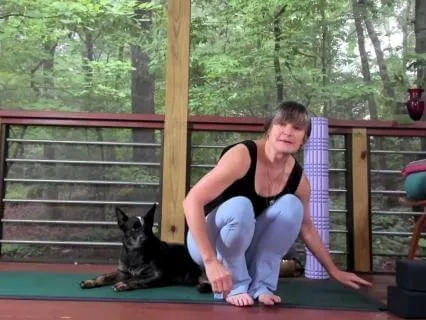
Arriving on the mat.
Have your walls nearby.
And if you don't have balls,
You could use a foam roller or you could use.
.
.
I rolled up yoga mat for some of the things.
Or your fingers.
So have the balls nearby.
And a block.
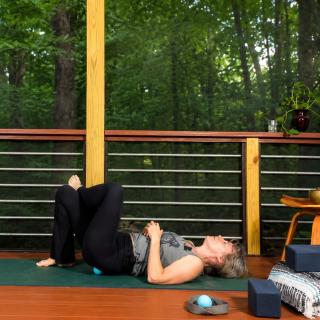
And we'll just start in constructive rest.
Just arriving.
The knees can be bent,
Feet out wide,
Arms to the sides.
Just arriving.
For the next 45 minutes or so,
Letting the outside world fade away as you move inward.
Beautiful.
And start to notice your breath.
Noticing your inhale.
And noticing your exhale.
And the invitation today is to use that exhale to let go of tension.
Thoughts.
Expectations.
Any speed or rush that you've collected in your body,
Letting that go.
So this practice.
.
.
Is great for the body,
But also for the nervous system.
The Spirit.
Beautiful.
So grab your balls when you're ready.
And before we get started,
One more thing we should do is just stretch our legs out long.
You can have your balls in your hands.
Stretch your legs out long,
And reach your arms past your ears and just feel into your body.
Feel into the right side,
Reach the right fingers away from the right toes.
And feel into the left side,
Reaching the left toes away from the left fingers and move a little side to side.
And you're getting.
You're moving the skin layer.
Away from the.
That fascia layer right underneath.
So we're just adding a little bit of movement there.
Beautiful bend the knees and the first place we'll start is the upper trap.
So I'm just going to show you where the neck.
Meets the torso and then the shoulders,
So right in the center.
So where you would kind of bring your hand back and massage yourself if you've had a long day and you kind of want to give yourself a little massage,
That's where we're replacing the balls.
On each side.
Getting into the upper traps.
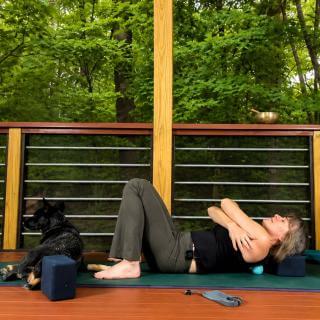
And you have a block nearby,
I will bring that underneath the sacrum.
If you don't have a block,
You could use a blanket fold.
So I like to have both balls,
One in each hand.
And then I take the right.
Ball that's in the right hand and place it on the left side.
It's just a little easier to get to.
And then take the ball in the right hand and place it on the left side.
Watch out for your hair.
You can just move it back.
And notice how that feels.
You can use your fingers to adjust the ball.
You could stay here and you might not feel much.
But just notice how that feels.
And for some people,
This is enough.
And you could also use your feet and kind of press into the balls and come back out.
So you're just kind of pushing yourself back and then releasing.
If you want to add the block,
You're just going to lift your pelvis and take the block underneath the low setting or the second setting.
So that's going to help push the balls a little deeper into your body and roll the body over the balls a little bit more.
And just notice how this feels.
This is a place that we come to a lot in this class or in all the classes I teach.
It's also.
In the meridians in Chinese medicine,
It's the gallbladder meridian,
Acupressure number 21.
Really good for anxiety,
Stress.
Bringing the awareness into the body.
If you feel like your head is full,
It's a great place to work.
If you have headaches.
Beautiful,
Great,
Of course,
For the shoulders.
So you could stay still.
Or you can add movement,
Just moving the arms.
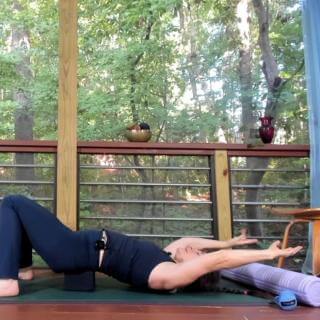
Almost like you're making snow angels.
Like you're lying in the snow.
Or I like to think about it as you're lying underneath a tree with the blossoms fallen.
Like right now,
The crepe myrtles,
All the blossoms have fallen because of the rain.
And so beautiful.
So whatever visualization that you have,
If you want to use that,
You can.
And this not only is helping the body,
But we're slowing things down and helping the nervous system relax.
So instead of that fight and flight.
We're letting it rest and digest,
Or even just that invitation.
Beautiful.
I'm going to check the chat,
But feel free to.
Just do things that feel good in your body.
You can move your arms.
Yay!
Okay,
Great.
Yes,
This is going to help the shoulders and the neck.
Beautiful.
Beautiful.
We'll be here for about three more rounds of breath,
And you can always move the balls closer or further away,
Adjusting the balls.
And you could always lift,
Make the block a little higher too.
Or lower.
The cool thing is you're in charge.
Beautiful.
One more inhale wherever you are.
Exhale,
Slowly bring the arms to the sides.
You can remove the block.
And we're just going to take the balls and bring them closer to the spine.
They're not touching the spine,
They're outside of the spine.
And noticing how that feels.
So here,
You could stay still.
You could add the block or you can bring your hands behind the head.
Lift your pelvis and you're just going to move a little bit back and forth.
Tiny movements.
For me,
This is an intense area,
So I'm just being really kind to myself.
And less is more.
You don't have to do as much.
You're not trying to hurt yourself.
You're just being really kind to yourself.
And exploring.
You're an explorer.
So you can keep the pelvis up and kind of just do these little movements where you're moving back and forth,
Or lower the pelvis down.
You could keep the head up and maybe move a little side to side,
Like you're moving your elbow.
Like the left elbow towards the left hip.
And the right elbow towards the right hip.
Or you could just use the block and rest and keep the head down.
So making it as easy as you can.
But listening to your body.
Is the number one thing.
Beautiful.
And we'll roll.
Our bodies up and roll the balls down a little bit more.
So we're going along the spine.
We're outside of the spine.
We're not on the bone.
And we're going down a little bit more.
Towards this middle or like inside the shoulder blades.
You can keep your pelvis down.
I have my head lifted.
I'm moving a little side to side,
But you could always just have the block.
Rest the head down and just pause here.
Using your exhale as that release valve.
You could have an open mouth exhale.
Or you could do a pursed-lipped exhale like straw breathing.
Beautiful work in the,
Kind of in between the shoulder blades in the rhomboid area.
Again,
Staying still or adding that little movement.
You could even bring your upper arms on the mat and then just lift your pelvis up a little bit and move a little bit back and forth.
Move a little bit more.
Beautiful.
Pausing along the way.
Beautiful.
And we'll be here for about two more rounds of breath.
And know that you're in charge so you could go anywhere that you wanted to go.
I'm just a guide.
One more inhale.
That long,
Slow exhale.
If you have your pelvis lifted,
Lowering it down.
And you'll just take your,
You can just roll to the side and come up and come off the balls.
Just take a moment to notice.
You can circle the shoulders and if you feel a little bit of softness.
Like your shoulders aren't coming towards the ears,
They're coming down.
Can circle your neck just dropping it down and circling it towards like it's like you're taking your ear towards the left.
And then you're keeping the chin down and circling it,
The right ear towards the right.
Beautiful.
Now we'll get into the front of the chest and we'll also get into the glutes and the hamstrings along the way,
But let's get into the pecs.
So we're getting into the front of the chest.
So we just worked the upper traps and we got into the rhomboids and a little bit along the erectors and now we're going to get into the pecs.
You can take your hand and bring it inside of the armpit and like that.
So you bring it inside the armpit and getting inside that flap in the front of the armpit and you could take your finger and kind of press and just move your arm and you can feel your pectoral muscle.
And if you don't have a ball,
This is a great place to work.
You could just press here and move your arm around.
And your family.
Finger is like it's the ball a little bit.
So you could do that.
Or we're going to take the ball and the block and work there.
So it's underneath the collarbone in that area.
And if your breast tissue is in the way you can just move it move it a little bit to the side or down.
And if it doesn't feel good to be on the floor,
You could also.
.
.
Go against the wall.
You have the wall,
The ball,
And you can press into the block like that and move your arm.
So pretty much what I'm saying,
On the floor you could do against the wall.
So we'll lie down.
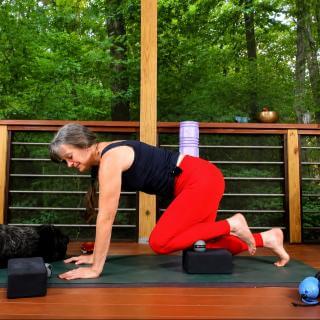
You have to get onto your belly here.
And the block,
You have to move it.
So I use the pokey part,
Like the corner of the block is kind of facing me.
And I'm lying over that.
And the ball is underneath the collarbone in a soft area.
And you can use another block to rest your head in.
So this is an awkward position.
You could always use your foam roller here.
Stay still.
Letting your body know that it's okay.
When we're in that fight and flight,
Our pecs are tight,
Like we're protecting our heart and our shoulders are rounding.
This we're kind of opening up the packs,
We're adding some sharing.
Shearing motion by pressing the ball down and you can move your arm a little bit back and forth.
Like you're kind of swimming maybe in that pool.
The right arm.
Or like you're saluting the sun.
And using your breath to just really Let the ball press into your chest.
So you're breathing in,
Pressing into the ball.
Breathing out and letting the ball nuzzle into your pack.
And it's not a place that you usually get massaged.
As deeply.
So just being really kind to yourself.
Check the chat.
Okay,
To aim a little bit.
Yeah,
I can show you a little closer.
So I've got the ball,
And I've got the block,
And I'm lying on it like this.
I'm moving my arm back and forth.
Yeah,
Thank you for asking.
I totally want to make this able for everyone to see.
So I'm lying on the floor.
I've got the ball and it's underneath the collarbone.
A little bit inside of where the arm meets the armpit.
The chest and the belly.
You just and you can move it up or down and I'm moving my arm like I'm swimming or any kind of movement like that.
And as you press the ball down,
You're shearing the muscle and that connective tissue.
I love the feedback,
So that's awesome.
We'll be here for about two more rounds of breath.
If this doesn't feel good,
You could always take a block.
Underneath your armpit and you would just roll and use that pokey part of the block and it would press into your fat tissue or you could use your foam roller.
Which would also be in the armpit area.
And you would roll on that.
Okay,
Just so you have all the possibilities.
And you can always let me know what tools you do have.
And we can go from there.
So one more inhale.
Exhale,
Releasing and slowly.
Rolling off of that and coming up to a seat.
I'm just noticing the two sides.
To that pack.
That chest area might feel a little more opened.
And you could even feel it with your hand.
It might feel warm.
Can I always feel like I can see it in the camera where the one shoulder is dropping down it's just everything's opening up.
So we'll do the other side.
You've got some of that wisdom that I just shared with you as far as different tools to use.
So again,
The ball is underneath the collarbone,
And you've got the block stacked.
And you're going to adjust the block so it fits underneath your body.
And you're going to lie down.
And you can move your arm or stay still.
And each side is so different,
So just notice how this side feels.
So I'm lying on my belly.
I've got the block.
If it doesn't feel good to lie on your belly,
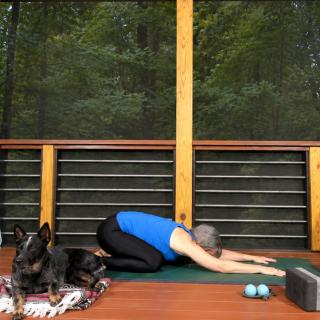
You could always come into child pose.
It would just be a different feeling.
It's a little less.
Which might feel good.
Using your breath to let go of the tension.
To let go of thoughts.
And just you're moving your awareness into the body.
And into this area of the body that works so hard.
I like to think about it like you're planting.
Tiny seeds.
Of gratitude to different areas of the body.
So stay still or move your arm.
Hi Mimi,
I haven't recorded it,
But I will record.
My fashion release class.
I'm still learning everything.
I have all the tools I need to put it together.
Beautiful.
So we'll be here for maybe three more rounds of breath,
But you could always stay longer.
Each exhale,
Just letting go.
And knowing you don't have to move your arm at all,
You could just lie here with the block or the ball and the block.
Each breath is just this release.
One more inhale.
Exhale with great care to slowly,
You can roll to the side and come off of it.
And then we'll sit up and just notice.
Hi Lauren,
We were working into the packs.
And we just did the two sides of the pack,
So like,
You know,
Right where you can grab hold in the front of the chest.
And the pec area.
With the ball and the block.
And now we're going to go into the hamstrings and the glutes.
So let's go to the glutes first.
We will get around the hip.
And we'll end with an occipital release.
Yes,
Yeah,
Sorry,
I brought in a little confusing.
Thank you for asking.
So now we're going to the glutes.
The center of each buttocks,
We're going to take the balls.
And this is some place we work a lot in my class.
So grabbing hold of the balls.
You lie down in that constructive rest again.
You'll bring the blocks underneath.
Well,
You can bring the block underneath your head,
But the balls are.
.
.
On the center of each buttock.
So you have one ball.
Underneath each of your buttocks.
You could stay still.
Or you can windshield wiper your knees side to side.
You can have the block or you can just keep your head on the mat.
And if it doesn't feel good to lie like this,
You could sit in a chair.
This is a,
I think at this point.
As dislikes.
Clearing out,
Clearing the slate so you can.
You know,
Go into your day or.
.
.
It's nice as a transition between work.
And home.
I love to do it before.
After I'm done with work.
Okay,
So I'm moving my knees side to side.
You can pause.
On one area that feels like it needs attention.
So maybe bringing your knees to the right or to the left and pause.
Using your exhale to let go.
Beautiful.
And then go to the other side and just drop your knees to the other side.
This is just a really nice point.
Area to work,
You know,
When you've been sitting at your desk or if you've been running.
You've been playing pickleball or you've been driving.
It's just a great place to work.
If you have low back pain.
A really great place to work.
Beautiful.
Oh,
Thank you,
Lauren,
For asking.
OK.
So now.
We were.
We do this a lot so today I'm going to offer something different.
So you're going to take So we just winch or wiper the knees side to side.
We're getting into the piriformis.
And now taking one ball,
Or you could take two balls,
You're going to roll to your side and you're going to bring the ball right down.
So you have that pokey bone of the hip.
You're going to go kind of like in the,
Like you have a seam on your pant leg,
You're going to go on the outer side of the hip.
So I've got the pokey part of my bone,
My hip bone.
I'm going to go to this area right it lines up with that and it's like the seam of my pants.
You can have one ball or two balls there.
So you're rolling to your side.
And you're side-lying like this and I've got the ball underneath me.
You can stay still.
You could bring a block for your head and just make it more relaxing.
You could take two balls if it's a little intense.
And from here,
What I like to do is take my top knee,
It's lifted,
And I'm going to lift and lower my bottom leg.
So I'm using the top leg as just a support,
And I'm lifting and lowering my bottom leg,
And I'm getting into glute medius and glute minimus.
And you can adjust the ball with your hand,
And you can always bring the foot in front of you.
And that might make a little more,
A little more.
Intense.
But we're really not looking for intensity.
It's more we're bringing in hydration to the tissues.
Getting rid of any stagnation or any stickiness.
If you were to look at a cadaver.
The muscles are smooth.
And it's the connective tissue that gets what we consider the knots.
Beautiful.
We'll be here for maybe three more rounds of breath.
You can stay still.
You could even just have your knees bent and pause here.
And I like to rock a little side to side sometimes just moving my body over the balls.
Beautiful.
Okay,
Remember what side you did.
And now where we're going to go,
We're going to stop along the way and we're going to lie on our bellies.
And bring the balls,
They're going to be inside the hip bones and down about an inch.
So inside and down and we're going to lie on our bellies and then we'll do the other side.
So now we're getting into.
The psoas,
Hip flexor area.
So I'm lying on my belly again.
I'm bringing the balls inside the hip bone.
On each side and down about an inch,
But just feeling how it feels in your body,
Listening to your body.
And you know how we shorten our pecs when we're in that fight and flight,
When we're in stress mode?
We shorten our pecs too.
And we're like,
So now we're getting into the pectoral muscles.
No,
I'm sorry,
We're getting into the psoas muscle.
And that's another place that we shorten,
And now we're adding some.
Shearing movement.
So you could bend the knees and move a little side to side.
And all the information that I'm sharing with you is translations of what I've learned.
If anything is wrong,
Just let me know.
I'm a massage therapist,
And I've done a lot of training,
But sometimes I might say the wrong things.
Feel free to correct me.
Anytime.
But just notice how this feels in the psoas.
You could just stay still and bring your head down,
Stack your hands on top of each other and just rest.
This is another place that we don't always get massaged.
And it's delicate and just being really kind to yourself.
If it doesn't feel good,
Just take the balls away.
You could always take a blanket roll and lie on that instead.
Using the exhale to release.
The psoas is connected to the diaphragm.
And so when you breathe in,
The diaphragm drops down.
And when you breathe out,
The diaphragm lifts up.
And if the psoas is tight,
The diaphragm can't lift up as much.
And so noticing your breath,
You might feel that tug on the psoas.
We'll be here for about three more rounds of breath.
You can bring your toes underneath your heels,
Lift the knees,
And you can do a little shearing.
So I'm just moving a little bit back and forth.
And this is kind of like it feels so good,
But it really hurts so good.
Yay,
Okay.
Yeah,
This is one of my favorites.
Places to work,
But it wasn't always that way.
It took me a while to.
.
.
To love this area.
So staying still or you're moving a little bit back and forth.
And you're using your breath to let go.
Being really kind to yourself.
Beautiful.
One more inhale.
And stay for the exhale,
Letting go.
Okay.
So maybe take your hands back.
Underneath your shoulders and press back into child's pose,
Just as a transition.
And you could always stay in tabletop instead.
Just as a transition.
And we're going to get ready to go to the other side of the,
On the other side of the hip.
Beautiful and I love that feeling you can walk yourself up and just feel that warmth at the psoas It's that warmth and tingling feeling And now you can roll to the other side.
I'm just turning so you can see me and I've got my ball.
And it's,
I got my hip bone.
Luckily I've got the hip bone and then it's going to come outside on that kind of like that line of my pant leg,
The seam.
I'm going to get into this area.
If one ball is too much you could always use two balls.
You can use a block or a blanket roll for your head.
And just you're lying down.
And just notice how the side feels.
You can use your forearm and just keep yourself up so it's not as intense.
I mean,
This feels good.
It's like.
And as you stay,
It gets deeper.
But you could always bring your head down.
And my back leg.
I'm just bringing my knee up,
The top knee,
And then the bottom leg is just going to lift and lower.
It's kind of like.
.
.
Shearing,
I'm pinning the muscle down and I'm moving.
Another part of the body.
Using the exhale to release.
And if there's a mantra that comes up.
Or.
.
.
A word that you want to bring into your practice,
You could do that now.
Like,
Everything's gonna be all right is kind of a mantra,
Which is a song.
Quote,
But I've just been using that lately.
Everything's going to be all right.
But it could be I'm capable.
I'm patient.
I am worthy of love.
" Anything you wanted to bring in.
And if you just had your knees bent,
You could rock a little bit back and forth.
Just this.
Release.
And it's so cool to know that we have these tools that we can take care of ourselves.
We can get rid of any stagnation.
Beautiful.
We'll be here for two more rounds of breath.
Beautiful.
So use your arms.
You can roll off your ball.
Or you can come up.
Remove the ball.
And let's just slide back on our back.
Stretch the legs out long and just kind of feel into the body for a moment.
Feel the warmth.
Around the hips and even in front of the hips.
And the warmth and opening in this,
In the.
The back and the shoulders and the chest.
Beautiful.
Roll to your side.
I'll show you the next.
So thank you.
Hamstrings were asked.
There's different ways you could do this.
If you have a foam roller,
You could use the foam roller on your hamstrings.
So you have a foam roller.
I'm going to show you different things.
You could just kind of have fun and roll back and forth like this,
Which just feels so good.
Can just.
I mean,
The foam roller is great.
It's a little broader than the balls.
And it's a great.
Way to work the hamstrings.
And you could always just pause,
Take one foot on top of,
One leg on top of the other,
And just kind of hang out here.
And maybe move a little side to side.
Another thing you could do.
Is take your blanket or your towel and you roll it up like a little burrito.
And maybe halfway,
So it's not a really huge burrito,
It's a thin one.
And um.
.
.
This is another way I like to work the hamstrings.
It's a little awkward to get into.
So you kind of come into a child's pose-ish or like a tabletop,
Kind of low tabletop.
And then you come back.
And I've got the blanket underneath.
All right,
Let me get closer.
So I've got the blanket.
And I'm sitting on it.
And it's pressing into the hamstrings.
The lower part of the hamstring and the calf.
So you could stay still.
You can move back a little bit.
And using your breath to let go.
So this is just a different way to work it.
You could use the foam roller,
You could use the blanket roll,
Or you could use your balls.
So this.
.
.
The balls,
You would put one set of balls,
You could put them in a sock.
And they would go.
Right here.
Which is a little more intense than the ball.
So you've got,
If you're doing the balls and you have just one set of two,
You do one side at a time.
The blanket roll is nice because you can do on each side and you can make it thicker.
So what I do,
It's nice to have support for the knees.
Is you stay close to the.
.
.
The knee crease to start with.
You're pausing.
And then when you're ready,
You're slowly going to move the roll down a little bit so it's like in halfway.
It's about halfway on the calf.
And you're coming.
Halfway from the.
.
.
Glutes to the knee.
And you can lean back here.
Just this releasing,
And the blanket roll makes it softer,
Of course,
And the balls are a little bit more intense.
Beautiful,
And just using your breath to let go on the exhale.
If you're using the blanket roll or the balls,
You can go a little bit towards the Achilles.
And the upper part of the hamstrings where it attaches to the glutes.
You can stay still,
You can lean back.
And sometimes I even lift and lower and I'm just adding some compression.
This is just a gentle way to work it.
The balls are a little more intense and the foam roller is really nice.
Beautiful.
Okay,
And slowly come up when you're ready.
And you can just bring the feet onto the mat and the windshield wiper side to side.
Beautiful.
And stretch your legs out long and you might feel like a little warmth or tingling.
Or just a little more spaciousness.
And this is something that you could do a couple times a day.
OK,
And now the last thing we're going to do.
Oh,
Eva.
Okay,
So you notice that your calves are really,
Really tight.
Okay,
So that's where we're in,
The calves.
So this time,
So that roll is really great that we just did for the calves and the hamstrings.
So you could keep,
You know,
Continue doing that.
Another thing that I like to do is take a ball and the block.
Grabbing my block.
And you're going to be between your ankle and your knee.
You can take the block and rest the block and the ball right at the hamstring.
You can lie back or lay on your back.
You can sit back or lay back and you're just relaxing your leg over the ball.
This is very relaxing for me,
But it's also intense.
So you're lying on your mat.
You've got the.
Fall underneath the cast.
I'm lying back.
And you could stay here,
Or you could take your top leg over here.
The leg with the ball.
And I would lie all the way down,
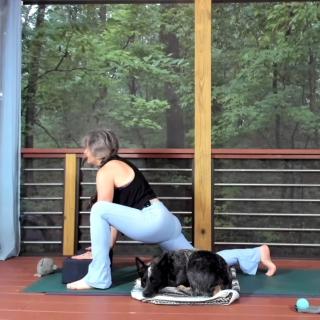
My dog's here,
So it's a little harder to lie down,
But it's hard not to give her love.
And so you're just letting,
Relaxing as much as you can.
And as you stay,
The ball is melting into the tissue.
And the calves are another place that we tighten.
When we're stressed.
Like ready to run.
And it definitely can move up the whole body.
If you have tight calves,
It can affect your hamstrings,
It can affect your glutes,
It can affect your back.
Everything is connected.
And just using your breath to relax.
Beautiful.
I'll be here maybe two more rounds of breath.
You could always move the ball,
Like roll your leg up a little bit.
Or roll your leg down and you can move the ball to a different area.
And you don't have to add the weight.
And you could circle your foot around the ankle and that.
Add something to it.
Yeah and usually I would just be lying down like this and relaxing as much as I can.
That relaxation helps to get deeper.
And so we'll do the second side.
So you just have to lift up a little bit and move your block and your ball to the other leg.
I'll just move so you can see.
I like to start in the center between the knee crease and the ankle.
And just using your breath to.
.
.
Let go,
Release.
Myofascial release is really nice to do before meditation.
So if you wanted to do some meditation next or yoga nidra.
Or you could do it before you practice like vinyasa or hatha class.
It's also really nice to do before sleep.
You can always stack the top leg on top of the bottom just to add more weight.
And for me,
This side's like,
Oh,
Yeah,
I can feel it.
A little deeper,
So I'm using my breath to let my body know it's okay.
Be really kind to yourself.
Planting these seeds of.
.
.
Gratitude to different parts of the body.
Think Rumi said.
Be a farmer,
Plant seeds of devotion,
Be a farmer of the heart.
And exhale,
A release.
And when you think you've relaxed enough,
Just that invitation to.
.
.
Relax a little bit more over the balls.
Beautiful.
You can always move your body a little bit up or down and come to a different area.
All right.
When you're ready.
Remove the balls and the blocks.
And just lie down.
Without any props.
And just feel what you feel.
You might feel that tingling and warmth in the calves.
You might feel warmth and tingling and spaciousness in the hips and the glutes.
And the shoulders and the pecs.
The whole body might feel a little bit more spacious.
Ready for the next activity.
Hug your knees into your chest.
Give yourself a hug.
You are precious.
Your body is precious.
So precious.
Roll to your favorite side.
And we'll meet in a seat when you're ready.
Bringing some warmth to your hands when you make it to the seat or you can lie on your back and just place your hands at your heart center.
Bowing to the inner teacher within each of us.
The light of awareness.
That connects each one of us and makes us one.
Om Shanti Shanti Shanti.