Welcome.
To your practice,
I'm Rebecca,
And I've got.
.
.
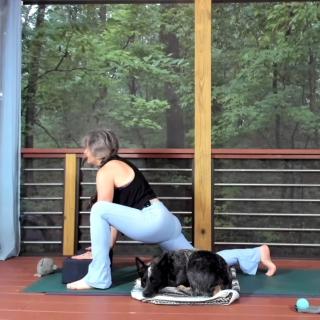
Nova with me today and Luna over there.
Grab your props.
Two myofascial release balls or tennis balls.
A foam roller.
If you don't have a foam roller,
You could roll up your yoga mat.
That could work.
Some blocks.
Blanket possibly and a bolster just if you needed that for support.
All right,
Well,
Let's get started.
Lying down on your back.
And have your,
Yeah,
Have your foam roller nearby.
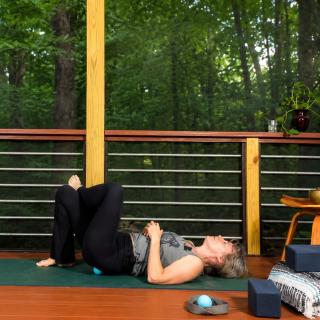
Lie down on your back and just arrive.
Your knees can be bent.
Feet walk out a little bit.
On the mat.
Just taking up some space,
Or you could stretch the legs out long.
And just feeling how your body's feeling.
Noticing that transition from doing to being.
And start to notice your breath.
Noticing your inhale.
And noticing your exhale.
Beautiful.
And as you bring awareness to your breath,
Maybe your inhale gets a little bit longer.
And your exhale gets a little bit longer.
Beautiful.
And the invitation to use your breath along the way,
Letting go of tension,
It's a great way to let go of tension without even using any tools.
Just using your breath,
It's built in to your body.
Okay,
Roll to your side.
And grab your myofascial release.
I mean,
I'm sorry,
Your foam roller.
I have some notes.
For myself just in case.
So I've got my foam roller.
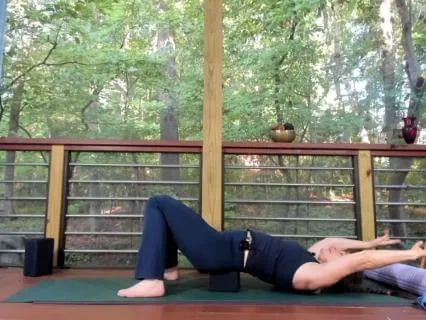
And you're going to lie back.
About mid-back,
So below where your arms meet your back.
And you can clasp the hands behind your head.
So you're making like a little hammock for your head.
And you're going to lift your pelvis off the mat.
You're still kind of thinking about your back being a hammock.
So it's laying off of the foam roller.
And we're just going to roll this tiny movement back and forth.
So you've got your foam roller,
You could use a yoga mat.
Possibly and just you wouldn't really be able to roll on it as much,
But you can do compression there.
Using your exhale to release.
So the exhale The breath is a great way to let go of tension that might bubble up.
And I did this earlier,
Just trying it out this morning,
And it was so intense,
But now it feels a lot better,
Because I worked out on Thursday,
But I can still feel the workout.
Beautiful.
And listening to your body,
You can move.
A little bit further down.
But they're just tiny movements.
And really less is more,
So you don't really have to hurt yourself or really do a lot.
These small movements.
Are really powerful.
And now I'm just going to lift my left elbow up.
And have a little more weight on the right side.
And we're getting into like.
More of the edge of this shoulder blade.
So you have a little more weight on the right side.
My left elbow is just lifting up a little bit.
And I'm just rolling a little bit on that side.
Beautiful.
Coming back to center.
And if you have any questions,
Just let me know.
And then you'll lift your right elbow and kind of More weight is on the left side.
I usually do the myofascial release pause but I thought today it would be nice to do a little bit with the foam roller.
Because I know not everyone has the myofascial release balls.
And the foam roller is just a different feeling,
And it's kind of a little forgiving.
It's like.
.
.
Calmer it feels like.
Beautiful.
Come back to center,
Lower your pelvis down and just let your head lean back.
And you can move a little side to side here.
So I still am cradling my head in my hands and I'm just moving a little side to side.
Getting into the thoracic spine.
Beautiful.
Okay.
And now we'll roll to the side.
And You're going to have the shoulder blade You're going to have your shoulder on the roll,
The foam roller.
So you're going to have your shoulder on the foam roller and the arm,
Like the elbow.
So I'm side-lying,
I've got my arm.
The foam roller and the shoulder and I'm just going to roll a little bit back and forth.
So I'm getting into that this area.
And I've got my elbow on and I'm side lying.
I'm just kind of rolling up and down a little bit.
We're getting into that posterior delt so you can kind of roll a little bit on the deltoid.
So you're kind of right where the arm meets the shoulder.
And the deltoid is such,
It's just beautiful.
Muscle that looks like a tulip.
It's really beautiful.
Beautiful.
And then pause and maybe straighten.
Your arm out like you have an offering it and bending it.
This invitation to soften your neck.
As much as you can.
You can even kind of move a little bit.
Like turning your arm,
Your hand side to side and just feeling that on the foam roller.
Beautiful.
And then we're going to get into the triceps so you can turn.
So the foam roller is kind of in front of me.
And I'm sidelining,
But I'm rolling my fingers.
Tricep on the foam roller.
I'm doing it takes a little effort so I have my right hand down to support me and you can even bend bend.
And straighten your arm.
Kind of a place we don't work a lot of.
But it's an important area,
Especially if you do like overhead sports,
Like if you play pickleball or tennis.
Or if you're an electrician and you're pulling wire.
Beautiful.
Okay,
Slowly come up.
And just kind of notice the two sides.
Maybe you feel a little more openness in the shoulders.
Maybe a little tingling.
And I'm going to show you the second side.
I'm going to try to move.
Nova over a little bit.
So again,
I've got my.
.
.
Shoulder on the floor.
The foam roller and my arm.
So I'm up higher.
And I'm rolling side-lying,
I'm rolling back and forth.
And I'm also kind of getting into the deltoid,
So I'm rolling.
Thinking about.
The arm where the arm meets the shoulder and moving a little bit back and forth there.
This attachment.
Even affecting the neck and the upper traps.
Beautiful!
I'm just noticing how it feels.
OK,
Mimi,
We're going to be moving into the balls in just a moment.
We'll be in the foam roller for just like another minute.
Just to finish this side.
So pausing at center.
And if you have a roll-up yoga mat,
You could do that also.
And then you're just going to straighten.
Your arm.
And done that.
So we'll be here for maybe.
.
.
Another minute or so and then we'll be getting into the balls.
And if you have balls and you have your sock or a pouch,
Your tricep like this,
Rolling on the block and the ball,
And you can open and close your arm like this for the tricep.
I mean,
That feels really good.
If you have a foam roller,
You're going to do the same thing.
You're rolling.
And maybe you're opening and closing your arms.
I worked my tries out.
And they're so sore,
Because I guess we don't do that as much in my workout.
So just being really kind to yourself.
So you're either doing a foam roller or you're doing the balls and the blocks.
And it feels really good.
We're going to do a little more with the tricep too.
Unless you have another area you want to work,
You can let me know,
Too.
Beautiful.
OK,
And you could use your foam roller as a.
Kind of like a pillow for your head or you can use a block for the pillow for your head.
And now we'll get with the balls.
And yeah,
And just notice how that feels.
If you were using the foam roller,
Noticing the back of the shoulders,
The triceps.
And even the front of the chest.
Now we have the two balls.
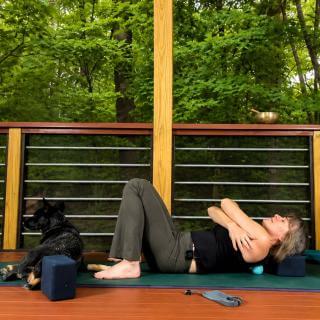
And we're going to take the two balls on one side.
So they're going to go between the shoulder blade and the spine.
And you're going to put them onto the mat and lay down.
So it's going to be a little lopsided.
So I'm putting my balls down.
On one side.
If two balls is too much you can just use one ball.
And I'm going to lie down and just kind of find that area.
Near the shoulder blade and off of the spine.
I'm using my foam roller for my pillow,
But you could use your blocks.
And just notice how this feels.
For me,
This is.
.
.
A little.
Something I don't usually do,
So my body is like,
Oh,
Wow,
What's going on?
And it feels a little awkward because it's not balanced.
Being okay with that,
You can bring your knees together,
Feet out wide.
And relax into it as much as you can.
I have a pillow for my head.
You could always use a block or you could use your bolster.
Yeah,
Just noticing how that feels.
We're thinking about thoracic spine.
The mid spine.
You can stay still or you can drape this left arm.
Over the belly.
So the balls are underneath my left side.
I'm draping my left arm over and my right arm is on the mat and I'm just rocking back and forth.
You can kind of see the balls underneath me and I'm rocking a little back and forth.
Using my exhale to let go.
Beautiful.
And when my knees come to the left,
I'm having more pressure on the left side.
And when my knees come to the right,
I'm having less pressure on the right side.
Side with the balls.
You can stay here,
You can even move your arm.
Up and down.
The arm.
On the side of the balls.
Beautiful.
It feels so good.
And now we'll do the second side.
So you could just lift up.
Move to the second side.
I'm just letting your balls outside of your spine.
So they're not on your spine bone,
The bone that goes up and down your back.
They're on the side and they're in between the spine and the shoulder blade.
So I'm on the other side.
Just noticing how this side feels.
Adjusting your.
Your little pillow underneath your head.
And breathing.
Breathing into your belly.
And softening.
Beautiful.
You can drape your right hand over your belly,
Your left hand down to support you,
And rock a little bit back and forth.
This exhale is a release valve.
And it doesn't have to be the exact area.
It can be up the spine a little bit or down the spine a little bit,
Where you think you need it.
With this mid spine.
It helps us twist.
Doesn't have as much mobility.
That's the lumbar spine.
Stay still or you can pause.
Reach your right arm up and down.
Or any other movements that feel good.
Using that exhale as a release valve.
You might feel relaxation coming through.
This calmness that comes when you're rolling out.
Beautiful.
One more inhale.
Exhale,
Slowly roll to the side.
Remove the balls.
You can lie down and just notice what you feel.
You might feel warmth or tingling.
You might even feel like you can breathe a little bit more.
Like when you breathe in.
The lungs are expanding,
The diaphragm's dropping.
Breathing out.
As the diaphragm lifts,
Pushing into the lungs.
Beautiful.
Okay.
The next area we're going to is the rotator cuff.
So if you bring your hand underneath the armpit to the back.
Between the.
.
.
The arm and the shoulder like inside of there.
You can move your arm and feel that.
And if you didn't have a ball,
You could just use your fingers and roll like that.
We're gonna lie on our side and place the ball there.
Underneath the arm pit area.
So I'm rolling to my side.
I've got the block underneath my head.
I kind of roll back.
I take the ball in my right hand and place underneath my left side.
So I'm placing the ball under.
Finding an area.
That feels okay.
You can stay with the knees lifted up and be more of like you're half side lying,
Half looking up at the ceiling,
Or you can roll to your side a little more.
So the more you roll to your side,
The more intense it gets.
This is like another area that's kind of awkward to get massaged,
But it could be the culprit.
A lot of the times.
So.
.
.
Using your breath.
To let your body know it's okay.
You can stay still or you move your arm.
A little bit back and forth.
As you get into it,
Your body relaxes,
Or for me it relaxes,
And then maybe you can turn a little bit more.
You can move your arms side to side or you keep your elbow on the mat and then just.
Straighten.
Like you're offering something with your hand and then you're taking it away.
Or you're offering and then you're receiving.
And it's like a hurt so good feeling,
But if it's sharp.
You can move the ball to a different area or take the ball away.
And I'm just trying to offer difference.
Areas of the body.
And this is another spot.
Place for overhand sport if you play pickleball or tennis.
Beautiful.
Slowly roll to your side.
Remove the ball.
So now we're going to take the ball underneath.
The tricep.
So the ball,
I'm side-lying,
I've got the ball underneath the arm.
And you could also use two balls in the pouch.
Or in your sock.
And I've got my one ball here.
And I'm just scrolling up and down.
So it's kind of a little more.
Relaxing.
Maybe than the foam roller because you're kind of more active.
Here,
You're side-lying.
And you can take your top hand and bring it on.
On your arm to make a little more pressure.
And you're just rolling and noticing.
You can open your arm and close your hand.
And even kind of turning back and forth,
Just noticing how that.
.
.
Changes how it feels.
And move to a different area.
You could roll or you could just move your ball up or down.
And again,
Opening and closing.
Or maybe turning your arm a little side to side.
And that movement brings that shearing and that helps hydrate the tissues.
Beautiful.
And then come down closer to the elbow.
So you're getting right close to where the elbow meets the upper arm.
And you can bring your top arm on it or your hand on it and you're going to just open and close.
We're getting close to that tricep tendon.
And if you have.
Like tennis elbow,
This is a great place to work.
Um,
Goth elbow,
They call it.
So it's either on the outer part of the arm or the inner part of the arm where you might feel some tenderness.
Or it might be hard to straighten your arm.
And this is the exhale letting go.
Beautiful.
Now you can come up a little bit.
We're going to work on that.
Lower so we were above the elbow and now we're going below the elbow on the hairy side of the arm and you could bring your block.
With you.
Or you could be lying down still,
And you're just going to kind of put a little weight on there.
And you can even move your arms a little bit.
We're getting into the extensors.
Might be easier side lying down.
And then just moving your arm.
Like if you type a lot,
This is a great place to work.
I'm a massage therapist,
So anything on the forearms feels so amazing to me.
And a lot of times,
If you're having shoulder issues,
Working into the arm,
You know,
Makes a big difference.
Where the pain is,
Is not usually where the problem is.
And I'm just kind of moving down towards the wrist.
And I'm just taking my top hand and just kind of giving a little more weight.
And if you have the two balls in a pouch.
You could even roll back and forth.
And this feels so good to me.
You can turn your arm.
And now we're going to do the other side but before we we move on.
Just coming up.
And noticing the two sides of the body.
And you might even feel like.
The left shoulder,
Since I work the left side,
I feel like my left side is coming away from my neck even more.
And I can feel.
Some tenderness,
But also a little openness.
So we'll move to the other side.
Have your block.
Or whatever thing you're using for your head.
Now I'm moving to the right side and I'm going to be sidelined.
I'm taking my ball and it's going to go underneath the arm.
And we're getting into the rotator.
So underneath the arm,
Between the shoulder blade and the arm,
So that space in between.
I'm side-lying,
I'm picking my left hand to bring it underneath the right side,
And it's underneath the armpit.
So it's like outside of the armpit.
I got the ball there.
And then I'm rolling to my side.
And you can stay up a little bit.
Or you can roll to your side more.
The more you roll,
The more pressure you get.
And just breathe.
You can always adjust the ball with your fingers.
That exhale letting go of any pressure.
Any speed and rush of the day.
Expectations or tension that you're feeling in your body.
You can move your arm back and forth like you're reaching.
You can see the ball underneath me.
Or you can bring the top of the arm down and move a little side to side or open and close your arms.
You can just see what feels good.
Using your breath.
Kind of like a hurts so good but if it's sharp you can take it away.
So I'm sidelining,
But not all the way.
It's kind of like I'm half looking up at the ceiling and a half to the side.
Beautiful.
And I can feel it radiate down to the elbow.
That exhale letting go.
That release valve.
Beautiful.
And now we're going to.
.
.
The tricep.
So underneath the arm,
I'm still sidelining.
So I've moved away from the rotator.
I'm coming underneath the arm.
And I'm sidelining.
I'm kind of close towards the deltoid to start with and you can straighten your arm and close your arm and just feeling how that feels.
And then moving down the arm when you're ready.
Pausing anywhere along the way.
I'm coming to the elbow.
So just above the elbow.
That tricep tendon.
I've got my top arm,
Kind of my hand on my right arm.
So the left hand is on the right arm.
I'm just going to open and close the hand.
Or move a little side to side.
So I'm doing a little shearing.
This is kind of tedious work,
But so nourishing.
A lot of times.
The upper traps might be louder,
Or your low back,
Or your hips,
And you forget about your forearms and your triceps.
But really you want the energy to flow through the whole body.
Beautiful.
And now we're going to go to the lower part of the arm.
So below the elbow,
You're going to avoid the pokey bone of the elbow.
Go below on the hairy side of the arm.
And in Chinese medicine,
They think of the hairy side as the young side and that softer side.
The inner side as the yin side of the body.
See,
I'm below the elbow.
I'm using my top arm to just press down.
I'm side-lying,
Which feels really good,
And I'm just moving my arm back and forth.
I'm moving my hand back and forth,
Really.
The muscles of the fingers are in the forearm.
And how we touch the world.
Through our arms and our hands,
How we express ourselves.
We make art and show love through our hands.
You can roll down a little bit more to a different area going towards the hand.
And I'm just on that hairy part of the side of the arm.
I love myofascial release for that.
Idea of planting these seeds of gratitude in the body.
In this forearm area that maybe we don't think about as much.
And into the hand and the arm and the tricep and the rotator.
These seeds of gratitude.
Beautiful.
Okay.
Release the ball.
And slowly come up.
You can circle the shoulders.
Maybe reach the arms out and turn the head.
Like kind of do like little hula hands with your arms.
Okay,
And now we'll get into the upper traps.
We'll do something familiar.
So where the neck.
Meets the shoulder right at the center area will bring the balls there.
So this is a place that we work a lot.
Go there.
So you have your balls and.
A prop for your head.
Or no,
Actually,
This is going to go underneath your sacrum this time.
So lie down.
You have,
I have both balls,
One in each hand.
The right ball is going to go underneath the left shoulder in between the shoulder and the neck.
And the left ball is going to go underneath the right side.
And just pause here.
If you have a foam roller,
You could bring the foam roller right across the back,
Right below the neck area,
Underneath the shoulders.
Lift your pelvis and bring your block under there if that feels good for you.
If you want a little more intensity.
And you can bring your knees together.
Relax your lower body as much as you can.
And move your hair out of the way.
And just breathe.
Maybe there's this like nice exhale release valve.
This is also an acupressure point.
Gallbladder 21.
Really good for releasing tension and anxiety.
Really good if you have headaches.
Stay still or add movement.
So you can just reach your arms up like you're I like to think about being seagrass and you're just floating in the really calm water.
My teacher in Maine,
She loves the cold plunge in the wintertime in Maine.
And I've been lucky enough to go visit her.
I visit her more in the summer,
But the water is still really,
Really cold because the labyrinth current passes by there.
Um,
So it's really cold water and it's so refreshing,
But I just love to think about her.
Cold plunging in the ocean,
But it's this most beautiful place.
She does it with her friends and she calls it,
They call it bobbling.
Beautiful.
And you can adjust your balls a little bit closer to the spine.
And move a little back and forth.
Or you could always just bring your arms down and just pause in stillness.
Beautiful.
And take the balls a little closer to the spine so they're just outside of the spine.
You can clasp your hands around your head.
And why don't we just come off the block?
Clasp your hands around your head.
Just like we were doing earlier,
But now we've got the balls instead of the foam roller.
And we're higher up.
You can lift your pelvis up and you're just going to roll a little bit back and forth.
For me,
This is like,
Whoa,
Intense.
So I'm letting my body know it's okay.
The foam roller is not as strong.
It's more broad,
So it's not quite as intense.
Because we're getting right into the erectors,
Right?
That come along the spine.
You can adjust your balls if you need to.
I've got my head in my hand,
I'm lifting my pelvis up and I'm rolling.
Or stay still and maybe move a little side to side.
And use the Excel to release.
Any tension that might be bubbling up.
And then you're going to roll your head up and your body down as the Yeah,
You're going to roll your body up and the balls are going to go down to the next area.
Pause.
Maybe move side to side,
Or keep rolling back and forth.
You are in charge of the intensity and you're in charge of removing the balls if you need to.
But being really kind to yourself.
Less is always more here.
Beautiful and we'll go down the spine.
So we'll go a little more.
Watch out for props.
And roll a little bit back and forth.
It might feel a little different once you get past the shoulder blades.
It might feel a little different.
I'm going to move down because I've kind of got off my runway of the mat.
So just adjusting your balls as you move down there outside of the spine.
Just noticing how it feels.
Adding any movements that might feel good or you're rolling back and forth.
And move to the next area.
And sometimes.
.
.
It's nice to bring the block underneath the head.
Beautiful,
You can stay,
You can rock your knees side to side.
So I'm past.
My shoulder blades I'm kind of kind of midway down.
And then I'm going to roll a little more,
So you're just rolling your head up and your balls down to the next area.
Or you're rolling the whole time and you've got your head lifted and you're just rolling back and forth.
That exhale valve of release.
Beautiful.
And move the balls down a little bit more.
So we're moving towards the sacrum.
I like to bring the knees into the chest when the balls are lower down so they're kind of closer to my waist.
And I'm going to lift my knees and move a little bit back and forth.
I'm letting go with each exhale,
That release valve.
And then I'm lowering them down and now mine are outside of my sacrum.
So you can go slow,
You could spend a really long time just going really slowly along the spine.
Or go a little faster,
You decide what you need.
You can always come back to this.
I like to windshield wiper my knees side to side when I'm getting close to where the sacrum,
Outside of the sacrum where the attachments are to the glutes.
Beautiful.
Two more rounds of breath.
Beautiful.
Remove the balls,
Stretch the legs out long,
Stretch the arms past the ears,
And just notice how you feel.
Maybe move your shoulders a little side to side as your arms are reaching,
And you can move your hips side to side.
Beautiful.
Roll to your side.
Come to a seat.
We're going to close.
I'm just going to do a couple things for the face before we close.
So our Shavasana is upright today and the first place we're going to go is right at the jaw.
So you can kind of use your ear as a kind of diagonal from the ear.
And we're just resting the elbow on the thigh if that feels okay.
I've got my ball in my hand.
And you can close your eyes.
You could also open and close your mouth just a little bit.
And you could do this little,
Like,
Circling motion.
So you can decide if you want to just rest.
Or circle the ball.
And this is a great place to work if you're feeling neck pain,
If you clench your jaw at night.
Even in the upper traps,
If you're feeling tightness in the upper traps,
This is a great place to work.
And if you're feeling a lot of tension.
Each exhale is this release valve,
Just letting go.
Beautiful.
Now slowly moving it up to the temporalis,
So it's right outside of the eye.
You can kind of feel that divot there.
We'll bring the ball there.
Like outside the eye and up a little bit.
You can just pause or you could circle.
Being really kind to yourself.
Great place to work for headaches.
All these places are great to work for anxiety or stress.
Really nice to do before sleep.
Or before meditation.
Beautiful.
Pause and center,
Maybe circle the shoulders down.
And then we're going to move to the other side and you can change the cross of your leg.
Or change your position in any way you need to.
And I'm resting my head in my hand and I've got the ball for the jaw.
And my jaw isn't clenched,
It's relaxed.
My mouth is relaxed.
I'm circling.
Or staying still.
Letting that tension melt away.
The masseter is the strongest muscle in the body.
Work so hard chewing our food.
Helping us talk.
Express ourselves.
Beautiful.
And it's just kind of intuitive motion.
So you're staying still or moving,
But intuitive.
But kind.
And then we'll bring it up to the temporalis just outside of the eye and up a little bit.
You can circle or relax and just hold it.
Just letting go of tension is just draping off.
Speed and rush of the week.
Of the past week is just draining away.
Coming back home to yourself.
Knowing that whatever you're offering is more than enough.
Beautiful.
We'll be here for two more rounds of breath.
Exhales or release out.
Beautiful,
Slowly remove the ball.
You can circle the shoulders a little bit one way.
And the other way.
Keep your eyes closed or open your eyes.
And just hands to the heart,
Bowing to the inner teacher within each of us.
The light of awareness that connects each one of us and makes us one.
Om Shanti,
Shanti,
Shanti.
Peace,
Peace,
Peace.