Hello and welcome to The Rhythm Within,
A space to explore the communication between our hearts,
Minds and bodies,
And the small ways that we can find a little more balance in everyday life.
I'm Rachel,
A clinical naturopath and HIV practitioner.
I created The Rhythm Within because I believe these simple self-regulation practices shouldn't only be found in a clinic consultation.
They should be available to everyone.
Our breath,
Our heartbeat and our nervous system are with us wherever we go and learning to work with them is something I'd love everyone to have access to,
Whatever their situation or circumstances.
If you've just come from my calm confidence breathing practice,
Welcome back.
And if you're new here,
I'm glad you've joined me.
Today we're talking about the moments that matter.
Big events coming up,
An exam,
A job interview,
A presentation,
A speech,
Or even just a conversation that you've been rehearsing for days.
You can be well prepared,
Yet when the moment arrives,
Your heart races or the words disappear and you go blank.
And so I wanted to discuss a little bit about the physiology behind that,
Why does that happen,
And what we can do to help.
It's interesting,
Isn't it,
How our bodies can begin responding to something that hasn't even happened yet?
When our brain senses uncertainty or feels that we're being evaluated,
Our stress response prepares us.
Adrenaline sharpens alertness,
Our heart beats faster,
Our breathing changes,
And cortisol may play a role too.
None of this is a flaw,
We need this response.
A little nervous energy can help us to pay attention and to help us to rise to a challenge.
When stress becomes too intense,
It can interfere with the prefrontal cortex,
So this is the part of the brain involved in memory,
Focus,
And finding words.
And that can be one reason why our minds go blank in a moment of importance.
It doesn't mean that we lack ability,
It just means that we are having a little bit of difficulty in accessing what we know in that moment.
And I see this in clinic and I also recognize it in myself too.
Sometimes we become so busy trying to think our way through something that we don't notice what our bodies are doing or the way they are responding.
You might notice that some people seem to sail through big moments in life with ease,
While others feel every flutter.
And if you're someone who feels it more,
There are good reasons for that,
And not necessarily weaknesses.
Part of it is simply how we're made.
Some people have a naturally more sensitive nervous system.
Researchers estimate that around 15-20% of people have a trait called high sensitivity.
Noticing and feeling things more deeply.
Our past experiences matter too.
If a similar situation was difficult before,
The nervous system remembers its previous response and may begin preparing us for it to happen again.
Being watched or judged by others is one of the strongest triggers of all.
Research has found that situations where we're being evaluated by others,
Especially when we feel we have little control,
Tend to cause some of the largest rises in cortisol.
And then there's what we're already carrying,
Whether that's poor sleep,
Illness,
Hormonal changes,
Or ongoing stress that can leave us with less in our reserves.
So the next challenge may feel bigger.
The encouraging part is that the nervous system is adaptable.
So with regular practice,
Like the breathing that we explore here,
We can build more flexibility so it becomes easier to rise to the moment and then to settle again afterwards.
It's something that we can see reflected in heart rate variability.
What I find super interesting is the brain isn't simply sending messages or instructions down to the body,
It's listening as well.
Pathways,
Including the vagus nerve,
Carry information between the body and the brain.
And our heart and breath are part of that conversation.
In fact,
This conversation through the vagus nerve run mostly up toward the brain.
So around 80% of the fibers in the vagus nerve carry information from the body back up to the brain rather than the other way around.
So in many ways,
Your heart is talking to your brain more than your brain is talking to your heart.
The heart even has its own intricate network of neurons,
Sometimes known as the heart's little brain,
Which means that how your heart is beating Steady or erratic is constantly shaping how your brain feels and functions.
And something I love sharing with my clients is that a healthy heart doesn't beat like a perfectly timed metronome.
The gaps between beats will naturally vary.
And we call this heart rate variability or HRV.
So as we breathe in,
Our heart rate usually rises a little.
And as we breathe out,
It falls.
And that slow,
Comfortable breathing that we did in the practice,
Often this can be around five seconds in,
Five seconds out,
Can make that variation more rhythmic,
Like gentle waves.
And this pattern is sometimes called heart coherence.
It doesn't take away your stress or your worry,
But the paced breathing can support stress regulation.
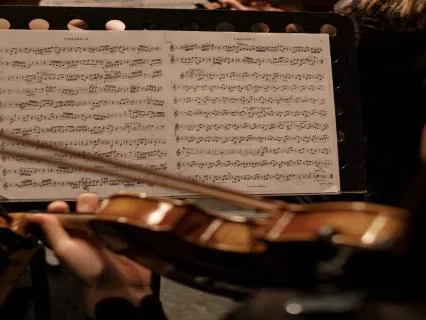
I like to picture heart coherence like an orchestra.
Your heart,
Brain,
Breath,
Hormones and nervous system are all instruments within the orchestra,
Each with their own part to play.
When we're stressed or out of coherence,
It can be as if every musician starts playing their instrument to a different beat.
And there's plenty of sound,
But it just comes out as noise.
Whereas when we slow the breath and settle into the rhythm of the heart,
It's like the musicians in the orchestra finding the same tempo again.
And the instruments are beginning to play with one another.
And then the noise becomes music.
In the companion practice,
We did three simple things.
First,
We brought our attention to the area around the heart.
When the mind is racing ahead that gives our attention somewhere physical to rest.
And researchers studying the heart-brain connection have found that gently shifting our attention to the area of the heart,
Together with slower breathing,
Helps the body to ease into that smoother,
More coherent rhythm more readily.
And then we slowed the breath without forcing it,
Just finding that comfortable pace.
And then adding in the genuine positive emotion.
Where we remembered someone or something that brings a genuine feeling of warmth or appreciation or love.
And then we slowed the breath without forcing it,
Just finding a comfortable pace.
And then layered in the renewing or positive emotion.
So we remembered someone or something that brings a genuine feeling of warmth or appreciation.
And in studies of heart rhythms and emotion,
When people sincerely felt appreciation or care.
Their heart rhythms became smoother and more ordered within moments.
While feelings like frustration or anger made them more erratic and switched up the stress response.
And researchers have also found that slow breathing alone can guide us into a more coherent rhythm.
But pairing it with a genuine positive feeling helps us to stay there more naturally.
And in one study,
Adults who practiced this kind of heart-focused technique regularly for a month had lower cortisol,
Higher levels of DHEA,
Which is a hormone associated with resilience,
Vitality,
And they also reported feeling less stressed.
So it's not about pretending that everything is wonderful and taking stressful situations away.
It's about making room for other feelings alongside the nerves.
So we can feel uncertain and still feel the appreciation.
And then we also added the gentle tapping,
Alternating left and right on the thighs.
And this left-right rhythm is similar to the bilateral stimulation used in EMDR,
Or eye movement desensitization and reprocessing,
Which is a structured therapy specifically used for trauma.
What we're doing here isn't necessarily EMDR therapy,
But it's simply an optional rhythmic movement that some people find soothing and grounding,
And it gives our attention something physical to return to,
Rather than getting lost in the worries running through our minds.
And it's important to remember too that nervousness isn't necessarily the enemy.
Often it isn't the event itself that creates so much of our stress,
But the way we're viewing it.
When we see a big moment as perhaps a test that we might fail or a chance to be judged,
Our bodies brace for that threat.
Whereas when we see it as an opportunity to share what we know,
To grow,
To learn,
Or as simply something that really matters to us,
Our body can meet it in a different way.
So the event hasn't changed,
But our view of it has.
And actually,
Research shows that nerves and excitement can feel similar.
And in performance research,
It suggests that reframing nervous energy as excitement may help.
So perhaps instead of,
I can't do this because I'm nervous,
We can try,
I'm nervous because this matters and I can still do it.
You don't have to feel completely calm to be capable.
And I'll be completely honest with you,
I'm still learning this myself and relearning it again and again.
My natural state leans towards nerves and fear and they can block my ability to share publicly.
Those that know me know that I do not like to be in front of the camera.
Even this recording,
Recording talks like this one can feel like a real stretch for me.
So these practices definitely aren't something I've mastered and left behind.
They're something that I come back to every time something matters to me.
And each time I'm reminded that I can feel nervous and still show up.
And going back to the example of orchestras,
There was actually some interesting research carried out with real orchestra musicians when they tried to repeat a past performance they'd been happy with.
The music was good.
But when they were asked to make it new in small ways that only they would notice.
It was interesting that audiences actually preferred those performances and the musicians enjoyed playing them more.
I guess as a takeaway that in your own big moments,
Whether that's an exam,
A job interview,
A speech,
Whatever it is,
Rather than trying to recreate a perfect rehearsal,
Maybe staying curious,
Noticing something new,
The light in the room,
A friendly face,
The feel of your feet on the floor,
Being present can help you feel more alive and perhaps will help you perform better too.
And so a few actionable steps.
Practice breathing on regular days before the event.
Practice the breathing techniques that we've gone through.
And then before an event Really make sure to prioritize your sleep,
Take breaks,
Nourish yourself with good food,
Hydrate,
And perhaps even noticing if caffeine or other caffeinated beverages make you a little bit more jittery.
And then on the day,
Leave yourself a little breathing space.
So in that,
If your mind does go blank in a meeting or an interview,
It's perfectly okay to pause and say,
Let me take a moment to think about that.
In an exam,
Move to the next question and return when you can.
And then afterwards resist replaying every word.
Maybe you could take a walk?
Give yourself credit for showing up.
And let the past be in the past and it's been done and move forward.
And always remember that if anxiety is impacting your day-to-day life if it's regularly disrupting your sleep.
It is worth reaching out to a qualified health professional for support.
So in closing,
Next time something important approaches,
Remember that your body isn't necessarily working against you,
It's trying to prepare you.
Pause,
Bring attention to your heart,
Take three slow,
Comfortable breaths,
And recall something that brings you warmth,
Love,
Appreciation,
Joy,
And you can add in that gentle tapping if that helps.
And just give your inner orchestra a moment to find its rhythm again.
It may not change what lies ahead,
But it might change how you meet it.
If you'd like to try the full practice,
You'll find the companion recording,
Calm Confidence for Exams,
Interviews and New Beginnings here on Insight Timer.
Thank you for spending this time with me on The Rhythm Within.
Until next time,
Take care.