Welcome,
My name is Peter and I'm grateful you've invited me to sit with you for the next few minutes exploring one lesson from Memories of the Future.
If you like what you hear today,
Please join us for the full course.
Pivotal moments in our lives can be catalysts for deep or core memories that stay with us long after the moment itself has passed.
I remember a perfect sunny summer day when my kids joined me riding in the mountains for the first road trip on some new motorcycles.
I remember the smells of the oil in the garage and the smiles on everyone's faces as we got ready to head out,
The blue of the sky as we sped past the forests,
And I'll never forget it.
In this exercise,
We're going to explore the relationship between memories and past events so that we can get curious about the relationship between crafting a memory of the future that hasn't happened yet and future events.
So for this exercise,
You're going to need a few things,
A journal or a notebook,
Pen,
A quiet space where you won't be interrupted,
Willingness to share your insights and exploration with others,
And playful curiosity.
So let's get comfortable.
Sitting works well if that feels good to you,
Or you can lay down.
Take a deep breath in through the nose and out through the mouth.
Find a slow,
Steady pace that works for you for a few breaths.
In through the nose and out through the mouth.
One more.
In through the nose,
Out through the mouth.
Now you can slowly return to normal breathing,
Gentle breathing,
Whatever feels good for you.
I'd like you to join me now in a visualization.
Picture yourself on the shore of a slow,
Small river.
It's a beautiful,
Sunny day.
The area around the river is deserted,
Only the wind in the grass and the occasional bird call break the silence.
You sit on the riverbank,
Taking it all in,
The smells,
The sounds,
The sunlight,
And that river flows by steadily.
As you relax,
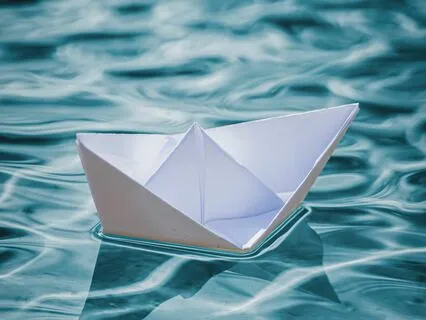
You notice a few paper boats scattered around you.
You've been folding them for some time now,
Enjoying the soothing effect of folding that paper and listening to the water.
You stand up and with a few boats in hand,
Make your way towards the shore.
With slow,
Gentle strides,
You get up and wade barefoot into the river,
The sun warmed water splashing at your ankles and then your shins as you go deeper,
Almost up to your knees as you stand in the center.
As the water curls around your legs unconcerned,
You turn to face downstream,
Watching the water flowing away from you.
You feel the current pushing against the front of your calves,
The waves sparkling.
Once that water approaches you and then moves past you and keeps going downstream,
You'll never encounter it quite the same way again.
Notice what the water feels like as it rushes past your shins.
What is the sensation of that water continually flowing away from you?
Reaching down carefully,
You gently place one of your paper boats on the water and watch it float away from you going downstream.
Through the noticing of that boat bobbing on the river,
A memory begins to form of this day and this particular moment.
That one time you stood in the river with the current lapping against your calves,
Watching your paper boat disappear down the river and around the next curve.
Take a deep breath with me,
In and out.
With a gentle smile,
You turn slowly to face upstream,
The water unchanged,
The current unchanged,
But now lapping against your shins.
You watch the flow of the water approaching you,
Continuing its path unchanged,
Unabated,
Steady.
Notice what it feels like for the water to hit your shins,
The front of your legs.
What is the sensation of that water moving towards you?
Take a spot on that river upstream from you.
Picture in your mind one of your boats floating towards you from that spot.
Now take one of your boats and gently toss it towards that spot and watch it float gently back towards you,
Just like you imagined.
Through that noticing,
A memory begins to form of this particular moment.
That one time you stood in the river with the current lapping against your shins,
Watching your paper boat coming towards you,
Going beside you,
And then moving on downstream away and past the curve.
Take a deep breath,
In through the nose,
And out through the mouth.
Picture time like this river.
It flows at a constant rate,
For the most part.
One minute at a time,
One day,
One year.
Always in the same direction,
Gently lapping at our calves or our shins depending on which way we face,
Which way we direct our attention.
Our little paper boats,
These represent these pivotal moments in our life.
They follow the flow of the river of time toward us from the future,
Into this present moment beside us and with us,
And then away into our past leaving only the memories behind.
Take one more deep breath,
In through the nose,
Out through the mouth,
And gently come back into the space.
When you're ready,
Get your journal and your pen and we're going to do a couple of exercises together.
Exercise one,
To generate a memory of placing our first little boat in the water,
Our pivotal moment,
And watching it float down the river,
We had several steps.
We sat on the shore and we folded that paper to create it.
We built and experienced a pivotal moment.
We took that boat and walked out into the river.
We placed it in the water and released it,
Watching it flow away from us downstream.
That experience of putting the boat into the water is over.
We had the experience first,
And then the memory came.
So consider this prompt.
What's one of your paper boats?
What's a memory you have of an experience or pivotal moment in your life that stands out to you?
Something that made you who you are,
Whether pleasant or unpleasant,
Traumatic or uplifting.
Write a short one to two line description of this moment in your journal.
What is a memory you have of an experience or pivotal moment in your life that stands out to you?
You can pause the recording here if you need to while you journal.
Exercise two,
To generate a memory of tossing our second little boat upstream,
Watching it float towards us,
There were also several steps.
We sat on the shore and folded the paper to create it,
That pivotal moment in our life.
We walked out into the river.
We tossed the boat upstream and watched it flow towards us.
The experience of tossing that boat and observing it is over.
Except the memory of the boat floating towards us happened before it reached us when we picked that spot upstream and noticed where we wanted to toss the boat.
We remembered it first and then the experience happened of the boat floating towards us.
What's a memory that you have of an experience or pivotal moment in your life that stands out to you but hasn't happened yet?
Something that you'd like to experience that could make you who you want to be.
Write a short one or two line description of what this moment could be.
What is a memory you have of an experience or pivotal moment in your life that stands out to you but hasn't happened yet?
Take some time to write this in your journal and feel free to pause the recording and resume when you're ready.
Our brains have extremely well-developed storytelling mechanisms,
And the core of this exercise today is to curiously explore turning them around 180 degrees from focusing on the past to the future.
Memories of the past are generated during a pivotal moment that sticks with us.
Memories of the future,
Well,
That sounds crazy.
How can I have a memory of something that hasn't happened yet?
Well,
I invite you to get curious about the potential impact of deliberately and intentionally creating a memory that hasn't happened yet to experiment with bringing something you want from an idea that it might happen sometime in the future to right now,
Present moment.
So I have a confession.
At the beginning of the lesson,
I shared one of my pivotal memories of sitting in the garage,
Getting ready to go riding with my kids on two new motorcycles.
Well,
That hasn't happened yet,
But I believe it will.
This practice isn't new.
It's often called visualizing or visioning or manifesting.
It's an exercise to help identify and visualize that which we want to bring into our lives,
Into it through a different understanding of the relationship between memories and events.
So what do we do with this?
What's next?
Writing down a memory of the thing that I want is just one step.
Another step is action.
How do we bring that into reality?
I'd love for you to join me for the full course to dive deeper into that exploration.
As we close,
I want to share something with you.
Once upon a time,
Not that long ago,
I did this exercise for myself.
The memory of the future I sat with was having recorded an exercise about memories of the future and now you're listening to it.
It became real.
This recording began with a memory of the future,
An original piece of content that at one point was nothing more than a notion.
That notion became an idea.
That idea became a memory and that memory ultimately became reality in the form of you listening to me speak right now.
So thank you for taking this time and I look forward to practicing with you again.