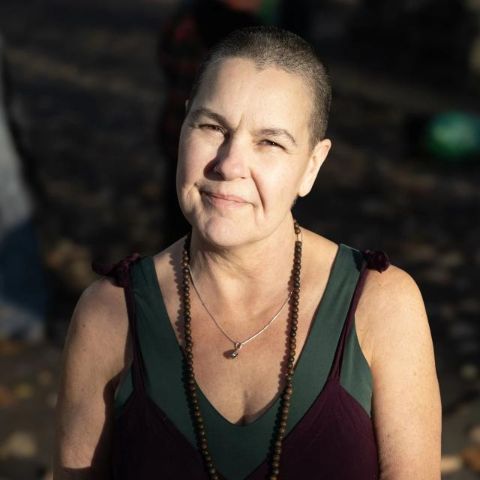
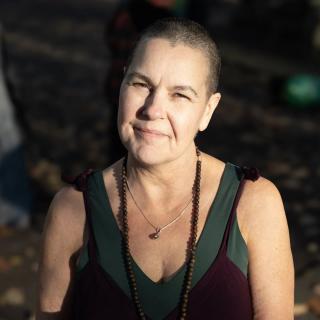
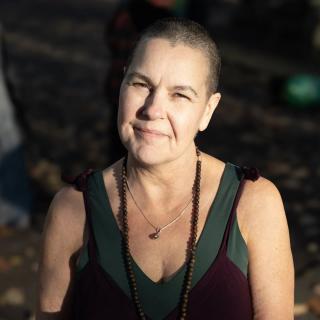
My name's Birdie Milestone.
I am a death doula here in the Willamette Valley in Oregon.
I'm into death work.
Because I grew up,
Well,
For many reasons.
I grew up a medically fragile child.
So some of my first memories are hearing adults in the room talk about my odds of survival and how poor they were.
And then when you make it,
You hear them say,
Oh,
She must be really meant for something.
I didn't share the same religion as the nurses saying those comments,
But the seed was planted in me that death doesn't have to be that scary.
It's just kind of a fact of life.
We're here now because we're not there.
Between that and being raised by a home birth midwife,
I came to really respect the in-home care factor of care.
Not everything really needs to be industrialized,
Institutionalized.
Backing up to growing up in the hospital,
I gained so much respect for the nurses that when I finished high school,
I went to be a CNA,
To be a nurse's assistant.
Landing my first jobs in long-term care.
Really gave me the view of institutionalized death care.
And I remember being 17,
Feeling very strongly,
Oh my gosh,
I hope this doesn't happen to me.
So that's planted the seed and it's now blossomed into the death care practice I have now.
I work,
I'd say 60,
40,
60% with folks.
In a traditional home environment and about 40% of the time with folks living in severe poverty.
And when I arrived in Minneapolis,
I left myself open to whoever it was that may need me.
And it didn't take long until I met a gentleman.
Who heeded my offer for support.
He was caring for his best friend the best way that he knew how.
And these two gentlemen had battled homelessness and addiction for most of their life.
And at this point,
I met them there probably in their 60s,
Appearing to be in maybe their 80s.
We built trust over a few days.
And this gentleman,
Randy,
Was the one I was meeting with.
Expressed to me his absolute fear and terror of leaving alone his friend who was bed-bound.
He says,
Well,
I'm just afraid to leave because what if Malachi dies and I'm not there?
What if he's sick and I can't save him?
It will be all my fault.
And it just broke my heart.
And I was able to have the discussion with him that,
You know,
Malachi will die,
And you won't be able to save him.
And also,
It won't be your fault.
So in coming to their.
.
.
Their home.
Which was a camper trailer that was housing everyone that needed warmth,
Both with two legs,
Four legs,
And eight.
Just a tiny spot to seek shelter from the snow.
And these men had been in there.
For probably years,
Although.
The accuracy of their historical accounting is questionable,
As with anyone with severe trauma.
Anyway,
I'm led past an abandoned warehouse into a camper trailer that He was so concerned with my well-being.
He says,
Honey,
You're going to be so cold.
It's so cold in there,
The heater doesn't work.
Handle it.
Acknowledging his concern.
He says Malachi always was the one that fixed the heat,
But he's lost too many fingers to the frostbite.
He can't fix the heater anymore.
I have a little lamp,
I have my little broom and we enter their area and I work with Randy to make a path from the doorway to the bed and the bed to the bathroom.
We set up a little care station of things that might make their life easier.
In trying to get a sense of what was happening in that.
In that home.
Randy would say to me,
Well,
He told me before he quit talking,
He told me that he can't really feel anything on the back of him anymore.
But once a week I pick him up and I put him in the tub and we get the regulars out and then I put him back in the bed.
And other than bringing him food he doesn't eat and drinks he doesn't drink,
He's just in here.
So as a doula,
I was able to explain,
Demonstrate somewhat how to give a bed bath with dignity without running water.
I explained to Randy what the active dying phase would look like as Malachi in the time that I first met him was just in the,
Excuse me.
In the the long-term sleeping,
Very few.
Moments of consciousness,
A lot of confusion,
A lot of sleeping.
But yet at the beginning,
He wasn't in the active dying phase.
So I explained to Randy what that might look like.
Various possible end-of-life phenomena.
Sometimes folks at the end of life will do kind of this reaching up to the corner or look at things that we on this side of the veil can't see.
In addition to changing in skin color and breathing.
All sorts of small changes happen as a lot of,
As I know you know.
It was such a wonderful opportunity to meet these gentlemen and to be trusted within their care space.
And I did mention,
I said,
Next time you see any sort of county worker,
Sign up for hospice.
Hospice is such a great service in terms of getting the durable medical equipment and extra support.
Randy said to me,
He says,
There's no way I'm letting a county worker back here.
And if either of us go for help,
We're going to be separated.
So going for help would mean being separated.
Being evicted from the place that they found safety.
So I was honored as an off-the-books kind of worker.
In that capacity,
I was a volunteer doula.
Anyway,
We build a.
.
.
Some rapport,
And.
.
.
Each day we'd meet at the same spot.
And on my last day in Minneapolis,
He wasn't there.
And I just thought,
Oh my gosh.
Do I respect their autonomy?
Do I show up unannounced at their trailer?
I made the decision to go and knock on the door.
And just see.
And I arrived there.
To Randy,
Very grateful to see me,
And he immediately launched into,
Oh,
Malachi's doing the things.
He's doing all the things you said he would do.
I just don't quite know what to do.
So I came in.
With my lamp and we all sat together.
And just knowing the relationship between the two and how much they cared for one another.
It was really awe inspiring for me and we sat and I rubbed Malachi's forehead that can be really relaxing for folks,
Especially folks that don't get a lot of human touch.
It is both intimate and not intimate.
I don't know the right word for that.
Yeah.
Anyway,
I'm rubbing his forehead and we're having a talk.
I explain to our dying Malachi that I'm there with Randy.
His friend wouldn't be left alone.
You're safe to transition.
You can go if you're ready.
And not immediately after I say it,
But within the afternoon,
Malachi passes away.
And there's this utter silence.
And then a loud rumble and the heater turned on.
Here in their trailer that hasn't worked in years that Malachi always fixed before he lost his fingers.
There's no.
.
.
Hard and fast way to define those things,
But being able to witness them as a doula.
Really keeps me coming back to the work.
It's as if,
As Malachi's last act on earth was to turn the heater on for his friend,
So we knew he wouldn't be alone in cold.
Yeah.
It was just such a moment of privilege for me to be able to witness that.
To give voice for these experiences and for people that feel forgotten or dismissed.
I'm now partnering with my.
Local street outreach team and have begun delivering end-of-life care and mostly end-of-life compassion to people choosing not to go back to the hospital.
We have a local gentleman that has advanced cancer and he says,
I hide in the bushes every time I see an ambulance because I don't want them to put me in there.
So we've found a way to partner with the local hospital the local hospice.
And myself as the doer and the creator.
The daytime drop-in center that offers a lot of resources to our neighbors experiencing homelessness,
That we are now holding a workshop to fill out advanced directives and post forms for the folks that live outside.
So they can have their their wishes respected.
Yeah.
Wow.
I really hope to deliver that freedom of choice to people who don't have a lot of choice.
Wow,
That's great.
That is super great.
Yay.
In addition to my doula services,
I'm continuing my education.
I live down here in Corvallis by Oregon State University.
And while I was young,
I did not have the opportunity to attend college.
I have learned that you can audit college classes as an adult.
All you need is permission from the professor.
And you can sit in and take a class.
So I'm now taking thanatology,
The study of death and dying,
To augment my practice that I've gained.
From personal experience and the ancestral rites of birth and death.
Being raised by a midwife with four nurses for grandparents.
Some of it's just in here.
Sure.
Yeah.
Well,
I mean,
That's what it's all really about.
I mean,
What we have to offer as individuals,
It's not what we're certified in or I mean,
That stuff's all great and it's good to learn extra things.
But I have found that the beautiful thing about so many different doulas is it comes from within us.
And so our uniqueness just flows.
So you don't need a certificate for that.
It's just who you are.
Yeah,
Thank you.
On the flip side to the.
Very intense end of life moments.
Another very,
I'm not sure popular is the right word,
Another very Let's try again.
Often as a doula,
I focused less on just the very end bit,
The death doula,
Which was the term I first liked.
But to use end of life doula for my clients that I refer to as my last best friends,
I function a lot as someone's last best friend.
But it's so great to just be there for someone.
Get a lot of life out of life while also accepting that death is pending and we can walk towards it eyes open.
Yeah,
And doing it joyfully certainly helps.
Yes.
Right?
When you're free,
All the things to just be finally free.
Sometimes I struggle when someone asks me,
So what is it that you do?
It's very well.
That category is so large.
Currently an unregulated industry.
It's private practice.
I can do anything you need me to.
I can do whatever you negotiate for me to do.
Having that freedom is really important to me.
I don't make a very good rule follower.
As I've now learned that there's a called an FSP,
A funeral service provider,
Is the caveat on how you can do funerals without having to go to mortuary school.
You don't have to do the embalming and the cremating,
You can just do the funerals.
That interests me because I have done some,
Both living funerals,
Which don't really count,
But some home funerals.
They count.
They count,
Yeah.
I offer post-mortem shroud wrapping.
Which then I learned when I had a colleague who was going to fill in for me while I was out of town.
And I said,
It's unlikely that our client will pass away while I'm gone.
But if she does,
The shroud is in the closet.
We have a plan to tuck flowers in.
And my colleague says,
Oh.
Oh,
No,
I don't do any of that.
Once a person passes away,
It has to be a funeral director or the family.
So I can teach the family how to do it,
But I can't do it.
And that was just such a different perspective than I had heard before,
Especially being raised by a midwife who wasn't in the nursing background before.
When you get hired,
You show up with the skills you have and you use them.
If shroud wrapping is a skill I have.
Why does the funeral industry need to have a cut of that,
I suppose?
Right.
Now we're exploring being a funeral service provider to make sure everything's on the up and up.
We'll see what comes of that.
You're gathering all these different things in.
And that again,
That's the beautiful thing is that it's just every different death doula is just such a beautiful thing.
Conglomeration isn't the right word,
But.
You know,
It's just,
It's just so beautiful because it touches so many things in life and just in the life experience.
Thank you.
Yeah,
The tapestry of involvement.
Thank you.
That's a better word.
Tapestry.
The tapestry of involvement in my community.
It's really,
I'm looking at a tapestry now.
There's one from Peru here.
Ooh,
Nice.
That was one of the first places I traveled where I really saw death care done differently.
And I'm hoping to bring that back here in the US where it's less industrialized.
Death care like birth care was historically always done by women.
I come from Irish ancestry,
And they had the Keening women.
I don't know if you know about those yet,
Pamela.
They're the women that did death care and also the mourning and the grieving.
Akini would do the singing.
In a fairly customizable grief song about the person who had passed.
And I'm hopeful we can bring back some of that.
Yeah,
Yeah,
It's so healing and it's so beautiful and it makes so much sense once people either hear about it or are involved,
It's like,
Of course,
Of course it makes sense that we would do that.
We sing happy birthday,
So why don't we sing you out as well?
Mm-hmm.
Wow.
That is so cool.
Nice.
There are many interesting things.
So many.
What else?
Anything else you want to share about what you do or how it's changed you as a person or just.
.
.
I have one for that.
I thought I had one for that.
And then I looked outside and the mailman walked by,
And with it,
My package of thoughts.
You know,
My husband's a mailman,
So that happens to me,
Too,
When my mailman walks by.
Bye.
A quote that I wish I could tell you who said it first.
Learned actually in my thanatology class regarding death and dying.
Is we hear often live each day to its fullest or live each day like it is your last.
But there's a second half to that.
Live each day as if it could be your last,
But also the first in a thousand more.
And having that second bit has really changed how I live.
Because it's really easy to go all out,
Balls to the wall,
YOLO,
We're gonna do it,
And the rest doesn't matter.
But then to think about when life lingers.
Like for my client now,
Whose husband has passed away.
Who doesn't have children.
She really thought I'll have a good time and when my husband goes,
I'll probably go soon after.
But we're finding now,
While she is an amputee,
She's otherwise healthy.
And we haven't really planned for this,
What is now looking like years from the time between widowhood and when she passes away.
Another important part to my death work.
This is taco.
He has snuggled many a person as they transitioned out of this planet.
And he's just keen to do it.
To accept the pets or the snuggles of anyone.
In the long-term care facilities we frequent,
He climbs lap to lap,
Wheelchair to wheelchair.
Everybody gets that warmth.
For families in the community.
In spaces where people are dying,
Oftentimes he's a great distraction if someone's overcome with emotions and needs a moment.
Here,
Go throw the ball for the dog.
Go be over here remembering that life.
Still continues on.
Even in Greece.