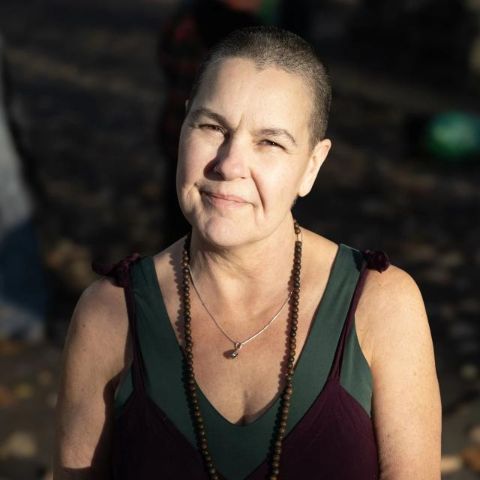
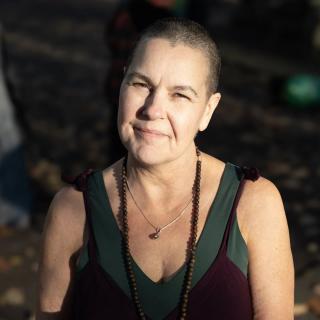
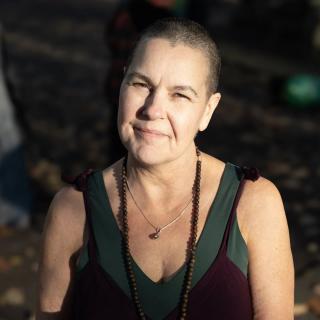
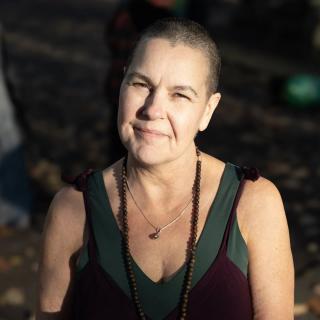
Today we have Casey and she's just gonna share her little part,
You know,
Her part of the world of doulas.
Thanks Casey.
All right,
Thank you for having this conversation with me today,
Pamela.
It's always nice to talk with other deaf doulas across the world.
I kind of think it's a very old profession without us even realizing it sometimes.
So yes,
My name is Casey.
I am a newly educated slash newly awakened end of life doula.
I've been trying to figure out a good way to call myself that and a newly awakened one.
Feels like a good way.
To explain it because it feels very natural to me.
I have multiple ways that I'd like to support people who are dying along with their friends and family.
I have two bonus daughters.
They are teenagers.
They do not like discussing death.
It is something they are not familiar with.
So that is something that I will be working into this field later on.
I have some plans to help bring teens into this conversation.
So I am someone who has always been very fascinated by death.
I grew up in a partially Jewish household where a lot of Jewish comedy is based around death and the macabre and morbidity.
I think it's part of the Jewish people's way of healing and dealing and coming to terms with tragedies of the Holocaust and just thousands of years of persecution.
So it's something has always been a natural thing for me to discuss.
And over the last few years,
I've realized the comfort level I have found.
In being able to support people discussing death,
Whether it be theirs or someone else's or just that concept.
My Jewish background is more familial than religious,
So I don't have a particular religious affiliation.
So I feel as though I can support people along any avenue with it.
Spiritual,
Faithful,
Or a faith,
Or just a holistic.
At the end of the day,
Very human is what I can offer.
Also,
This is the one singular experience that every human will go through,
And we only really get to do it once.
So I'd like to honor that.
Anyone that I can as well.
I know this job is not for everyone.
It really isn't.
So that's why I say a newly awakened end of life doula because it's I realized,
Oh my gosh,
This is for me.
I didn't even know what an end of life doula was until a friend explained it to me out of a conversation about grief therapy.
And once that concept was put in front of me,
There was nothing else.
That felt any more natural to me.
And I said,
Yes,
That's it.
Now,
I do love the phrase death doula.
But I understand the work I'm wanting to do.
Is end of life related.
It's not necessarily those final moments.
And plus I'm here to support not only that person,
But their family and their friends as well.
So there's an article that I really like that I'm gonna quote very quickly.
It's about this idea of becoming an empty vessel.
It says,
I can hold,
This quote is from PhD Virginia Chang.
And she says,
I can hold space for the words,
Stories and emotions of the dying because I am an empty vessel.
So for each person,
What they need from me is individual.
But I like the idea of coming in like a.
.
.
Just taking everything in for what people need.
So everything is a little different and unique for each human because each end-of-life path,
These transitions will be unique for everybody.
Yeah,
So that is how you got into it by just having someone mention that there's death doulas and you were like,
What is that?
Yes,
And I.
.
.
Over the last few years,
Work worth doing.
Has become very important to me.
I have spent my life working in the entertainment industry,
Special effects makeup for film,
Theater,
Haunted houses.
I do a lot of theatrical work in general with my kids and stuff in school.
I play music.
I love all of that.
But how do I then incorporate all of those things into what I'm doing now?
So.
The music will come about.
The theater and film as far as understanding people and maybe realizing that what they're saying doesn't come from words out of their mouth.
And that's a big thing at the end of life.
Not everyone can verbalize,
Dying or not,
What they might need.
So I'm there to kind of help pull it out.
Once I realized I wanted to do this,
I continued with training through the University of Vermont.
And while there's no national accreditation,
I have finished my deep dive education into this as best I can.
And moving forward,
Everything else will be experience-based.
I do volunteer with the hospice service.
I really enjoy going in and just spending time with people and being a companion to them.
Sometimes I'll bring the ukulele in and play.
I have had a couple of residents who were very music-based when they were younger.
For example,
One resident I worked with grew up in a tavern and Yeah,
With the Roosevelt's actually.
Up in Hudson Valley,
New York.
And she didn't like living in this nursing home because it was so quiet and that wasn't natural to her.
And so I would not only play music for her because she'd been a singer in her youth,
But I just played sounds of restaurants,
Clinging of plates and glasses and just murmuring.
There was a little bit of that life around.
If you are not able to be at home in your final days,
That can be very lonely.
So I feel as though the work,
The volunteer work,
Any volunteer work that people do with hospice is so meaningful and really.
Is just so important and helpful in a very natural way.
Yeah,
I mean,
So much about being a doula is being present,
Just being there.
Yeah.
And a lot of people are alone,
You know,
And they feel alone.
And like,
I really like the way you said that,
That at the end of life,
People can't always verbalize out of their mouth,
Whether they're the person dying or not.
It might be the family members that cannot verbalize out of their mouth.
Yeah.
And that's also,
It led me into thinking about what people really need and what I've heard people discuss.
A lot of what I've heard is,
My parents are dying.
Or they had just passed and I didn't know this was so expensive.
I don't know what they want.
We never talked about this.
It was scary.
Or blended families where there is maybe too much communication.
All kinds of things.
But I think it's important to help everyone talk about their wishes with end-of-life care,
Medical or otherwise,
Because you want those wishes to be understood and respected,
Especially if you are unable to speak on your own behalf.
This does help,
Of course,
Something like aging parents,
But You know,
In this world,
We never know what could happen.
I'm 40,
My husband's 50.
God forbid something terrible happens health-wise,
Accident-wise.
If I have to make those decisions for him and he is unable to speak,
It is significantly easier for me to refer to paper we've already discussed so I can keep his best wishes.
And the same thing vice versa,
I think for him with me as well.
And I have found that even within my age range,
We're never prepared.
I don't think anyone is really ever prepared.
So just starting with a basic conversation of an advanced directive,
Which is a sheet of paper that will prompt you questions.
And even that,
I feel,
Is a simple way to start putting your own wishes into your own hands and that of your loved ones.
And that's to really think about for yourself what you want.
For yourself moving forward.
Yeah,
You know,
And I really have thought that,
And I've heard this,
That every person 18 years of age and older should fill out an advanced directive.
People die,
Right?
Kids,
20 year olds die.
People die every day.
No one knows it.
And,
You know,
That's also a good way to bring the subject up with high school kids.
Like,
I think there should be a class in high school on this.
Right.
So since I was 16,
I've been trying to have some of these conversations with my parents,
Mainly because I understand that my parents have two different religions.
So even if I'm going the basis of that.
And one is more faith driven than the other.
It still puts me in a place to start a little bit.
I love talking about it.
Death.
I just do.
It's so interesting.
To me,
It's,
Yeah,
It's dark,
It's scary.
But it's,
Like I said,
The one thing we all go through.
It is inevitable.
And if we talk about it this early,
And implement it back into like everyday conversation.
I don't think it is as scary.
A hundred years ago,
People were all dying in their homes.
I go back to the Civil War,
For example,
Because for the first time we start having embalming and then people can be sent home.
But until then,
People died at home and they died with their families around them.
So by the time you get to something like the Civil War,
You have many,
Having their final moments on the field,
But instead of having their family around them,
They have carried photos with them and they had set their photos up around them.
And I think that's such an interesting concept.
Because even in those final moments for them,
They wanted to be surrounded by loved ones and family.
And again,
I think that's something so natural.
And you determine who your family is to an extent by that point.
So at that time when you're seeing family members and their lives at home,
Children see it,
Adults see it,
The older,
And it's part of it.
Yeah,
I mean,
It's been,
It's so beautiful to hold that space for people and then have them also have that aha moment of like,
Oh,
Okay.
Because we're so used to building,
Creating,
We're not used to dying.
No,
Unfortunately not.
I have a note here that we only get to die once,
Why not make it a good one?
And similarly to what I've told you before,
To die well,
We must live well.
So not only do you then think about your death,
But you're thinking about your life as a whole.
I think that's a big part of what I want to do with this,
Because the other two services right now that are within my beginning offerings,
Besides the advanced directives,
I also like the idea of legacy projects.
And I have done one with a friend of mine who is my age and is by all means deaf.
Knock on wood,
Healthy and happy and all those things,
But someone who had experienced a lot of death and a very good understanding of what was going on.
He wanted to get out of this legacy project.
So if you're unfamiliar,
Legacy projects are a part of what we call dignity therapy.
And it's really to help that dying person reflect on their life as a whole.
It is an opportunity for someone to give their final thoughts,
Final feelings,
Words.
It also helps to to work with those psychosocial and the existential burdens that we face at the end of life that we just didn't realize maybe.
And when I worked with my friend on this project,
I asked him.
Four questions the whole time,
And we spoke for an hour and a half.
Let me rephrase.
He spoke for an hour and a half.
And I now have this beautiful document for him that I have sent to him and he of course can edit however he may be but the way I captured it is his voice and he's for him reading it months later,
He said he cried because he'd never looked at himself like that from the outside.
And so I think that if you're healthy and you're doing this,
Maybe that's the effect.
I know my father,
For example,
Maybe hasn't told my siblings everything he wants to say.
Allows him to say those things to someone without having the physical ability of having to write,
Of having to type.
So it provides an accessibility.
It's at their pace.
And sometimes we just like having that one more thing.
I mean,
Who doesn't want to have that one more moment sometimes with a loved one before they pass?
So I think being able to have to open up for that person on their own final transition as well,
Helps them and puts them at ease and allows them to maybe have that final thought of,
I'm not leaving people with nothing left of myself.
Yeah,
Absolutely.
It's so beautiful.
Thank you.
Thank you.
And it's like I said,
It's difficult to talk about all these things for some of us,
Those who are lucky enough to say,
Let's just get into it.
I can be very darkly comic with a lot of people,
But I'm have the ability to read a room.
If it's not for that group,
It's not for that group.
I would back off real fast.
If I see someone might react to certain things,
I'm like,
Hmm.
Okay,
All right,
I see.
And humor is very healing for people.
The final service that,
Um.
I'm offering and that actually the first one I'm starting with are death cafes.
And then My ultimate goal within that is to host this for teenagers,
Because I think that for like my kids,
I see preteens and teens,
You know,
Maybe they lose a pet or grandparent this early.
That's kind of the first ones I think most kids experience.
One of my kids,
However,
Has not experienced that.
She has been to two funerals and they've both been for children.
And then she lost a pet over the summer,
Two pets actually.
I saw a rocky grief.
Now everyone's grief is always going to be at their own pace and nothing is ever wrong.
And you will work with your grief for the rest of your life.
But there are moments that can be rocky where communication is helpful.
And I can see my child working that through in her brain,
But not really sure of what to say.
So in that sense,
A death cafe will open up communication.
Within our community for these tougher subjects,
Allow people to know they do have additional resources.
Grief can be brought up.
I'm not a grief counselor.
I'm not a therapist.
I want it to be.
I don't even want to have a particular subject.
I'd like to have points to mention in case to help a conversation going to facilitate that.
But otherwise I want people to know that they're not alone and that these feelings are natural and someone else who you don't know who has a very different background might be experiencing the same thing as you because they're also human.
And the nice thing about a death cafe.
Is there are some very cute snacks,
And who doesn't like to bond in their community over very cute snacks?
Absolutely.
Yeah,
Death cafes are great.
Yeah,
I've done death cafes.
People are just,
Leave them uplifted.
They tend to be like,
Wow,
I didn't even know it was possible to talk about death like this.
I think that people are afraid of that moment of death more than either what's going on right before or right after.
I think if you are a person of faith or religion,
It might come a little easier to you because generally there's a written word somewhere that has said this is what happens.
It gives you a little bit of a direction,
More or less.
But if you're someone who does not subscribe to those beliefs or those writings,
You might feel a little lost sometimes.
And It's individual for everyone.
Some people just think they're going to go right into the ground and then that's it.
That's okay.
I like thinking that,
Yeah,
You'll go into the ground and if your belief is not there's an afterlife,
Okay,
You're in the ground,
But you know what?
You come back,
You have fertilized the soil,
You come back as mushrooms,
You come back as fungus,
And you go back into the earth.
Back to the earth from whence you came.
In Judaism,
That's a big deal.
Yeah.
Amen.
And I love that concept.
It could be anything,
You know,
If you believe that you're going to.
Be with a god in another realm,
And so you'd like to prepare your end of life thinking that way,
I'm going to this next thing.
I think that's great.
But if you're just looking towards,
I don't know,
We're people,
Let's find a little direction together.
Yeah.
And,
You know,
Unfortunately for,
You know,
The people of faith of religions,
Many,
Many of them are very fearful of what's after because there is a lot of fear in religion and hell.
And,
You know,
Did you were you good enough when you were alive?
And so I found that there's there's a lot of fear of the afterlife because we absolutely do not know what what's waiting for you.
I mean,
I grew up religious and I was I was like,
I think I think I've asked God to forgive me for everything.
What if I'm like Sinian and I don't even know it?
I mean,
Like it was deep in me.
Well,
I think that for some religions,
Which Obviously,
This is not a very religious.
Conversation,
But I think we know some create more guilt than others.
I have taken my learnings from each of the religions that my family travels in.
And I have come to terms with the concept of this is the only life I know that I have.
I can only work with the things here on Earth right now.
And whatever happens next or what happens before or after,
Okay.
But this is the life I know I have.
For me,
I can't necessarily worry about what I'm doing for something that may not exist later on.
But again,
My own personal thing.
That's a great place to be.
I mean,
I know a lot of people would love to be in that place.
But I never want to stop anyone if they believe otherwise.
It's not my job to get in their way.
And I have in some of my own personal studies with reading a lot about this,
I have found,
Unfortunately,
The background faith of the author comes into play.
A lot.
How they describe this type of role and this type of work.
I say unfortunately in the way that I am not a religious person.
So I choose to look for multiple ways.
I have,
You know,
Started read,
I've read a little bit of how some Roman Catholics and parts of Christianity handle afterlife care and whatnot.
I have a rather large book on,
Uh,
Uh,
The Jewish Kiddush and morning rituals that are very interesting in the fact that it's just really listed.
The book is like,
OK,
We're doing this,
We're doing this,
We're doing this.
And who doesn't love a little directional sometimes?
But like everyone's different.
Yeah.
Yeah.
And that is the beautiful thing about the variety.
Because,
You know,
Even for the very religious people,
There's some doulas that are very religious.
And so there's all kinds of people and they're in your community so they're probably tend to be like you.
And where I am is a very mixed community,
Which I'm very happy about.
I've never lived in a not mixed community.
I grew up in Brooklyn and moved to Philadelphia when I was 18 to go to college.
So I've done like half Philly,
Half New York.
And it's important for me to hear multiple languages,
To see different people,
To have different food and all these things.
And so then having these different beliefs as well.
It comes into that.
Yeah.
And understanding that everyone has.
Individual.
Everything,
You know,
Like I said,
I'm going to be that empty vessel,
Whatever you need.
Let me do that.
I want to leave all my stuff at the door to really be here for you.
That's what I want to do at the end of the day.
Yeah.
Wow.
I'm sure you do too.
I can tell.
You got it.
Wow,
This is great.
I love all the things that you do.
I love the idea of bringing in the music and the theatrics and what that can turn into,
Because being able to express always is great.
But certainly,
You know,
At that time for,
You know,
The family as they're experiencing it,
And just I definitely preferred I played clarinet,
That was my main instrument.
I was a woodwind player for many years,
But that was kind of tough to do.
It's not the most comfortable sound,
Unless you're really into that.
But string instruments and piano tend to do a little bit better.
They're a little bit more soothing.
My teenager,
Actually,
Her best friend plays the harp.
She's one of the people in the area.
And I told him she gets older.
Totally.
But the harp is important.
Because it's what I found ukulele or guitar as well because of the vibrations.
So if someone is not able.
To hear all the way,
They can still feel those vibrations.
And sometimes that in and of itself,
You know,
You're not always playing music.
Sometimes you're just playing tones,
Which I find to be really interesting also.
So there's an element of music,
But I don't want it.
I've had this happen before and I wasn't into it.
It shouldn't feel like a performance.
And if I have a set list,
We've gone too far.
When I was working within a nursing unit for people with cognitive everything,
Really,
At the end of the day,
We would put on karaoke sing-along songs for them.
And I had about 13 people I would work with,
Half of who were verbal,
None of whom could walk freely on their own,
Either in wheelchairs or jerrychairs.
And I would put on certain songs that we kept to the 50s and 60s.
For the most part.
And they perk up.
They might not verbally respond,
But.
And I.
.
.
Found that the most popular songs You are my sunshine.
Take me out to the ballgame.
That's it.
Newer.
Hmm,
There are a couple others.
I can't remember offhand,
But those are the big ones that I remember being surprised by.
Because all those songs would have come from youth.
Right.
That was really interesting.
Now,
I ended up singing a lot on my own there.
But they enjoyed it.
And you go over and I'm a big musical theater person.
I like a lot of show tunes and I like very old show tunes.
I'm a big Rodgers and Hammerstein fan.
Even before that.
I'll be running around singing Show Boat sometimes,
Which is from like the early 20s.
But because of that.
Some of that music is also familiar in the background.
So I can sing some of those,
And we can sing Edelweiss from The Sound of Music.
And again you just see faces light up and you know that they are probably having memories and reoccurring things that they probably can't describe.
And most of them don't,
But they know it and they can hone it.
And I come around to them and I pick their hands up and I dance a little with them.
And sometimes they smile and sometimes they say,
Eh.
You read the room,
They want to do it or they don't.
So the music is memory is a big element that I really enjoy also.
And I think that with anyone,
You know,
When you're not well,
Especially at nonverbal moments,
Music becomes very important.
I would like to eventually work with vigil settings as well.
Music being a large part of that and creating environments and safe spaces for people to have those final moments.
Yeah,
I think that music,
The recall of music,
Like recalls the feeling of joy they had then.
So their body kind of fills with that same feeling.
That's what I've experienced.
Well,
You know what?
This has been great.
This has just been such a good conversation.
Thank you.
Yes,
Thank you.