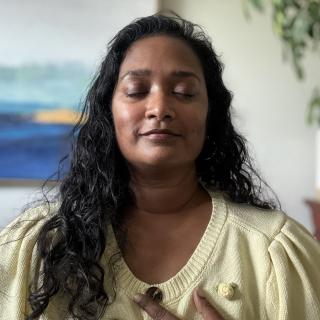
Hi,
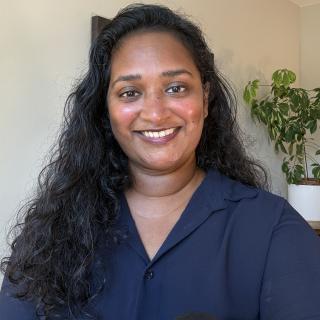
My name is Pamela Pawelski,
And I'm a licensed clinical social worker and therapist.
Our bodies.
Hold.
Not only physical.
Tension,
Physical energy.
But our mental energy as well.
You might notice.
When you're anxious,
Your shoulders are a little closer to your ears.
You might notice your hands are tight in a fist.
And so this progressive muscle relaxation exercise is to help your body and muscles relax,
But also to release that anxiety,
That anger.
Those emotions.
So go ahead and close your eyes if you'd like or you can stare into a spot in your room.
And take a deep breath in.
.
.
And as you exhale,
You can thank yourself.
For taking this moment.
To prioritize you.
Notice your feet.
Our feet are relatively smaller than the rest of our body parts.
And yet,
Their able,
Their muscles,
The bones.
Are able to balance our entire weight system.
On these two little things.
So if you imagine there's the muscles in your feet are so strong.
They're arranged in such a way to perfectly balance you to walk through.
To stand up.
And to do a lot more.
So just like you would make a fist with your hands,
Let's make a fist with your feet.
And hold.
1.
.
.
2.
.
.
3.
.
.
And release.
Let's do that again.
Make a fist with your feet.
1.
.
.
2.
.
.
3.
.
.
And release.
If you'd like,
You can say a thank you to your feet.
Thank you feet for guiding me.
Taking me to the places.
I need to go.
Let's draw our attention to your calves.
Like your feet,
We often sometimes don't think about our calves and all they do to support us.
Again,
To be able to stand and sit,
Climb stairs,
Walk.
So if you're seated,
You can point your toes down and tighten your calves.
If you are standing or lying down,
You can make a move to tighten your calves and hold.
Too.
And release.
Let's do that again.
.
.
Tighten your calves.
.
.
2.
.
.
3.
.
.
And release.
We can say thank you to our calves.
Thank you for listening.
Effortlessly.
Taking us to places.
Effortlessly.
Helping us stand and climb and walk.
Draw your attention to your thighs.
You have muscles on the front of your thighs called quadriceps.
You have muscles on the back of your thighs called hamstrings.
And not only do they help you climb stairs,
Or do squats or lunges,
But more importantly,
They help you balance your posture when you're standing so you don't fall forward or fall backward.
They're stabilizing muscles.
And they deserve a lot of thanks.
So if you're sitting,
You can imagine straightening,
Lifting your feet and straightening your quads on the front of your thighs and holding.
One,
Two,
Three,
And drop.
Let's do that again.
Lift your feet and tighten your quads.
1.
.
.
2.
.
.
3.
.
.
And release.
If you are sitting or lying down,
You can activate the back of your thighs by just imagine bringing your calves to your butt and holding.
One,
Two,
Three,
And release.
Activate your hamstrings.
.
.
1.
.
.
2.
.
.
3.
.
.
And release.
Let's take a moment to thank our thighs for doing everything they can to stabilize our bodies.
Regardless of our weight,
They are working so hard.
To help us get up.
Balance.
And exercise.
Let's draw our attention to our butt.
Our gluteus maximus,
Gluteus minimus,
Gluteus medius.
There's multiple muscles in our butt that help us sit and stand,
Of course,
But also ensure our hips don't go too forward.
They help regulate us to even stand,
Of course,
To walk.
Of course,
To do many,
Many different things.
So let's tighten our butt.
Hold.
1,
2,
3,
And release.
Let's do that again.
Tighten your butt.
Too.
And release.
And take a moment to say thank you to your butt.
Thank you for.
.
.
Everything you do without me even thinking about it.
Thank you for helping me be able to stand straight,
Be able to climb hills.
Let's draw our attention to our abs and our stomach,
The ab muscles.
These muscles help us be able to stand up straight.
They helped take care of.
Tension off of our back from doing too much work.
They keep our organs in place in our torso.
So you can imagine doing a mini crunch,
A tiny crunch,
Just tighten your stomach once.
And release Let's do that again.
Tighten your muscles too.
3 and release we can thank our abs for the work it does without us even thinking about it.
It knows to help us keep our bodies straight.
So we don't have to worry about that.
Thank you,
Apps,
For taking care of us.
And bring your attention to your hands.
We have so many muscles in our hands and fingers.
Would that help us to,
Of course,
Grab things,
Scratch,
Clean,
Care for ourselves,
Type,
Write,
Eat,
Etc.
And they do them autonomically without us even paying attention.
Take a moment and make a fist and hold.
2.
.
.
3.
.
.
And release.
Let's do that again.
Make a fist with your hands.
2.
.
.
3.
.
.
And release.
And let's thank our hands.
Thank you,
Hands.
For doing all the work without me having to think about it.
Thank you hands for helping me create,
Helping me eat,
Helping me groom myself,
Helping me raise a family.
Let's draw our attention to our biceps.
Part of our arms.
Our biceps are the muscle on the front upper arm that helps us lift our arms,
Helps us lift items.
So let's flex our biceps.
1,
2,
3 and release.
Do that again.
Flex 1,
2,
3 and release.
Can thank our biceps for being here.
Helping us be able to lift and do things.
Being able to carry things into our homes.
If we have family members,
Being able to carry family members if we need to.
And let's draw attention to our face.
We have many muscles in our face.
We'll start with the jaw.
Or jaw.
Can hold a lot of tension,
Sometimes when we're sleeping.
If we're angry or anxious,
We will unconsciously clench our jaw.
But let's take a moment and stretch our jaw out.
So lower your lower jaw.
And feel the tension release from the muscles.
You can wiggle your lower jaw left and right as long as it feels comfortable for you.
And you can imagine yawning.
To release some of those jaw muscles.
If you'd like,
You can bring your pointer finger or middle finger to your jaw muscles on either side of your jaw and give a nice massage.
Helping it release.
Tension.
We can thank our jaw.
Thank you,
Jah,
For helping us to eat to stay alive.
Thank you for taking the tension off of our minds sometimes.
Thank you for allowing us to be able to talk and communicate.
Let's take a moment and notice your eye muscles and your cheek muscles.
Which help us to,
Of course,
See things.
But also express,
Express our emotions.
Express our joy.
Express our anger.
Express feeling relaxed.
So you can scrunch up your face muscles like your eyes and cheeks and mouth all at the same time.
A big face scrunch.
One,
Two,
Three,
And release.
It feels good.
Let's scrunch up our face muscles.
1,
2,
3 and release.
Thank you,
Face,
For doing so much for us,
Helping us breathe,
Helping us communicate.
Thank you,
Face.
Lastly,
Let's focus on our shoulders.
Our shoulders,
When we're tense,
Will raise a little bit towards our ears.
So let's do that now.
Let's raise your shoulders towards your ears as if they're touching your ears and hold it.
And release.
Notice that tension floating away.
Let's do that again.
And release.
Just take a moment and say thank you to your shoulders.
Our shoulders allow us to bear weight on them when we're lying down.
They help us get up if we're on the floor.
They help us,
Of course,
To carry things,
Lift things.
They help us when we fall.
Our shoulders often are one of the first things that hit the ground,
And they bear tension for us to save our life.
Organs and the important parts of our body.
They're so strong.
Even if they appear weak,
They are strong.
So say thank you to your shoulders for protecting you.
So take a moment and breathe.
Just scan your body.
From the top of your head down to your feet.
Notice how you feel.
You can take a deep breath in and as you exhale You can say a final thank you to your body.
I hope this practice has helped you feel more connected and connected.
Appreciative of everything your body does for you Thank you.
My name is Pamela Puelsky.
Take care of yourself.