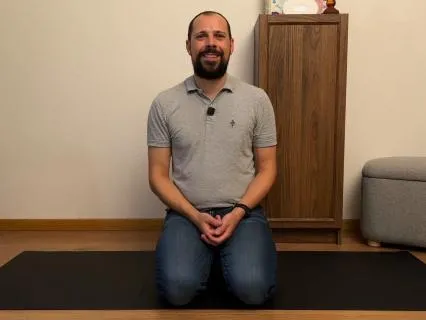
So welcome to the mindful movement practice.
In this practice,
We'll be doing postures lying down.
And just like with all the other mindful movement practices,
It's not about doing the posture in any particular way.
If you're not able to do a posture,
Or if you need to adapt it,
Or do it less,
Or do something different,
Feel free to do so.
What's important is the type of attention,
The quality of attention,
That you're paying to the physical sensations in the body as you move and in between the movements.
And so we'll begin lying down on a surface that's not too soft,
Not too hard.
So a bed,
For example,
Is too soft.
Perhaps a yoga or a Pilates mat or even just a towel on the floor is a good thing to do.
So taking a moment to notice.
The body as you lie here,
What physical sensations are already present.
Just lying here.
Bending the knees,
The feet are flat on the floor,
We'll be rotating the pelvis.
So tilting the pelvis so that the lower back presses against the floor.
And then rotating.
The lower back in the other direction so it creates a slight arch in the lower back.
So we're rotating.
Pelvis,
The hips forward and back.
Slowly noticing the sensations as we move.
Perhaps one more time.
And just allowing the hips to rest in.
What is a neutral position for them today in this practice?
Allowing the legs to come down.
Or if this creates a lot of tension on the lower back,
You may wish to place a cushion or a bolster under the knees to raise the knees slightly in this position.
And bringing the right knee into the chest.
Interlacing the fingers on the shin,
Pulling this in.
Again,
It's not about how far or how much you pollute in.
What's going on in the body right now?
What's going on with the physical sensations?
And then releasing the hands,
Allowing that leg to slowly come back down to the ground.
Noticing.
If perhaps there's any difference between the left side and the right side,
Maybe there is,
Maybe there isn't.
Seeing what's true for you in this practice.
Tension on the body as you move,
Bringing the other knee in.
Injury in the fingers and pulling.
The thigh,
The knee in closer towards you.
And then releasing and slowly bring that leg up.
Down with continued attention on the body as it moves.
And then bringing both knees in at the same time.
Grabbing the hands.
On the legs.
.
.
Or perhaps opposite wrists if that's accessible for you.
Lemony Zen.
The head can be up towards the knees for a little bit of extra talent.
Or the head can be rested on the ground if that's okay for the neck.
And then releasing the hands and the legs slowly.
To the floor.
Noticing the body,
What's present here in between the movements and the physical sensations.
And now bending the knees,
Feet are flat.
And then turning over onto one side,
And then using the hands to push against the floor.
Bring yourself up.
Onto all fours,
So the hands are approximately under the shoulders,
The knees approximately under the hips.
And we'll be doing what they call in yoga a cat-cow position,
Where we arch the back one direction and the other.
So exhaling,
Bringing the chin to chest and arching the back up.
And inhaling.
Looking forward,
And if the neck allows,
Even perhaps slightly up.
The pelvis towards another direction.
Exhale.
And inhale,
So moving the body with the movement.
Arching the spine one direction and then the other.
The hips as your spine permits in this moment.
And just allowing.
Hips in the back to come back to her.
A neutral position.
Be bringing.
One arm up.
Pointing straight ahead,
And then the opposite leg.
Raises.
So this is a bit of a balanced position that's also working a bit the muscles in the back.
With the concentration as well.
Again,
This isn't about how you do the position or for how long you hold it,
But it's really about what are you noticing in the body as you move.
And bring the hand and the knee down.
Noticing perhaps.
Sometimes a judgment can sneak in if we're not able to do the posture in a way we think we're supposed to be doing or should be able to do it.
So if that's there,
Seeing if it's possible to.
.
.
Note and accept this presence.
And then see if it's possible to let go of the judgment.
As we now go to the other side.
So bringing the opposite arm up,
Pointing ahead.
And the opposite leg.
Raising behind you,
Pointing straight.
Noticing perhaps the breath.
What's the physical sensations of breathing like in the body right now?
And bringing the hand down,
And the leg down as well.
I'm noticing the body Coming down once more.
Under the hips and then onto the bark.
This position can be a great position to check in with the body as well.
There's no muscles needed to hold the body up.
To see what is truly present.
In the next position,
Bending the knees.
Feet flat,
Bringing the heels close enough to perhaps touch the tips of your fingers.
We'll be doing what's known as a bridge pose.
So adapting this to your body.
What's needed in this moment.
Lifting the hips up Noticing the sensations in the body and then slowly lowering down,
Perhaps vertebra by vertebra if that's available for you.
And then keeping the knees together.
We'll reach one arm out in the opposite direction,
Bringing one hand over for a spine.
Twist.
So bringing both knees over in one direction.
And the opposite arm,
Though,
Just to help counterbalance,
So you don't fall over.
And then bringing up to center.
And the opposite direction.
And then back to center.
And then slowly lowering.
Legs back down.
This will be the final position to practice.
So noticing any physical sensations that are present.
Perhaps noticing the breathing or temperature.
The muscles,
Feel free to stay here as long as you wish.
And when you get up.
.
.
See if it's possible to.
.
.
Keep this type of awareness as you continue with your day.