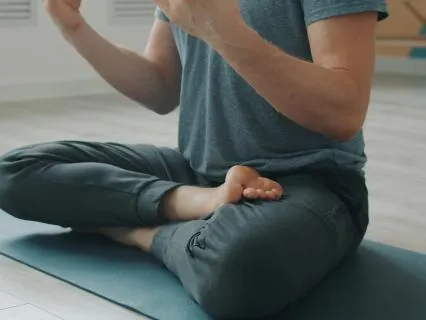
This is a 30 minute breath awareness practice.
So just settling into your posture,
Ensuring you are comfortable.
A sense of uplift in the upper body.
But also feeling grounded on the chair or on the cushions.
And starting by taking a few slow,
Deep,
Soft breaths.
Breathing in through the nose and out through the mouth.
As you breathe in,
Lifting the smile.
And as you breathe out,
Allowing the body to become more at ease.
Now checking in with how you are,
Just noticing your state of mind.
Noticing how you feel in this moment.
And as best you can,
Doing so without judgement.
Without the need to modify,
Just allowing whatever is there to be there.
And now expanding your field of awareness to your whole body.
Just noticing your posture.
Noticing your facial expression.
And with your awareness,
Just scanning through your face,
Through your body.
For any noticeable signs of tension or tightness.
And seeing if it's possible to soften those areas somewhat.
Typically we feel tension in the shoulders,
In the jaw between the eyebrows.
This could be anywhere in the body.
And now noticing the contact between the body and the chair and the floor,
The cushions.
Bringing some awareness to your environment.
The light,
The sounds.
Sense of space.
And when you're ready,
Bringing your breath into the foreground of your attention.
And simply noticing when you're breathing in and when you're breathing out.
You may find it helpful to silently say to yourself,
Breathing in when you're breathing in and breathing out when you're breathing out.
And if your mind wanders at any point during the meditation,
Just gently guide your attention back each time.
Back to the breath,
Back to the body.
Using the breath or the body as an anchor for your attention.
So following the journey of the breath.
So you may notice the breath entering the nostrils or the mouth.
Moving like a column down the body,
Expanding the torso.
Seeing if it's possible to maintain your attention on the whole journey of the breath.
Notice how the torso expands as you breathe in.
And how it contracts as you breathe out.
And there's no need to force the breath in any way.
Just simply allow the breath to breathe in its natural way as best you can.
Letting the attention rest on the natural breath.
And now to fine tune the attention a little more.
Noticing the four parts of the breath.
The in-breath,
The pause before the out-breath,
The out-breath and the pause before the in-breath.
Perhaps you can imagine the breath a bit like the sea lapping up onto the shore.
It comes in.
There's that moment where it turns around.
Goes back out.
Again,
Another turning before it comes back in again.
Seeing if it's possible just to settle into the rhythm of your breathing.
Noticing those four parts.
It can be helpful to notice the uniqueness of each breath.
You may notice,
For example,
That some breaths are long,
Some are short,
Some are deep and some are shallow.
From time to time,
Checking your posture,
Readjusting if necessary.
Now we're going to fine tune the focus a little more by focusing on certain parts of the body.
Starting with bringing attention to your shoulder blades.
Noticing how your shoulder blades part as you breathe in and how they contract back as you breathe out.
Now moving the attention up to the tops of the shoulders.
Noticing how the shoulders rise and fall as you breathe in and out.
You may notice as your shoulders rise and fall,
So do your arms.
Now bringing attention mainly to the left shoulder.
Noticing the rise and the fall as you breathe.
Now switching the attention to the right shoulder.
Then back to both shoulders.
Now moving the attention to the chest area.
You may find it helpful to place a hand on the chest to help you tune in.
Noticing how the chest rises and falls as you breathe in and out.
Releasing the hand and bringing your attention to your belly.
Placing a hand on your belly to tune in.
Noticing how your belly expands and contracts as you breathe.
Perhaps noticing as the belly expands how it stretches into the palm of your hand.
Now I invite you to place the other hand on your chest.
Just noticing as the lungs expand how it creates a wave sensation.
Belly moving first and then the chest.
Releasing the hands,
Allowing them to rest in your lap.
Now moving the attention to the tips of the nostrils.
Noticing the sensations of breathing in this part of the body.
You may notice here as you breathe in a cool sensation.
And as you breathe out a warmer sensation.
So just staying with this cool and warm sensation for a short while.
And you may notice other sensations present in the nostrils.
For example you may notice how the nostrils flare slightly as you breathe in.
You also may notice that as you breathe in the breath is smoother than the out breath.
You also notice the sound.
Just perhaps noticing how the sound is different on the in breath to the sound of the out breath.
Bringing the attention to the whole of the breath again.
Simply being aware of when you're breathing in and when you're breathing out.
Bringing attention to the whole of the upper body.
Just noticing how the upper body expands and contracts with each breath.
I invite you now to expand your field of awareness to the whole of the body.
Just imagining the whole body is breathing with the breath.
Whole body expanding and contracting.
Expanding your field of awareness further to include your environment.
Noticing the contact between the body and the cushions,
The chair,
The floor.
Noticing the temperature of the air on the bare skin.
Noticing light.
Noticing sound.
With your breath as the central focus,
Just sitting in an open awareness of your whole experience.
And perhaps again checking in with how you are.
Just noticing your state of mind,
How you feel.
See your posture,
Your facial expression.
You're starting to wiggle the toes,
Wiggle the fingers.
Take a bit of a stretch with the arms.
Gently opening the eyes if you have them closed.
And just taking in the panorama in front of you.
And just relaxing as you wish now.
Thank you for partaking in this meditation.
Enjoy the rest of your day.