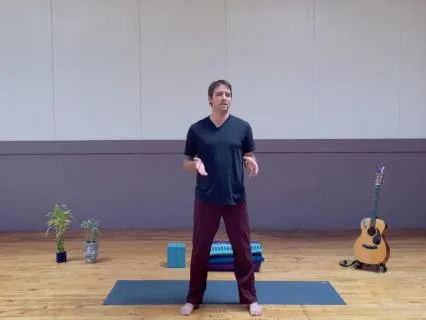
So my name is Matt and this is an acoustic restorative yoga practice.
So I was thinking the last few classes I filmed were inspired by the full moon and then also the season of autumn.
And I got to thinking with that,
You know,
There's things in life that happen,
Like seasonal changes,
Energy changes with the full moon,
That kind of inspire different yoga practices.
And this is the same kind of thing where I think restorative yoga is needed more so than ever,
At least for me,
People that I know.
So for this practice,
It's around the holidays right now,
So I think especially if you're feeling kind of extra stressed out,
This could be a good practice for that.
So for this class,
You'll need some props.
So I suggest having a bolster and a few blankets and then a couple blocks.
You don't necessarily need all that,
But it's just nice to have kind of just in case.
I'm on a hardwood floor here,
So it's kind of nice to have the blankets for extra padding.
And then what works best for me too is doing a sequence where I'm lying face down.
I don't like to do that for every restorative yoga practice,
But this will basically kind of be that.
So for me,
It helps just get my nervous system into a really relaxed state.
I feel very grounded and calm and clear afterwards,
So I hope it works in the same way for you.
So to set up,
We're just going to have a blanket to either side.
And then if you do have the blankets kind of folded up like this,
So if you get some yoga blankets like that,
The long side is going to be parallel to the long side of your mat.
And then that's just going to go about halfway between the front and the back of your mat.
And then also some extra padding for your knees can be nice too,
Especially if you're on a hardwood floor like I am here.
And then I'm just going to keep the bolster off to the side.
And then we're actually going to start in a child's pose.
So a wide knee child's pose in a supported version.
So you can use the bolster to just kind of pull in between your knees.
And then we'll be here for a little while,
So every pose will be at least five-ish minutes.
And then so if you do need a block or two underneath your hips,
Mine don't seem to need it right now,
But I'm going to place those,
See how that feels.
And then we'll just start from the very beginning,
Just kind of getting really set up to where we can really relax.
So if there's even more props that you need to do that,
Grab those,
Maybe even an extra bolster or two to place your torso on top of.
This already feels great for me.
So just take your time to get relaxed.
And you can turn your head to one side.
I'm going to go to the side of the bolster.
Place one side of my head near the edge,
Just so nothing's kind of compressed there.
Once you feel like you've found your version of the supported child's pose,
We'll just start to tune into the breath.
So notice yourself breathing right now,
How that feels.
And just notice that once you bring your attention to your breath,
It just naturally wants to deepen on its own.
So to help land here in an even more deep,
Grounded way,
Take a longer inhale,
Breathing through your nose.
Long exhale,
Sigh.
And we'll just do that once to land and just relax.
So if you notice that your mind is kind of wandering from one place to the next,
Maybe something that happened in the past or something you're maybe anxious about in the future,
You can always bring it back to some deep breaths to help anchor yourself back to the here and now.
And now just take a moment to notice if you're holding any tension anywhere.
So is there any part of your body that's kind of tense?
Is there any part of tension that you're holding that's kind of preventing you from relaxing into the props more?
And if there is,
See if you can use your next exhale to let that go.
So nothing else to do here,
But just be and breathe.
So if you had your head turned to one side,
Turn your head to this,
The opposite side.
So that same principle of just kind of having inside of your head near the edge of the bolster,
So it kind of hangs off a bit.
I'm actually going to keep my head on the opposite side because the mic is going to not work if I do it on the opposite side.
And again,
As you're ready,
Take that inhale through your nose.
Long exhale,
Sigh,
Relaxing even deeper.
And a few more good breaths in this pose.
So this is great.
If you just kind of released or relaxed into that more relaxed state,
You can stay there.
If you're ready to come out,
Take your time,
Just being mindful as you move.
So walk your hands back.
All righty,
I feel more relaxed,
More grounded.
And then just move some props off to the side.
And once you're feeling good in that tabletop,
So nice and grounded,
Then bring in some movement.
So maybe make some hula hoop hip circles in one direction,
Nice and slow.
And in the opposite direction.
Once you're even there,
Back to center,
Back to a table.
Next,
Inhale,
Cow pose.
Exhale,
Cat pose.
Take about three more to set your own pace.
Next time you're in cat pose,
We'll actually hang on to cat pose.
So breathe deeply.
Bring your belly button up and in a little bit more to feel that core engagement.
Not too intense,
Just enough.
You can let your head hang or nod your head yes a few times,
Nice and slow.
Nod your head no a few times,
Nice and slow.
Give your head time to come back to the center.
So we're just back in cat.
Back to table,
Good long breath,
Table.
And then from there,
We'll set up for half frog pose.
So coming to lie down.
And then we'll start on the left leg first,
Just to keep it kind of focused on the inside of things.
So left leg goes out to the left.
And especially if you're on the hardwood floor,
Like I am,
Just taking care to make sure the whole of that left leg is supported with the blanket.
The left knee is kind of in line with that left hip.
And you can keep the knee bent or straighten through the leg.
And then stack one hand on top of the opposite hand.
And then forehead to hands.
And we'll land here in that same way.
So as you're ready,
Deep inhale through nose.
Long exhale,
Sigh.
And maybe just keeping a gentle ujjayi breath going the whole time.
So breathing,
Inhaling,
Exhaling in and out your nose.
Making that oceanic wave like sounds,
Just a gentle ujjayi.
And again,
Just checking in,
Seeing if there's any tension that you're holding that you don't need.
Really allowing that three dimensionality to your gentle ujjayi breath.
To continue,
You should feel a gentle pressing into the mat with your low belly.
And then as you contract,
Just gently pulls up.
Your hips release more to your mat.
And to keep that going.
About five more good breaths on this side.
Again,
As always,
If you need extra time,
If you just kind of got to that relaxed space,
Stay as long as you need.
But once you're ready to come out,
Again,
Being mindful as you transition,
Bring that left leg back to right leg.
And it can stay here.
So keeping the hands stacked.
Or another option is a gentle sphinx pose.
So coming up to forearms.
And we'll take a few long breaths in sphinx.
So we do that pose on one side.
Just notice how you feel side to side.
Maybe a little rocking of the hips side to side.
Releasing back down.
Leaning a bit more to your left.
And so right leg goes out.
Actually,
Even better of a transition.
So the more you lean to the opposite side,
Less tension towards the leg with the bent knee,
Which is nice.
And once you're set up,
You get that support there.
Again,
Any last adjustments,
We stack hands.
And the opposite hand on top this time.
And forehead back to hands.
Again,
That same breath to land even more deeply.
Inhale through nose.
Long exhale,
Sigh.
And again,
Now that you've given yourself time to really land,
Keeping that nice three-dimensional quality to your ujjayi breath cycle.
So expanding,
Contracting all directions with your breath.
And really breathing into your low belly to help tell your nervous system it's time to relax even more.
So each inhale,
You feel that pressing into your mat.
Each exhale,
Releasing back and up.
We don't want to add in any unnecessary tension as we do that.
Just bring our awareness there.
And about five more good breaths on this side.
Noticing the quality of your pose as you relax deeper and deeper.
So again,
Stay as long as you need.
Once you are ready to come out,
Right leg again back behind.
So both legs straight back behind.
Maybe this time,
Bring the big toes to touch.
Let your heels fall away.
That should feel extra nice for your low back.
Again,
Staying here with that sphinx pose.
This time,
I'm going to stay here.
It's a little bit longer,
So about five long breaths.
So this is actually a yin version of shavasana.
So we're just lying face down.
If that is great,
You can stay.
Otherwise,
I'm going to add in a supported version,
That same version of shavasana.
So taking your time to transition out.
So if you'd like to follow along with that version there.
So with one blanket,
We're going to roll that up.
And we're going to place that.
It's going to go underneath our ankles.
And then we're going to fold one blanket up.
So if you have it like this,
Just fold that up one more time.
The place near the top of the mat,
That'll go underneath our forehead.
And the bolster is going to go underneath our torso.
I know that I'm going to need the blanket roll further back,
So I'm going to bring that further back there.
And taking your time.
So this time,
You may not need the blanket underneath your knees,
But you can use that last blanket underneath knees if you like.
The reason why you may not need it is because most of the weight is going to go on top of the bolster now.
And so you just want as much of your torso as possible on the bolster.
And then pulling the blankets that's folded up underneath your forehead.
And as always,
Just really giving yourself time to really lay in there.
You know,
Taking the time to get yourself set up to where you don't have to move at all.
You're just fully supported,
Relaxed.
So making any last adjustments to make that happen.
Cactusing arms out to the side.
And once you really landed there,
Long inhale through your nose.
Long exhale,
Sigh.
Lay in there.
Let go of any tension that you don't need.
You have no other responsibility.
This is really just time for you to let go and relax in your space.
This is a newer one called In the Here and Now.
It is here underneath all we've tried to achieve.
Feel your breath in and out right to the here and now.
Passing your bat like mistrains.
You're living your life on the way.
The balance brings it all back to focus.
Showing you that all is not lost.
In this place,
There is life like a heartbeat.
Feel your breath in and out right to the here and now.
In this place,
There is life like a heartbeat.
It is here underneath all we've tried to achieve.
In your silence,
You feel peace.
There's a knowing inside.
Feel your breath in and out right to the here and now.
Underneath all we've tried to achieve.
In your silence,
You feel peace.
There's a knowing inside.
Feel your breath in and out right to the here and now.
So if you are in that lying face down version of Shavasana,
Starting to bring in some movement.
So pressing through your hands to bring yourself up.
And then we'll take it back to an easy supported Shavasana.
Just for a few breaths.
And then from there,
We'll transition to Tabletop.
So we're going to move the bolster up to the side a bit.
I'm going to use that for Sukhasana.
So I'm going to sit up on that,
Crossing one ankle in front of the opposite ankle.
You can use the blanket to sit up on or maybe just straight down on your mat.
So take a few breaths to just notice palms face down on thighs.
Just notice how you feel now versus when you first started your practice.
And we just take a moment to appreciate the ripple effects to everything,
Everyone around us by doing that.
And then we'll just end with one collective breath.
So inhale for no.
Staying here as long as you need.
But once you are ready to transition,
Open back up eyes.
Thanks so much for joining.
Enjoy the rest of your day.
Namaste.