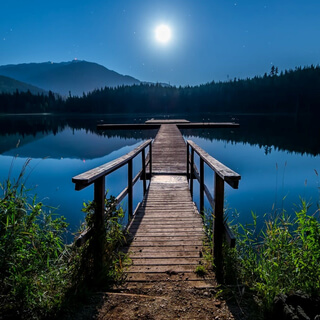
THE LANTERN KEEPER There was once a quiet valley where the nights were never fully dark.
Not because the moon was always full and not because the stars burned brighter than elsewhere,
But because lanterns were kept.
Every evening,
Just as the sun slipped behind the hills,
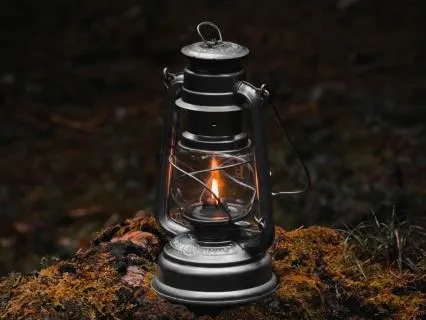
Small lanterns would glow to life along the paths,
The doorways,
The riverbanks,
And the edges of the forest.
Their light was soft,
Warm,
And steady,
Not bright enough to blind,
Just enough to guide.
And the lanterns did not light themselves,
They were tended by a single keeper.
Her name was Ellen.
Ellen lived at the edge of the valley in a small stone house with windows that faced the hills.
She rose each morning early and slept early each night.
She spoke little,
Listened often,
And moved through the world with the calm patience of someone who had learned not to rush or could not be hurried.
Each day she walked the valley paths,
Checking the lanterns.
She cleaned the glass,
Trimmed the wicks,
Refilled the oil.
She adjusted the ones that leaned,
Replaced those that had cracked in the cold.
People rarely noticed her work until a lantern went out,
Then they would feel it.
A stumble on a familiar path,
A pause at a crossing that once felt easy,
A sense that something small but important was missing.
And Ellen would come,
Quietly,
And set it right.
What no one knew was that Ellen carried a lantern of her own,
Not one she held in her hand,
But one she carried inside her chest.
It had been given to her long ago,
When she was young and the world felt wide and unsteady.
Someone she loved,
Someone whose voice had once felt like home,
Had taught her how to tend it.
Light doesn't disappear,
They had said,
It just needs care.
And so Ellen learned.
But time passed,
Seasons changed,
And the person who taught her eventually walked a path she could not follow.
The lantern inside Ellen dimmed after that,
Not all at once,
Slowly and gently,
Like a flame learning how to be quieter.
Still she carried it,
She still protected it,
But some nights she worried it might go out entirely.
One evening,
As Ellen made her rounds,
She noticed something unusual.
A lantern near the riverbank flickered,
Not from wind,
Not from lack of oil,
But from something deeper.
Its light pulsed softly,
As if uncertain weather to stay.
Ellen knelt beside it.
She checked the wick,
It was fine,
The oil,
It was full,
The glass,
Clean,
Yet still,
It trembled.
She sat with it for a moment,
Breathing slowly,
Letting the quiet of the valley settle around her.
She placed her hand near the lantern,
Not touching,
Just close enough to feel its warmth.
And then she realized something.
The lantern was tired,
Not broken,
Not empty,
Just tired.
So Ellen did something she'd never done before.
She stayed.
She didn't fix it,
She didn't rush,
She simply kept it company.
And slowly,
The flame steadied.
That night,
Ellen returned home later than usual.
She lit a single candle and sat by the window,
Watching the valley glow below.
For the first time in a long while,
She felt the weight of her own tiredness.
Not the kind that sleep alone could fix,
But the deeper kind.
The kind that comes from carrying responsibility for a long time without pause.
She placed a hand over her chest and felt the warmth of her own lantern.
Still there,
Still glowing,
Just quietly.
Ellen realized then that she had spent so long tending the light of others,
That she had forgotten something essential.
Lanterns need rest.
Even the strongest flame cannot burn brightly without moments of stillness.
The next morning,
Ellen did something radical.
She delayed her rounds.
She brewed tea.
She sat in the sun as it warmed the stones outside her door.
She listened to the birds,
Not to identify them,
Not to mark time,
But simply to hear them.
The valley did not collapse.
The lanterns did not go out.
And when she finally walked the paths later that day,
Something had changed.
They seemed kinder,
The light brighter,
As if it recognized her not only as a keeper,
But as a companion.
Weeks later,
A message reached Ellen from the far edge of the valley.
A lantern had gone dark entirely.
Not flickered,
Not dimmed.
Gone.
Ellen walked the long path toward it as dusk fell.
And when she reached the spot,
She found the lantern cold,
Its glass intact,
Its wick unburned.
It had not failed.
It had finished.
Ellen sat with it as the stars came out.
She felt grief rise in her chest.
Not sharp,
But deep and familiar.
The kind that knows it has lived here before.
She did not try to relight it.
Instead,
She whispered a thank you.
And then gently she lifted the lantern and carried it home.
Ellen placed the lantern on a shelf in her house.
It did not glow,
But it still mattered.
Some lights are meant to guide.
Some are meant to teach.
And some are meant simply to be remembered.
That night,
Ellen's own inner lantern burned a little brighter.
Not because she forced it,
But because she had finally allowed herself to honor what had been lost without trying to replace it.
From then on,
Ellen changed how she worked.
She still tended the lanterns,
But she also taught others how to care for their own.
She showed them how to notice flickers before they became darkness,
How to rest before exhaustion,
How to sit with a flame rather than control it.
And slowly,
The valley became a place where light was shared,
Not carried alone.
If you ever walk that valley at night,
You might notice something.
The lanterns glow,
Not brighter than before,
But steadier.
And if you listen closely,
You might feel something familiar within your own chest.
A small warmth,
A gentle glow,
A reminder that your light does not need to be constant to be real.
It only needs care and rest and permission to be exactly as it is.
And as the night settles in,
May you remember that even the quietest light is enough and that you too are allowed to rest.
And that is the end of our story this evening.
Until next time,
Sweet dreams.