CHAPTER THIRTEEN DO YOU BELIEVE IN FAIRIES?
The first to emerge from his tree was Curly.
He rose out of it into the arms of Secco,
Who flung him to Smee,
Who flung him to Starkey,
Who flung him to Bill Jukes,
Who flung him to Noodler.
And so he was tossed from one to another till he fell at the feet of the Black Pirate.
All of the boys were plucked from their trees in this ruthless manner,
And several of them were in the air at a time,
Like bales of goods flung from hand to hand.
A different treatment was accorded to Wendy,
Who came last.
With ironical pleasantness,
Hook raised his hat to her,
And offering her his arm,
Escorted her to the spot where the others were.
He did it with such an air that she was too fascinated to cry out.
She was only a little girl.
They were tied to prevent their flying away,
Doubled up on their knees close to their ears.
Sufficient of this,
Hook guessed to persuade him that Peter at last lay at his mercy,
But no word of the dark design that now formed in the subterranean caverns of his minds crossed his lips.
He merely signed that the captives were to be conveyed to the ship,
And that he would be alone.
How to convey them?
Hunched up in their ropes,
They might indeed be rolled down hills like barrels,
But most of the way lay through a morass.
Again Hook's genius surmounted difficulties.
He indicated that the little house must be used as a conveyance.
The children were placed in it,
Forced out pirates raised it on their shoulders,
The others fell in behind,
And singing the hateful pirate chorus the strange procession set off through the wood.
I don't know whether any of the children were crying,
If so the singing drowned out the sound,
But as the little house disappeared in the forest,
A brave though tiny jet of smoke issued from its chimney as if defying Hook.
Hook saw it,
And it did Peter a bad service.
It dried up any trickle of pity for him that may have remained in the pirate's infuriated breast.
The first thing he did on finding himself alone in the fast-falling night was to tiptoe to Slightly's tree,
And make sure that it was provided him with enough passage.
Then for long he remained brooding,
His hat of ill omen on the sword,
So that any gentle breeze which had arisen might play refreshingly through his air.
Dark as were his thoughts,
His blue eyes were as soft as periwinkle.
Intently he listened for any sound from the netherworld,
But all was as silent below as above.
The house under the ground seemed to be but one more empty tenement in the void.
Was that boy asleep,
Or did he stand waiting at the foot of the Slightly tree with his dagger in hand?
There was no way of knowing save by going down.
Hook let his cloak slip softly to the ground.
He was a brave man,
But for a moment he had to stop there and wipe his brow which was dripping like a candle.
Then silently he let himself go into the unknown.
He arrived at the foot of the shaft,
And stood still again biting at his breath which had almost left him.
As his eyes became accustomed to the dim light,
Various objects in the home under the trees took shape.
But the only one on which his greedy gaze rested,
Long sought for and found at last,
Was the great bed.
On the bed lay Peter,
Fast asleep.
Unaware of the tragedy being enacted above,
Peter had continued for a little time after the children left to play gaily on his pipes.
No doubt rather a forlorn attempt to prove to himself that he did not care.
Then he decided not to take his medicine,
So as to grieve Wendy.
Then he lay down on the bed outside the coverlet to vex her still more,
For she had always tucked them inside it,
Because you never know that you may not grow chilly at the turn of the night.
Then he nearly cried,
But it struck him how indignant she would have been if he laughed instead.
So he laughed a haughty laugh,
And fell asleep in the middle of it.
Sometimes,
Though not often,
He had dreams,
And they were more painful than dreams of other boys.
For hours he could not be separated from these dreams,
Though he wailed piteously in them.
They had to do,
I think,
With the riddle of his existence.
At such times it had been Wendy's custom to take him out of bed and sit with him on her lap,
Soothing him in dear ways of her own invention,
And Wendy grew calmer to put him back to bed before he quite woke up,
So that he should not know of the indignity to which she had subjected him.
But on this occasion he had fallen at once into a dreamless sleep.
One arm dropped over the edge of the bed,
One leg was arched,
And the unfinished part of his laugh was stranded on his mouth,
Which was open,
Showing the little pearls.
Thus defenseless,
Hook found him.
He stood silent at the foot of the tree looking across the chamber at his enemy.
Did no feeling of compassion disturb his somber breast?
The man was not wholly evil.
He loved flowers,
I've been told,
And sweet music.
He was himself no mean performer on the harpsichord.
And let it be frankly admitted,
The idyllic nature of the scene stirred him profoundly.
Mastered by his better self he would have returned reluctantly up the tree,
But for one thing.
What stayed him was Peter's impertinence appearance as he slept.
The open mouth,
The drooping arm,
The arched knee,
They were such a personification of His cockiness as taken together will never again,
One may hope,
Be presented to eyes so sensitive to their offensiveness.
They steeled Hook's heart.
If his rage had broken him into a hundred pieces,
Every one of them would have disregarded the incident and leapt at the sleeper.
Though a light from one lamp shone dimly on the bed,
Hook stood in darkness himself,
And at the first stealthy step forward he discovered an obstacle.
The door of Slightly's tree.
It did not entirely fill the aperture,
And he had been looking over it.
Feeling for the catch,
He found to his fury that it was low down,
Beyond his reach.
To his disordered brain it seemed that the irritating quality in Peter's face and figure visibly increased,
And he rattled the door and flung himself against it.
Was his enemy to escape him after all?
But what was that?
The red in his eye had caught sight of Peter's medicine standing on a ledge with an easy reach.
He fathomed what it was straight away,
And immediately knew that the sleeper was in his power.
Lest he should be taken alive,
Hook always carried about his person a dreadful drug,
Blended by himself of all the death-dealing rings that had come into his possession.
These he had boiled down into a yellow liquid quite unknown to science,
Which was probably the most virulent poison in existence.
Five drops of this he now added to Peter's cup.
His hand shook,
But it was in exultation rather than in shame.
As he did it he avoided glancing at the sleeper,
But not less pity should unnerve him merely to avoid spilling.
Then one long gloating look he cast upon his victim,
And turning,
Wormed his way into difficulty up the tree.
As he emerged at the top he looked the very spirit of evil breaking from its hole.
Donning his hat at its most rakish angle,
He wound his cloak around him,
Holding one end in front as to conceal his person from the night of which it was the blackest part,
And muttering strangely to himself,
Stole away through the trees.
Peter slept on,
The light gutted and went out,
Leaving the tenement in darkness,
But still he slept.
He must have not been less than ten o'clock by the crocodile when he suddenly sat up in his bed,
Wakened by what he did not know.
It was a soft,
Cautious tapping on the door of his tree.
Soft and cautious,
But in that stillness it was sinister.
Peter felt for his dagger till his hand gripped it,
Then he spoke.
Who is that?
For there was no answer,
Then again a knock.
Who are you?
No answer.
He was thrilled,
And he loved being thrilled.
In two strides he reached the door.
Unlike Slightly's door,
It filled the aperture so that he could not see beyond it,
Nor could the one knocking see him.
I won't open unless you speak,
Peter cried.
Then at last the visitor spoke,
In a lovely bell-like voice.
Let me in,
Peter.
It was Tink,
And quickly he unbarred to her.
She flew in excitedly,
Her face flushed,
And her dress stained with mud.
What is it?
Oh,
You could never guess,
She cried,
And offered him three guesses.
Out with it,
He shouted,
And in one ungrammatical sentence,
As long as the ribbons that conjurers pull from their mouth,
She told the capture of Wendy and the boys.
Peter's heart bobbed up and down as he listened.
Wendy bound,
And on the pirate ship?
She who loved everything to be just so?
I'll rescue her,
He cried,
Leaping at his weapons.
As he leapt,
He thought of something he could do to please her.
He could take his medicine.
His hand closed on the fatal draught.
No,
Shrinked Tinkerbell,
Who had heard Hook mutter about his deed as he sped through the forest.
Why not?
It is poisoned.
Poisoned?
Who could have poisoned it?
Hook.
Don't be silly.
How could Hook have got down here?
Alas,
Tinkerbell could not explain this,
For even she did not know the dark secret of Slightly's tree.
Nevertheless,
Hook's words had no room for doubt.
The cup was poisoned.
Besides,
Said Peter,
Quite believing himself,
I never fell asleep.
He raised the cup.
No time for words now,
Time for deeds,
And with one of her lightning movements,
Tink got between his lips and the draught,
And drained it to the dregs.
Why,
Tink,
How dare you drink my medicine?
But she did not answer.
Already she was reeling in the air.
What is the matter with you,
Cried Peter,
Suddenly afraid.
It was poison,
Peter,
She told him softly.
Oh,
Tink,
Did you drink it to save me?
Yes.
But why,
Tink?
Her wings could scarcely carry her now,
But in reply she alighted on his shoulder and gave his nose a loving bite.
She whispered in his ear,
You silly,
And then tottering to her chamber,
Lay down on the bed.
His head almost filled the fourth wall of her little room as he knelt down near her distress.
Every moment her light was growing fainter,
And he knew that if it went out she would be no more.
She liked his tears so much that she put out a beautiful finger and let them run over it.
Her voice was so low that at first he could not make out what she said.
Then he made it out.
She was saying that she thought she could get well again if children believed in fairies.
Peter flung out his arms.
There were no children there,
And it was night time,
But he addressed all who might be dreaming of the Neverland and who was therefore nearer to him than you think,
Boys and girls in their nighties and naked papooses and their baskets hung from trees.
Do you believe,
He cried.
Tink sat up in bed almost briskly to listen to her fate.
She fancied she heard answers in the affirmative,
And then again she wasn't sure.
What do you think,
She asked Peter.
If you believe,
He shouted to him,
Clap your hands.
Don't let Tink go.
Many clapped.
Some didn't.
A few beasts hissed.
The clapping stopped suddenly,
As if countless mothers had rushed to their nurseries to see what on earth was happening,
But already Tink was saved.
First her voice grew strong.
Then she popped out of bed.
Then she was flashing through the room,
More merry and impudent than ever.
She never thought of thanking those who believed,
But she would have liked to get at least one who had hissed at her.
And now to rescue Wendy.
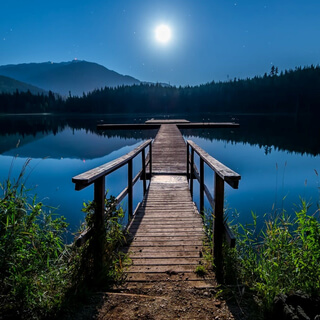
The moon was riding in a cloud heaven when Peter rose from his tree,
Begurt with weapons and wearing little else,
To set out upon his perilous quest.
It was not such a night as he would have chosen.
He had hoped to fly,
Keeping not far from the ground so that nothing unwanted should escape his eyes,
But in that fitful light to have flown low would have meant trailing his shadow through the trees,
Disturbing birds and acquainting a watchful foe that he was astir.
He regretted now that he had given the birds of the island such strange names that they were very wild and difficult of reproach.
There was no other course but to press forward in the native fashion at which happily he was an adept.
But in what direction,
For he could not be sure that the children had been taken to the ship.
A light fall of snow had obliterated all footmarks,
And a deathly silence pervaded the island.
As if for a space nature stood still in horror of the recent carnage.
He had taught the children something of the forest lore that he himself learned from Tiger Lily and Tinker Bell,
And knew that in their dire hour they would not likely forget it.
Slightly if he had an opportunity would have blazed the trees,
For instance,
Curly would drop seeds,
And Wendy would leave her handkerchief at some important place.
The morning was needed to search for such guidance,
And he could not wait.
The upper world had called him,
But would give no help.
The crocodile passed him,
But not another living thing.
Not a sound,
Not a movement,
And yet he knew well that sudden death might be at the next tree or stalking him from behind.
He swore this terrible oath,
Hook or me this time.
Now he crawled forward like a snake,
And again erect,
He darted across the space on which the moonlight played,
One finger on his lip and his dagger at the ready.
He was frightfully happy.