If you've ever chopped up an onion and ended up with streaming eyes and a runny nose,
Then you've already got the basic idea behind homeopathy.
Homeopathy is built on a principle called like cures like.
It's the idea that something capable of creating a particular set of symptoms can sometimes be used to help someone experiencing those same symptoms.
Let's stick with the onion analogy for a sec.
When you chop up an onion,
Your eyes might water,
Your nose might run,
You might get irritated around your face.
So if someone comes to a homeopath like me with symptoms that look very similar to that,
Similar to what an onion produces,
Then we might choose a remedy made from an onion.
That is the basic principle.
The symptom pattern will point us towards the right remedy.
And this is not a completely new idea.
We see this idea playing out in conventional medicine,
Like forms of immunisation.
They expose the body to a tiny part of what we're trying to build an immune response to.
And also exposure therapy that gradually introduces someone to something that they fear.
The principle isn't identical to homeopathy,
But the idea of using something related to the problem as part of the solution is way more universal and natural than you might think.
Hermiopathy simply approaches that idea in its own way.
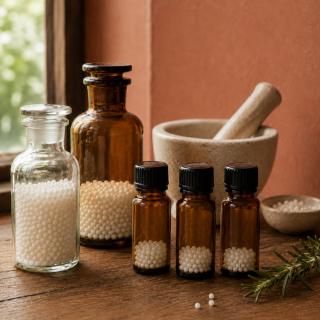
Homeopathic remedies go through a process of repeated dilution and preparation.
By the time that the remedy actually reaches the patient,
There is often little or none of the original substance left.
This is because we don't view remedies as working the same way as conventional medicine,
For one.
Instead,
Homeopathy is described as energy medicine.
This is because through that preparation process,
What it does is it leaves behind the energetic information or the energy signature of the original substance,
Which can then be matched to the person's symptom picture.
And that's where homeopathy becomes a different form from many other approaches.
A homeopath like me isn't only interested in the name of your illness,
We're interested in you.
What exactly are you experiencing?
What do your symptoms feel like?
Are they better?
When do they get worse?
Do you feel hot?
Do you feel cold?
Do you want company around you or do you want to be left alone?
Two people can have the same diagnosis but leave with completely different remedies because their experience of that diagnosis is different.
Homeopathy focuses on the individual,
Not the condition.
If you're completely new to homeopathy,
Then that's probably the biggest thing to understand.
It's less about finding a remedy for an illness and more about finding a remedy that matches the person experiencing it.
And one final point.
Homeopathy is something that many people choose to explore alongside their normal health care,
Not instead of it.
If you have concerns about your health,
Always speak to your doctor and seek appropriate medical advice.
This video is simply an introduction to one of the core ideas behind homeopathy and how homeopaths think about symptoms.
Thank you so much for watching.