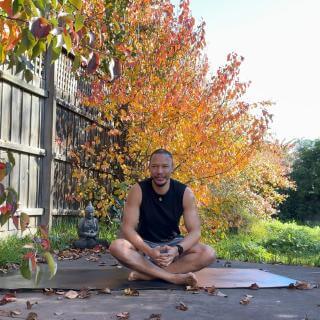
Hey all,
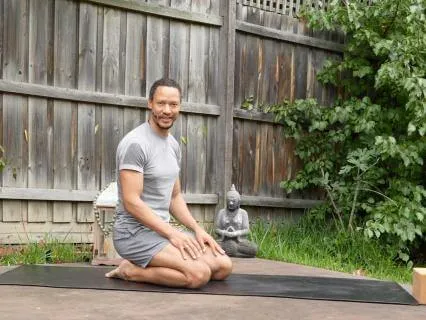
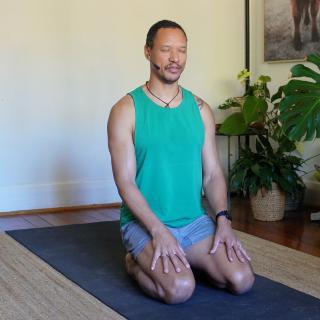
My name is Nicole.
I'm here to just give you a little bit of pointers and tips on things that in my yoga practice I found useful.
In relation to arm balancing,
Which is a huge passion of mine.
I love handstanding,
I love kind of any arm balance that you've got.
So wrists are super important to any arm balance.
We're kind of putting all our weight onto our wrists and we're not used to that.
Unless you are somebody that hangs upside down all the time on your hands.
Uh.
.
.
We're predominantly on our feet uh.
.
.
So Warming up the wrists is a really super important part of preparing the body for arm balances.
How you grip the mat is very subjective.
A few people have suggestions of having your index fingers parallel to each other.
I kind of follow that rule.
My arms or hands placement is usually a little bit wider than shoulder width.
I find that tends to be a little bit more comfortable for me as I get upside down to take my weight.
But as you become a little bit more proficient with your arm balancing,
You want to try and draw your hand a little bit further in each time to eventually get them underneath your shoulders.
And that's going to help you a lot with alignment.
The eyes of your elbows,
Which is this part of your arm,
Is generally going to be pointing forwards.
So you're going to be turning your arms and this creates a little bit of tension in your hands as you're gripping the floor.
And it also allows you to lengthen a little bit more,
Open your shoulders and push out through that space.
So imagine your fingers are spread so you've got a little bit more space,
You are gripping the ground,
You are twisting the eyes of the elbows open and you're pushing down.
So that's the kind of foundation.
A couple of tips I have to strengthen different parts of the hands would be one,
Heel raises,
So hand heel raises.
Which is basically just rolling up the hand and just doing you know maybe 10,
20 of these every day.
And that will definitely get your forearms warmed up and ready for your practice and a lot stronger.
But make sure that you're incorporating also a couple of stretches as well.
So those could be turning your hands around,
Fingers pointing towards the knees and just moving the hips back forwards,
Maybe even rolling the hand up.
To bring a little bit more of a challenge.
You can start to incorporate lifting the knees on these exercises as well.
So when as you're lifting the palms,
You can take the knees off the floor and that gives you a little bit more weight and then shifting that to like a plank and then eventually being able to get that against the wall upside down,
Lifting your hands and then eventually freestanding.
So that's definitely progressions you can work towards.
Other wrist stretches I have are palms up towards the ceiling and you can point the fingers in all different directions to warm up different parts of the wrist.
Making sure that we are not putting too much pressure onto them.
So you can walk the hands back towards the knees to bring less pressure or forwards to bring more weight onto the hand.
Another thing I like to do is stretching the shoulders for example.
So taking one arm,
Taking it across the chest and drawing the shoulders in,
Making sure they're nice and relaxed.
Making sure we do that to both sides,
Because we're not one-arming yet.
I'm sure we'll get there if you continue your practice.
And making sure we do things like shake the hands out.
Um,
Twirling the hands and twirling the fingers around or the hands around so we warm up the wrists.
And again,
Making sure you go both ways so you make sure you're getting a bit of balance there.
You can bring the fingers together and imagine you are creating this Italian symbol or sign.
And then taking the backs of the hands into the armpits,
Bring yourself forward and bring the elbows in as far as you can.
And that you'll find will definitely stretch the back of the hands and it'll warm you up.
What else?
Things like back bends,
Whether it be puppy pose,
Reaching the arms forward,
Keeping the hips aligned above the knees and drawing the shoulders down.
That will definitely open up your shoulders.
You can even use blocks in front of you to draw the elbows down onto.
And you can draw yourself down in between drawing the shoulders down and this will definitely work towards opening your shoulders out more.
Once you eventually progress up to getting upside down.
My suggestion is to start small.
So if you're working towards a handstand,
You want to learn how to use your hands properly to balance.
And if you can imagine it might be a good idea to stand up and be on your feet.
So imagine when you're standing.
Your weight shifts forwards and backwards all the time and you're using your toes to stop yourself moving forward and the heels of your foot to stop yourself from moving backwards.
So same kind of analogy with your hands,
You're using your fingertips to stop yourself from falling out or falling forwards,
Coming into a backbend or a wheel,
And the heel of your hand to stop yourself from falling out of your handstand.
So if you can imagine you're in a crow pose,
Where you are balancing on your hands,
You're using your hands to draw yourself backwards,
Forwards,
Backwards,
Forwards,
And then eventually you're going to use your shoulders as well to help you with that balancing act.
Because when you're upside down it's minuscule movements and if you watch an arm balancer they look like they're stable and straight and not moving at all but if you look at the hands you'll see these micro movements of them moving themselves backwards and forwards to try and maintain that balance.
That's going to be it for now.
Hopefully you'll follow through and I'll create some more videos of arm balancing and show you little tips and tricks to try and progress your practice.
If you have any questions feel free to reach out.
I'm very available to help answer your questions.
My handstand journey now has been going for a couple of years.
I've done numerous workshops and it's still a journey.
I can hold a handstand,
I can get into a handstand,
I can transition to handstands and out of handstands.
But I wouldn't say it's a perfect handstand.
I still have very closed shoulders.
And also,
I struggle with breathing.
So breathing is a huge one.
When you're upside down,
You kind of forget to breathe.
So,
You know,
I'm trying to remember to continue breathing in and out,
In and out when you're upside down.
People tend to hold their breath,
And that means they can only hold their handstand for as long as they can hold their breath.
My name's Nicole.
See you soon.